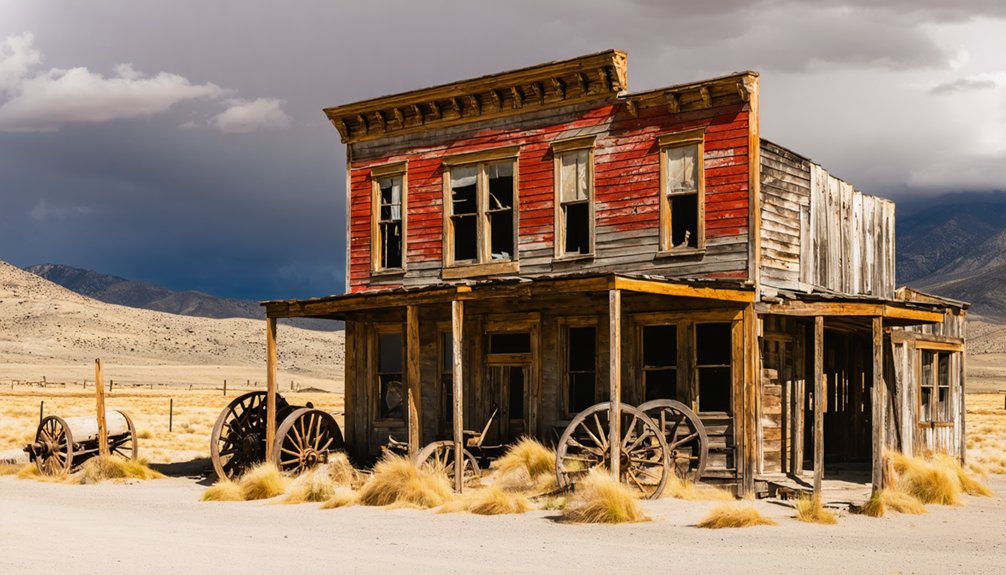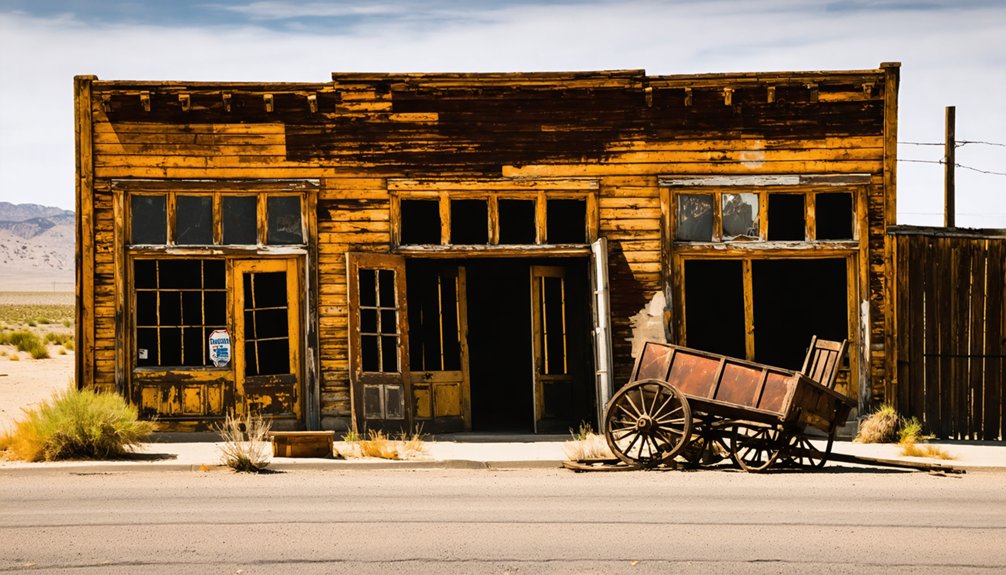
The term “ghost town” captures something “abandoned” simply can’t. When you call a place abandoned, you’re describing emptiness. When you call it a ghost town, you’re acknowledging that its past identity still haunts the structures, streets, and silences left behind. Scholar T. Lindsey Baker defines it as “a town for which the reason for being no longer exists.” The word “ghost” implies a lingering presence — and understanding what created that presence reveals far more than the label itself.
Key Takeaways
- The term “ghost town” implies a lingering presence, not just emptiness, suggesting a past identity still haunts the space.
- Scholar T. Lindsey Baker defines a ghost town as “a town for which the reason for being no longer exists.”
- Lambert Florin describes ghost towns as “a shadowy semblance of a former self,” capturing their eerie, half-present quality.
- “Abandoned” describes emptiness; “ghost” conveys something more haunting — the remnants of former vitality and community life.
- The term gained cultural footing during the Wild West era, growing organically from economic collapse and mass abandonment.
What Does “Ghost Town” Actually Mean?
When you hear the term “ghost town,” you might instinctively picture something supernatural, but the phrase is purely figurative. It describes a once-active settlement now wholly or nearly deserted, its structures standing as silent evidence of former vitality.
Scholar T. Lindsey Baker defines it as “a town for which the reason for being no longer exists.” That definition cuts straight to the core.
Writer Lambert Florin reinforced this by calling such places “a shadowy semblance of a former self.”
The term carries significant cultural symbolism, representing lost opportunity, economic collapse, and the fragility of human enterprise.
It’s also increasingly applied to urban decay, where neighborhoods shed residents and economic function without full abandonment.
You’re looking at absence made visible, not haunting made literal.
Where Did the Phrase “Ghost Town” Come From?
If you trace the phrase “ghost town” back through recorded history, you’ll find its earliest documented appearance in 1894, referencing an abandoned California settlement, with a more widely cited appearance in 1908.
The term gained its cultural footing during the Wild West era, when boomtowns built around gold and silver rushes collapsed as quickly as they’d risen, leaving behind hollow shells of once-thriving communities.
Early Recorded Usage Origins
Though the phrase “ghost town” feels like it’s always been part of the American vocabulary, its recorded origins are surprisingly recent and somewhat disputed. Etymologists trace its earliest confirmed appearance to 1908, yet a California newspaper used it as far back as 1894. This gap exposes historical myths surrounding the term’s emergence, suggesting it didn’t spring fully formed from Wild West lore.
You’ll find that its cultural significance grew gradually, gaining broader traction in the 1920s according to Google Ngram data. Scholar consensus ties the term to post-boom mining settlements, where exhausted resources left structures standing but populations vanished.
The evidence confirms the phrase developed organically, shaped by economic collapse and abandonment rather than folklore, making its origins more practical than the romanticized narrative you’ve likely encountered.
Wild West Era Influence
These towns reflect patterns you can trace directly to Wild West conditions:
- Gold and silver rushes created overnight settlements
- Railroad rerouting isolated previously thriving communities
- Resource exhaustion triggered mass departure
- Remaining structures preserved a frozen moment in history
- The eerie emptiness demanded new vocabulary to describe it
The Wild West didn’t just produce ghost towns — it produced the cultural framework that made “ghost town” a meaningful, necessary phrase in American consciousness.
Rising Popularity Over Time
While the phrase “ghost town” appeared in print as early as 1894, it didn’t gain widespread cultural traction until decades later. Google Ngram data confirms a notable surge in usage during the 1920s, suggesting that broader social forces — urbanization, economic shifts, and urban decay — made the term newly resonant.
As populations migrated toward industrial centers, abandoned settlements became more visible and more frequent, giving the phrase practical relevance.
You can trace the term’s staying power to its cultural symbolism. It captured something Americans recognized: the fragility of prosperity and the consequences of dependence on single industries.
What began as regional slang for failed mining camps evolved into a precise, evocative label that scholars, journalists, and everyday speakers found equally useful across contexts.
Why Are They Called Ghost Towns and Not Abandoned Towns?
The word “abandoned” describes a condition — a place left behind — but “ghost” captures something far more evocative: the haunting presence of what once was.
“Ghost” implies a lingering identity, not mere emptiness. It signals historical preservation — structures still standing, streets still mapped — yet life conspicuously absent.
Urban decay becomes visible, almost narrative.
Consider what “ghost” communicates that “abandoned” doesn’t:
- A past identity that still shapes the physical space
- Remaining infrastructure suggesting former prosperity
- An eerie atmosphere rooted in contrast between presence and absence
- Cultural memory embedded in surviving architecture
- A metaphorical “haunting” by economic or social collapse
You’re not just looking at a deserted place — you’re confronting what it used to be.
That distinction is precisely why “ghost town” endures as the defining term.
The Boom-and-Bust Cycle That Built and Killed Most Towns
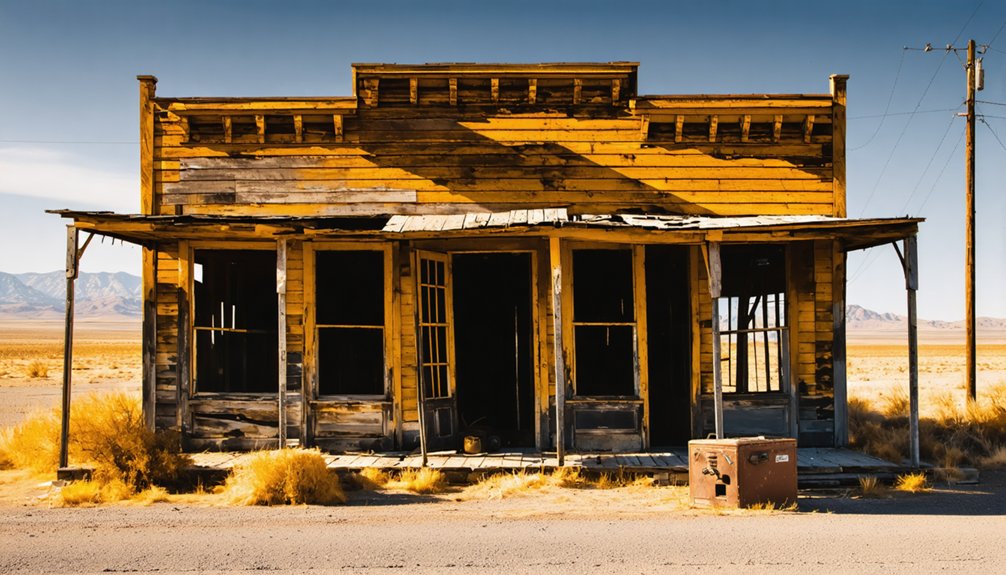
Most ghost towns didn’t die slowly — they were engineered for collapse from the start. When you examine their historical significance, a pattern emerges: extraction economies created rapid population surges with no sustainable foundation.
Miners, loggers, and oil workers flooded in, businesses followed, and towns incorporated almost overnight. Then the resource ran out.
Once the economic engine stopped, departure was swift. Railways rerouted, investors pulled out, and residents chased the next boom elsewhere.
What remained was urban decay frozen in place — storefronts, houses, and infrastructure without purpose or population.
You’re fundamentally looking at capitalism’s raw mechanics: build fast, extract everything, abandon the rest. Ghost towns aren’t accidents. They’re the predictable outcome of prioritizing resource extraction over community permanence, which is precisely why so many share identical histories.
What Causes a Town to Become a Ghost Town?
Abandonment rarely happens by accident — it follows a recognizable set of conditions that strip a town of its economic reason to exist. Once that foundation collapses, urban decay accelerates rapidly, and historical preservation becomes the only evidence a community ever thrived.
Towns don’t die randomly — they die when their economic purpose disappears.
Several documented causes drive towns toward ghost status:
- Exhausted mineral, timber, or oil resources
- Railway or road rerouting that cuts economic access
- Natural disasters forcing permanent community relocation
- War, nuclear accidents, or forced governmental displacement
- Epidemics that depopulate settlements beyond recovery
You’ll notice these causes share one outcome: the removal of human purpose. When people can’t earn, survive, or rebuild, they leave.
What remains are structures frozen in time — tangible proof that towns aren’t permanent institutions. They’re economic experiments, and some experiments simply fail.
Do Ghost Towns Have to Be Completely Empty?
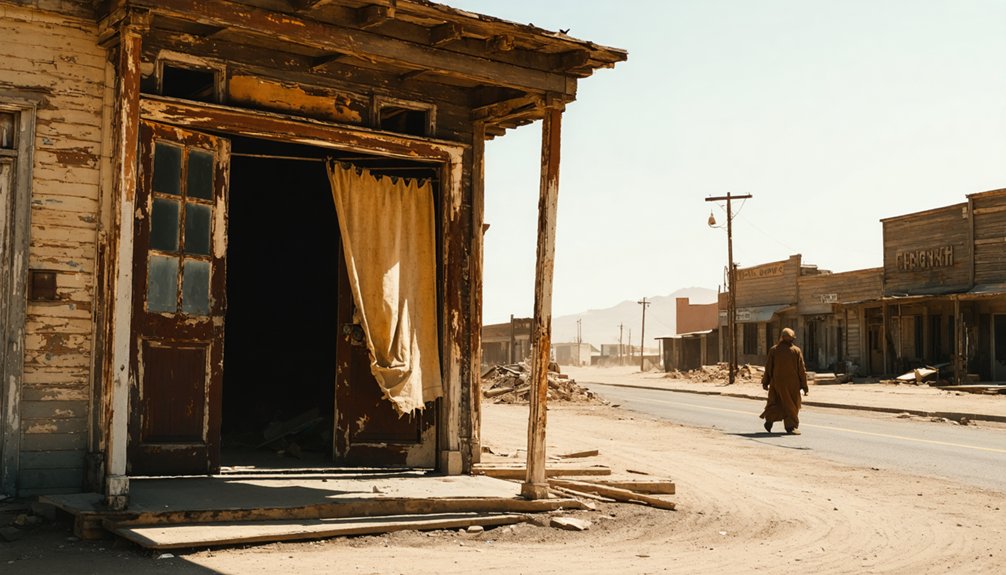
Contrary to what the name implies, ghost towns don’t require total abandonment to earn the label. You can find settlements with small, lingering populations that still qualify. Scholars broadly agree that a ghost town is defined by its diminished state relative to its former self, not by a strict headcount of zero.
What matters more is the visible decay, the hollowed-out infrastructure, and the loss of the economic function that once sustained the community.
Historical preservation efforts in some of these towns actually confirm their ghost town status by treating them as relics rather than living communities.
Their cultural significance lies precisely in this ambiguity — they exist between life and abandonment, serving as evidence of how quickly human settlements can collapse when their foundational purpose disappears.
The Most Well-Known Ghost Towns and Why They Were Left Behind
Some of the world’s most recognizable ghost towns share a common narrative: rapid growth driven by a single resource or economic function, followed by equally rapid collapse once that foundation disappeared. Their historical preservation and cultural significance make them worth examining closely:
The most iconic ghost towns share one haunting truth: boom, bust, and abandonment follow single-industry economies with ruthless consistency.
- Bodie, California – Abandoned after gold deposits ran dry in the 1880s
- Pripyat, Ukraine – Evacuated permanently following the 1986 Chernobyl nuclear disaster
- Centralia, Pennsylvania – Deserted due to an underground coal mine fire burning since 1962
- Kolmanskop, Namibia – Left behind when diamond mining shifted southward
- Calico, California – Collapsed after silver prices crashed in the 1890s
Each settlement reveals how fragile single-industry economies truly are, reminding you that prosperity built on one foundation rarely survives its removal.
Ghost Towns in Europe, Asia, and Africa Most People Overlook
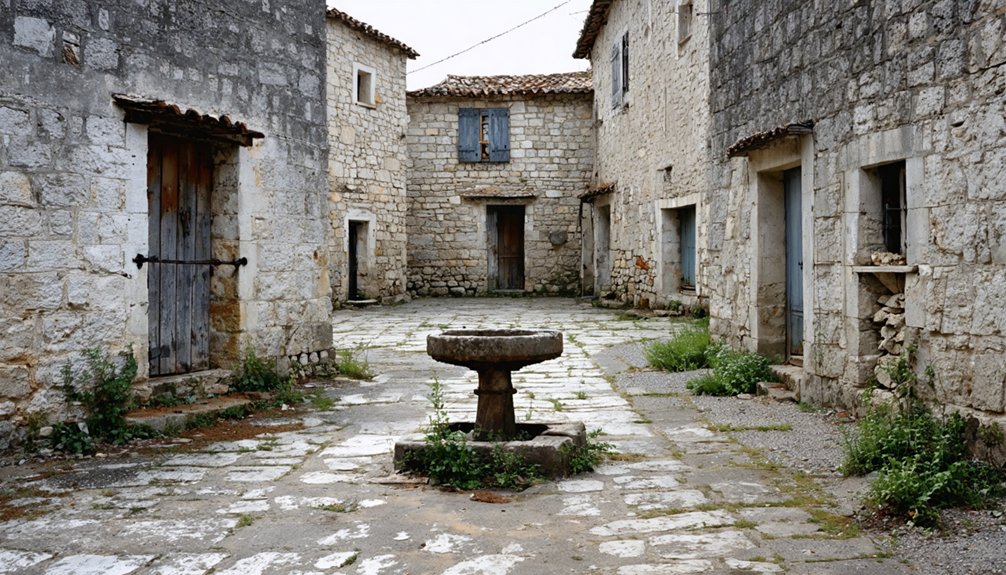
While North America dominates the popular imagination around ghost towns, Europe, Asia, and Africa hold equally compelling — and far less examined — abandoned settlements that reflect distinct historical pressures.
You’ll find Craco in southern Italy, emptied by landslides and rural exodus; Kolmanskop in Namibia, consumed by desert sands after diamond mining collapsed; and Hashima Island in Japan, sealed off when coal extraction ended in 1974.
Each site carries unique cultural interpretations shaped by local memory, colonial history, and economic transformation.
Preservation challenges differ sharply across these regions — limited funding, political instability, and competing land claims frequently accelerate decay.
Unlike American ghost towns, which often attract heritage tourism, many of these settlements remain inaccessible or legally restricted, leaving their histories dangerously close to permanent erasure.
Can You Visit a Ghost Town: and Should You?
If you’re drawn to the eerie stillness of abandoned places, you’ll find no shortage of accessible ghost towns worth exploring, from Bodie, California, to Pripyat, Ukraine.
You should, however, approach these sites with a clear understanding of safety risks, including structural instability and restricted access zones.
Ethical exploration matters just as much as physical preparation, since responsible visitors protect fragile remnants rather than accelerating their decay.
Popular Ghost Towns To Visit
Ghost towns aren’t just relics of the past—they’re accessible destinations that draw millions of visitors annually, blending history, architecture, and atmosphere in ways few other sites can. Their historical preservation and cultural significance make them worth exploring firsthand.
Here are five popular ghost towns you can visit:
- Bodie, California – A preserved mining boomtown frozen in time since the 1940s
- Pripyat, Ukraine – Abandoned after the 1986 Chernobyl disaster
- Rhyolite, Nevada – Features striking ruins from a short-lived gold rush settlement
- Bannack, Montana – Montana’s first territorial capital, now a state park
- Centralia, Pennsylvania – Abandoned due to an underground coal fire burning since 1962
Each site offers you direct engagement with documented history rather than reconstructed narratives.
Visiting Ghost Towns Safely
Visiting a ghost town is entirely possible—and for most sites, it’s encouraged—but whether you *should* depends on the legal status, structural conditions, and environmental hazards specific to each location.
Many sites operate under formal tourism development frameworks, offering guided access, marked trails, and interpretive signage. Others remain on private land or within restricted jurisdictions, making unauthorized entry illegal.
Structurally, deteriorating buildings pose collapse risks, and former mining towns frequently contain toxic residues like arsenic or asbestos. You’ll want to research each site individually before arriving.
Where historical preservation efforts are active, your visit directly supports conservation funding and community heritage programs.
Check ownership status, consult local authorities, and wear appropriate protective gear when warranted. Responsible visitation keeps these remnants accessible for future generations.
Ethical Ghost Town Exploration
Before entering, ask yourself:
- Do you have legal permission, or are you trespassing on private or protected land?
- Will your presence accelerate structural decay or disturb artifacts?
- Are you documenting respectfully rather than vandalizing or removing remnants?
- Does the site hold cultural significance to Indigenous or descendant communities?
- Are you contributing economically to preservation efforts where possible?
You carry responsibility the moment you step inside. Taking nothing, leaving nothing, and sharing knowledge rather than coordinates protects these places for future generations.
Ethical exploration isn’t restriction—it’s informed freedom exercised with accountability.
Why Ghost Towns Still Capture Our Imagination Today
There’s something undeniably compelling about a place where human ambition once thrived and then collapsed into silence. Ghost towns embody historical preservation in its rawest form — no curators, no guided tours, just structures bearing witness to decisions made and abandoned.
You recognize in them a mirror of human vulnerability: entire communities dismantled by exhausted resources, rerouted railways, or economic collapse. Their cultural significance lies precisely in that honesty. They remind you that prosperity isn’t permanent and that freedom includes the liberty to fail, relocate, and begin again.
Scholars note their growing appeal as tourist destinations reflects a broader cultural appetite for unmediated history. You’re drawn not to the literal ghosts, but to the unmistakable evidence that people once lived, worked, and ultimately left behind everything they built.
Frequently Asked Questions
Are Ghost Towns Legally Considered Abandoned Properties by Local Governments?
The knowledge doesn’t confirm that. You’ll find ghost towns vary in property rights and legal classifications—some governments claim them, some don’t, and local laws ultimately determine each town’s official abandoned status.
Can a Ghost Town Ever Be Officially Repopulated and Revived?
Yes, you can officially repopulate a ghost town through historical preservation efforts and urban decay reversal initiatives. Evidence shows several former ghost towns have successfully attracted new residents, investment, and economic activity through tourism and heritage development programs.
Do Ghost Towns Appear Differently Across Various Cultural or Religious Traditions?
Yes, you’ll find ghost towns carry distinct cultural symbolism and religious significance across traditions—some view them as spiritually cursed, others as ancestral memorials, reflecting how your cultural lens shapes interpretations of abandonment, decay, and human absence differently worldwide.
Are There Ghost Towns Currently Forming in Modern Cities Today?
Over 20% of U.S. urban neighborhoods show ghost town traits today. You’re witnessing modern ghost towns forming through economic decline, where historical preservation efforts and tourist attractions sometimes revitalize these eerily depopulated spaces before full abandonment occurs.
Who Typically Owns the Land and Buildings Inside a Ghost Town?
When you examine ghost town property rights, you’ll find ownership varies—governments, private heirs, or corporations typically hold titles. Historical ownership records often reveal original settlers’ descendants still legally retain land, even when you see complete abandonment.
References
- https://en.wikipedia.org/wiki/Ghost_town
- https://www.reddit.com/r/etymology/comments/n3b4mw/ghost_town_language_of_origin/
- https://www.britannica.com/topic/ghost-town
- https://www.youtube.com/watch?v=ZiJctD8Cs70
- https://www.merriam-webster.com/dictionary/ghost town
- https://www.dictionary.com/browse/ghost-town
- https://www.bunnytrailspod.com/2023/08/episode-203-ghost-town.html
- https://tvtropes.org/pmwiki/pmwiki.php/Main/GhostTown
- https://forum.thefreedictionary.com/postst3580_Ghost-towns—origin-of-the-concept-.aspx
- https://www.collinsdictionary.com/us/dictionary/english/ghost-town