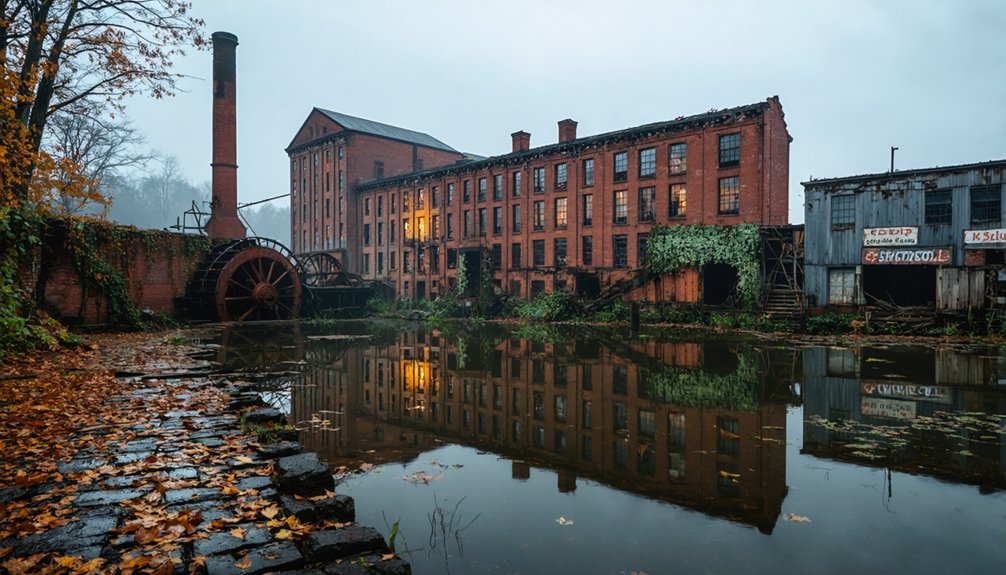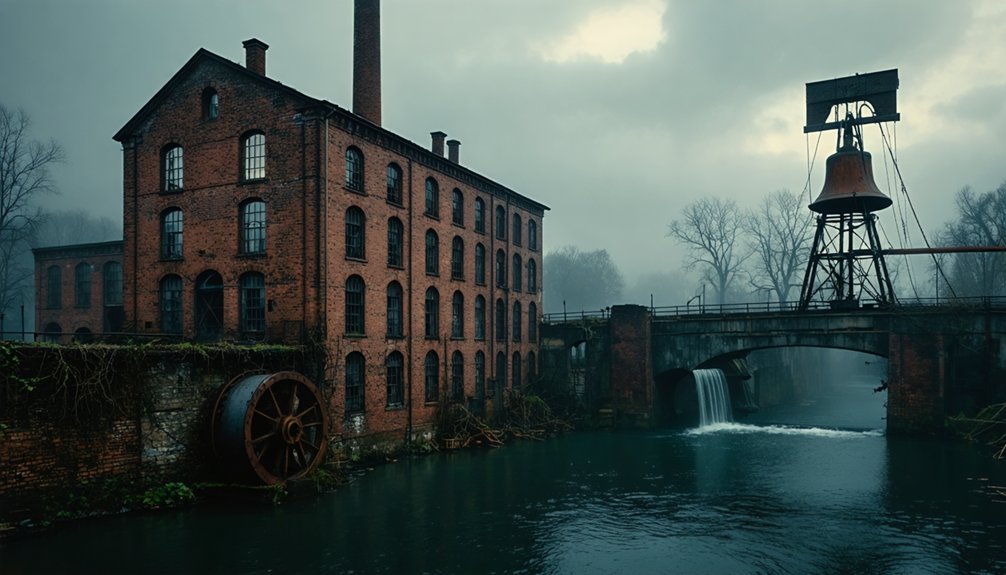
Abandoned mill towns attract spirits due to their potent combination of industrial tragedies, economic devastation, and psychological trauma. You’ll find these sites marked by catastrophic accidents, mass layoffs, and community collapse – creating deep emotional imprints that paranormal researchers say fuel supernatural activity. The physical remnants, from dormant machines to empty worker housing, seem to trap time itself, while documented phenomena like cold spots and unexplained sounds suggest these industrial ghosts haven’t quite finished their shifts.
Key Takeaways
- Tragic industrial accidents and disasters claimed numerous lives, creating emotional imprints that paranormal investigators associate with spirit activity.
- The sudden economic collapse left many residents’ hopes and dreams unfulfilled, potentially tethering their spirits to these locations.
- Physical remnants like machinery and architecture act as emotional anchors, preserving the energy of former workers and residents.
- Historical trauma from mass layoffs and community disintegration created intense negative emotions that paranormal theorists link to hauntings.
- Industrial ruins provide ideal conditions for perceived paranormal activity with their eerie atmospheres, cold spots, and unexplained sounds.
The Economic Heart Stops Beating: How Mill Towns Became Ghost Towns
When the economic heart of a mill town stops beating, the effects ripple outward with devastating precision.
You’ll witness the economic collapse unfold like a domino effect: massive job losses trigger business failures, which lead to plummeting tax revenues and crumbling municipal services.
The multiplier effect accelerates community disintegration as foreclosures mount and unemployment soars.
You’re watching a town’s identity dissolve in real time.
Like watching photographs fade in acid, the soul of the community bleeds away as its economic lifeline is severed.
As single-industry dependence proves fatal, you’ll notice how global forces and technological advances conspire to hollow out these once-thriving communities.
Cities like Youngstown became infamous for their high murder rates as social decay set in during the 1990s.
The data tells an unmistakable story: when mills close, mortality rates climb, health problems multiply, and social services deteriorate.
Nearly 1,000 communities across America represent these left-behind counties, struggling to recapture their former economic vitality.
What’s left is a shell of former prosperity – a stark reminder that when manufacturing dies, it often takes entire communities with it.
Echoes of Industry: Physical Remnants That Trap Time
The skeletal remains of America’s industrial past stand as silent witnesses to bygone prosperity.
You’ll find these industrial architecture relics scattered across landscapes – brick walls reaching skyward, granite foundations anchored in earth, and weathered timbers that have defied decades of decay.
They’re accidental time capsules, preserving the physical framework of a vanished era.
Former workers’ homes reveal pieces of mill town life, with two-story structures that once housed multiple generations of textile workers.
Water-powered remnants tell their own stories through abandoned dams and canal systems, while scattered equipment and personal artifacts map the daily rhythms of mill life.
Nature’s slow reclamation adds another layer to these sites – vegetation crawls up walls, and weather steadily etches its mark into stone.
Every crumbling wall and rusted machine serves as a tangible link to when these places pulsed with industrial might, waiting for those bold enough to explore their secrets.
Many of these abandoned industrial towns contain cellar holes and cemeteries as the last visible traces of their existence.
When Tragedy Writes History: Dark Tales From Mill Town Pasts
Beneath the physical decay of America’s abandoned mill towns lies a darker historical legacy etched by industrial catastrophes and human tragedy.
You’ll find haunting memories in places like Franklin, Washington, where a suspicious mine fire claimed 37 lives in 1894, leaving 14 widows and 38 orphaned children.
Industrial echoes reverberate through Graniteville, where a 2005 chemical disaster forced mass evacuation and shuttered a 161-year-old mill.
In Mortimer, the devastating flood of 1916 erased 80 lives and an entire community’s future.
These aren’t just statistics – they’re turning points that rewrote destinies.
The community’s spirit was tested when Oregon Improvement Company brought in strikebreakers, sparking violent riots in 1891 that divided the town.
The tragic derailment unleashed deadly chlorine gas that claimed nine lives and permanently scarred the community’s health.
From Atkinson’s burning lumber mills to Bodie’s fatal accidents, each disaster triggered an exodus, transforming once-thriving communities into shells of their former selves, their stories preserved in crumbling foundations and empty streets.
The Psychology of Empty Streets and Silent Machines
Physical ruins tell only half the story of abandoned mill towns, as their psychological imprint runs far deeper than visible decay.
You’ll find generations of residents battling heightened anxiety and depression, their minds shaped by a legacy of industrial decline and emotional neglect. When you walk these empty streets, you’re experiencing more than just architectural deterioration – you’re witnessing psychological decay that spreads through communities like rust through metal. Visual signs of vacancy have led to mental illness spikes among local populations.
You’re seeing how the eerie silence of dormant machines creates a suspended reality, where past and present blur uncomfortably. The vacant buildings don’t just house memories; they amplify feelings of powerlessness and social isolation. Areas hit hardest show life satisfaction rates 29% lower than other regions.
Research shows you’re 31% more likely to encounter emotional instability in these communities, where the ghostly remains of industry continue to haunt the collective psyche.
From Production Lines to Paranormal Tourism
While abandoned mill towns once echoed with the rhythms of industrial production, they’ve found new economic life through an unlikely source: paranormal tourism.
You’ll find these former industrial hubs transforming their tragic histories of accidents, disasters, and economic collapse into compelling paranormal narratives that drive a $31.89 billion dark tourism industry. Towns like Bodie Brewery and other preserved structures draw thousands seeking authentic ghost town experiences.
As you explore these atmospheric locations, you’ll encounter carefully preserved machinery halls and derelict facilities where reported spirit encounters fuel year-round ghost tours.
The psychological impact of empty production floors, coupled with genuine historical tragedies, creates an environment where cold spots and unexplained phenomena seem more plausible. The heightened interest in these haunted spaces reflects recent studies showing 61.4% of Americans believe in ghosts.
These experiences aren’t just drawing seasonal thrill-seekers – they’re generating substantial revenue, with ghost tours contributing up to 20% of local tourism income in these reborn communities.
Frequently Asked Questions
Can Spirits From Mill Towns Follow Visitors Home?
While ghostly attachments from mill towns following you home remain unproven, your visitor experiences might suggest otherwise. Science can’t verify these claims, though many report unusual phenomena after their visits.
Those who dare to explore the haunted whispers of midwest towns often find themselves caught between skepticism and intrigue. As they wander through the abandoned buildings and eerie landscapes, stories of restless spirits unfold, creating an atmosphere thick with mystery. With each step, the line between the unexplained and the ordinary blurs, inviting further curiosity into the unknown.
What Equipment Should Paranormal Investigators Bring to Abandoned Mill Towns?
You’ll need EMF meters, thermal cameras, audio recorders for spirit communication, and protective gear. Don’t forget weather-resistant notebooks, flashlights, and smartphones for documenting your investigation techniques systematically.
Do Mill Town Hauntings Intensify During Specific Seasons or Weather Conditions?
Like autumn leaves spiraling into darkness, you’ll notice seasonal energy peaks in fall and winter. Weather patterns intensify reported paranormal activity, with cold, foggy conditions amplifying the mysterious atmosphere.
How Do Native American Beliefs Influence Supernatural Occurrences in Mill Towns?
You’ll find Native beliefs shape mill town phenomena through the spiritual significance of burial grounds and cultural rituals that view these sites as portals between worlds, influencing local supernatural interpretations.
Why Do Some Mill Town Ghosts Appear in Period Clothing?
Right off the bat, mill town ghosts don period attire to reflect their historical significance, preserving their identity from when they lived and worked, symbolizing their enduring connection to the community’s industrial past.
References
- https://nightofthejack.com/2025/01/23/top-creepy-ghost-towns-in-america/
- https://www.mentalfloss.com/geography/wanderlust/creepiest-ghost-towns-united-states
- https://en.wikipedia.org/wiki/Ghost_town
- https://www.geotab.com/ghost-towns/
- https://995wlov.com/2024/10/29/ranking-every-u-s-state-from-most-to-least-haunted/
- https://www.losethemap.com/scariest-ghost-towns-in-the-world/
- https://www.loveexploring.com/gallerylist/188219/the-us-state-with-the-most-ghost-towns-revealed
- https://ysu.edu/center-working-class-studies/social-costs-deindustrialization
- https://www.richmondfed.org/publications/research/econ_focus/2023/q3_economic_history
- https://archives.hud.gov/news/1999/leftbehind/nowmain.html