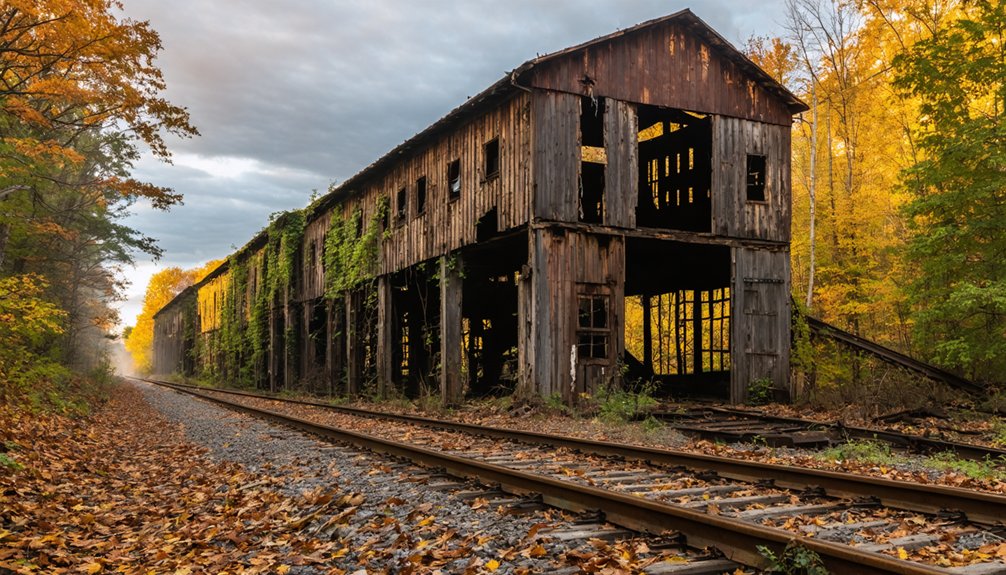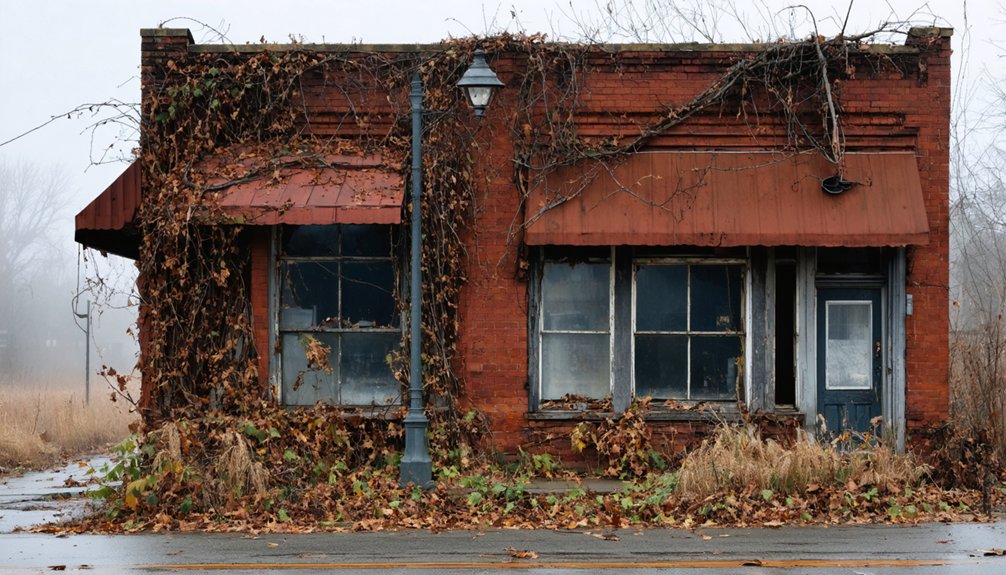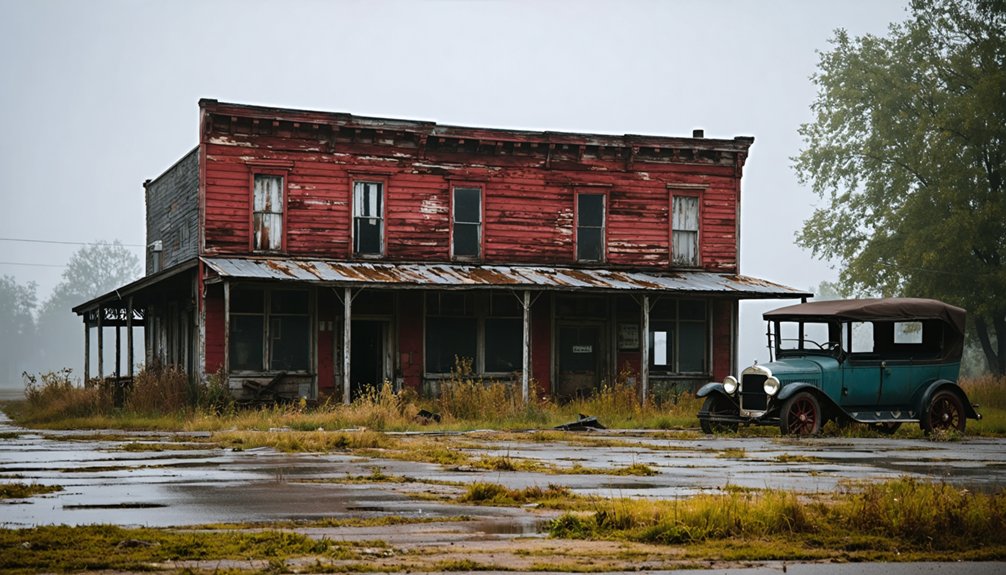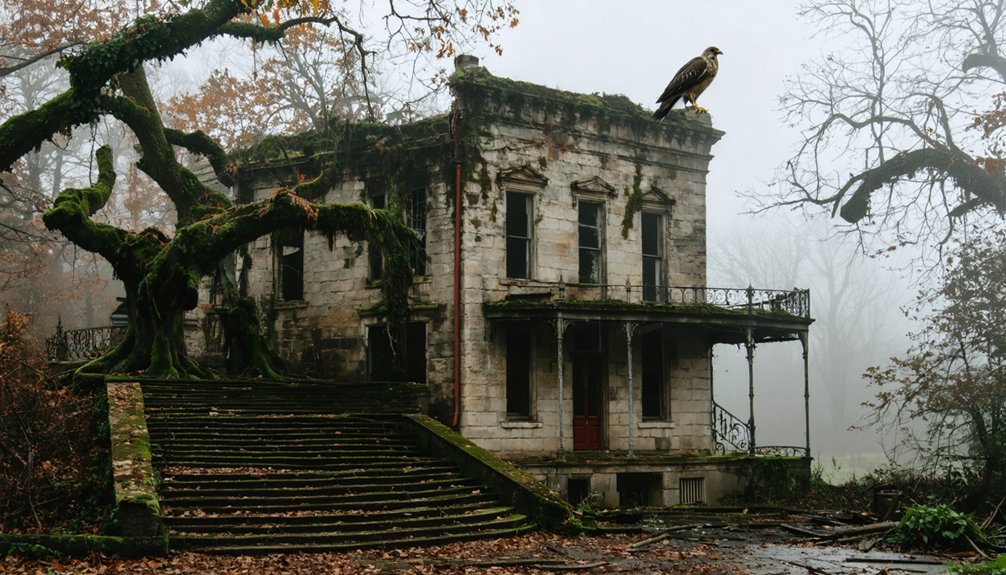
You’ll discover Indiana’s most famous ghost towns concentrated in the southern counties, where Crawford and Lawrence counties alone contain thirteen abandoned settlements. Tunnelton’s 1957 high school still stands among deteriorating storefronts, while Hindostan once housed 1,200 residents before a mysterious epidemic sparked its decline. Monument City lies completely submerged beneath Salamonie Reservoir, its foundations emerging only during severe droughts. These communities fell victim to floods, railroad bypasses, and economic shifts that transformed thriving settlements into haunting remnants of Indiana’s ambitious past.
Key Takeaways
- Tunnelton features a 1957 high school and Big Tunnel remains after a devastating 1907 fire destroyed the settlement.
- Hindostan once had 1,200 residents and served as political center before mysterious epidemic and economic depression caused decline.
- Monument City lies submerged beneath Salamonie Reservoir, with foundations emerging during droughts and relocated Civil War monument.
- English and Fort Ritner showcase eerie deteriorating structures reflecting past prosperity before floods and economic decline.
- Howesville peaked at 700 residents in 1910 with button factories before railroad bypasses and steamboat disappearance caused collapse.
Southern Indiana’s Abandoned Settlements
Southern Indiana’s rolling hills and winding creeks once supported thriving communities that have since faded into haunting remnants of their former selves.
Beneath Indiana’s pastoral landscape lie the weathered bones of communities that time and progress left behind.
You’ll discover thirteen accessible ghost towns scattered across Crawford and Lawrence counties, each telling stories of forgotten history through crumbling foundations and weathered facades.
In Tunnelton, you can explore abandoned architecture including a 1957 high school and deteriorating storefronts.
English offers eerie structures that remind you of once-bustling prosperity, while Fort Ritner’s buildings stand as evidence to decades of floods and fires before its post office closed in 1976.
Marengo’s post-apocalyptic scenes and Youngs Creek’s haunting remains complete this roadmap of southern Indiana’s vanished settlements, where you’re free to witness forty-one total ghost towns throughout the state. Warren County alone holds several forgotten communities like Brisco, which consisted of just a one-room school and general store before vanishing by the 20th century. The Wabash & Erie Canal played a crucial role in the rise and fall of many settlements, including Baltimore, which thrived as a grain shipping town until canal traffic diverted commerce away in the 1840s.
Northern and Central Indiana Ghost Towns
While southern Indiana’s ghost towns emerged from mining and river trade, northern and central Indiana’s abandoned settlements tell different stories of agricultural decline and railroad bypasses.
You’ll find Brisco history vanished by the 20th century in Warren County, where only memories remain of its one-room school and general store.
Chatterton decline reduced this northern settlement to a single mailbox and house, barely marking its former existence.
Corwin development never materialized due to nearby Romney’s growth, leaving this short-lived community extinct.
Rutland population maintained just 30 residents by 1990 in Marshall County, surviving as a tiny settlement. Many of these communities faced economic stagnation when expected railroad development never came to fruition.
Granville cemetery stands as the sole reminder of this Tippecanoe County town that completely disappeared post-19th century, preserving Wea Native American heritage. Today these sites serve as tourist attractions for visitors seeking to understand Indiana’s forgotten past.
Clay County’s Lost Communities
You’ll discover Clay County’s ghost towns through three distinct stories of rise and fall across the 19th century.
Howesville’s highway remnants mark where transportation routes once promised prosperity, while Jimtown flourished as a commercial hub before economic shifts left it abandoned.
Hindostan’s decline from political prominence illustrates how quickly frontier settlements could lose their essential functions and fade into memory. The county seat itself relocated multiple times, moving from Bowling Green to Brazil in 1876 as communities competed for political and economic advantages. Among the surviving communities, Ashersville maintains a population of 200 as a trading point for local coal mining operations.
Howesville Highway Remnants
Although modern travelers speed past along Highway 59 near Jasonville without a second glance, they’re crossing through what once was Howesville, a thriving Clay County community that vanished from Indiana’s landscape decades ago.
You’ll find no markers indicating this Howsville history, yet beneath the asphalt lies evidence of Connecticut settlers Zebulon and Seth Leavenworth’s 1818 establishment.
The highway significance becomes clear when you understand how transportation shaped this town’s destiny. Howesville peaked at 700 residents by 1910, supported by three button factories and steamboat fuel operations.
However, when railroads bypassed the community and wood-burning steamboats disappeared, economic collapse followed. Like other abandoned locations across Indiana that now attract paranormal enthusiasts seeking ghostly encounters, these forgotten settlements carry an eerie atmosphere of their former lives. Many such communities experienced similar fates when the automobile revolution reduced railroad dependency and transformed transportation patterns across the state.
Today’s Highway 59 remnants represent the final chapter of this once-prosperous settlement, serving as subtle reminders of Clay County’s lost industrial heritage.
Jimtown’s Commercial Past
Clay County’s pattern of vanished settlements extends beyond Howesville to encompass Jimtown, a community that emerged during the county’s formative decades following its 1825 establishment from portions of Owen, Putnam, Sullivan, and Vigo counties.
You’ll find this abandoned settlement’s history tied directly to National Road commerce, which provided the economic foundation for early settlement development throughout Jackson Township.
Jimtown thrived during the 1820s-1840s when the National Road served as America’s primary western corridor. You can trace its commercial activity to the period before railroads transformed Indiana’s transportation landscape in the 1860s.
The settlement supported local trade alongside Bowling Green, the original county seat established in 1828. Clay County’s total population as of 2010 reached 26,890, reflecting the demographic shifts that occurred as communities like Jimtown disappeared while other areas developed.
However, you’ll discover Jimtown couldn’t compete when Brazil’s industrial boom emerged, leading to the county seat’s relocation in 1876 and the community’s eventual abandonment. Today, this ghost town exists only in historical records, with no physical remnants marking its former location.
Hindostan’s Political Decline
While Clay County’s settlements like Jimtown struggled against commercial competition, Hindostan in neighboring Martin County faced a far more devastating decline rooted in political upheaval and natural disaster.
Hindostan’s founding in 1816 by Captain Caleb Fellows created Indiana’s fastest-growing frontier settlement, reaching 1,200 residents by 1820. You’d have witnessed its designation as Martin County seat during the late 1820s, when over 1,000 inhabitants made it the region’s political center.
However, a mysterious epidemic struck between 1820-1828, killing over half the population in just three months. Survivors fled as economic depression followed. The county seat relocated to Mt. Pleasant in 1828, accelerating abandonment.
Hindostan’s legacy reminds you how quickly prosperity can vanish on America’s frontier.
Lawrence County’s Historic Ruins

Lawrence County’s rolling hills and creek valleys harbor the remnants of communities that once thrived but couldn’t overcome the environmental and economic challenges of frontier life.
You’ll find Palestine’s decline particularly striking—this former county seat, platted with 276 lots and a central square in the early 1800s, succumbed to recurring malaria and polluted water by 1825.
Liberty’s abandonment followed a similar pattern when the Salt Creek settlement, founded in 1829, collapsed within two years due to “sickly” conditions.
Railroad towns like Tunnelton and Fort Ritner survived longer but eventually contracted.
You can still explore Tunnelton’s surviving railroad tunnel from the 1850s, while Fort Ritner’s remnants tell stories of devastating floods in 1913 and 1937 that ultimately sealed these communities’ fates.
Drowned Towns and Vanished Cities
When Indiana’s engineers began constructing dams and reservoirs throughout the 20th century, entire communities vanished beneath rising waters or fell victim to government condemnation.
You’ll find Monument City history submerged beneath Salamonie Reservoir in Huntington County, where foundations emerge during drought years like ghostly reminders of displaced residents. The Civil War monument and graves were relocated uphill before the mid-1960s flooding.
Elkinsville folklore tells of Brown County families forced from Salt Creek Valley for Lake Monroe’s expansion—though the reservoir never fully materialized, leaving an empty valley instead.
Old Leavenworth residents faced nature’s wrath when the 1937 Great Flood destroyed half their homes, forcing relocation to higher bluffs and abandoning their Ohio River settlement forever.
Railroad and Canal Era Ghost Towns
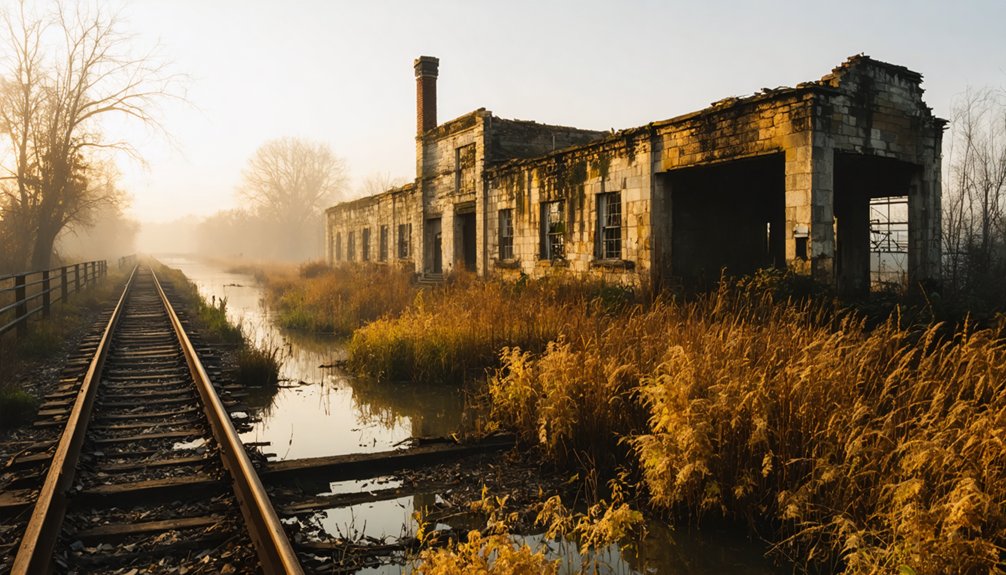
As Indiana’s railroad network exploded across the landscape during the mid-1800s, ambitious entrepreneurs rushed to establish towns along newly carved routes, many of which couldn’t survive the industry’s inevitable shifts.
You’ll find Tunnelton’s ghost town origins traced to 1859, when railroad expansion through Dearborn County created Big and Little Tunnels. Though fire devastated the settlement in 1907, Little Tunnel still stands as a symbol of these ambitious dreams.
Conrad represents railroad expansion’s promise and peril. Jennie and George Conrad transformed 4,400 acres of drained meadowland into a thriving livestock center by 1885, eventually expanding to 7,000 acres.
Ambitious entrepreneurs transformed thousands of acres of Indiana meadowland into thriving railroad-era settlements, embodying both opportunity and inevitable decline.
The Chicago and Western Indiana Railroad provided essential passenger service until Jennie’s 1939 death ended the dream.
Lawrence County’s Woodville and Juliet followed similar patterns—railroad-dependent settlements that vanished when tracks relocated or extended elsewhere.
Frequently Asked Questions
Are There Any Ghost Towns in Indiana That Are Rumored to Be Haunted?
You’ll find several haunted ghost towns in Indiana with documented haunted legends. Tunnelton features ghostly sightings from the 1882 Wilson Gang Massacre, while Mitchell’s Whispers Estate reports paranormal activity from tragic historical deaths.
Other notable locations in the state are often highlighted as some of the best ghost towns in Indiana. These places not only boast eerie stories but also invite adventurous visitors to explore their rich histories. Each town offers a unique glimpse into the past, with abandoned buildings and relics that tell tales of yesteryear.
What Caused Most Indiana Ghost Towns to Become Abandoned Over Time?
Economic decline caused most Indiana ghost towns’ abandonment. You’ll find resource depletion, job losses, and factory collapses drove residents away. Transportation changes bypassed trade centers, while railroads extending north destroyed terminus towns completely.
Can Visitors Legally Explore These Ghost Town Sites Without Permission From Landowners?
You can’t legally explore most ghost town sites without permission due to exploration regulations protecting landowner rights. Indiana’s trespass laws prohibit unauthorized entry onto private property, regardless of abandonment status or historical significance.
Which Indiana Ghost Town Had the Largest Population at Its Peak?
Hindostan Falls had Indiana’s largest ghost town peak population at approximately 1,200 residents by 1820. You’ll find its rapid population decline followed devastating disease outbreaks, cementing its historical significance as Indiana’s “lost jewel.”
Are There Any Ghost Towns in Indiana With Original Buildings Still Standing?
Yes, you’ll find original buildings with architectural significance in several Indiana ghost towns. Little Chicago preserves 1835 structures including Buddell Sleeper’s home. Aberdeen retains Palmer’s Store and mill, demonstrating excellent historic preservation efforts.
References
- https://wkdq.com/southern-indiana-ghost-towns/
- http://freepages.rootsweb.com/~gtusa/history/usa/in.htm
- https://www.onlyinyourstate.com/experiences/indiana/ghost-towns-in
- https://www.youtube.com/watch?v=45D4dbASJyE
- https://www.geotab.com/ghost-towns/
- https://storymaps.arcgis.com/stories/9a3b3f4a63ba4031a46cb53907a0515c
- https://kids.kiddle.co/List_of_ghost_towns_in_Indiana
- https://103gbfrocks.com/ixp/71/p/southern-indiana-ghost-towns/
- https://www.youtube.com/watch?v=hLhT2kw5J_A
- https://en.wikipedia.org/wiki/List_of_ghost_towns_in_Indiana