Planning a ghost town road trip to Clinton, Texas means visiting DeWitt County’s forgotten first seat of power. You’ll find it along US 183, roughly 3 miles southeast of Cuero, marked by a Texas historical marker. Once a thriving county seat, Clinton lost everything when the railroad bypassed it in favor of Cuero. Today, a weathered cemetery, scattered remnants, and dirt streets are all that remain. Stick around to uncover the full story behind Clinton’s rise and fall.
Key Takeaways
- Clinton, Texas, once DeWitt County’s seat, is now a ghost town located along US 183, roughly 3 miles southeast of downtown Cuero.
- Look for the Texas historical marker on the west side of US 183, approximately 40 feet north of Clinton Road (CR 410).
- The site is accessible via standard 2WD vehicles, requiring no special equipment, making it an easy detour on any road trip.
- Visitors can explore a weathered pioneer cemetery, scattered remnants of structures, and dirt streets offering an authentic, unpolished ghost town experience.
- Clinton’s decline stemmed from losing its county seat status and being bypassed by the railroad, which shifted growth toward nearby Cuero.
What Was Clinton, Texas?
Once a functioning county seat in south-central Texas, Clinton served as the governmental heart of DeWitt County through much of the mid-1800s before fading into obscurity.
Named for empresario Green DeWitt, the county itself was created in 1846, and Clinton took over as county seat by 1848. You’d have found historical architecture ranging from a log cabin courthouse to frame buildings housing local government.
Named for empresario Green DeWitt, Clinton became DeWitt County’s seat in 1848, boasting architecture from log cabin courthouses to frame government buildings.
Many prominent pioneers called Clinton home, building a community complete with a post office established in 1849. Local legends likely grew around the hanging tree still referenced today.
But once the railroad bypassed Clinton and Cuero claimed the county seat, decline came quickly. By 1886, even the post office had closed, leaving Clinton to become the ghost town you’re visiting today.
How Clinton Became DeWitt County’s First Real Seat of Power
When DeWitt County was carved out in 1846, it needed a power center, and Clinton stepped up fast. Named for empresario Green DeWitt, the county shifted its seat from Cameron to Clinton by 1848, and the town quickly became the region’s governing hub.
You’d have found a courthouse complex built from a log cabin and two frame buildings — modest structures that held real authority over south-central Texas life.
Clinton earned its reputation through the pioneers who settled there, leaving behind local legends and historical artifacts that still draw curious travelers today. A post office opened in 1849, cementing Clinton’s role as a functioning community.
For nearly three decades, this town shaped DeWitt County’s identity before Cuero ultimately claimed that power.
Why the Railroad Killed Clinton and Built Cuero Instead
When you look at why Clinton faded while Cuero thrived, the railroad tells the whole story. Crews laid tracks through Cuero, handing it an economic engine that Clinton never got access to.
That bypass sealed Clinton’s fate, stripping it of commerce, population, and eventually its county-seat status as Cuero rose to replace it.
Railroad Bypassed Clinton Completely
The railroad didn’t just pass Clinton by — it effectively signed the town’s death warrant. When rail lines pushed through the region, they bypassed Clinton entirely, steering commerce, settlers, and opportunity straight toward Cuero instead.
That single decision dismantled everything Clinton had built. Pioneer families who’d anchored their lives around the county seat watched their futures redirect toward a town with better connections. Businesses followed the tracks. Growth followed the businesses.
Clinton’s historic architecture — the log cabin courthouse, the frame buildings that once housed county government — stood increasingly empty as residents drifted away. You can’t sustain a community when the economic engine simply skips your stop.
Cuero got the railroad, the county seat, and the future. Clinton got silence.
Cuero Gained Rail Access
Rail access transformed Cuero from a rival settlement into a regional powerhouse, and Clinton never stood a chance once that happened. When the railroad chose Cuero, merchants, settlers, and commerce followed immediately.
You can still trace this dramatic shift today by exploring Cuero’s historical architecture, where Victorian-era storefronts and courthouse buildings tell the story of a town that railroads built almost overnight.
Clinton, meanwhile, faded without that economic lifeline. The pioneer stories embedded in Clinton’s cemetery and scattered remains speak to a community that thrived on political influence alone, which proved fragile once transportation changed everything.
Visiting both towns together gives you the clearest picture of how a single infrastructure decision determined winners and losers across DeWitt County’s landscape, shaping the region you’re driving through right now.
Where Exactly Is Clinton Today: and How Do You Get There?
You’ll find Clinton’s modern site along US 183 in Cuero, roughly 40 feet north of Clinton Road (CR 410) and about 3 miles southeast of downtown. It is marked by a Texas historical marker on the west side of the highway.
From Cuero, traveling there is straightforward — just follow US 183 southwest toward the US 87 split. You’ll spot the marker before you reach it.
The road access is standard 2WD-friendly, so you won’t need a truck or SUV to make the trip.
Clinton’s Modern Location
Finding Clinton today takes a bit of local knowledge, since almost nothing marks it as a former county seat. You’ll locate the site along US 183 in Cuero, on the west side roughly 40 feet north of Clinton Road (CR 410), about 0.3 miles southwest of the US 87 split.
Expect a quiet crossroads with dirt streets, a handful of homes, and acre-plus lots spreading outward. The cemetery stands as one of the few surviving historical artifacts connecting you directly to the pioneers who built this place.
Local legends surrounding the hanging tree add a grittier layer to the story. Your standard 2WD vehicle handles the terrain fine, making Clinton an easy detour during any south-central Texas road trip.
Navigating From Cuero
Cuero serves as your practical jumping-off point for reaching Clinton, sitting just a short distance from the ghost town’s remnants. Head southwest on US 183, watching for the Texas historical marker on the west side of the road, roughly 40 feet north of Clinton Road (CR 410) and 0.3 miles before the US 87 split.
If you prefer landmark navigation, the site sits approximately 3 miles southeast of Cuero‘s center. You won’t need a four-wheel drive — standard 2WD handles the access fine.
Expect a crossroads settlement with dirt streets rather than a curated museum. What you’re really chasing here are historical artifacts, quiet atmosphere, and local legends tied to DeWitt County‘s earliest government.
Keep your expectations rooted in discovery rather than spectacle.
Road Access Conditions
Clinton sits at a crossroads in south-central Texas, and reaching it’s straightforward once you’ve anchored yourself to US 183 southwest of Cuero. You don’t need a four-wheel drive or any special equipment — standard 2WD handles the access roads comfortably. Watch for Clinton Road (CR 410) near the historical marker, positioned about 40 feet north on the west side of US 183.
Once you arrive, you’re standing where pioneer stories shaped an entire county’s identity. The crossroads setting reflects the modest scale of what remains — dirt streets, a handful of homes, and a cemetery quietly preserving the memory of early settlers.
Don’t expect polished historical architecture or maintained structures. Clinton rewards visitors who appreciate raw, unfiltered history over curated tourism experiences.
What’s Left to See at the Clinton Ghost Town Site?
Though Clinton’s glory days are long gone, a handful of remnants still anchor the site to its past. You’ll find a cemetery where historical artifacts of pioneer life quietly endure — weathered markers telling stories of the people who built DeWitt County from the ground up.
Weathered markers and pioneer stories quietly endure at Clinton’s cemetery — fragments of DeWitt County’s forgotten past.
Local legends surround the hanging tree, a striking presence that connects you directly to frontier justice and raw Texas history.
An old building still stands, hinting at the town’s former role as a county seat.
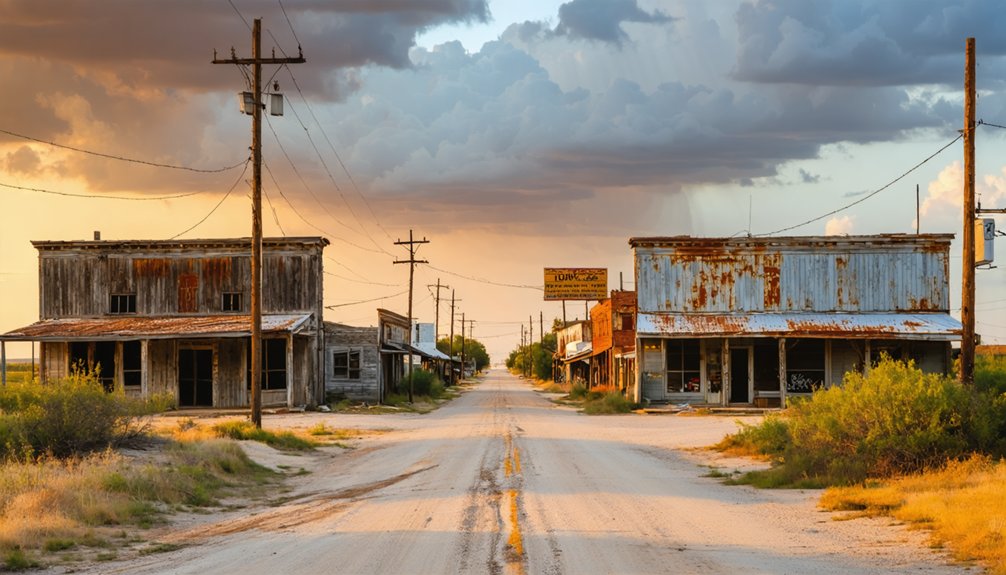
The crossroads area features a few homes on dirt streets, preserving a lived-in, unhurried atmosphere.
Don’t expect a polished attraction — Clinton rewards visitors who appreciate authenticity over spectacle, offering a rare, unfiltered glimpse into south-central Texas’s forgotten past.
Is Clinton Worth Visiting on a Texas Ghost Town Road Trip?
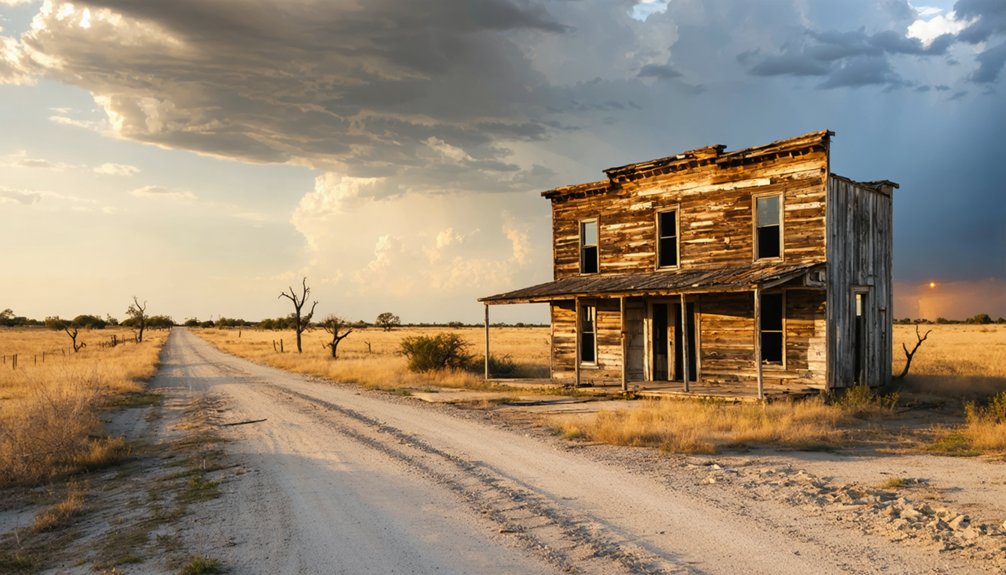
For ghost town enthusiasts plotting a Texas road trip, Clinton delivers exactly what the genre promises — raw history with few modern distractions. You won’t find polished museums or guided tours here, just a crossroads, a cemetery, dirt streets, and local legends tied to a vanished county seat.
The historical architecture is gone, replaced by open land and scattered homes, but that absence tells its own story. Clinton thrived, lost its courthouse role to Cuero, got bypassed by the railroad, and quietly faded.
If you’re driving US 183 near Cuero anyway, a brief stop costs you nothing but a few minutes. Set realistic expectations, bring curiosity about DeWitt County’s origins, and Clinton rewards you with exactly the kind of unfiltered, forgotten Texas history road-trippers crave.
Who’s Buried in Clinton Cemetery: and What the Graves Reveal?
The cemetery is where Clinton stops being an abstract historical footnote and becomes something personal. Walk among the pioneer graves and you’re reading DeWitt County’s earliest chapter in stone.
These weren’t settlers passing through — they built courthouses, raised families, and shaped a county seat from raw Texas land.
Unlike historical architecture, which can crumble or disappear entirely, a cemetery holds names, dates, and relationships that no ghost town’s decline can fully erase.
Clinton lost its post office in 1886, got bypassed by the railroad, and faded into crossroads obscurity — but the graves remained.
You don’t need a guided tour or a museum brochure. Just show up, walk slowly, and let the headstones tell you what Clinton once meant to the people who actually lived there.
Frequently Asked Questions
When Did Clinton’s Post Office Officially Open and Close?
You’ll find Clinton’s historical postal services opened in 1849 and closed in 1886. These dates mark the town’s rise and fall, offering you a vivid glimpse into ghost town preservation and frontier community life.
What Buildings Made up Clinton’s Original Courthouse Complex?
You’ll absolutely love knowing that Clinton’s courthouse complex, a marvel of historical architecture and courthouse significance, consisted of a humble log cabin and two frame buildings — proof that big county-seat power didn’t always need fancy digs!
Is the Clinton Ghost Town Site Accessible by a Regular Vehicle?
You’ll find Clinton’s ghost town easily accessible by regular 2WD vehicle, making it one of Texas’s most approachable roadside attractions for history lovers. Drive right up and explore this historical preservation site without specialized equipment!
Were There Other Texas Towns Named Clinton Besides the Dewitt County One?
Yes, you’ll find Texas naming origins reveal multiple Clintons existed across the state! Historical ghost towns like this weren’t unique in name — Texas commonly reused popular town names, reflecting settlers’ shared cultural roots and pioneering spirit throughout different counties.
What Empresario Was Dewitt County Named After?
Like a pioneer carving trails into untamed wilderness, you’ll find DeWitt County honors Green DeWitt, a towering figure in land grant history and one of Texas’s most celebrated historical figures among empresarios.
References
- https://www.texasescapes.com/CentralTexasTownsSouth/Clinton-Texas.htm
- https://kids.kiddle.co/Clinton
- https://www.texasescapes.com/CentralTexasTownsNorth/Clinton-Texas.htm
- https://en.wikipedia.org/wiki/Clinton
- https://www.ghosttowns.com/states/tx/clinton.html
- https://atlas.thc.texas.gov/Details/5123000922
- https://en.wikipedia.org/wiki/List_of_ghost_towns_in_Texas