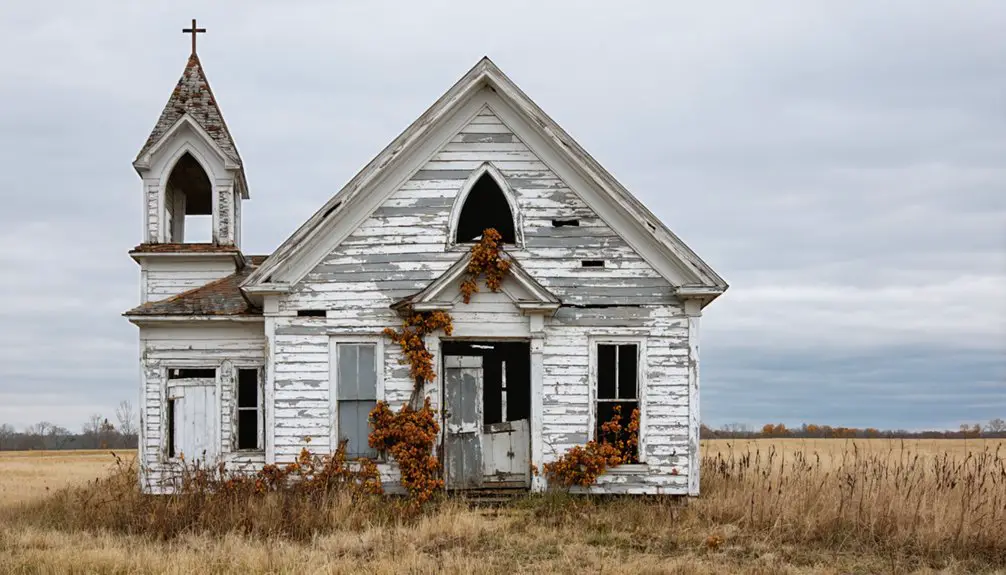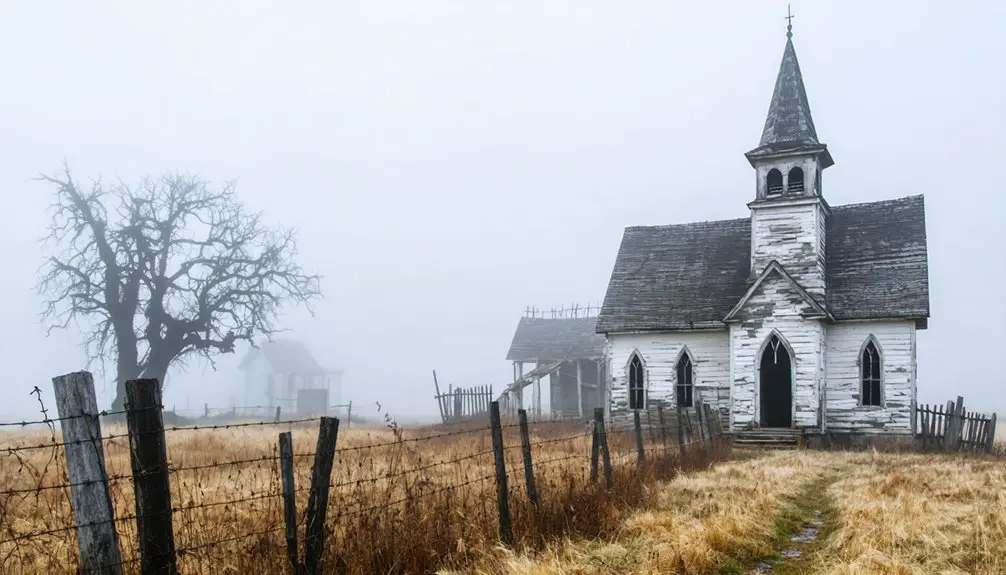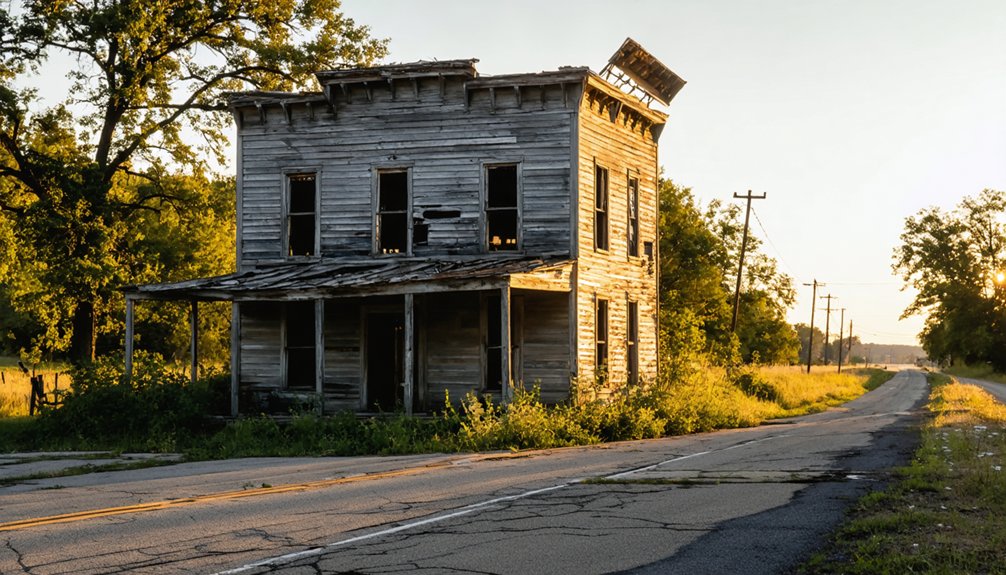
Planning a ghost town road trip to Goldman, Missouri means heading about 25 miles south of St. Louis into Jefferson County’s quiet rural landscape. You’ll follow Old Lemay Ferry Road to the site of a post office that operated for just ten years, from 1895 to 1905, before Goldman faded into legend. No structures remain, but the history’s still rich. Spring and fall offer the best conditions for your visit, and there’s plenty more to uncover ahead.
Key Takeaways
- Goldman, Missouri, is a ghost town located 25 miles south of St. Louis in Jefferson County, accessible via Old Lemay Ferry Road.
- The town’s only confirmed landmark is the former post office site, which operated briefly from 1895 to 1905.
- No physical structures remain, so visitors should prepare to experience the site through imagination and local legends.
- Spring and fall offer the best travel conditions, with mild temperatures and clear skies ideal for walking and photography.
- Pack water, snacks, offline maps, sturdy shoes, and a camera, as no nearby amenities exist at the site.
What Makes Goldman, Missouri a Ghost Town?
Goldman, Missouri checks all the boxes of a classic ghost town — a post office that opened in 1895 and shuttered just a decade later, no municipal government, and an economy that never grew beyond basic agriculture and local trade. You won’t find elected officials, city charters, or modern commercial development here.
What you’ll find is a rural stretch along Old Lemay Ferry Road where time practically stopped. Local folklore fills the gaps that written history leaves behind, giving the area a quiet, mysterious character that draws curious travelers.
The historic architecture, though minimal and weathered, hints at what small-town life once looked like in Jefferson County. Goldman’s gradual depopulation wasn’t dramatic — it simply faded, and that slow disappearance is exactly what makes it worth exploring.
Where Exactly Is Goldman, Missouri?
Tucked into Jefferson County, Missouri, Goldman sits about 25 miles south of St. Louis, just five miles north of the Jefferson County Courthouse in Hillsboro. You’ll find it along Old Lemay Ferry Road, a historic trade route that once connected rural communities to the bustling St. Louis metropolitan area.
If you’re chasing historical architecture and local legends, Goldman’s GPS coordinates — approximately 38.2972°N, 90.5214°W — will guide you right to it. Standard passenger vehicles handle the road conditions without issue, so you won’t need special equipment.
Jefferson County highways provide straightforward access from multiple directions. It’s a deliberately off-the-beaten-path destination, offering you the kind of raw, unfiltered rural freedom that overdeveloped tourist spots simply can’t replicate.
The History Behind Goldman’s Rise and Decline
Goldman’s roots trace back to an agricultural community that thrived along Old Lemay Ferry Road, where farmers relied on the historic trade corridor to connect with markets in Hillsboro and St. Louis.
In 1895, the establishment of a post office signaled Goldman’s brief moment of civic identity, giving the settlement a recognized place on the map.
But by 1905, that post office had closed, and without economic infrastructure to sustain growth, Goldman quietly faded into the rural landscape it remains today.
Goldman’s Agricultural Origins
Like many small Missouri communities, Goldman took root in the fertile soil of 19th-century agricultural life, growing around the trade connections that Old Lemay Ferry Road made possible. This farming legacy shaped every aspect of early Goldman, from its modest homes to its post office established in 1895.
Goldman’s agricultural heritage centered on four key realities:
- Crop production sustained families and fed regional trade markets
- Old Lemay Ferry Road moved goods directly between Hillsboro and St. Louis
- Small-scale farming defined land use across Jefferson County’s rural landscape
- Local trade networks kept Goldman economically connected to surrounding communities
When you visit today, you’re walking ground that once supported hardworking independent farmers who valued self-sufficiency and open land above everything else.
Post Office Era Significance
When Goldman’s post office opened in 1895, it signaled something important: this small Jefferson County community had earned enough recognition to warrant official federal infrastructure. Post office history tells us more than just mail delivery dates — it reveals a community’s significance at a specific moment in time.
For Goldman, that moment lasted exactly a decade. By 1905, the post office closed, and with it went the community’s most visible connection to broader civic life. You can trace Goldman’s rise and decline directly through that ten-year window.
A post office meant people were here, commerce existed, and connections to St. Louis mattered. Its closure meant the opposite. Understanding this community significance helps you appreciate what Goldman once represented before the land quietly reclaimed its rural identity.
Economic Decline Factors
Agriculture and local trade once anchored Goldman’s small economy, but neither proved strong enough to sustain the community as regional development shifted toward larger towns with better infrastructure. Several economic factors accelerated Goldman’s population decline:
- Agricultural limitations made large-scale farming unsustainable on Goldman’s rural terrain.
- Trade route decline stripped Old Lemay Ferry Road of its commercial significance as modern highways bypassed the area.
- Service migration pushed residents toward Hillsboro and St. Louis, where jobs and amenities existed.
- Infrastructure stagnation left Goldman without schools, commerce, or public services to attract new settlers.
You can see how these compounding pressures transformed a once-functional community into a quiet rural remnant.
Goldman’s story reflects what happens when opportunity moves faster than a small town can adapt.
How Old Lemay Ferry Road Shaped Goldman’s History
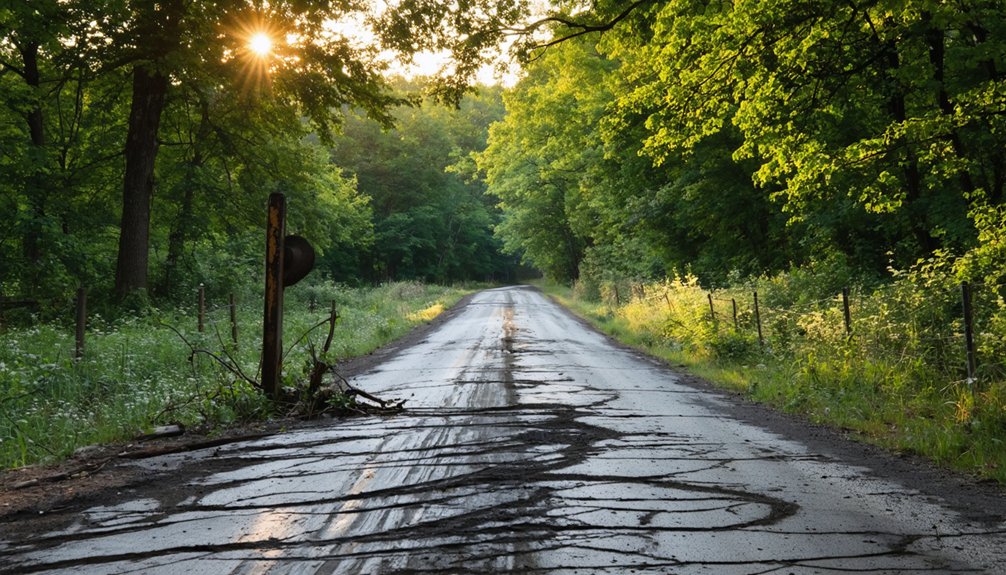
Old Lemay Ferry Road once served as the backbone of Goldman’s early identity, connecting the small community to both Hillsboro and the St. Louis metropolitan area. As you travel this historic route today, you can almost feel the rhythm of wagons carrying agricultural goods along what was once an essential trade corridor.
The road shaped Goldman’s early economy, drawing settlers and commerce that briefly gave the town purpose. Local legends suggest the route carried more than just trade — it carried stories, culture, and connection.
Though little historic architecture survives, the road itself remains a living artifact of Goldman’s past. Driving it gives you a rare, unfiltered glimpse into a community that thrived on movement before gradually fading into the quiet rural landscape you see today.
How to Get to Goldman, Missouri From St. Louis
You’ll find Goldman easy to reach from St. Louis, sitting just 25 miles south via Jefferson County highways.
Old Lemay Ferry Road serves as your primary access point, guiding you directly into the heart of this quiet rural community.
Standard passenger vehicles handle the road conditions well, so you won’t need anything special to make the trip.
Route From St. Louis
Getting to Goldman, Missouri from St. Louis is a straightforward drive that rewards your sense of adventure and curiosity about local legends and cultural preservation. Head south on Jefferson County highways, covering roughly 25 miles through rolling rural landscapes.
Follow these steps for a smooth route:
- Start on I-55 South from St. Louis, heading toward Jefferson County.
- Exit toward Hillsboro, the county seat located five miles south of Goldman.
- Navigate north from the Jefferson County Courthouse along connecting roads toward Goldman.
- Merge onto Old Lemay Ferry Road, the historic trade corridor delivering you directly into Goldman’s quiet, rural heart.
GPS coordinates 38.2972°N, 90.5214°W keep you precisely on track. Standard passenger vehicles handle road conditions without difficulty.
Road Conditions And Access
Road conditions along the route to Goldman are generally well-suited for standard passenger vehicles, so you won’t need a truck or SUV to make the trip. Jefferson County highways connect smoothly from St. Louis, guiding you south toward Old Lemay Ferry Road, your primary access point into this forgotten community.
Once you turn onto Old Lemay Ferry Road, you’ll sense the shift from modern suburban sprawl into quieter rural territory. The roads are straightforward, letting you focus on the surrounding landscape rather than navigation challenges.
Goldman’s community preservation efforts may be minimal, but local legends about its vanished post office and agricultural roots make the drive genuinely compelling. Pack water, charge your phone, and verify your GPS coordinates — approximately 38.2972°N, 90.5214°W — before departing.
The Former Post Office Site: Goldman’s Only Remaining Landmark
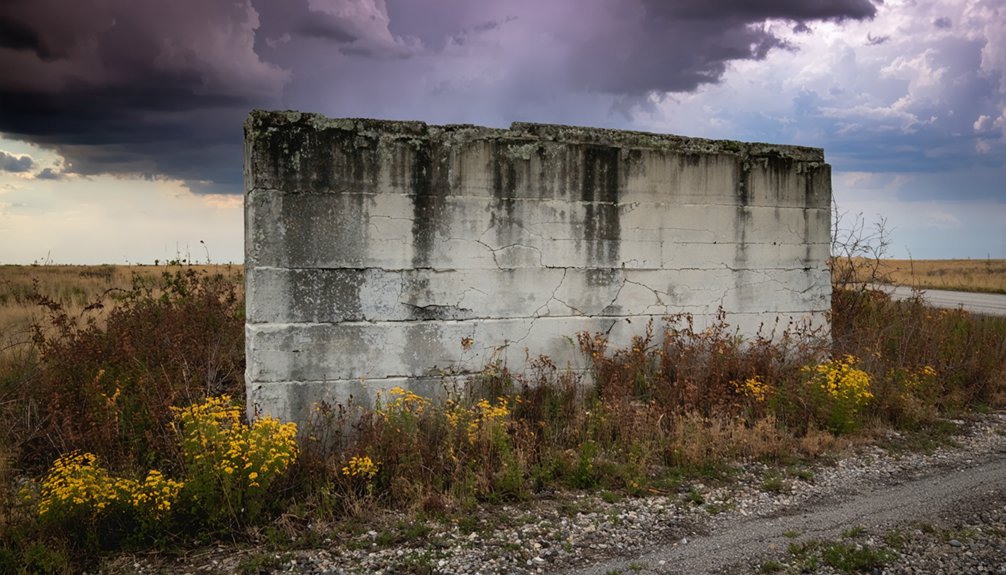
Although Goldman has little left to show for its brief existence, the former post office site stands as the town’s only confirmed historical landmark. Operating from 1895 to 1905, this location whispers community legends of a once-active rural hub.
You won’t find preserved historical architecture, but the site rewards curious explorers willing to imagine Goldman’s brief, vibrant past.
When you visit, keep these four details in mind:
- The post office operated for just 10 years before closing permanently.
- No physical structure remains standing today.
- Community legends suggest the site anchored early settler activity.
- Jefferson County maintains all historical records connected to this location.
Bring your curiosity, respect the land, and let Goldman’s quiet history speak for itself.
Is Goldman Worth the Drive?
Whether Goldman is worth the drive depends entirely on what you’re chasing. If you crave open roads, quiet landscapes, and the raw honesty of a forgotten place, Goldman delivers. There’s something freeing about standing where a community once thrived and simply disappeared.
You won’t find formal preservation efforts or curated tours here. Jefferson County doesn’t prioritize Goldman’s history, so you’re largely on your own to interpret what remains. That independence is part of the appeal.
Local legends surrounding the area give the drive an extra edge, hinting at stories no historical marker will ever confirm. Goldman rewards curious, self-directed travelers who don’t need polished attractions to feel satisfied.
If that sounds like you, Old Lemay Ferry Road is waiting.
The Best Time to Visit Goldman, Missouri
Spring and fall offer you the most comfortable conditions for exploring Goldman, with mild temperatures making the outdoor rural landscape far more enjoyable to navigate. You’ll want to avoid Missouri’s brutal summer heat and humidity, which can make a simple drive down Old Lemay Ferry Road feel exhausting rather than adventurous.
Winter visits aren’t impossible, but icy road conditions on rural Jefferson County highways can turn a straightforward 25-mile trip from St. Louis into an unnecessary challenge.
Ideal Visiting Seasons
When’s the best time to visit Goldman, Missouri? Spring and fall deliver the most rewarding experience, offering comfortable temperatures and clear skies perfect for exploring local legends tied to this forgotten community. You’ll want to avoid harsh winter conditions that make rural roads less accessible.
- Spring (March–May): Mild temperatures make walking Old Lemay Ferry Road enjoyable while wildflowers frame the landscape.
- Summer (June–August): Long daylight hours maximize exploration time, though humidity runs high.
- Fall (September–November): Crisp air and foliage create atmospheric conditions ideal for ghost town photography.
- Winter (December–February): Road conditions may challenge access, though solitude intensifies Goldman’s eerie, abandoned feeling.
Unfortunately, preservation efforts remain minimal here, so every season reveals the same quiet, weathered rural landscape waiting for your discovery.
Weather Considerations For Travel
Choosing the right season sets the stage, but understanding Goldman’s specific weather patterns sharpens your planning even further. Missouri summers hit hard, pushing temperatures past 90°F with thick humidity that makes outdoor exploration uncomfortable.
Spring and fall deliver milder conditions, perfect for wandering Old Lemay Ferry Road and soaking in the area’s atmosphere.
Winter visits carry charm but bring icy road risks along Jefferson County highways. You’ll want clear skies if you’re chasing local legends tied to Goldman’s faded past.
Preservation efforts, though minimal here, have left scattered traces worth discovering, and good weather simply makes that search more rewarding.
Pack layers in shoulder seasons, carry water in summer, and always check road conditions before heading out. Goldman rewards prepared travelers.
Avoiding Extreme Temperatures
Although Missouri’s climate swings between punishing extremes, Goldman’s sweet spot falls in April through May and September through October. You’ll explore abandoned structures comfortably without brutal heat or icy roads interfering with your adventure.
- Spring (April–May): Mild temperatures between 55–70°F let you investigate haunted legends and photograph decaying buildings in ideal lighting.
- Fall (September–October): Crisp air and golden foliage create an atmospheric backdrop perfect for ghost town exploration.
- Avoid Summer: July humidity regularly hits oppressive levels, making outdoor exploration genuinely miserable.
- Avoid Winter: January ice storms make rural Jefferson County roads treacherous and potentially impassable.
Pack layers during shoulder seasons since temperatures drop sharply after sunset, especially when you’re wandering Goldman’s quiet, rural landscape after dark.
What to Bring on a Day Trip to Goldman, Missouri
Since Goldman offers little in the way of modern amenities or services, you’ll want to pack smart before heading out. Bring plenty of water, snacks, and a fully charged phone with downloaded offline maps, since cell service can be unreliable along Old Lemay Ferry Road.
Pack smart before visiting Goldman — bring water, snacks, and offline maps, since cell service along Old Lemay Ferry Road can be unreliable.
Wear sturdy walking shoes suitable for uneven rural terrain.
Pack a small notebook if you’re drawn to local legends and ghost stories — Goldman’s abandoned character tends to spark imagination.
A camera captures the quiet, weathered atmosphere better than any postcard could.
Carry a basic first aid kit, sunscreen, and insect repellent depending on the season.
Since no shops exist nearby, everything you need must come with you.
Preparation transforms this remote rural detour into a genuinely rewarding experience.
Other Jefferson County Ghost Towns to Pair With Goldman
Jefferson County holds more ghost town stories than Goldman alone, and pairing your visit with nearby abandoned communities makes for a richer, more rewarding road trip. You’ll uncover local legends, abandoned structures, and forgotten histories that paint a vivid picture of Missouri’s rural past.
- Antonia – A once-thriving settlement now swallowed by suburban sprawl, offering glimpses of early Jefferson County life.
- Grubville – A quiet, faded community carrying agricultural roots and scattered remnants worth exploring.
- Pevely’s outskirts – Forgotten pockets near this small city reveal abandoned structures tied to early industrial ambitions.
- Morse Mill – A compelling stop featuring historic ruins and local legends surrounding its mysterious past.
String these stops together along Jefferson County’s backroads, and you’ve built a genuinely unforgettable ghost town circuit.
Frequently Asked Questions
Does Goldman, Missouri Have Any Cell Phone Coverage or Signal?
Cell phone coverage in Goldman, Missouri isn’t guaranteed, so you’ll want to check your carrier’s rural maps before heading out. Signal strength can be weak or nonexistent in this remote, sparsely populated area — embrace the disconnected freedom!
Are There Any Restroom Facilities Available Near Goldman?
Don’t let restroom concerns stop your adventure! You won’t find facility locations in Goldman itself, but nearby Hillsboro offers clean restroom cleanliness standards at local businesses and the Jefferson County Courthouse, just five miles south.
Is Private Property a Concern When Visiting Goldman?
Yes, private property’s a real concern in Goldman! You’ll want to stay on public roads like Old Lemay Ferry Road to avoid trespassing concerns, since most land surrounding this rural community belongs to private landowners.
Can Goldman Be Visited Safely After Dark?
You can visit Goldman after dark, but it’s not ideal. Without historical landmarks or lit paths, traversing’s tough. Local legends may tempt you, yet respect private property and bring reliable light for safety.
Are Pets Allowed When Exploring the Goldman Area?
You can bring your pets to Goldman’s open rural roads! Keep pet safety in mind by honoring leash requirements, ensuring they don’t wander into unfamiliar terrain as you freely explore this quiet, historic community.
References
- https://www.youtube.com/watch?v=Nrh1eUwOwrM
- https://www.onlyinyourstate.com/experiences/missouri/more-ghost-towns-mo
- https://www.youtube.com/watch?v=Tv7VLv68amY
- https://www.myleaderpaper.com/features/looking_back/looking-back—-to-the-town-of-goldman/article_7571e8c2-1770-11e4-929c-001a4bcf6878.html
- https://www.youtube.com/watch?v=ME_UUyjSs0o
- https://sites.rootsweb.com/~motttp/history/ghost_towns/index.htm
- https://www.youtube.com/watch?v=xKn4j60NKxk
- https://jefferson.mogenweb.org/com_goldman.html
- https://en.wikipedia.org/wiki/List_of_ghost_towns_in_Missouri
- https://www.youtube.com/watch?v=kiYZGmVed2g