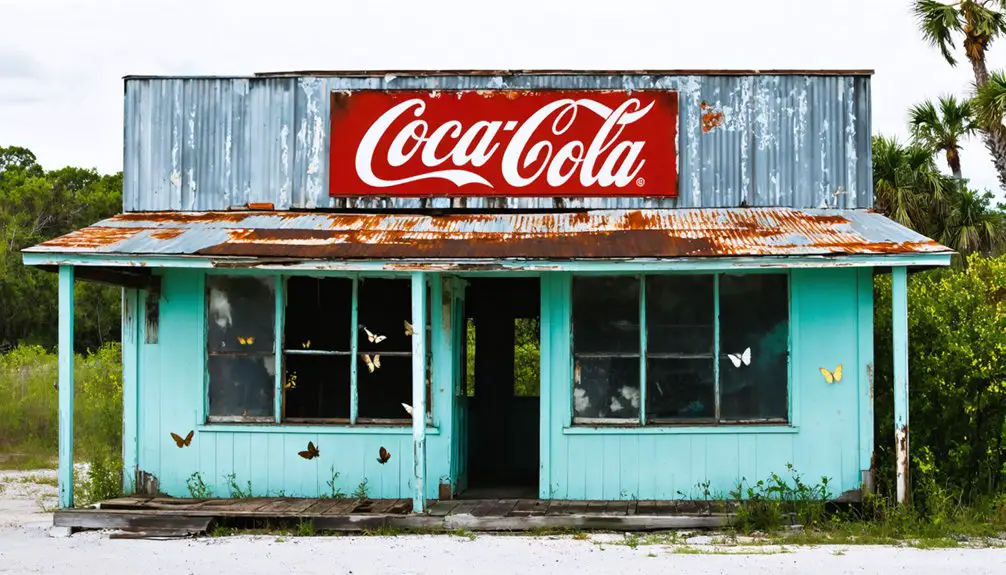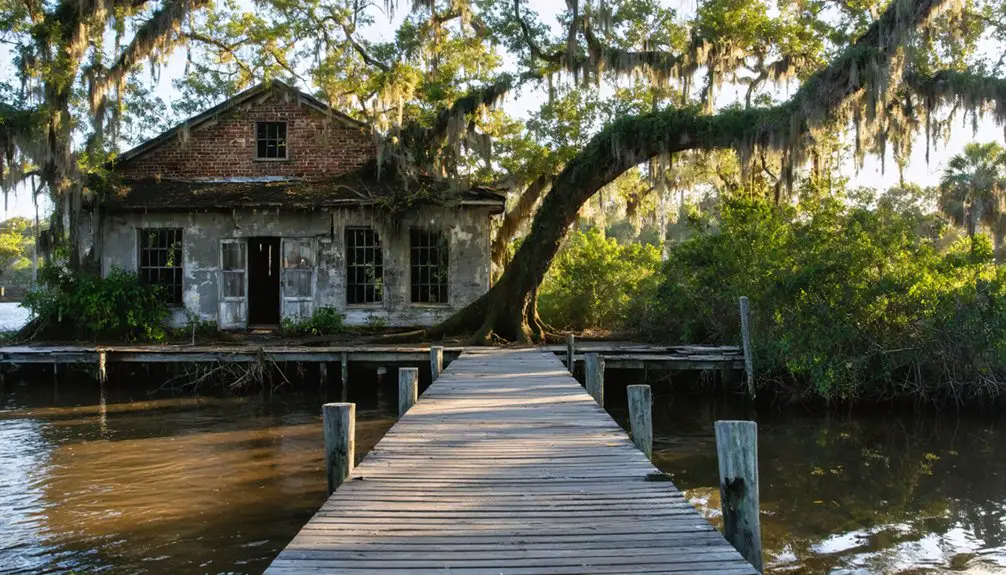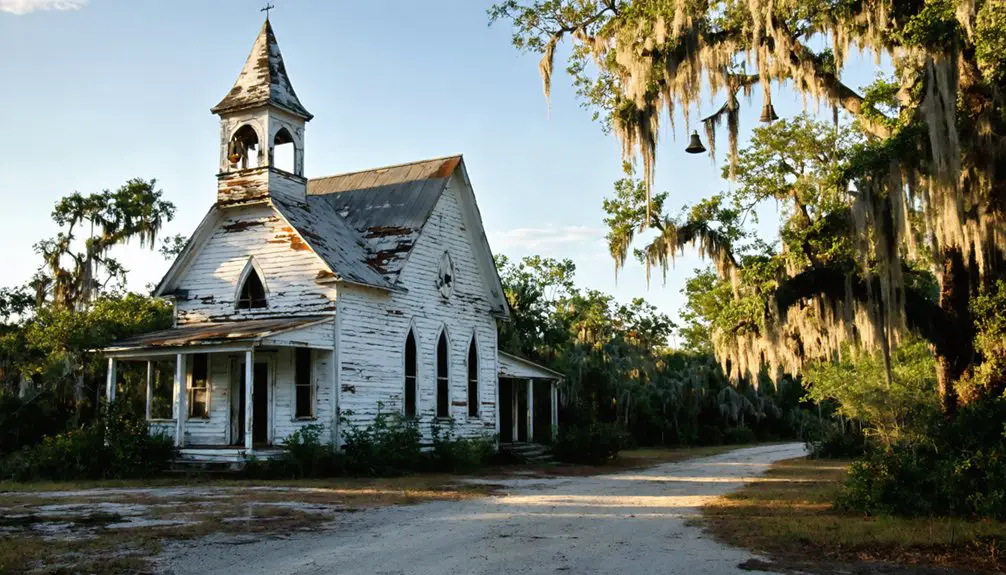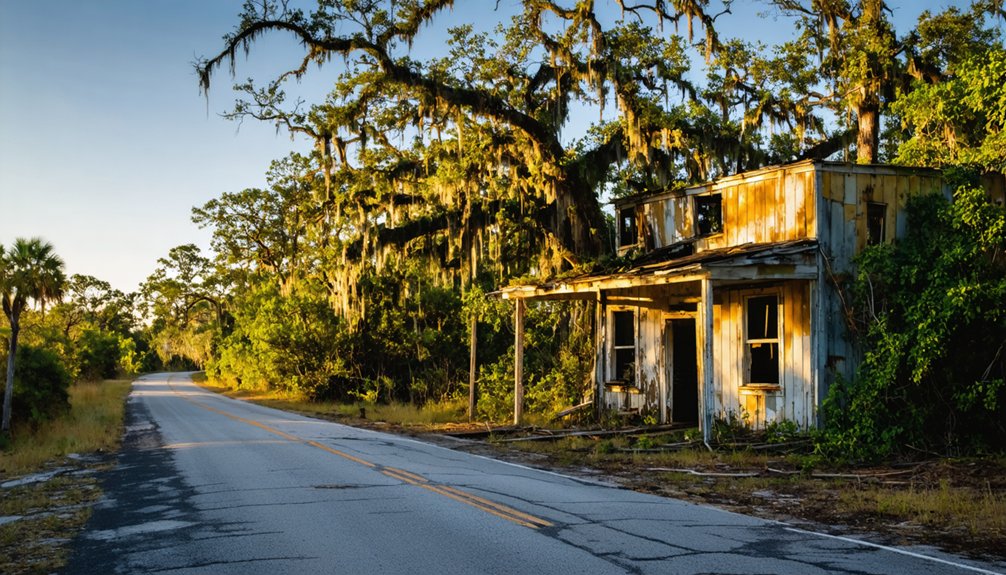
To plan your ghost town road trip to Illahaw, Florida, head north on Highway 441 from Kenansville for about 10 miles into Osceola County. Your standard 2WD vehicle handles the flat, open road just fine. Don’t expect dramatic ruins—the old railroad substation is the main landmark, and most remains hide behind private property lines and dense foliage. Bring binoculars and realistic expectations. There’s far more to this quiet, mysterious boomtown than first meets the eye.
Key Takeaways
- Illahaw sits along Highway 441, approximately 10 miles north of Kenansville in Osceola County, accessible by standard 2WD vehicles.
- The railroad substation building is the primary visible landmark; bring binoculars since dense foliage may obstruct roadside views.
- No designated parking exists, so use roadside pulloffs, and respect private property boundaries that limit exploration beyond public roads.
- Illahaw’s turpentine industry roots, post office closure in 1935, and railroad end in 1947 shaped this now-vanished Florida ghost town.
- Visit nearby Forever Florida, home to Camp Illahaw, which preserves the ghost town’s legacy through adventure programming and historical storytelling.
Illahaw, Florida: A Turpentine Ghost Town on Highway 441
Tucked along Highway 441 about 10 miles north of Kenansville in Osceola County, Illahaw, Florida, is a ghost town with roots in the turpentine industry. Its name derives from the Indian word *Yalaha*, meaning “orange,” hinting at a richer cultural history beneath its quiet exterior.
The Consolidated Land and Naval Stores Company once ran the turpentine operation here, supporting a small but functional community complete with a railroad station.
Today, you’ll find only a railroad substation building and local legends surrounding an unconfirmed cemetery known as Tracy Cemetery. Historical artifacts tied to the town’s past may still exist on private property, keeping some mysteries just out of reach.
It’s a raw, undisturbed slice of Florida history waiting for the freedom-seeking explorer.
The Rise and Fall of Illahaw’s Turpentine Economy
Illahaw’s story really begins with the turpentine trade, the economic engine that pulled a small community into existence along the Florida East Coast Railroad’s Kissimmee Valley Extension. The Consolidated Land and Naval Stores Company operated the local turpentine works, keeping families employed and the railroad station relevant. A post office opened in 1923, signaling real municipal ambition.
But you can’t harvest trees forever. Once the surrounding timber was exhausted, the turpentine operation collapsed, taking Illahaw’s economy with it. No replacement industry stepped in.
The post office closed in 1935, and by 1947, the railroad pulled out entirely. Today, urban legends and local folklore keep whispers of Illahaw alive, but the land itself tells a quieter story — one of resource depletion and rapid abandonment.
How to Get to Illahaw, Florida From Kenansville
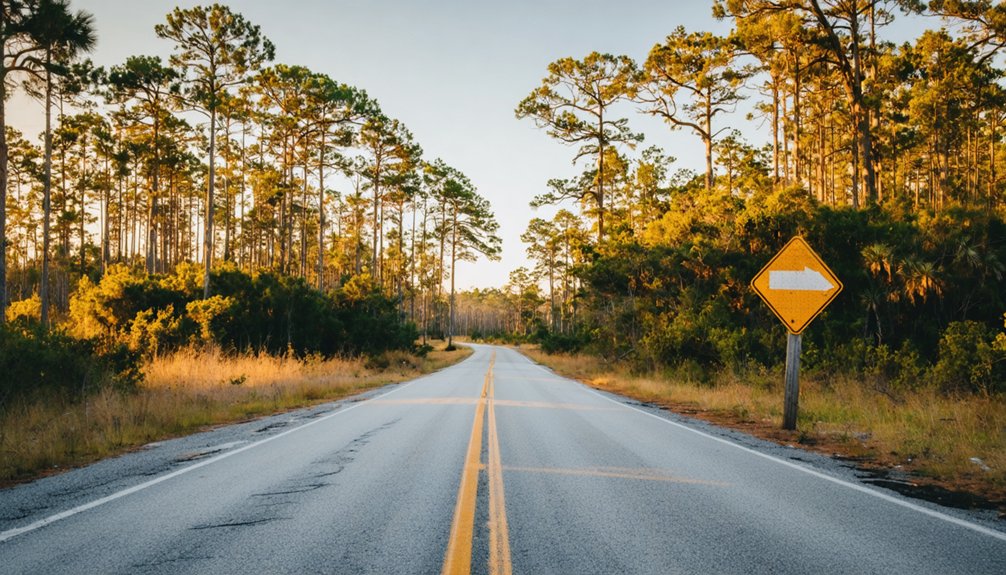
Getting to Illahaw is straightforward — you’ll head north out of Kenansville on Highway 441 for roughly 10 miles through Osceola County’s flat, open landscape. The drive is easy since the site carries a 2WD road rating, meaning your standard passenger vehicle handles it without trouble.
Head north out of Kenansville on Highway 441 for roughly 10 miles — any standard passenger vehicle handles it with ease.
Once you arrive, you’re stepping into a place where historical artifacts are scarce but meaningful — a lone railroad substation building stands as a quiet witness to the town’s turpentine past.
Local legends also point to a nearby cemetery called Tracy Cemetery, though researchers haven’t pinned down its exact location yet.
Keep an eye on property boundaries, as some potential remains sit on private land. Respect those limits, and you’ll still find the experience genuinely rewarding.
The Railroad Substation and What Remains at Illahaw Today
When you arrive at Illahaw, the railroad substation building stands as the town’s most tangible surviving structure — a weathered remnant of the Florida East Coast Railroad’s Kissimmee Valley Extension that once gave this turpentine community its commercial pulse.
Among the abandoned structures and railroad relics scattered across this landscape, it’s the clearest proof that a real community once thrived here.
You’ll also want to search for the Tracy Cemetery, reportedly located near the town site, though researchers haven’t successfully pinpointed its exact location.
Keep in mind that additional remains likely exist on private property, so respect posted boundaries.
What you can freely explore is limited, but those railroad relics carry genuine historical weight — silent evidence of an industry that built Illahaw and, ultimately, couldn’t save it.
The Tracy Cemetery: Illahaw’s Hidden Landmark
Beyond the railroad substation, another mystery pulls at curious visitors — the Tracy Cemetery, Illahaw’s most elusive landmark. Researchers have reportedly confirmed its existence near the town site, yet no one has successfully pinpointed its exact location. That uncertainty makes it both frustrating and compelling for independent explorers like you.
If you’re drawn to historic artifacts and the quiet stories they carry, this hidden burial ground represents something worth searching for. Cemetery preservation becomes difficult when a site loses its community, and Illahaw’s graveyard reflects that hard truth.
Access is further complicated by surrounding private property, so respect posted boundaries during your visit.
You won’t find a marked trailhead or a welcome sign here — just open land holding secrets that Illahaw hasn’t fully surrendered yet.
How Close Can You Actually Get to Illahaw’s Remains?
When you arrive at Illahaw, you’ll find that private property boundaries limit how close you can get to most of the town’s potential remains, so staying on public roads is essential.
From the road, you can spot the old railroad substation building, which stands as one of the few visible reminders that a community once thrived here.
The Tracy Cemetery adds another layer of frustration to your visit, as researchers haven’t successfully pinpointed its exact location despite confirmed reports of its existence near the town site.
Public Versus Private Access
Although Illahaw’s ghost town status makes it sound like an open-air ruin waiting to be explored, the reality is that most of its remaining structures sit on private property. Access restrictions mean you can’t simply wander onto the land to investigate every crumbling remnant you’ve read about.
What you *can* do is reach the railroad substation building and potentially locate the Tracy cemetery from publicly accessible areas along Highway 441. You’ll want to respect private property boundaries strictly, as trespassing laws apply regardless of historical curiosity.
The 2WD road classification gets you close without specialized equipment, so your standard vehicle handles the journey easily. Think of it as an observation experience rather than a full exploration — you’ll still absorb the quiet, forgotten atmosphere Illahaw carries.
Visible Remains From Roads
Pulling off Highway 441 near Illahaw, you’ll find that visibility of the remaining structures depends heavily on where you position yourself along the road. The railroad substation building stands as one of the few accessible historical artifacts you can actually observe without crossing private property lines.
Florida’s relentless vegetation growth demonstrates the environmental impact of decades without human maintenance, with thick subtropical foliage gradually reclaiming what was once an active turpentine community. You’ll want to bring binoculars since dense tree lines can obstruct clear sightlines from the roadway.
The unconfirmed Tracy cemetery remains elusive, with researchers never successfully pinpointing its exact location. What you can see from public roads tells a quiet but powerful story about a town that simply faded when its resources disappeared.
Cemetery Location Challenges
Beyond what you can spot from the roadway, the Tracy cemetery presents a uniquely frustrating challenge for ghost town explorers. Despite reports confirming its existence near the Illahaw town site, researchers conducting burial site investigation have never successfully pinpointed its exact location. You’re fundamentally chasing a ghost within a ghost town.
Cemetery preservation efforts are difficult when the site itself remains unconfirmed. If you’re planning to search, understand that private property boundaries complicate your access considerably. Trespassing isn’t just illegal — it cuts off future researchers from cooperative landowner relationships that burial site investigation depends on.
Your best approach is respecting those boundaries while documenting what you observe publicly. The cemetery’s elusiveness actually deepens Illahaw’s mystery, making your road trip feel like genuine historical detective work rather than a routine sightseeing stop.
Road Conditions, Parking, and What to Expect on Arrival
Since Illahaw carries a 2WD road classification, you won’t need a truck or SUV to make the trip — your standard passenger vehicle will handle Highway 441 just fine. Pull up your map navigation before leaving Kenansville and head north roughly 10 miles to reach the site.
Parking tips are straightforward: roadside pulloffs work best since no designated lot exists. Once you arrive, expect a quiet, largely open landscape rather than dramatic ruins. The railroad substation building stands as your primary visible landmark.
Keep private property boundaries in mind — some potential remains sit beyond legal access. The freedom of exploring here comes with the responsibility of respecting those limits. Arrive with realistic expectations, and the site’s understated history will still make the detour worthwhile.
Camp Illahaw: The Living Legacy of a Lost Town
As you explore the Illahaw area, you’ll find that the town’s name lives on through Camp Illahaw, a horse and adventure camp for teens nestled within Forever Florida. The camp draws a direct line back to the original turpentine community, preserving the legacy of a settlement that vanished decades ago.
Today, you can visit a fully operational facility where young people experience outdoor adventures on the same land that once supported a thriving railroad stop.
Camp Illahaw’s Historical Roots
Though the town of Illahaw has long since faded from the map, its name lives on through Camp Illahaw, a horse and adventure camp for teens nestled within the Forever Florida nature preserve. The camp keeps the spirit of this lost community alive, connecting you to local legends and historical architecture that defined the original settlement.
Here’s what ties the camp to its roots:
- The name “Illahaw” derives from the Indian word *Yalaha*, meaning “orange”
- Forever Florida preserves the land surrounding the original town site
- The camp honors the turpentine community’s pioneering heritage
- Teens experience the same untamed Florida landscape early settlers once navigated
You’ll find the past isn’t truly gone — it’s just wearing different boots.
Preserving The Town’s Legacy
Camp Illahaw doesn’t just borrow a name — it carries a living piece of Illahaw’s identity forward into the present. While urban development has erased most physical traces of the original turpentine community, this horse and adventure camp for teens keeps the spirit alive within Forever Florida’s boundaries.
Historic preservation doesn’t always mean maintaining crumbling structures; sometimes it means embedding a name into something actively thriving. You’ll find no museum or guided tour here, but the camp’s very existence reminds you that Illahaw meant something real to the people who built it.
When you visit the site, knowing the name survived through intentional stewardship adds depth to what might otherwise feel like an empty roadside stop along Highway 441.
Teen Adventure Camp Today
Nestled within Forever Florida’s boundaries, Camp Illahaw transforms the ghost town‘s legacy into something teens can actually experience — horseback riding, adventure activities, and the kind of outdoor immersion that the original turpentine settlers knew intimately.
You’ll find the camp keeps Illahaw’s spirit alive through:
- Horseback riding across landscapes the original settlers once roamed
- Adventure programming that connects participants to local legends surrounding the town’s rise and fall
- Outdoor exploration that mirrors the self-reliant lifestyle of early turpentine workers
- Historical artifacts and storytelling that preserve the community’s forgotten narrative
While the physical town has vanished, Camp Illahaw ensures the name endures meaningfully. If you’re craving history with genuine wilderness freedom, this camp delivers exactly that experience.
Nearby Florida Stops Worth Pairing With Illahaw
Since Illahaw sits in the heart of Osceola County, you’ve got plenty of rewarding stops within easy driving distance to round out your road trip.
Illahaw puts you right in the middle of Osceola County, with rewarding road trip stops always within easy reach.
Kenansville, just 10 miles south, offers a quiet rural atmosphere where preservation efforts keep Florida’s cattle country heritage alive through historical artifacts and local landmarks.
Head further into Osceola County and you’ll find Forever Florida, a sprawling conservation ranch that blends wildlife exploration with authentic Florida Cracker history.
If you’re craving something livelier, Kissimmee sits within reasonable driving range and delivers a completely different energy.
The surrounding region also features natural springs, cattle ranches, and open grasslands that remind you why central Florida earned its wild reputation long before theme parks ever arrived.
Frequently Asked Questions
Is There a Fee to Visit the Illahaw Ghost Town Site?
There’s no fee mentioned for visiting Illahaw’s ghost town site, so you’re free to explore! Just respect historic preservation efforts and private property boundaries, as visitor regulations require cautious access to this fascinating, open Florida landmark.
Are Pets Allowed When Visiting the Illahaw Ghost Town Area?
No official pet restrictions exist, but you’ll want to prioritize pet safety during potential wildlife encounters in this rural Florida area. Ready to explore freely? Keep your furry companion leashed and stay alert on private property boundaries.
How Long Does a Typical Visit to Illahaw Usually Take?
You’ll typically spend one to two hours exploring Illahaw’s historical preservation sites. Don’t miss photography opportunities at the railroad substation, but you’re free to linger as long as the open road calls you!
Is Illahaw Ghost Town Suitable for Young Children to Visit?
You’ll find Illahaw suitable for curious kids, but prioritize wildlife safety on the open terrain. Historical preservation makes it educational, though private property limits roaming, so keep young explorers close while you discover this fascinating, freedom-filled ghost town together.
What Should Visitors Wear When Exploring the Illahaw Site?
When exploring Illahaw, you’ll want sturdy appropriate footwear for uneven terrain and overgrown areas. Don’t forget sun protection, as Florida’s hot climate shows no mercy. Dress light, stay comfortable, and embrace the freedom of uncovering history!
References
* https://www.ghosttowns.com/states/fl/illahaw.html