You’re chasing a town the reservoir swallowed whole. Linwood, Utah was a frontier settlement platted in 1890 along Henrys Fork, famous for a saloon straddling two states and a schoolhouse that disciplined kids based on which side of the border they stood on. By the early 1960s, Flaming Gorge Reservoir buried it forever. Today, only a historical marker at Linwood Bay remains above water — and the legends run deeper than you’d expect.
Key Takeaways
- Linwood, Utah, now submerged beneath Flaming Gorge Reservoir, is best accessed via Linwood Bay, marked by a historical commemorative marker.
- Fuel up and download maps in Manila before arriving, as the area has limited cell service and rugged terrain.
- Bring binoculars to scan the shoreline and spot wildlife like osprey, mule deer, and waterfowl over the submerged townsite.
- Notable legends include the Bucket of Blood Saloon and the 1904 Stateline School, both straddling the Utah-Wyoming border.
- Fall and winter offer unique views, with golden cottonwoods in autumn and receding water levels revealing shoreline details in winter.
What Was Linwood, Utah Before It Vanished?
Before Flaming Gorge Reservoir swallowed it whole, Linwood was a scrappy frontier village tucked along Henrys Fork of the Green River, just a stone’s throw from the Wyoming state line in Daggett County, Utah.
Surveyors platted the townsite in 1890, and cottonwood trees lining the banks inspired its name.
Where Linwood Once Stood and How to Find It Today
If you’re searching for Linwood today, you won’t find it on dry ground — the rising waters of Flaming Gorge Reservoir swallowed the townsite after the dam’s completion in the early 1960s.
The original settlement once hugged Henrys Fork of the Green River, roughly five miles east of Manila near the Utah-Wyoming border, but that landscape now lies beneath the surface.
Your best access point is Linwood Bay, where a historical marker anchors the story of what once stood there, giving you a place to stand, look out across the water, and imagine the town below.
Locating the Submerged Townsite
Though nothing breaks the water’s surface to mark where Linwood once stood, you can still find the ghost town’s resting place if you know where to look. Head to Linwood Bay on Flaming Gorge Reservoir, where a historical marker anchors you to the site.
The reservoir swallowed everything — the Bucket of Blood Saloon, the mercantile stores, the dance hall — when the dam filled in the early 1960s. Local legends claim the water still holds historical artifacts beneath its depths, silent remnants of a frontier community that once drew cowboys, outlaws, and sheep ranchers alike.
Stand at that marker, scan the blue water stretching toward Wyoming, and let yourself feel the weight of what’s buried just below the surface.
Visiting Linwood Bay Today
Knowing where Linwood sleeps beneath the reservoir is one thing — getting there’s another. Head to Linwood Bay on Flaming Gorge Reservoir, where a historical marker anchors you to the site. You’ll stand above streets, saloons, and schoolyards now silenced by water.
Scan the shoreline slowly — wildlife sightings here are common, with osprey, mule deer, and waterfowl threading through the canyon edges. Let that wildness remind you what drew settlers here in the first place.
Before leaving, fuel up with local dining in Manila, just five miles west — small-town meals earned after honest exploration.
The bay won’t reveal much, but knowing what lies beneath transforms a quiet shoreline into something electric with forgotten history.
The Bucket of Blood Saloon and Linwood’s Wildest Legends
No ghost town road trip feels complete without at least one saloon story, and Linwood’s best is the Bucket of Blood. This notorious watering hole sat deliberately on the Utah-Wyoming state line, letting drinkers and troublemakers sidestep jurisdiction with a single step.
The Bucket of Blood saloon straddled the Utah-Wyoming line, where one bold step could outsmart the law.
Local legends say the name alone kept some folks honest.
Then there’s the Stateline School, built in 1904 straddling both states. Teachers reportedly marched misbehaving students to whichever side carried the harsher punishment that day.
It’s the kind of frontier ingenuity that defines Linwood’s character.
These historic landmarks remind you that Linwood wasn’t just a quiet ranching village. It was a place where people bent rules, crossed borders, and lived boldly on the edge of civilization. That spirit still echoes across Linwood Bay today.
Linwood’s Stateline School That Straddled Two States
When you stand at the edge of Linwood Bay today, you’re standing near the ghost of one of America’s most unusual schoolhouses — the 1904 Stateline School, built directly on the Utah-Wyoming border with its north half in Wyoming and its south half in Utah.
Teachers reportedly enforced discipline by moving misbehaving students to the appropriate state’s side, turning jurisdiction into punishment.
That little schoolhouse outlasted the town itself, with some accounts placing it among the few structures moved rather than surrendered to the rising waters of Flaming Gorge Reservoir.
A School Across State Lines
One of Linwood’s strangest landmarks wasn’t a saloon or a mercantile—it was a schoolhouse built deliberately on the Utah-Wyoming border in 1904.
Historical preservation efforts kept this story alive, and local legends made it unforgettable. Here’s what made the Stateline School remarkable:
- The north half sat in Wyoming, the south half in Utah
- Two jurisdictions meant two sets of rules under one roof
- Teachers reportedly moved misbehaving students to whichever state had stricter discipline that day
- The little red schoolhouse was eventually relocated near Manila before floodwaters erased Linwood forever
You’re chasing a frontier where boundaries were negotiable and ingenuity ruled. That schoolhouse embodied the independent, rule-bending spirit that defined every soul who settled this unforgiving borderland.
Discipline By Jurisdiction
Built squarely on the Utah-Wyoming state line in 1904, the Stateline School turned an accident of geography into a daily experiment in frontier justice. Local folklore claims that teachers disciplined students according to which state they stood in — misbehave on the Utah side, and Utah rules applied. Step north into Wyoming, and the consequences changed entirely.
Whether strictly true or polished through generations of ghost town legends, the story captures something real about Linwood’s spirit. People here understood borders as negotiable, authority as regional, and geography as leverage. You could literally move your feet and shift your legal reality.
That kind of frontier ingenuity defines Linwood more than any single building. It’s a reminder that out here, the rules depended entirely on where you planted your boots.
The Schoolhouse’s Lasting Legacy
Most frontier schoolhouses simply taught children to read and write — the Stateline School taught them that authority itself had a geography. Built in 1904, this piece of historical architecture straddled two worlds simultaneously. Local legends about its boundary-splitting design still captivate visitors today.
Here’s what made it remarkable:
- The north half sat in Wyoming, the south half in Utah
- Teachers reportedly moved misbehaving students to the appropriate state for punishment
- The little red schoolhouse was preserved — relocated outside Manila before the flood
It stood as proof that frontier communities found creative solutions to bureaucratic boundaries.
When you visit Linwood Bay, you’re not just touring a drowned town — you’re honoring a community that refused to let state lines define their daily lives.
Why Linwood Disappeared Beneath Flaming Gorge Reservoir
By the time the federal government arrived to buy up the last private parcels in 1957 and 1958, Linwood was already a ghost of itself. Decades of farm consolidation, overgrazing, and shifting roads had quietly drained the town of its lifeblood long before any dam broke ground.
Linwood was already dying before the dam ever broke ground — the federal buyout just made it official.
The sheep boom faded, businesses shuttered, and buildings collapsed under their own neglect.
Then Flaming Gorge Dam sealed Linwood’s fate permanently. Rising waters swallowed the townsite whole in the early 1960s, erasing every street, saloon, and memory above the waterline.
Today, ghost town myths and local legends are all that remain above the surface. You won’t find crumbling walls or rusted signs here — just cold, deep water covering the freedom-chasing frontier life that once thrived below.
What Survives at Linwood Bay Today
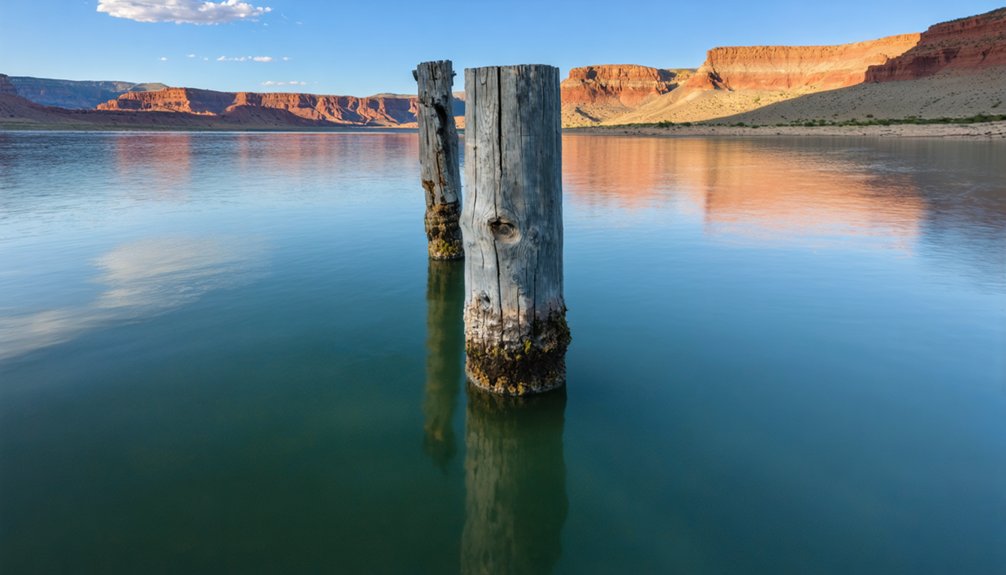
Linwood is gone, but it hasn’t vanished without a trace. Head out to Linwood Bay on Flaming Gorge Reservoir, and you’ll find echoes of that frontier world still waiting.
Here’s what survives for the road-tripping explorer:
- The Linwood Bay historical marker — your gateway to understanding what once stood here
- Historical artifacts — remnants and records preserved through local oral history and regional archives
- The relocated schoolhouse — a little red building moved near Manila before the waters rose
- Wildlife viewing — eagles, deer, and waterfowl now roam the land where cowboys once rode
The reservoir claimed the buildings, but the story endures. Stand at that marker, scan the water, and let your imagination rebuild what history swallowed whole.
Nearby Stops Worth Adding to Your Linwood Road Trip
Once you’ve soaked in Linwood’s submerged history, the surrounding region rewards you with more ghost town grit and frontier drama. Head into Manila, just five miles west, where frontier-era stories still echo through local lore.
Drive south into the Flaming Gorge National Recreation Area, where canyon overlooks reveal the sheer scale of what the dam erased.
Ghost town legends cluster throughout the Uinta Basin, each site carrying its own vanished world. Browns Park, northeast along the Green River, draws outlaws’ ghosts — Butch Cassidy rode these flats.
Historic preservation efforts throughout the region protect fragments of this raw, untamed past. Every stop deepens the same truth: the West didn’t fade quietly. It burned, flooded, and scattered — and the road still connects the pieces.
Best Time to Visit Flaming Gorge
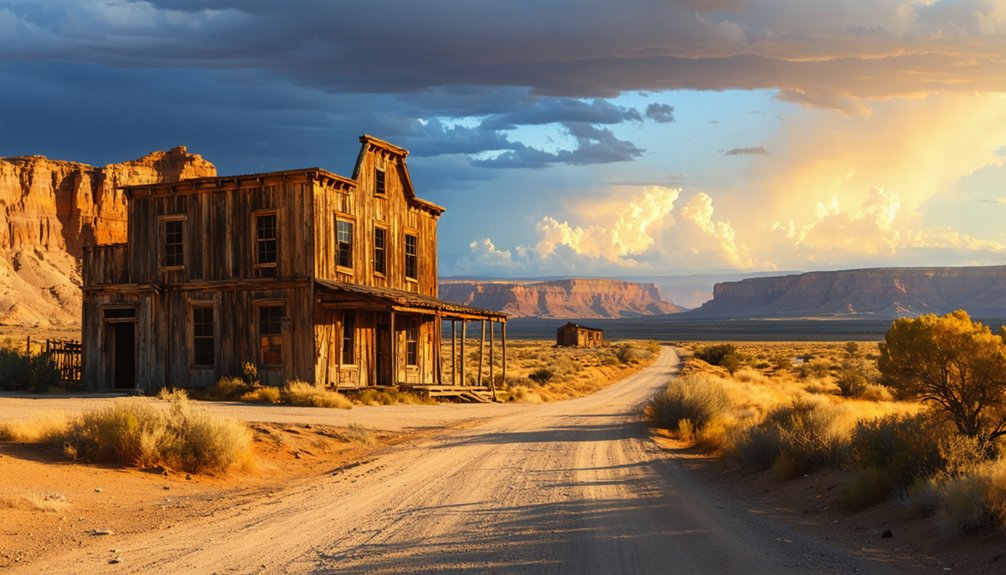
Timing your visit shapes everything at Flaming Gorge. Each season reveals a different layer of this drowned frontier landscape, where local legends and historical preservation intersect beneath open skies.
- Spring (April–May): Rising waters mirror canyon walls. Crowds stay thin, giving you space to explore Linwood Bay undisturbed.
- Summer (June–August): Peak recreation season brings boat access directly over the submerged townsite — history literally beneath your hull.
- Fall (September–October): Cottonwoods blaze gold, echoing the very trees that named Linwood itself. Cooler temps reward serious explorers.
- Winter (November–March): Stark silence descends. The reservoir pulls back slightly, occasionally exposing forgotten shoreline details.
Visit fall or spring if solitude matters to you. Summer works if you’re chasing the full Flaming Gorge experience on the water.
What to Know Before You Drive to Linwood Bay
Getting to Linwood Bay takes you through the high desert of northeastern Utah, where the road itself feels like part of the frontier story. Head toward Manila, then follow the signs east toward Flaming Gorge Reservoir. The drive rewards you with raw canyon views and open sky.
Before you go, know that Linwood’s original streets sit beneath the water. You won’t walk the ghost town — you’ll look out over it. Bring binoculars, a curiosity for local legends, and respect for what’s submerged below.
The historical marker near Linwood Bay is your anchor point for ghost town mysteries. Cell service is limited, so download your maps. Fuel up before leaving Manila. The frontier doesn’t wait, and neither should you.
Frequently Asked Questions
Was Linwood Ever Officially Incorporated as a Utah Municipality?
Linwood never earned official incorporation as a Utah municipality. You’ll find its soul alive in historic landmarks and local legends—a free-spirited frontier village that lived boldly, defied boundaries, and vanished beneath Flaming Gorge’s waters.
Who Surveyed the Linwood Townsite and What Year Did That Occur?
George Solomon surveyed the Linwood townsite in 1890—you’re tracing historical land surveys that sparked a frontier dream. Ghost town preservation keeps his adventurous legacy alive, inviting you to explore the freedom of Utah’s untamed, submerged past.
How Long Did the Linwood Post Office Operate Before Closing?
Like a frontier flame that burns bright then fades, Linwood’s post office ran 55 years — from 1903 to 1958. You’ll find its local legends and historical architecture now swallowed beneath Flaming Gorge’s waters, forever lost to freedom’s wild past.
What Caused the Sheep Industry in Linwood to Eventually Collapse?
Overgrazing drove the sheep industry decline, and you’d have watched the land give out beneath your boots. Those economic impacts hit hard, stripping Linwood’s frontier prosperity and leaving once-thriving rangelands barren, broken, and ultimately abandoned.
Were Any Linwood Residents Compensated When the Federal Government Purchased Land?
By 1957–1958, the federal government completed land acquisition across every private parcel. Yes, resident compensation was provided — you would’ve received payment, but you’d surrender your home forever to the rising waters of Flaming Gorge.
References
- https://en.wikipedia.org/wiki/Linwood
- https://stories.utahhumanities.org/stories/items/show/222
- http://genealogytrails.com/utah/daggett/history.html
- https://fillmorecity.org/wp-content/uploads/2021/08/Linwood-Utah_2021-0630.pdf
- https://en.wikipedia.org/wiki/List_of_ghost_towns_in_Utah
- https://archiveswest.orbiscascade.org/ark:80444/xv55474
- https://www.hmdb.org/m.asp?m=90096
- https://exhibits.lib.utah.edu/s/ghost-towns/page/railroad-towns
- https://www.ksl.com/article/25121076/flaming-gorge-is-full-of-beautiful-views-and-a-rich-history