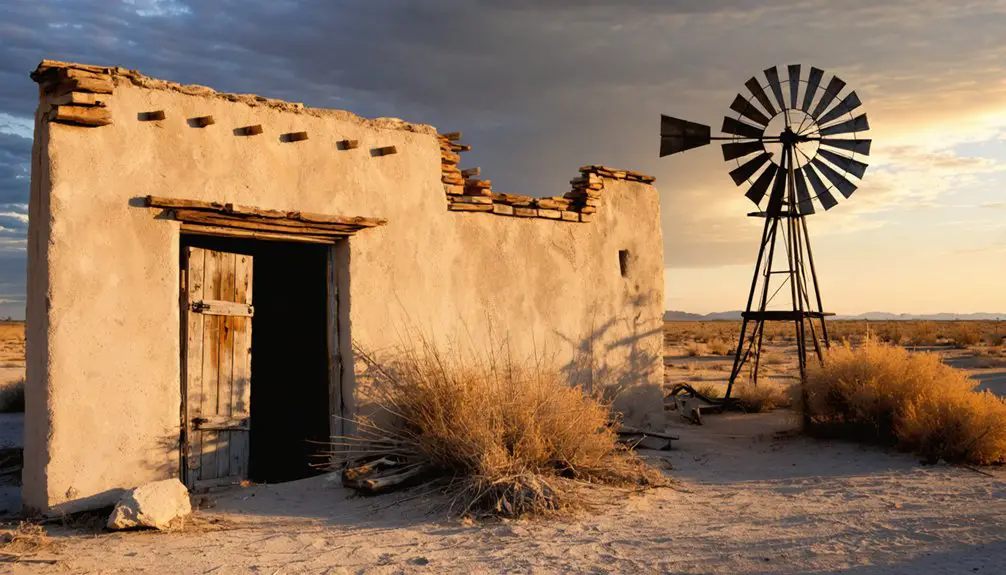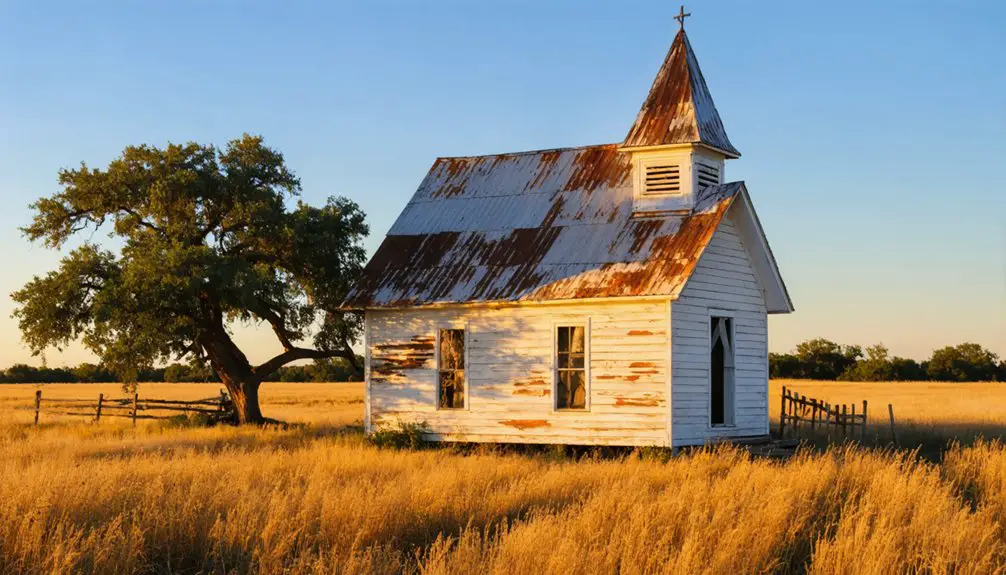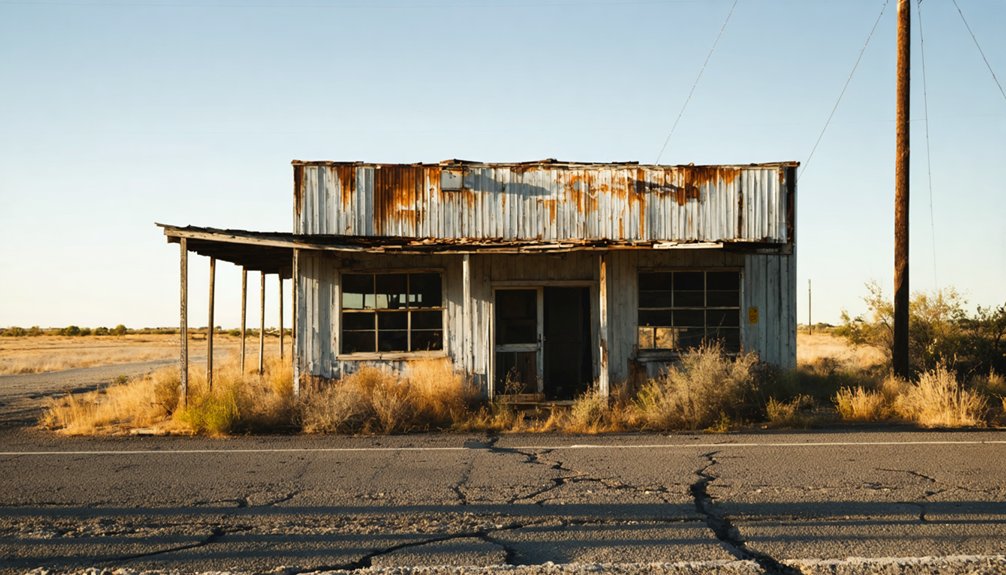
Osage, Texas won’t appear on most maps, but it’s worth every unpaved mile. Start in Weimar, head northeast along County Roads 205 and 208, and watch for osage orange trees marking the site. What you’ll find is a quiet cemetery holding nearly 200 graves, Civil War-era markers, and the carved names of Southern families who built a community the railroad erased. The full story runs deeper than the stones suggest.
Key Takeaways
- Osage, Texas, once a thriving 1850s settlement, declined after the 1873 railroad bypassed it, leaving only a cemetery and rural landscape.
- Navigate from Weimar northeast via County Roads 205 and 208, using Harvey Creek and osage orange trees as landmarks.
- Osage Cemetery, recognized as a Historic Texas Cemetery in 2016, holds roughly 200 graves dating to the Civil War era.
- Nearby Columbus and Weimar offer complementary historical stops, including Victorian architecture, local legends, and railroad-era history.
- Expect remote, unmarked rural roads, quiet surroundings, and little above-ground evidence of the former community beyond the cemetery.
What Is Osage, Texas: and Is It Worth the Drive?
Though it no longer appears on state maps, Osage, Texas was once a living community with a post office, platted streets, and families who’d traveled from Tennessee, Alabama, and Mississippi to build something permanent in Colorado County.
Then the railroad bypassed it, Weimar absorbed its commerce, and Osage quietly dissolved.
You won’t find urban decay in the traditional sense here — no crumbling storefronts or broken windows. What remains is subtler: a rural cemetery holding roughly 200 graves, Civil War-era markers, and the kind of silence that invites ghost stories without needing them.
If you value open roads, unfiltered history, and places that reward curiosity over convenience, Osage is absolutely worth the detour. It’s not a destination — it’s a reckoning with how quickly a community can vanish.
How Osage Grew From an 1850S Settlement Into a Texas Community
When you trace Osage’s beginnings, you’ll find a settlement taking shape in the early 1850s on land tied to the Henry Austin five-league survey.
Edward Austin’s 1853 subdivision opened the area to new arrivals, drawing families mostly from Tennessee, Alabama, and Mississippi who brought their Southern roots deep into Colorado County.
That wave of migration laid the human foundation for what would briefly become a recognized Texas community.
Early 1850s Settlement Roots
Before Weimar ever appeared on a map, Osage was already taking shape along the creeks and rolling terrain of northwestern Colorado County. Settlement began in the 1850s, anchored by land tied to the Henry Austin five-league survey. When Edward Austin subdivided the tract in 1853, families moved in quickly, most arriving from Tennessee, Alabama, and Mississippi.
They brought their cultural heritage with them, planting deep roots in unfamiliar soil. Their architectural styles, though modest, reflected Southern building traditions suited to Texas frontier life.
The community drew its name from the osage orange trees scattered across the land, a small but telling detail about how settlers read and claimed their new surroundings. You can still feel that pioneering spirit when you stand at the edge of what remains.
Land Surveys Encouraged Growth
Edward Austin’s 1853 subdivision of the Henry Austin five-league survey did more than divide land on paper—it opened a door. Once parcels became accessible, families from Tennessee, Alabama, and Mississippi moved in and staked their claims. They built homes, cleared fields, and established the kind of rooted community that values cultural preservation above convenience.
You can still sense that determination today. The land shaped how people organized their lives, and the settlement that emerged reflected both practicality and pride. Though little historic architecture survives above ground, the cemetery and surrounding rural landscape carry the memory of what once stood here.
The survey didn’t just encourage growth—it gave ordinary people the freedom to plant something permanent in Texas soil.
Settlers From Southern States
The families who settled Osage didn’t arrive by chance—they came with purpose, pulling up roots in Tennessee, Alabama, and Mississippi to plant them in Colorado County soil. They carried their customs, their faiths, and their stories with them, seeding a culture that would define the community for generations.
That cultural preservation showed up in how they gathered—through camp meetings, church fellowships, and shared labor—building something distinctly Southern on Texas ground. Local legends grew from those early years, stories passed down through family lines that still echo in the cemetery’s weathered markers.
When you visit Osage today, you’re walking ground shaped by those deliberate migrations. These weren’t wanderers—they were builders who chose this land and left a fingerprint history hasn’t fully erased.
How the Railroad Killed Osage and Built Weimar Instead
How quickly a railroad could rewrite a town’s fate. When the Columbus-to-San Antonio line launched in 1873, Weimar rose almost overnight, pulling businesses, families, and commerce away from Osage like a current. You can almost feel the silence that followed.
Picture the shift through three sharp moments:
- 1873 — Trains bypass Osage entirely, redirecting economic energy toward Weimar’s new depot.
- By 1900 — Osage’s commercial life has vanished, leaving only scattered homesteads behind.
- Today — Preservation efforts at the cemetery keep memory alive where urban legends now fill the quiet.
Weimar didn’t steal Osage’s future. The railroad simply handed it somewhere else. Knowing that, you’ll drive these county roads differently, reading the landscape like a map of what was lost.
How to Reach the Osage Cemetery From Weimar and Columbus
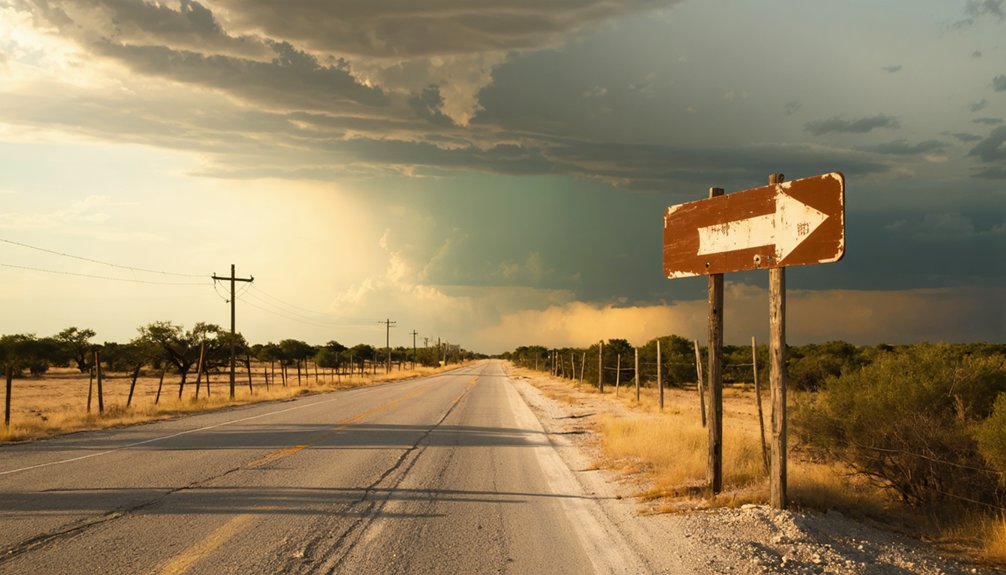
Whether you’re starting from Weimar a few miles to the southwest or rolling in from Columbus about 8 miles to the southeast, the Osage Cemetery is your clearest target in a landscape where the town itself has long since disappeared.
From Weimar, head northeast toward the junction of County Roads 205 and 208, keeping Harvey Creek as your general landmark. The roads out here are rural and unsigned in places, so slow down, watch your turns, and treat the drive itself as part of the historical experience.
Starting From Weimar
Since Weimar serves as your closest landmark, use it as your navigation anchor when heading out to the Osage Cemetery. This short drive pulls you through open ranch country where the past still breathes beneath the Texas sky.
- Head north from Weimar toward County Road 205, following the rural corridor a few miles northeast.
- Locate the CR 205 and CR 208 junction, where the cemetery sits quietly off the beaten path.
- Look for the historical marker placed at the cemetery entrance in 2018, a sign of the site’s cultural preservation and ongoing recognition of its historical significance.
You won’t find crowds or paved tourist paths here — just wind, old headstones, and the freedom to connect with something real.
Coming From Columbus
Columbus sits about 8 miles southeast of Osage, making it a natural starting point if you’re already exploring Colorado County’s seat. The town rewards a slow walk before you head out — its historical architecture, including a striking Victorian courthouse, grounds you in the same era that shaped Osage’s rise and quiet disappearance.
Local legends of early settlers and Civil War-era families linger in Columbus‘s streets, echoing what you’ll later find carved into cemetery stones at Osage. From Columbus, take US-90 West toward Weimar, then navigate north along County Roads 205 and 208.
The drive is short but rural, so confirm your route before leaving town. Columbus offers your last reliable stop for fuel and food before the landscape opens into scattered ranches and Harvey Creek country.
Once you’ve had your fill of Columbus, the road to Osage trades courthouse squares for open ranchland and creek-cut terrain. Head northwest toward Weimar, then find your way to the CR 205 and CR 208 junction near Harvey Creek. These rural roads reward the independent traveler willing to navigate without signage.
Keep these three details in mind:
- Use Weimar as your anchor — it’s your closest reference point for fuel and orientation.
- Watch the local flora — osage orange trees still mark old boundary lines and signal you’re closing in on the site.
- Slow down near creek crossings — hidden landmarks like fence lines and old field stones often appear where maps go quiet.
What Survives at the Osage Community Cemetery Today
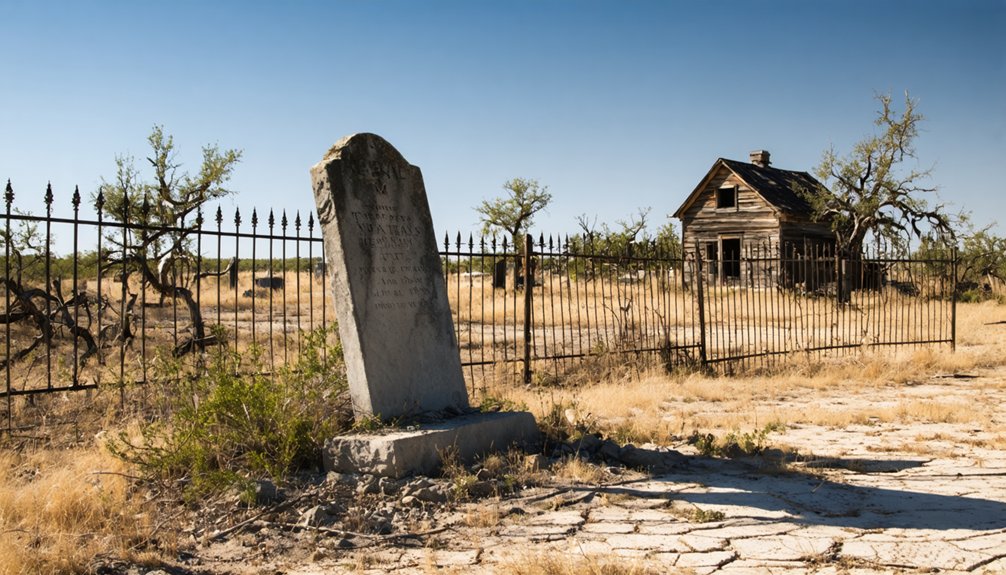
Though little physical evidence of Osage remains above ground, the Osage Community Cemetery endures as the ghost town’s most tangible connection to the past. When you visit, you’ll find roughly 200 graves, including both marked and unmarked burials that stretch back to the Civil War era.
Confederate symbols and pioneer-era markers make cemetery preservation here feel like an act of reclaiming forgotten American stories.
Texas officially recognized the site through its Historic Texas Cemetery designation in 2016, and historical markers placed at the entrance in 2018 give you essential context before you step inside.
You’re walking ground where early settlers from Tennessee, Alabama, and Mississippi were laid to rest. The names carved into aging stone are often the only proof these families ever called Osage home.
What to Pack and Expect at a Remote Osage Site Visit
Visiting Osage means stepping into genuinely remote Texas countryside, so you’ll want to prepare before you leave pavement behind. No urban development softens this landscape — no gas stations, no signs, no crowds. What you’ll find instead is quiet land, scattered ranches, and a cemetery standing as quiet cultural preservation against time’s erasure.
Osage offers no urban softening — only quiet land, scattered ranches, and a cemetery holding history against erasure.
Pack accordingly:
- Water and snacks — services disappear past Weimar, and the drive rewards patience, not convenience.
- Sturdy footwear — uneven ground surrounds the cemetery, especially near older, sunken grave markers.
- A camera and a county map — cell signal weakens along CR 205 and CR 208, so don’t rely solely on your phone.
Expect stillness. Expect history underfoot. Expect a place that asks you to slow down and pay attention.
Which Texas History Stops Pair Well With an Osage Road Trip
Packing your kit and plotting your route to Osage is really just the beginning — this corner of Colorado County sits within easy reach of several stops that’ll deepen the story you’re already chasing.
Columbus, just eight miles southeast, rewards curious travelers with its art and architecture, including ornate Victorian courthouse squares and buildings that carry local legends of frontier justice and Texas rebellion.
Weimar, the railroad town that effectively ended Osage’s commercial life, tells its own side of that economic shift.
Together, these towns form a corridor of layered history — settlement, Civil War, railroad expansion, and community loss.
You’re not just visiting a cemetery when you road trip this region; you’re tracing an entire chapter of Texas’s restless, westward-pushing identity.
Frequently Asked Questions
Can Visitors Access the Osage Cemetery on Weekends and Holidays?
Like pioneers who roamed freely across open Texas land, you’ll find no visitor restrictions blocking cemetery access. The Osage Community Cemetery welcomes you any day, including weekends and holidays, so explore its 200 graves whenever your road trip calls.
Are Pets Allowed When Visiting the Osage Community Cemetery Grounds?
No official pet policies or cemetery regulations are documented for Osage Community Cemetery. You’re free to visit this hallowed pioneer ground, but respect the buried souls resting there by keeping pets leashed and well-behaved.
Is Photography Permitted Throughout the Osage Community Cemetery?
With ~200 graves to document, you’re free to photograph throughout the cemetery. Capture its historical significance respectfully — your lens becomes a tool for cemetery preservation, honoring pioneers and Civil War souls who’ve shaped Texas’s enduring frontier legacy.
Does Colorado County Maintain the Osage Cemetery Regularly?
Specific maintenance details aren’t confirmed, but you’ll find preservation efforts honoring its historical significance evident throughout. The cemetery’s 2016 Historic Texas Cemetery designation suggests protective oversight, keeping these pioneer and Civil War-era stories alive for freedom-seeking explorers like you.
Are There Any Annual Events Held Near the Osage Site?
No official annual events mark Osage’s historical significance — but don’t let that stop you. Weimar’s local gatherings occasionally echo local legends, giving you the perfect freedom to explore this hauntingly quiet ghost town on your own terms.
References
- https://en.wikipedia.org/wiki/Osage
- https://www.texasescapes.com/CentralTexasTownsSouth/Osage-Texas.htm
- https://www.osagecemetery.com/about
- https://www.coloradocountycitizen.com/article/3780
- https://www.texasalmanac.com/places/osage
- https://www.texasescapes.com/CentralTexasTownsNorth/Osage-Texas.htm
- http://www.coloradocountyhistory.org/historical_markers/old_osage.htm
- https://digital.library.unt.edu/ark:/67531/metadc663630/
- https://www.tshaonline.org/handbook/entries/osage-tx-colorado-county
- https://en.wikipedia.org/wiki/List_of_ghost_towns_in_Texas