Planning a ghost town road trip to Fairview, Texas puts you on rural county roads southeast of San Antonio, deep in Wilson County’s quiet history. You’ll find a community that once thrived on cotton, crossroads commerce, and community pride—until boll weevils and two world wars stripped it all away. The Fairview Cemetery and an old Rock Church anchor the townsite today. Keep going, and you’ll uncover everything you need to make this trip unforgettable.
Key Takeaways
- Fairview is located along rural county roads southeast of San Antonio in Wilson County—confirm routing to avoid confusion with other Texas Fairviews.
- Use Fairview Cemetery as a key navigation landmark, as it remains active and accessible to visitors today.
- Pack supplies before visiting, as surrounding roads offer limited commercial support for travelers.
- Plan Fairview as a compact stop, combining it with nearby ghost towns to create a broader South Texas history loop.
- Key sites include the cemetery, a repurposed school building, and a still-standing church at the original townsite.
What Made Fairview, Texas a Ghost Town?
Although Fairview never became a classic abandoned ghost town, it steadily lost the pulse that once made it thrive. When you dig into its story, you’ll find a community that built itself around cotton, commerce, and community pride after the Civil War.
Henry Hudson opened a store along Old Oakville Road, a post office followed in 1868, and soon Fairview had churches, doctors, a blacksmith, a cotton gin, and a Masonic Lodge.
Then boll weevils arrived, and the agricultural economy collapsed after World War I. Local legends describe a slow unraveling rather than a sudden collapse.
Wilson County Fairview vs. Other Texas Towns Named Fairview
Before you load up your GPS and start chasing Fairview on a map, you’ll want to know that Texas has several towns carrying that name, and they’re not all telling the same story.
Collin County’s Fairview incorporated in 1958 and operates as a modern suburb, so skip it entirely for ghost-town purposes.
Bosque County’s Fairview holds some cultural significance through its church and school roots but offers a quieter rural-history angle.
The Wilson County site is your real destination. It delivers authentic historical preservation through its surviving cemetery, once called The Rock Church Cemetery, and a standing church that outlasted the town itself.
Always confirm the county before mapping your route, because arriving at the wrong Fairview wastes your time and dilutes the experience.
Cotton Farms, Crossroads Stores, and Early Community Life
Shortly after the Civil War ended, Henry Hudson opened a store along Old Oakville Road, and that single commercial decision planted the seed for everything Fairview would become.
One store. One road. One decision that quietly set an entire community into motion.
A post office followed in 1868, drawing residents who built homes, churches, doctors’ offices, a blacksmith shop, a cotton gin, a Masonic Lodge, and a telephone exchange around that original crossroads.
Cotton farming powered it all. Fields stretched across Wilson County, and Fairview’s merchants and tradespeople thrived on that agricultural energy.
You can almost feel the rural resilience embedded in every structure those early settlers raised from the ground up.
Community memory lives in those details — a working blacksmith beside a schoolhouse, a telephone exchange in a small Texas crossroads town.
Fairview wasn’t just surviving; it was genuinely flourishing.
How Boll Weevils and Two World Wars Emptied the Town
When you look at what unraveled Fairview, you’ll find a familiar but brutal pattern: boll weevils tore through the cotton fields after World War I, stripping the crop that kept every store, gin, and household running.
The economic blow hit so hard that families left and businesses closed faster than the community could recover.
Cotton’s Sudden Collapse
Cotton once ruled Fairview’s economy, but the boll weevil didn’t care about prosperity. When the pest swept through after World War I, it gutted harvests and drained the financial backbone from this Wilson County community. Farmers who’d built their lives around cotton suddenly had nothing to sell and nowhere to turn.
This agricultural decline hit hard and fast. Families left. Businesses closed. The rhythm that once connected neighbors through gins, stores, and lodge meetings simply stopped.
World War II finished what the weevils started, pulling younger residents away permanently.
What you’ll find today is rural heritage frozen at a crossroads — a cemetery, a surviving church, and silence where a thriving town once stood. Understanding this collapse makes your road trip feel less like tourism and more like witnessing history firsthand.
Boll Weevils Strike Hard
The boll weevil didn’t announce itself — it simply arrived and dismantled everything Fairview had built around cotton. Historical agriculture in Wilson County depended almost entirely on that single crop, so when the weevil swept through after World War I, farmers had little fallback.
Fields that once supported a blacksmith, a cotton gin, and a telephone exchange suddenly couldn’t justify their existence.
Then World War II pulled younger residents away for good. Community resilience kept a few institutions alive — two stores, two churches, a school teaching only first and second grade — but the momentum was gone.
You can feel that absence when you stand near the old crossroads today. The town didn’t burn or flood; it simply ran out of reasons to stay together.
War Accelerates Town Decline
Boll weevils cracked Fairview’s foundation, but two world wars finished the job. As young men left for overseas service, families followed economic shifts toward larger towns with steadier work and better schools. Nobody came back to rebuild the cotton fields.
Urban decay settled in quietly, block by block. By the time World War II ended, Fairview had shrunk to two stores, two churches, and a school teaching only first and second grade. That school eventually became a machine and welding shop, which tells you everything about what happened to community life here.
The forces that emptied Fairview weren’t unique. Across South Texas, war and agriculture collapse rewrote the map. You can see that same story written into every crumbling structure still standing at the old crossroads.
What Physical Landmarks Still Survive at the Townsite
When you pull up to the old Fairview townsite, you won’t find crumbling storefronts or rusted machinery lining the road, but a few quiet landmarks still anchor the community’s memory to the land.
The Fairview Cemetery — originally called The Rock Church Cemetery after a Methodist church built in the 1870s — remains active and gives you the clearest window into who once lived and worked here.
One church still stands on the grounds, while the last school building traded chalk and primers for a machine and welding shop before fading into rural obscurity.
The Fairview Cemetery Today
Although most of Fairview’s bustling crossroads community has faded into memory, you’ll still find tangible proof of its existence if you know where to look. The Fairview Cemetery remains active today, quietly anchoring the old townsite and welcoming visitors who appreciate honest, unpolished history.
Originally called The Rock Church Cemetery, it earned that name from the Methodist church built beside it in the 1870s. Local legends connect the grounds to the earliest settlers who shaped this cotton-farming community after the Civil War.
Preservation efforts have kept the cemetery functional rather than forgotten, giving you a rare opportunity to walk among marked graves that span generations of Wilson County life. Bring a camera, respect the space, and let the headstones tell you what the history books summarize.
One Church Still Stands
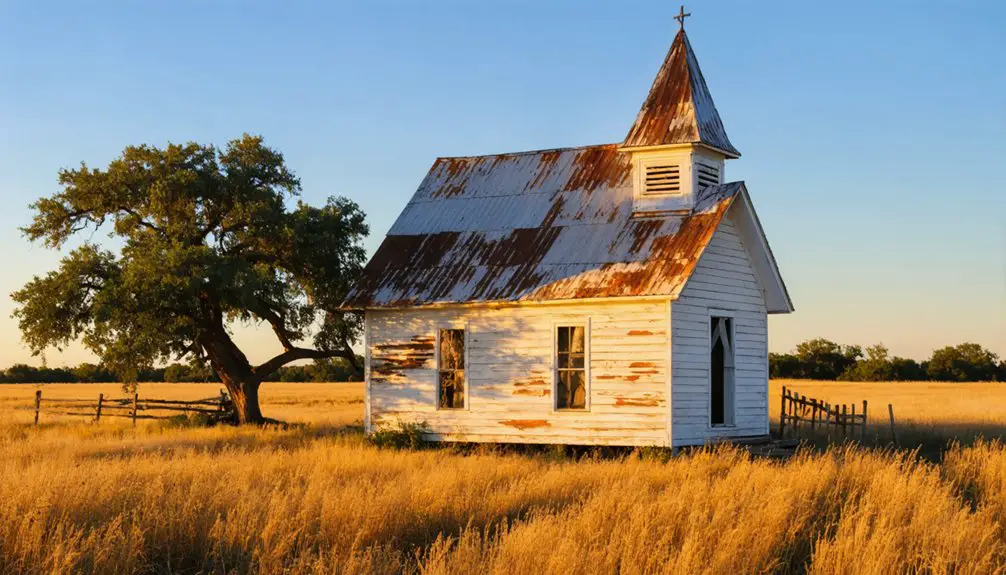
Beyond the cemetery, one church still stands at the old Fairview townsite, giving you a second reason to stop and take stock of what time has left behind. When the community collapsed after World War I, most buildings disappeared, but this structure held on.
Its church architecture connects you directly to the people who built Fairview from scratch following the Civil War.
Standing here alongside the cemetery preservation efforts already underway, you’re looking at the two strongest pieces of physical evidence that a real community once thrived at this crossroads.
Cotton farmers, blacksmiths, doctors, and teachers all called this place home. The church reminds you that survival isn’t accidental. Someone cared enough to maintain it, and that care gives your road trip a moment worth slowing down for.
Final School Building Fate
The church isn’t the only building with a story worth tracking down. Fairview’s final school building took a different path than quiet decay — it got repurposed. A machine and welding shop eventually moved in, transforming a symbol of community resilience into a working trade space. That shift tells you everything about agricultural history and rural survival.
When you visit, keep these three facts in mind:
- The school once served only first and second graders by the late 1940s
- No academic institution replaced it after closure
- A working shop occupied the structure in later years
You’re walking through layers of reinvention when you explore this townsite. Fairview didn’t just fade — it adapted until adaptation was no longer enough.
The Fairview Cemetery and Its Rock Church Origins
Tucked beside where a Methodist church once stood in the 1870s, the Fairview Cemetery carries a name few visitors expect: The Rock Church Cemetery. That original name ties directly to Rock Church history, reminding you that this burial ground didn’t exist in isolation — it grew alongside an active congregation that anchored the community.
When you visit today, you’ll find a cemetery that’s still in use, making it one of Fairview’s most enduring living landmarks. Cemetery restoration efforts have kept the grounds accessible and meaningful, connecting modern visitors to the cotton farmers, merchants, and families who built this crossroads town after the Civil War.
Walk the rows slowly. Each marker tells a piece of the larger story that the vanished stores and schools no longer can.
Getting to Fairview, Wilson County

Once you’ve walked the cemetery rows and let the Rock Church history settle, your next step is figuring out how to reach this quiet Wilson County crossroads. Fairview sits along rural county roads southeast of San Antonio, rewarding travelers who plan ahead.
Before you go, confirm these three things:
- Verify you’re routing to Wilson County, not Collin, Bosque, or another Texas Fairview.
- Use the Fairview Cemetery as your anchor landmark, since abandoned structures and local legends won’t appear on standard maps.
- Pack water and fuel beforehand — surrounding roads offer little commercial support.
The drive itself reflects true Texas freedom: open land, quiet crossroads, and an honest sense of rural history that no curated attraction can replicate.
South Texas Ghost Towns to Pair With a Fairview Stop
Since Fairview makes for a compact stop rather than a full-day destination, pairing it with nearby ghost towns turns your drive into a richer South Texas history loop. Wilson County sits within reasonable range of several communities that share Fairview’s story of agricultural decline, where cotton profits collapsed, boll weevils moved in, and populations quietly scattered.
Explore Bosque County’s Fairview if you’re willing to push further north, where church and school roots mirror Wilson County’s own rural architecture and community pattern.
Closer to home, scan county roads for weathered storefronts, abandoned gins, and overgrown cemeteries that tell the same postwar story. Combining two or three stops rewards you with a fuller picture of how South Texas built itself up and walked away.
Frequently Asked Questions
Is There an Admission Fee to Visit the Fairview Cemetery?
You’ll find no admission fee to explore Fairview Cemetery’s historical artifacts and uncover its cemetery legends firsthand. Simply drive up, step out, and let Texas rural history speak directly to your free-spirited soul.
Are Pets Allowed When Visiting the Fairview Townsite Area?
No official pet policies or animal restrictions are documented for Fairview’s rural townsite. You’re free to bring leashed pets, but always respect the cemetery grounds, nearby private property, and any posted signage you encounter.
What Is the Best Season to Visit Fairview, Wilson County?
Fall offers your best seasonal weather for exploring Fairview, Wilson County. You’ll enjoy cooler temperatures, clear skies, and comfortable walking conditions. Smart travel planning means avoiding summer’s intense South Texas heat for a truly freeing heritage experience.
Is the Fairview Townsite on Private or Publicly Accessible Land?
Since 1868, Fairview’s carried historical significance through generations. Land ownership of the townsite is typically private, so you’ll want to respect boundaries, but you can freely explore the publicly accessible Fairview Cemetery nearby.
Are There Restroom Facilities Near the Fairview Cemetery or Crossroads?
No restroom facilities or nearby amenities exist at the Fairview cemetery or crossroads, so you’ll want to plan ahead. Stop in a neighboring town before you venture out to explore this remote rural site.
References
- https://en.wikipedia.org/wiki/List_of_ghost_towns_in_Texas
- https://exploretexas.com/blog/history-of-fairview-texas/
- https://www.wilsoncountyhistory.org/talk-fairview
- https://communityimpact.com/dallas-fort-worth/features/2016/11/19/town-of-fairview-history/
- https://www.tshaonline.org/handbook/entries/fairview-tx-bosque-county
- https://www.collincountyhistory.com/fairview.html
- https://www.tshaonline.org/handbook/entries/fairview-tx-angelina-county
- https://www.tshaonline.org/handbook/entries/fairview-tx-tom-green-county
- https://www.hauntedplaces.org/fairview-tx/
- https://www.historictexas.net/city/fairview-texas