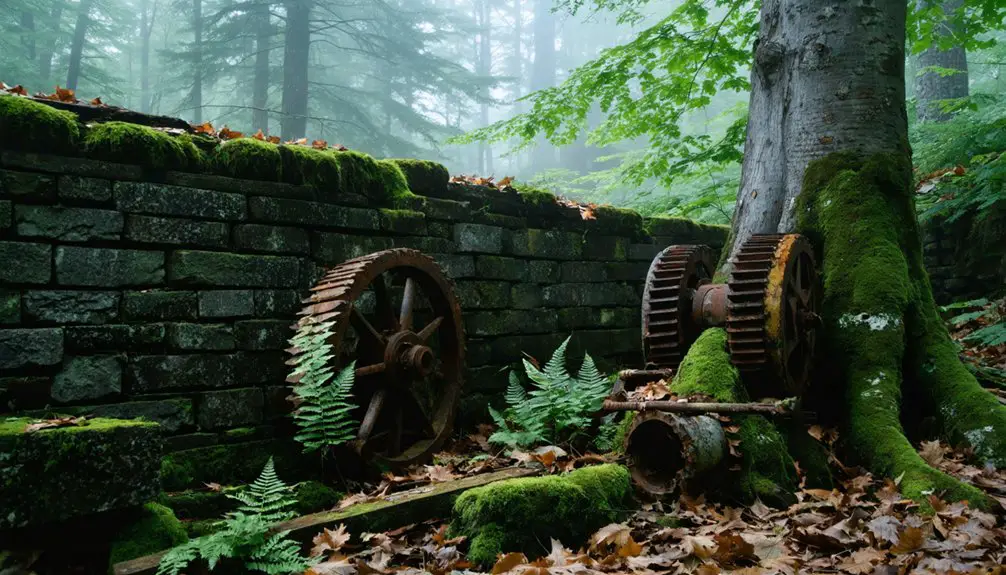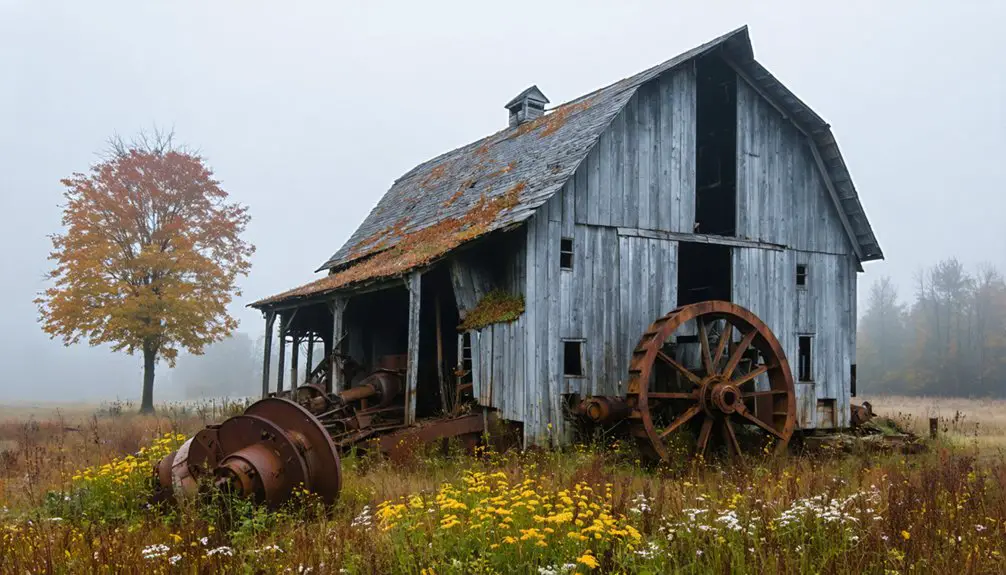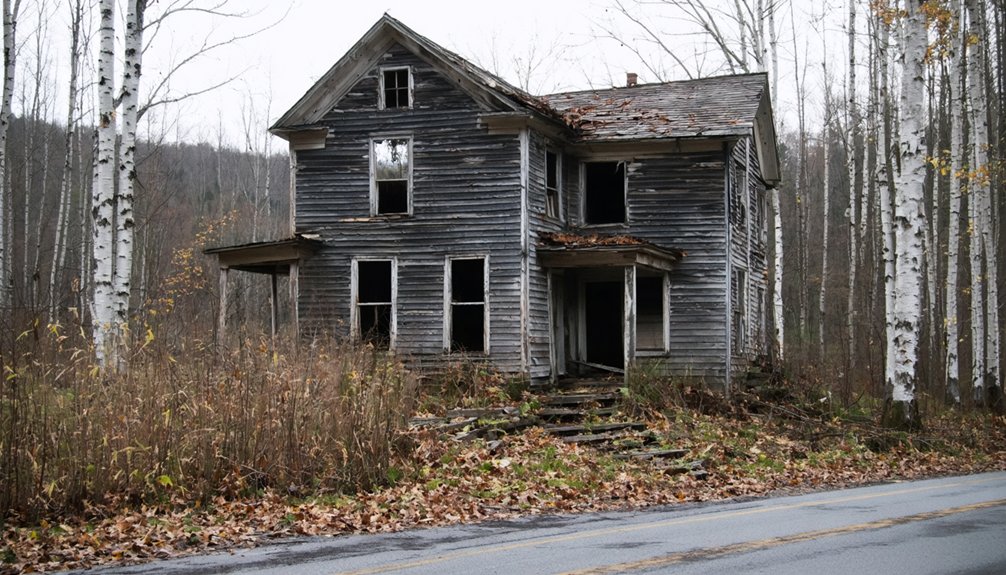
Planning a Vermont ghost town road trip means trading polished tourist spots for raw, unfiltered history. You’ll explore West Castleton’s toxic slate ruins, Copperfield’s riot-scarred copper remnants, and Glastenbury’s eerie mountain trails shrouded in disappearance folklore. Somerset’s submerged logging town emerges during low water, while Greenbank’s Hollow is nothing but a quiet field where 1,000 people once lived. Download offline maps before you go—cell service is scarce out here, and there’s far more to uncover ahead.
Key Takeaways
- West Castleton, founded in the 1850s, features 95% ruins from a collapsed slate industry, making it a must-visit stop.
- Glastenbury, abandoned by 1940, requires hiking the Long Trail with offline maps due to no roads or cell service.
- Somerset’s flooded logging town offers unique underwater ruins visible during low water levels, ideal for divers and history enthusiasts.
- Copperfield’s toxic copper mine ruins are remote with no cell service, so download offline maps before visiting.
- Greenbank’s Hollow, destroyed by fire in 1885, is now a quiet grassy field with preservation markers honoring its tragic past.
Why These Five Vermont Ghost Towns Belong on Your Map
Vermont’s ghost towns aren’t just abandoned places—they’re open-air museums where industrial ambition, natural disaster, and human drama left permanent marks on the landscape. Each site carries genuine cultural significance, telling stories that shaped Vermont’s identity.
You’ll walk through West Castleton’s slate-industry ruins, feel the weight of Copperfield’s toxic copper-mining legacy, and navigate Glastenbury’s eerie forested trails wrapped in unexplained folklore.
Somerset’s partially submerged structures draw divers into a flooded industrial past, while Greenbank’s Hollow’s grassy field quietly marks where fire erased an entire community overnight.
Historical preservation efforts protect these sites, ensuring future generations can experience Vermont’s raw, unfiltered history firsthand.
These aren’t tourist traps—they’re authentic windows into economic boom, collapse, and abandonment that you won’t find anywhere else.
West Castleton: Where the Slate Industry Died
When the global slate market collapsed in the early 20th century, West Castleton didn’t fade quietly—it crumbled fast. Founded during the 1850s quarry boom, the town once housed 1,200 residents at its industrial peak.
By 1920, foreign competition had gutted the slate industry, leaving buildings to decay into ruins.
Today, you’ll find 95% of those structures reduced to rubble, monitored by the EPA for toxic runoff. Yet historical preservation efforts keep West Castleton’s story alive and accessible.
It remains one of Vermont’s most compelling tourist attractions, drawing visitors eager to walk through a landscape frozen by economic collapse.
Bring sturdy boots and a camera. The ruins don’t sugarcoat history—they show you exactly what happens when an industry dies and a town follows.
Copperfield: The Copper Mine Town That Rioted and Vanished
From slate to copper—Vermont’s ghost towns share a common thread of industrial rise and brutal collapse. Copperfield tells that story through chaos and abandonment.
Founded in the late 1800s near the massive Ely copper mine, this town once housed 800 workers at its 1895 peak. Then the mine closed, riots erupted, and by 1910, Copperfield had vanished.
Today, you’ll find toxic ruins the EPA actively monitors for heavy metal contamination. Historical preservation efforts haven’t glamorized this site—it remains raw and unfiltered.
That honesty makes it one of Vermont’s most compelling tourist attractions for travelers who want real history, not a sanitized version. You’ll need offline maps since cell service doesn’t reach this remote area, so plan accordingly before you go.
Glastenbury: Vermont’s Most Mysterious Mountain Ghost Town
Glastenbury stands as Vermont’s eeriest ghost town, where a string of mysterious disappearances throughout the mid-20th century reduced a once-thriving logging community of 400 residents to a completely abandoned settlement by 1940.
Locals call the surrounding area the “Glastenbury Triangle,” a folklore-rich zone infamous for unexplained vanishings, Bigfoot sightings, and an unsettling atmosphere that draws curious visitors from across the region.
You’ll need to lace up your hiking boots to reach the site, as no roads lead to Glastenbury — only dense forest trails connect you to its haunting remains.
Glastenbury’s Mysterious Disappearances
Perhaps no Vermont ghost town carries a darker reputation than Glastenbury, a former logging settlement that didn’t just fade away — it vanished under deeply unsettling circumstances.
Between 1945 and 1950, six people disappeared on Glastenbury Mountain without explanation. Authorities never solved the cases, and locals began calling the area the “Glastenbury Triangle.” You’ll find the folklore compelling and genuinely chilling.
Wildlife conservation efforts now protect the dense forest surrounding the ruins, limiting access to foot traffic only. There are no roads in, so you’ll need solid navigation skills and offline maps.
Historical preservation markers document what little remains. Bigfoot sightings have been reported here too — whether you’re a skeptic or a believer, Glastenbury delivers an atmosphere unlike anywhere else on your road trip.
The Glastenbury Triangle Legend
The legend of the Glastenbury Triangle centers on a chilling cluster of disappearances between 1945 and 1950, when six people vanished on Glastenbury Mountain without a single convincing explanation. These historical legends have captivated researchers, hikers, and paranormal enthusiasts for decades.
The victims included hunters, hikers, and an elderly man — all disappearing under baffling circumstances with no recoverable remains. Local folklore tales suggest the mountain harbors something deeply unsettling, from mysterious vortexes to Bigfoot activity.
You’ll find that Bennington locals still speak about these events with genuine unease. The dense forest swallows sound strangely here, trails disorient experienced hikers, and the mountain’s remote terrain makes independent investigation genuinely risky.
If you’re visiting, bring a compass — cell service doesn’t reach this far.
Accessing The Abandoned Town
Reaching Glastenbury’s abandoned town requires serious commitment — there are no roads, no trailhead parking lots with pit toilets, and no ranger stations waiting to hand you a map. You’ll hike through dense forest on the Long Trail, covering roughly six miles one way before encountering any remnants of the former settlement.
Download offline maps before you leave civilization — cell service vanishes completely once you enter the mountain’s tree cover. Pack enough water, food, and emergency gear for a full day.
When you finally arrive, you’ll find scattered foundations and cellar holes, quiet testaments to historical preservation efforts that protect what little remains.
Local folklore warns that Glastenbury Mountain doesn’t release everyone who enters carelessly, so respect the terrain and plan your exit before darkness falls.
Somerset: The Logging Town Swallowed by Its Own Reservoir
As you wind through Vermont’s back roads, Somerset stands out as a ghost town with a twist — it didn’t just empty out, it sank.
In the 1950s, dam construction flooded 60% of the former logging settlement, displacing 1,500 workers and submerging the town’s bones beneath a hydroelectric reservoir.
During low water levels, you can spot ghostly structures lurking just below the surface, drawing history enthusiasts keen to glimpse Vermont’s drowned industrial past.
Somerset’s Logging Town Origins
How did a thriving logging town vanish beneath the waters of its own reservoir? Somerset’s story begins in the early 20th century, when the lumber industry drew roughly 1,500 workers into Vermont’s dense forests. You can almost picture the scene — sawmills humming, workers filling boardinghouses, and timber flowing steadily out of the wilderness.
Then everything changed. Somerset Dam’s construction created a hydroelectric reservoir that submerged nearly 60% of the town by the 1950s, displacing every resident almost overnight.
Today, historical preservation efforts recognize Somerset’s significance in Vermont’s industrial past, and tourism development has transformed this eerie site into a destination worth exploring.
During low water levels, you can actually spot underwater structures — a ghostly reminder that an entire community once stood exactly where you’re now standing.
Dam Construction Displaces Residents
When Somerset Dam’s construction began, it set in motion a displacement that would erase an entire community from Vermont’s map. Workers and families—1,500 strong—had built lives around the logging industry, only to watch engineers redesign their future without consent.
By the 1950s, rising reservoir waters swallowed 60% of Somerset’s structures, turning homes and businesses into submerged artifacts.
You’ll find this story compelling precisely because it challenges comfortable assumptions about progress.
Historical preservation efforts now protect what remains above water, and the site has become one of Vermont’s more unusual tourist attractions.
During low water levels, underwater structures become visible, drawing divers enthusiastic to explore what displacement created.
Somerset reminds you that infrastructure projects carry human costs that maps can never fully capture.
Underwater Ruins Attract Divers
What displacement created above ground, the reservoir preserves below it. During low water levels, you can see Somerset’s submerged foundations emerging from the depths — silent testimony to the town’s former life. Divers regularly explore these underwater ruins, maneuvering through ghostly structural remnants that historical preservation efforts have kept undisturbed.
The ecological impact here runs deep, literally. The reservoir fundamentally transformed Somerset’s original ecosystem, yet simultaneously created a unique underwater environment where history and nature now coexist.
You’ll want to bring proper diving equipment and check water levels before visiting, as visibility varies seasonally.
What makes this site compelling isn’t just the novelty — it’s the tangible connection to displaced workers whose entire community vanished beneath rising water. You’re practically swimming through living history.
Greenbank’s Hollow: One Night, One Fire, One Thousand People Gone
Imagine losing everything in a single night — your home, your livelihood, your entire community — reduced to ash before dawn. That’s exactly what happened in Greenbank’s Hollow in 1885. Fire swept through this thriving wool-manufacturing center overnight, displacing 1,000 residents and silencing 600 workers permanently.
You won’t find standing structures here — just a grassy field dotted with historical preservation markers telling the town’s tragic story. Urban legends surrounding the fire’s origin still circulate among local historians, adding mysterious depth to your visit.
No cell service reaches this remote location, so download offline navigation maps before you go. Standing on that quiet field, you’ll feel the weight of lives completely erased between sunset and sunrise — freedom and prosperity extinguished before anyone could react.
Frequently Asked Questions
Is Pearl, Vermont a Real Ghost Town You Can Visit?
Pearl, Vermont doesn’t exist! You won’t find it in any historical preservation records or local legends. It’s a phantom destination with zero official documentation — so redirect your freedom-seeking adventure toward Vermont’s real ghost towns!
How Many Ghost Towns Are Included in This Vermont Road Trip?
You’ll explore five real ghost towns rich in historical preservation and local legends — West Castleton, Copperfield, Glastenbury, Somerset, and Greenbank’s Hollow — since Pearl, Vermont doesn’t actually exist as a verified location.
Which Vermont Ghost Towns Require Offline Maps Due to No Cell Service?
Ready to roam free? You’ll need offline maps for Copperfield and Greenbank’s Hollow — both lack cell service. For historical preservation and tourist accessibility, download your maps before venturing into these remote, unforgettable ghost towns!
Are Any of These Vermont Ghost Towns Monitored by the EPA?
Yes, you’ll find two ghost towns under EPA monitoring for environmental concerns: West Castleton’s toxic runoff and Copperfield’s heavy metal contamination. Both balance historic preservation with safety oversight, so plan accordingly before exploring these fascinating industrial ruins.
Which Ghost Towns on This Route Are Accessible Only by Foot?
Deep in tangled forest shadows, you’ll trek to Glastenbury alone — abandoned structures and historical landmarks swallowed by wilderness. It’s the only foot-access-only ghost town on your route, where eerie legends and Bigfoot folklore await your discovery.
References
- https://en.wikipedia.org/wiki/List_of_ghost_towns_in_Vermont
- https://www.youtube.com/watch?v=2fvPo9iQC-w
- https://en.wikipedia.org/wiki/Category:Ghost_towns_in_Vermont
- https://www.tripadvisor.com/Attractions-g28966-Activities-c47-t14-Vermont.html
- https://ghost-towns.close-to-me.com/states/vermont/
- https://newenglandhistoricalsociety.com/six-new-england-ghost-towns/
- https://www.youtube.com/watch?v=Mf7cQUCM3hI
- https://www.reddit.com/r/vermont/comments/1rflulu/looking_for_a_ghost_town_or_abandoned_factories/
- https://urbexunderground.com/ghost-towns-in-vermont/
- https://newenglandwithlove.com/ghost-towns-in-vermont/