Planning a ghost town road trip to Possum Trot, Missouri, starts with heading southwest from Nixa about 5.5 miles along Missouri Route M into Stone County’s Ozark hill country. You’ll wind through quiet rural terrain until civilization thins and the old Fairview School and a solitary house come into view. There’s no signage, no tourist traps—just authentic history waiting to be discovered. Stick around, and you’ll uncover the fascinating stories, legends, and characters that made this little community unforgettable.
Key Takeaways
- Possum Trot is located in northeastern Stone County, Missouri, approximately 5.5 miles southwest of Nixa along Missouri Route M.
- The rural drive offers scenic Ozark scenery with minimal signage, so arrive with prior knowledge of the route.
- Key remnants include the Fairview School, a preserved one-room schoolhouse locally called Possum Trot School, teaching grades 1–8.
- No tourist markers, commercial structures, or active community buildings remain, making this an authentic, unpolished historical destination.
- The site’s history includes the Wilson family’s general store and a famous folklore claim connecting Kansas City to the Possum Trot name.
What Is Possum Trot, Missouri?
Tucked away in the hill country of northeastern Stone County, Missouri, Possum Trot is a ghost town that’s seen better days — though “days” might be generous. You’ll find the site roughly 5.5 miles southwest of Nixa along Missouri Route M.
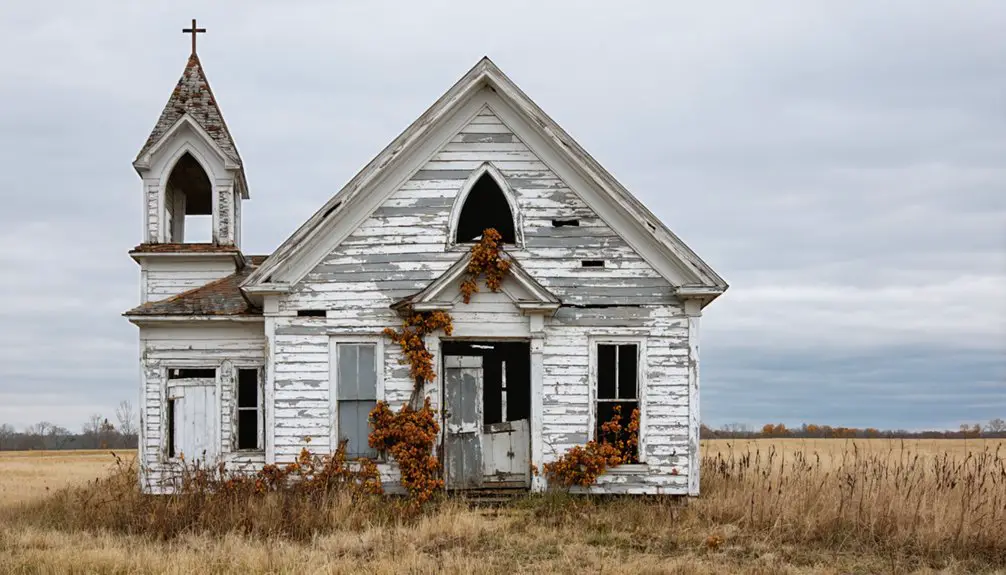
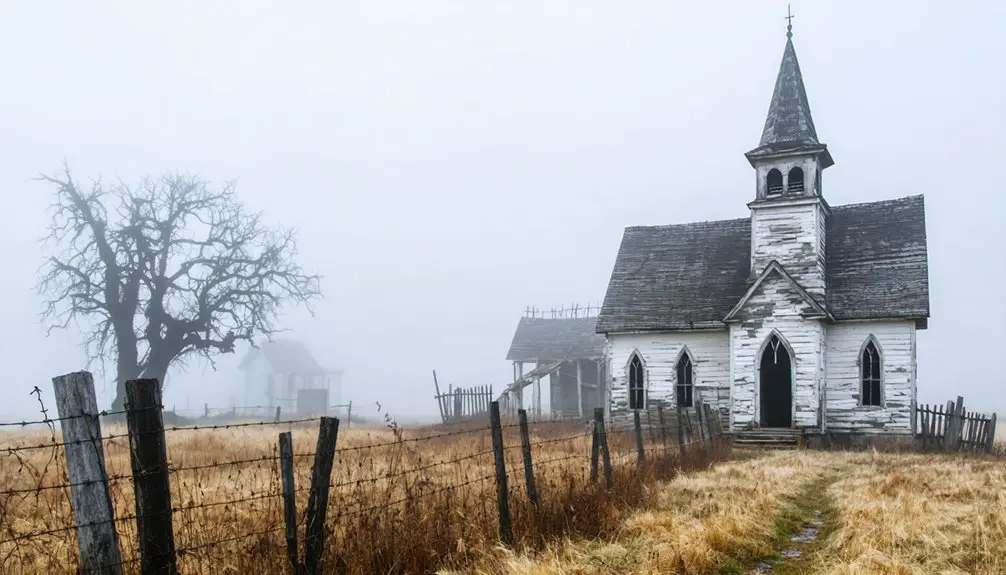
Where what little historical architecture remains consists of a crumbling one-room schoolhouse and a single house. Locals called that school Possum Trot School, though its official name was Fairview. It once taught grades 1 through 8.
What little remains stands as a crumbling schoolhouse — once called Fairview, once full of children.
The town also carries its share of local legends — including a dubious rumor that Kansas City nearly took the Possum Trot name by a single vote. Historical records debunk that story entirely.
What you’re left with is a quiet, forgotten community that once buzzed with commerce and now stands nearly silent.
How Possum Trot Became a Ghost Town
Like many small Missouri towns, Possum Trot didn’t collapse overnight — it faded. Residents drifted away gradually, chasing opportunity elsewhere as commerce dried up and new roads bypassed the community entirely. That’s the quiet death most ghost towns share — not a dramatic event, but a slow exhale.
What’s left of the historical architecture tells that story honestly. You’ll find the ruins of Fairview School and a single house standing against the hill country landscape — nothing more.
Local legends add color, including a wild rumor that Kansas City nearly carried the Possum Trot name by one vote, though records suggest the name barely registered.
When you visit, you’re not just seeing an abandoned place — you’re reading the uncensored history of a community that simply let go.
The Wilson Family and the General Store at the Heart of Town
When you picture small-town Missouri life in the early 20th century, a general store sits at the center of it all — and Possum Trot was no different.
You’ll find that the Wilson family, descendants of Jackson B. and Emma Stewart Wilson, kept the community supplied through their store, with brothers William Jasper and John Washington Wilson managing daily operations.
Over time, though, as residents drifted away, the commercial activity that once gave the town its heartbeat quietly faded with them.
Wilson Family Store Origins
How did a small Missouri ghost town sustain itself in its heyday? Like many rural communities, Possum Trot built its foundation around a central gathering place rooted in local folklore and historical architecture — the general store.
The Wilson family store stood as the town’s commercial lifeline, managed by descendants of Jackson B. and Emma Stewart Wilson. Here’s what you should know:
- William Jasper Wilson co-managed the store alongside his brother
- John Washington Wilson shared operational responsibilities
- The store operated during the early 20th century
- Essential goods kept the community self-sufficient and connected
You’re looking at a family-driven enterprise that gave Possum Trot real economic identity. Without it, residents would’ve struggled to access necessities without traveling considerable distances across Stone County’s rugged hill country.
Brothers Managing Daily Operations
Running a general store in early 20th-century rural Missouri wasn’t a one-man job, and William Jasper Wilson and his brother John Washington Wilson knew it. Together, they kept Possum Trot‘s commercial heart beating, stocking essential goods and serving neighbors scattered across Stone County’s rugged hills.
You’d find the store standing as more than a retail space — it was a gathering point where local legends were born and historical misconceptions spread freely between customers. The brothers, descendants of Jackson B. and Emma Stewart Wilson, managed daily operations with the kind of practical grit that defined rural independence.
Their efforts sustained a community that might otherwise have faded faster. Without their work, Possum Trot’s story would be considerably shorter — and far less worth your road trip today.
Decline Of Commercial Activity
Even the most determined effort can’t hold back the tide of economic change. The Wilson family’s general store eventually succumbed to the same forces that emptied countless rural communities. Local legends romanticize the store’s role, but historical misconceptions often overshadow the straightforward truth: population decline kills commerce.
Here’s what drove Possum Trot’s commercial collapse:
- Residents relocated to areas with stronger economic opportunities
- New roads bypassed the community, redirecting traffic and customers
- Population loss eliminated the customer base sustaining the store
- Rural consolidation pulled small-town commerce toward larger nearby centers
You’re visiting a place where free-spirited independence once thrived, then quietly faded. The Wilson brothers’ enterprise didn’t fail through mismanagement — the community simply dissolved around it.
The Legend That Almost Named Kansas City “Possum Trot”
Before you pack up and hit the road, you’ll want to hear the quirky legend that connects this tiny ghost town to one of Missouri’s biggest cities. A rumor claims that Kansas City nearly carried the name “Possum Trot” by a single vote, but historical records reveal that Squire Bowers proposed the name only to have it met with silent contempt by the voting group.
Kansas City escaped that fate by the skin of its teeth, making this footnote one of the more colorful stories you can share with fellow travelers on your ghost town road trip.
The Possum Trot Vote
One of the more entertaining legends surrounding Possum Trot is the claim that Kansas City nearly carried the same peculiar name — missing it by just a single vote.
Historical myths like this one stick around, but the real story differs markedly from town preservation lore.
Here’s what the historical record actually shows:
- Squire Bowers proposed “Possum Trot,” not the often-cited One-Eyed Ellis.
- Settlers met the suggestion with silent contempt, not serious debate.
- Kansas City won “by the skin of its teeth,” not a single dramatic vote.
- The name was never genuinely considered a strong contender.
You can appreciate this legend as colorful folklore, but don’t let it overshadow the factual history waiting for you at the actual Possum Trot site.
Squire Bowers’ Proposal
Behind the legend itself stands a specific moment worth examining — Squire Bowers stood up, proposed “Possum Trot” as the name for what would become Kansas City, and was met with something perhaps worse than outright rejection: silence.
The room treated the suggestion with quiet contempt, and the town naming process moved forward without serious debate.
Historical myths often distort these moments, turning silent dismissal into dramatic single-vote showdowns. The record tells a different story.
“Kansas City” won, but not by one vote — it scraped through by the skin of its teeth.
You’ll find that peeling back these historical myths reveals something more human and less cinematic.
Bowers proposed, the crowd ignored him, and history moved on.
That’s the unvarnished truth behind the legend.
Kansas City’s Narrow Escape
What nearly became of Kansas City? Local legends surrounding Possum Trot include a fascinating rumor tied to historical landmarks you mightn’t expect.
The story claims Kansas City was nearly named “Possum Trot” by a single vote. Here’s what the historical record actually reveals:
- Squire Bowers proposed “Possum Trot” during the naming vote.
- The group met the suggestion with silent contempt.
- “Kansas City” won by the “skin of its teeth,” not one vote.
- The name “Possum Trot” was never seriously entertained.
What’s Left to See at the Possum Trot Site Today?
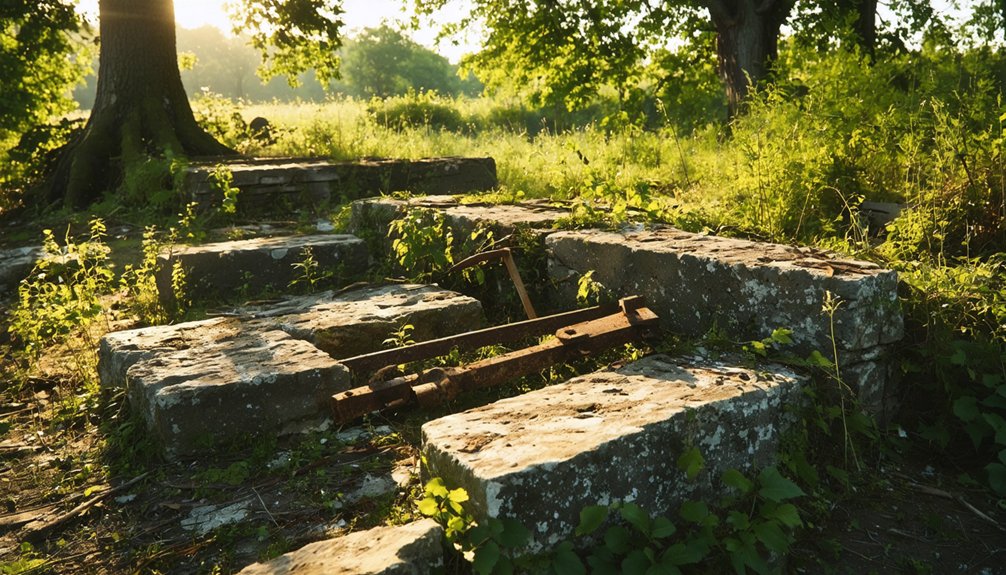
If you’re hoping to find a bustling array of historic buildings at Possum Trot, you’ll need to temper your expectations. The site offers very little regarding historical architecture — only the remains of the Fairview school and a single house survive today.
That one-room schoolhouse, which taught grades 1 through 8, carries its own local legends, as residents always called it Possum Trot School rather than its official name. It’s a quiet, stripped-down glimpse into rural Missouri life.
No commercial structures remain, and the general store once operated by the Wilson family has long since vanished.
If you’re driving Missouri Route M southwest of Nixa, treat this stop as a reflective pause rather than a destination packed with visual rewards.
The Fairview School: Possum Trot’s Last Standing Structure
Among the sparse remains at Possum Trot, the Fairview School stands as the site’s most significant surviving relic. This one-room historical architecture taught grades 1 through 8, and locals simply called it Possum Trot School.
When you visit, you’ll connect directly with the community’s educational roots and local legends surrounding this quiet corner of Stone County.
Here’s what makes Fairview worth your stop:
- Single-room design — a rare, preserved example of rural Missouri schoolhouse architecture
- Grade range — it educated students from grades 1 through 8 simultaneously
- Dual identity — officially “Fairview,” but universally known as Possum Trot School
- Survivor status — it’s one of only two structures still standing at the site
Don’t miss your chance to walk this living piece of Missouri history.
How to Reach Possum Trot on Missouri Route M
Start your journey in Nixa, Missouri, where you’ll head southwest along Missouri Route M for approximately 5.5 miles through the rolling hill country of Stone County.
The route cuts through rural terrain, so keep your eyes open for subtle landmarks as you navigate toward the site.
Once you’ve arrived, you’ll find very little fanfare — just the quiet remains of the Fairview School and a solitary house marking what was once a living, breathing community.
Starting Point From Nixa
Nixa serves as your launching pad for reaching Possum Trot, sitting just 5.5 miles northeast of the ghost town along Missouri Route M. Before heading southwest, fuel up on local cuisine at one of Nixa‘s restaurants — you’ll want energy for exploring rural Stone County’s hill country.
Here’s your simple departure plan:
- Start in downtown Nixa and locate Missouri Route M heading southwest.
- Drive approximately 5.5 miles through rolling Ozark terrain, watching for wildlife encounters along the rural corridor.
- Watch for minimal signage — ghost towns rarely announce themselves proudly.
- Look for the Fairview school ruins and a single house marking the site.
The drive itself rewards you with genuine Ozark scenery before you even arrive.
Missouri Route M is your main artery to Possum Trot, cutting southwest through Stone County’s rugged Ozark hill country. You’ll travel approximately 5.5 miles from Nixa, following a rural corridor that feels increasingly removed from modern life.
The road winds through landscapes steeped in local folklore, where stories of early settlers and vanished communities linger around every bend.
Keep your eyes open for subtle shifts in the terrain as you approach the site. Historic landmarks are sparse here — that’s precisely the point.
What remains are the ruins of Fairview School and a solitary house, standing as quiet monuments to a forgotten era.
Route M delivers you directly into that silence, rewarding travelers who crave authentic, unfiltered history over polished tourist attractions.
Arriving At The Site
Once you’ve set your course for Stone County, getting to Possum Trot is straightforward: take Missouri Route M approximately 5.5 miles southwest of Nixa, deep into the Ozark hill country. You’ll know you’ve arrived when civilization thins and the rural quiet takes over.
Watch for:
- Fairview School ruins – the one-room schoolhouse locals called Possum Trot School
- A single surviving house – the only standing structure remaining
- Historical inaccuracies posted online – urban legends falsely link this name to Kansas City’s founding vote
- Minimal signage – don’t expect markers; this is genuine backcountry exploration
Bring your own context, because the land won’t explain itself. Freedom-seekers appreciate exactly that raw, unfiltered authenticity Possum Trot quietly offers.
Why Possum Trot Rewards History Buffs More Than Sightseers
While Possum Trot offers little for the casual sightseer, it’s a fascinating stop for anyone drawn to the quieter corners of American history. You won’t find museums or markers here, but the historical significance of this forgotten settlement runs deeper than its crumbling remains suggest.
The Fairview school, once called Possum Trot School, quietly represents an entire community’s legacy — families who built lives, ran general stores, and educated their children in a single room through eight grades.
The Wilson family’s commercial enterprise tells a broader story of rural self-sufficiency that defined countless small Missouri towns.
If you’re someone who reads landscapes and finds meaning in absence, Possum Trot speaks volumes. It rewards curiosity, patience, and a genuine appreciation for community legacy over spectacle.
Ghost Towns Near Possum Trot Worth the Detour
If Possum Trot has sparked your appetite for Missouri’s forgotten places, the surrounding region won’t disappoint. You’ll find nearby ghost towns that offer their own blend of historical architecture and local folklore worth exploring:
- Jolly (Jollification) – A faded settlement carrying an ironic name and remnants of a livelier past.
- Monark Springs – Once a resort destination, now a quiet ruin echoing former ambitions.
- Self – A historically connected community that shares roots with Possum Trot itself.
- Additional stops on Missouri’s 15 dying towns list – Each site adds another layer to your understanding of rural abandonment.
Pack your map, hit Missouri Route M, and let these forgotten corners tell their stories on your own terms.
How to Build a Missouri Ghost Town Road Trip Around Possum Trot
Building a Missouri ghost town road trip around Possum Trot is simpler than you’d think—Missouri Route M gives you a natural spine for the journey, connecting this Stone County relic to a cluster of nearby abandoned settlements within a compact stretch of South Central Missouri’s hill country.
Start at Possum Trot, where the Fairview School’s historical architecture tells a quiet story of rural education. Then push outward toward Jolly and Monark Springs, two nearby ghost towns that round out the experience.
As you drive, you’ll encounter local legends woven into the landscape—like the rumor that Kansas City nearly carried the Possum Trot name. Pack light, keep your map handy, and treat the open road as your guide through fifteen dying Missouri towns worth discovering on your own terms.
Frequently Asked Questions
Is There an Admission Fee or Permit Required to Visit Possum Trot?
You don’t need an entry fee or visitor permit to explore Possum Trot! It’s a rural ghost town freely accessible via Missouri Route M, so you can roam its historic remnants with complete freedom.
Are Pets Allowed When Visiting the Possum Trot Ghost Town Site?
No official pet policies or animal restrictions are documented for Possum Trot’s rural, open site. You’re free to bring your furry companion, but keep them leashed and respectful of this historically significant ghost town.
What Is the Best Time of Year to Visit Possum Trot?
Spring and fall are your sweet spots for visiting this historical landmark. You’ll dodge summer’s brutal heat and enjoy comfortable temperatures, though visitor amenities are minimal, so pack everything you need for your freewheeling adventure.
Is the Possum Trot Site on Public or Private Property?
The knowledge doesn’t confirm whether it’s public or private property, so you’ll want to verify before visiting. Respecting boundaries supports historical preservation and protects the wildlife habitat that’s naturally reclaimed this fascinating, freedom-worthy ghost town destination.
Are There Any Accommodations or Camping Options Near Possum Trot?
The knowledge doesn’t detail specific camping options or nearby accommodations, but you’ll find Stone County’s rural landscape invites exploration! Check local listings near Nixa for lodging, and you’re sure to discover nearby accommodations that fuel your adventurous spirit!
References
- https://en.wikipedia.org/wiki/Possum_Trot
- https://kids.kiddle.co/Possum_Trot
- https://www.youtube.com/watch?v=wiF41PIwD74
- https://www.kcur.org/arts-life/2021-01-30/rumor-has-it-that-kansas-city-was-nearly-named-possum-trot-is-that-true
- https://www.youtube.com/watch?v=ME_UUyjSs0o
- https://www.youtube.com/watch?v=86-oCNoayss
- https://en.wikipedia.org/wiki/List_of_ghost_towns_in_Missouri
- https://kclibrary.org/news/2020-02/kc-q-possum-trot