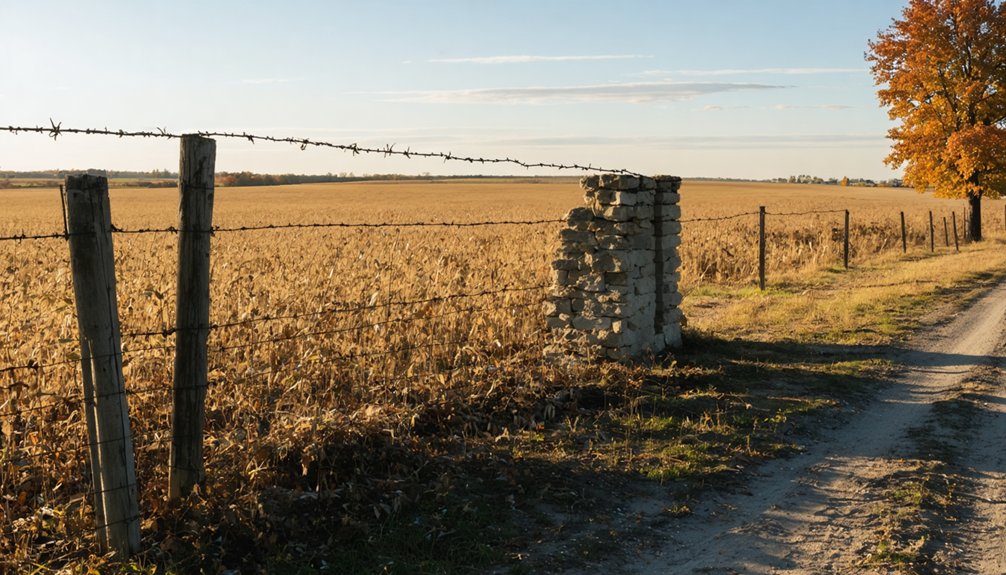
Planning a ghost town road trip to Sugarville, Illinois means heading deep into Fulton County, where a once-thriving coal mining community has vanished beneath farmland near Put Creek. You’ll want to use U.S. Route 24 and Illinois Route 78 to navigate the countryside. Moore Cemetery is your only real landmark — it’s where Sugarville’s memory survives. Check road conditions before you go, since access roads get muddy. There’s far more to this forgotten town’s story than you’d expect.
Key Takeaways
- Moore Cemetery, listed in GNIS, serves as the primary landmark and entry point for visiting the ghost town of Sugarville, Illinois.
- Use U.S. Route 24 and Illinois Route 78 to efficiently navigate the Fulton County countryside toward Sugarville’s rural location.
- Check weather before visiting, as roads near Put Creek in Joshua Township can become muddy and difficult to navigate.
- Respect private farmland boundaries, as Sugarville’s former town site is privately owned with no public signage marking the area.
- Combine your visit with nearby Canton, Lewistown, or the Spoon River Scenic Byway for a fuller regional ghost town experience.
What Was Sugarville, Illinois?
Once a thriving coal mining community tucked near Put Creek in Joshua Township, Fulton County, Illinois, Sugarville wasn’t always the empty stretch of fields it’s today. At its peak, you’d have found bustling streets lined with houses, a blacksmith shop, a general store, and a mill serving close-knit residents.
The Southern Gem Coal Company drove the local economy, employing hundreds and producing over 400,000 tons of coal annually by the 1920s.
Urban decay claimed Sugarville swiftly once mining jobs vanished in the late 1800s. Residents packed up and moved to larger towns, leaving the settlement to fade into farmland by the early 1900s.
Today, historical preservation efforts are virtually nonexistent here, leaving only Moore Cemetery to mark that this community ever existed.
Sugarville’s Coal Mining Boom in the Late 1800s
The coal boom that built Sugarville didn’t happen by accident. When the Southern Gem Coal Company arrived, it transformed a quiet rural settlement near Put Creek into a productive industrial hub.
Mechanized mining equipment replaced manual labor, dramatically increasing output and pulling hundreds of workers into the area.
When machines replaced men, the output soared — and Sugarville’s population grew to match it.
The town infrastructure expanded quickly to support them. Houses, a blacksmith shop, a general store, and a mill all rose from the ground to meet daily needs.
By the 1920s, Sugarville was producing over 400,000 tons of coal annually — a staggering figure for a small Illinois community.
You can picture it clearly: smoke rising, equipment running, and an entire town built on the promise that the coal beneath the soil would never run out.
How the Southern Gem Coal Company Built and Buried the Town
When you look into Sugarville’s history, you’ll find the Southern Gem Coal Company sitting at the center of everything the town became. The company mechanized local mining operations, employed hundreds of workers, and pushed annual coal production past 400,000 tons by the 1920s — fundamentally willing the community into existence.
But that same singular dependence on coal made Sugarville fragile, and once the mines dried up, the town had nothing left to hold its people in place.
Southern Gem’s Rise
Sugarville’s story is truly the Southern Gem Coal Company’s story. When Southern Gem arrived, it didn’t just extract coal — it built an entire world around mining technology that transformed raw Illinois land into a functioning community.
You’d have walked streets lined with workers’ houses, stopped into a general store, handed your tools to a blacksmith, and grabbed supplies milled right near Put Creek. That’s the town infrastructure Southern Gem created to keep hundreds of employees productive and rooted.
The company’s mechanization efforts pushed production to staggering heights, eventually exceeding 400,000 tons of coal annually by the 1920s.
Southern Gem fundamentally owned Sugarville’s identity. Every business, every household, every decision tied back to that one company — which made the town incredibly powerful during its peak, and devastatingly fragile beneath the surface.
Mining’s Inevitable Collapse
What Southern Gem built with remarkable speed, it dismantled just as efficiently — not through recklessness, but through the cold logic of resource exhaustion.
When the coal seams thinned, industrial decline followed without mercy. Jobs vanished, wages stopped, and families packed whatever they could carry. You’d have witnessed an economic collapse playing out in real time — storefronts emptying, the blacksmith’s hammer going silent, the mill grinding its last grain.
Southern Gem didn’t destroy Sugarville out of malice; it simply moved on when the earth stopped producing. By the early 1900s, the town existed in name only.
The people who’d built their lives around those mines scattered to larger towns, leaving nothing behind but memory, a quiet creek, and the dead in Moore Cemetery.
Why Did Sugarville Become a Ghost Town?
Once a thriving coal mining hub, Sugarville collapsed when its most vital resource ran dry. The Southern Gem Coal Company had kept hundreds of workers employed, but once the coal disappeared, so did every reason to stay.
You can almost picture it — families packing wagons, the general store going dark, the blacksmith’s hammer falling silent for the last time.
Without jobs, residents drifted toward larger towns, leaving behind historical architecture that eventually crumbled into nothing. Local legends suggest the community fought hard to survive, but economic reality proved unbeatable.
By the early 1900s, Sugarville had become a ghost town, swallowed by time and farmland.
Today, you’ll find empty fields where those streets once buzzed with life — nature reclaiming what industry abandoned.
How to Find Sugarville in Fulton County

Finding Sugarville isn’t like punching an address into your GPS and rolling up to a historic site — it takes a little detective work. The Geographic Names Information System lists Sugarville only as an alias for Moore Cemetery, so that’s your anchor point.
Sugarville won’t appear on your GPS — your only anchor is Moore Cemetery, listed in GNIS as its sole alias.
Head into Joshua Township in Fulton County and navigate toward Put Creek, where local flora has long reclaimed what was once a working coal town. You’ll encounter rolling fields and natural growth where hundreds once lived.
Check regional weather before you go — rural Illinois roads can turn muddy and impassable after heavy rain.
Moore Cemetery remains the one identifiable landmark on otherwise private farmland, so respect property boundaries, park responsibly along public roadways, and use the cemetery as your orienting reference point.
What’s Actually Left to See at Sugarville Today?
Sugarville doesn’t offer much for the eyes, but what little remains carries real historical weight. Moore Cemetery stands as the sole surviving landmark, while local flora has reclaimed the landscape entirely. Wildlife diversity thrives where miners once worked, giving the site an eerie, untamed beauty.
Here’s what you’ll actually encounter:
- Moore Cemetery – the only documented remnant of Sugarville’s existence
- Put Creek – still winding through the rural terrain as it did during the town’s peak
- Overgrown fields – where local flora has swallowed former homesteads and structures
- Wildlife diversity – birds, deer, and native species inhabit the abandoned grounds
- Privately owned farmland – restricting public access but preserving the site’s raw authenticity
Bring your curiosity, but don’t expect signage or restored structures.
Moore Cemetery: Sugarville’s Only Remaining Landmark

Among the sparse remnants of Sugarville’s past, Moore Cemetery stands as the town’s only documented landmark. When you visit, you’ll find it listed by the Geographic Names Information System as an alias for the former settlement itself — a telling sign of how completely the town has vanished.
Cemetery preservation efforts make this site meaningful for history enthusiasts like you. It’s where Sugarville’s coal miners and their families rest, connecting you directly to the community that once thrived here. Unlike historical artifacts buried beneath privately owned farmland, the cemetery offers you a tangible, accessible link to the town’s peak years.
As you walk among the headstones, you’re standing in Sugarville’s last surviving chapter — a quiet, powerful reminder of the hundreds who built their lives around Put Creek’s coal-rich landscape.
Is Sugarville Haunted? What Visitors Have Reported
Beyond the quiet rows of headstones, Moore Cemetery carries a reputation that goes beyond its historical significance — visitors have reported unsettling experiences that suggest Sugarville’s past isn’t entirely at rest.
Local legends tie these encounters to the miners and families who once built their lives here. If you visit, you might experience:
- Phantom touches on your arms or shoulders near older grave markers
- Unexplained tingles that move across your skin without any wind present
- A heavy, watchful feeling despite standing completely alone
- Whispered sounds that don’t match surrounding environmental noise
- Sudden cold spots unconnected to weather conditions
No historical artifacts remain above ground to explain these reports, but something about this forgotten landscape feels undeniably alive.
Trust your instincts while you’re there.
Other Abandoned Towns Worth Visiting Near Fulton County

Fulton County sits within a stretch of Illinois that once hummed with industrial ambition, and if Sugarville’s quiet fields left you hungry for more, several other abandoned settlements reward the curious traveler. Nearby communities like Liverpool and Ipava offer remnants of historical architecture that survived the region’s economic collapses, giving you tangible connections to lives once lived.
Liverpool’s riverfront decay tells stories of faded commerce, while smaller crossroads towns scattered across the county carry local legends that locals still whisper about today. You’ll find crumbling foundations, overgrown lots, and the occasional weathered structure that photography enthusiasts genuinely appreciate.
Pack a detailed county map, respect private property boundaries, and let each stop build on the last. The region rewards those willing to look closely.
How to Plan a Fulton County Ghost Town Day Trip
When you’re ready to hit the road, pairing Sugarville with nearby Canton or Lewistown makes for a well-rounded Fulton County day trip.
Since both towns offer historical context that enriches the ghost town experience, you’ll want to include them in your plans.
You’ll want to approach the area via U.S. Route 24, which connects smoothly to local county roads and puts you within easy reach of the Put Creek vicinity.
Mapping your stops in advance saves time, especially since Sugarville’s site sits on private land and requires you to adjust expectations around what you can actually access.
Nearby Towns Worth Visiting
Since Sugarville itself offers little more than an overgrown field and a cemetery, you’ll want to map out a few nearby Fulton County stops to make the drive worthwhile.
The region rewards curious travelers who appreciate local folklore and historical preservation with genuine character around every bend.
Consider adding these stops to your route:
- Lewistown – Fulton County’s seat, offering historic architecture and the Dickson Mounds Museum
- Canton – A small city with antique shops and preserved downtown buildings
- Spoon River – Follow the scenic byway tracing Edgar Lee Masters’ poetic legacy
- Cuba, Illinois – A quiet town with deep rural roots and local charm
- Banner – A small community near the Illinois River bottomlands worth a quick detour
Best Routes To Take
Once you’ve mapped out your nearby stops, stringing them together into a logical route makes the difference between a satisfying day trip and an exhausting one. Start in Lewistown, Fulton County’s seat, where local legends and historical artifacts give you solid context before you head into the rural landscape.
From there, drive southwest toward Canton for fuel and supplies, then cut through the countryside toward Joshua Township. Keep Illinois Route 78 as your backbone — it connects rural communities efficiently without trapping you on gravel detours.
Arrive at Moore Cemetery mid-morning when light favors exploration. You’ll want unhurried time to absorb what little remains.
Plan your return loop through Havana along the Illinois River for a scenic, rewarding finish to your Fulton County ghost town adventure.
Frequently Asked Questions
Can Visitors Legally Access the Sugarville Site Without Permission?
You can’t legally access Sugarville without permission, as it’s private property. Respect boundaries and seek legal access by contacting landowners directly — true freedom means honoring others’ rights while exploring history responsibly.
Are There Any Guided Tours Available for Sugarville Ghost Town?
You won’t find any guided tours at Sugarville. It’s privately owned farmland, so you’ll face limited photography opportunities and no organized access to historical artifacts. Your best bet’s visiting Moore Cemetery independently.
What Is the Best Time of Year to Visit Sugarville?
Fall’s golden curtain frames Sugarville’s haunting emptiness perfectly. You’ll find seasonal weather mild and visitor crowds minimal in September and October, letting you freely explore Moore Cemetery’s quiet solitude without summer’s heat or winter’s chill.
Is Put Creek Visible or Accessible During a Sugarville Visit?
You’ll spot Put Creek meandering through the landscape, but don’t expect hidden trails or abandoned buildings guiding your way — it’s surrounded by private farmland, so you’re viewing this historic waterway strictly from a respectful distance.
Are Metal Detectors Allowed on Private Farmland Near Sugarville?
Like a locked gate symbolizing barriers to exploration, farmland restrictions block your metal detecting dreams near Sugarville. Metal detecting policies require landowner permission, so you’ll need to secure private consent before uncovering any buried mining relics.
References
- https://en.wikipedia.org/wiki/Sugarville
- https://kids.kiddle.co/List_of_ghost_towns_in_Illinois
- https://illinoisstateonline.com/ghost-towns-in-illinois/