Michigan’s mining ghost towns offer you a vivid window into the state’s industrial past. Copper discoveries on the Keweenaw Peninsula in 1840 sparked America’s first mineral rush, spawning nearly 100 boomtowns that collapsed once ore veins dried up. Sites like Central Mine, Fayette, and Old Victoria preserve original structures you can still walk through today. Iron mining towns tell an equally dramatic story of sudden abandonment. There’s far more to uncover about these fascinating destinations.
Key Takeaways
- Michigan’s copper boom, discovered in 1840, spawned nearly 100 mining towns, most of which collapsed when ore veins dried up or markets shifted.
- Fayette Historic State Park preserves blast furnaces, a company store, and hotel ruins from an iron-smelting town abandoned in 1891.
- Central Mine closed in 1898, dropping its population from 1,300 to 100, with three original homes still open for free daily visits.
- Old Victoria features four log cabins with period furnishings, offering guided interior tours and open grounds accessible anytime.
- Underground mining caused land subsidence in some towns, while others like Gibbs City were deliberately burned, leaving little trace behind.
Michigan’s Copper Boom and the Ghost Towns It Left Behind
When Douglass Houghton discovered copper on Michigan’s Keweenaw Peninsula in 1840, he triggered America’s first mineral rush, drawing a wave of global immigrants who transformed a remote wilderness into a thriving industrial corridor.
Mining techniques evolved rapidly as operations scaled, producing nearly 100 towns across the Keweenaw landscape. You can still trace their footprints today through town architecture that once housed hotels, saloons, churches, and general stores built to sustain thousands of workers.
Nearly 100 towns once thrived here — their architectural bones still visible across the Keweenaw wilderness today.
Cities like Calumet, Hancock, and Central Mine flourished under copper’s promise, yet most collapsed just as quickly when ore veins dried up or markets shifted.
What remains isn’t failure — it’s evidence of a free-market boom cycle playing out in real time, preserved across one of America’s most isolated wilderness regions.
Ghost Towns on the Keweenaw Peninsula Worth Visiting
If you’re exploring the Keweenaw Peninsula’s ghost towns, three sites stand out as essential stops: Quincy Mine, Central Mine, and Old Victoria.
Quincy Mine, now designated as a national park, preserves most of its original buildings, giving you an unfiltered look at large-scale copper extraction infrastructure.
At Central Mine, you can tour three restored homes for free through mid-October.
While Old Victoria’s four furnished log cabins offer guided inside tours—revealing how miners actually lived during the copper boom era.
Quincy Mine National Park
One of the most historically significant ghost towns on the Keweenaw Peninsula, Quincy Mine has earned its place as a nationally recognized site, now preserved as part of a national park. You’ll find most of the original buildings still standing, offering a rare, unfiltered look at 19th-century mining technology that once drove America’s copper industry forward.
As you explore the grounds, local legends surrounding the miners who built their lives here add a human dimension to the structural remains.
The national park designation guarantees these structures won’t disappear, protecting your ability to experience this history firsthand. Quincy Mine doesn’t just preserve buildings — it preserves the economic and cultural forces that shaped an entire region, making it an essential stop for anyone serious about understanding Michigan’s mining heritage.
Central Mine Historic Village
Few ghost towns in Michigan match the raw historical weight of Central Mine, a copper settlement that opened in 1854, produced nearly 52 million pounds of copper, and closed in 1898 after 44 years of extraction. At its peak in 1887, the population reached 1,300 residents. Today, only two remain.
What makes Central Mine worth your time is its active restoration efforts. The Keweenaw County Historical Society continues rehabilitating original homes through donations, preserving Michigan’s mining heritage for independent explorers like you.
Three restored homes are open daily for tours at no charge, with a visitor center operating through mid-October. The Central Mine Methodist Church still hosts gatherings for miners’ descendants.
You’re walking through a living preservation project, not just ruins.
Old Victoria Restored Cabins
Tucked within the Keweenaw National Historical Park, Old Victoria offers something Central Mine doesn’t — four restored log cabins with period-accurate historical furnishings that let you step directly into a miner’s domestic world. The restoration efforts here prioritize authenticity, preserving structural integrity while furnishing interiors to reflect actual 19th-century living conditions.
Your access options split cleanly: walking the grounds costs nothing, while guided inside tours — available through October 8 — carry a fee. That fee funds continued restoration efforts, keeping the cabins structurally sound and historically accurate.
The historical furnishings inside aren’t decorative approximations; they represent deliberate curatorial choices that communicate how mining families actually organized domestic life. If you want genuine physical context for the copper boom era, Old Victoria delivers it with uncommon precision.
Iron Mining Ghost Towns in Northern Michigan
While copper dominated the Keweenaw Peninsula, iron mining carved its own ghost towns across northern Michigan, with Fayette standing as the most vivid example. From 1867 to 1891, nearly 500 people lived around the Jackson Iron Company’s blast furnaces and charcoal kilns.
When the charcoal iron market collapsed, Fayette emptied fast, leaving mining relics like twin furnaces, a company store, a hotel, and stone-framed private homes you can still explore today at Fayette Historic State Park.
Beyond Fayette, smaller abandoned settlements like Bumbletown and Copper City echo the region’s industrial past, while Allouez, Kearsarge, Phillipsville, and Wolverine sit literally feet apart in the Upper Peninsula, many lightly inhabited.
These towns remind you that iron mining shaped northern Michigan just as powerfully as copper once did.
What Caused These Michigan Mining Towns to Empty Out?
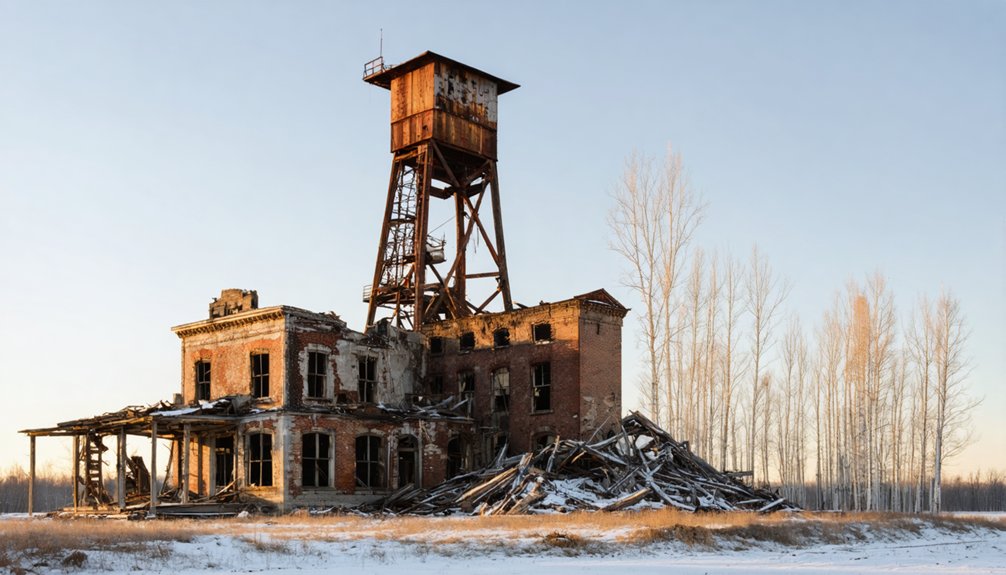
When you examine why Michigan’s mining towns emptied out, three distinct forces emerge: economic collapse, geological danger, and deliberate destruction.
You can trace Fayette’s death directly to the charcoal iron market’s decline, while the Caving Grounds in Negaunee forced complete evacuation when the earth itself became unstable.
In Gibbs City’s case, you’re looking at something rarer — an owner who simply burned his town to the ground, erasing it entirely.
Market Decline Drove Abandonment
Market forces, not time, emptied Michigan’s mining towns. When the charcoal iron market collapsed, Fayette lost its economic foundation overnight. Jackson Iron Company shut down operations, and nearly 500 residents simply walked away, leaving twin furnaces, a company store, and private homes standing in silence.
You’ll notice a pattern across the Upper Peninsula — mining culture thrived only as long as profits justified it. Central Mine closed in 1898 after copper extraction became economically unviable, triggering a population freefall from 1,300 residents to roughly 100 by 1905.
Historical preservation now captures what market abandonment left behind. These weren’t gradual declines — they were swift economic verdicts. Once commodities lost value, entire communities dissolved, transforming productive industrial hubs into the ghost towns you can explore today.
Geological Instability Forced Evacuation
Beyond market forces, geological instability rendered certain Michigan mining towns physically uninhabitable. When miners extracted mineral deposits from underground chambers, they left behind vast hollow networks that destabilized surface land. You can see this consequence most clearly in Negaunee, where land subsidence consumed entire neighborhoods, forcing complete evacuation of surrounding areas known today as the Caving Grounds.
Unlike economic downturns, which gave residents time to relocate gradually, geological failures struck suddenly and without negotiation. Once the earth began shifting beneath buildings, no amount of investment or community loyalty could reverse the danger. Residents had no choice but to abandon their homes permanently.
This geological reality reminds you that mining towns faced threats beyond human decision-making—the very earth reclaimed what industrialists had hollowed out beneath it.
Deliberate Destruction Erased Towns
Sometimes human decisions, not natural forces, erased Michigan mining towns entirely. Gibbs City stands as the starkest example — its owner deliberately set it ablaze, choosing destruction over abandonment. You won’t find gradual industrial decay here; you’ll find intentional erasure.
This act reflects a broader tension you should recognize: when economic value disappears, owners often prioritize control over cultural preservation. Rather than allowing communities to evolve naturally, some chose finality.
What remains of Gibbs City today tells you almost nothing, because that was the point. Unlike Central Mine or Fayette, where structures survived long enough to become historical assets, Gibbs City offers only absence.
Understanding deliberate destruction forces you to confront an uncomfortable truth — not every ghost town was abandoned. Some were executed.
Can You Still Tour These Abandoned Michigan Mine Sites?
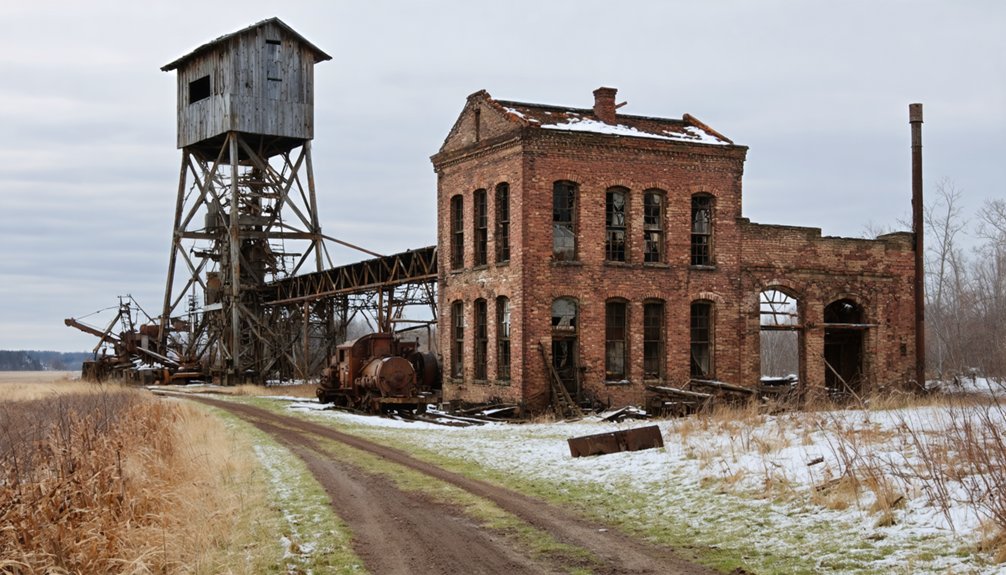
Though many of Michigan’s mining ghost towns have crumbled into ruins, several sites remain fully accessible and offer structured touring experiences. You can explore Central Mine’s three original homes daily at no charge, with a visitor center open through mid-October explaining both mining technology and town architecture.
Old Victoria offers guided interior tours through October 8 for a small fee, while you can walk the grounds freely at any time.
Quincy Mine, now a designated national park, preserves most original structures without charge.
Fayette Historic State Park lets you walk among twin blast furnaces, a company store, and private home ruins.
These sites give you direct, unfiltered access to Michigan’s copper and iron heritage without bureaucratic barriers limiting your exploration.
The Most Photogenic Michigan Mining Ghost Towns to Visit
Visiting these sites opens another layer of value beyond historical education: raw visual impact. Fayette Historic State Park delivers stone-framed ruins of twin furnaces, a company store, and a hotel, all set against Lake Michigan’s shoreline. You’ll find mining legends etched into every crumbling wall.
Central Mine’s preserved homes and restored church create striking contrasts between decay and intentional preservation. Old Victoria’s four log cabins, complete with period furnishings, photograph exceptionally well during autumn foliage.
These aren’t just hidden treasures for history enthusiasts; they’re compelling visual landscapes that reward patient photographers. Stone textures, collapsed rooflines, and overgrown pathways generate powerful imagery throughout the Keweenaw Peninsula.
Each site carries a distinct atmosphere, giving you genuinely different photographic compositions rather than repetitive industrial ruins.
Michigan Ghost Towns Outside the Keweenaw
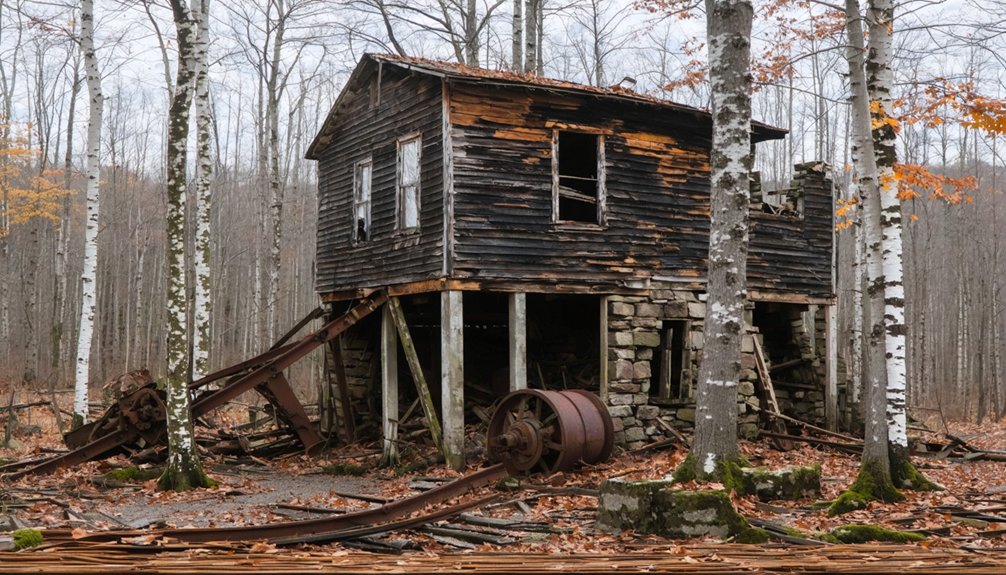
While the Keweenaw Peninsula dominates Michigan’s ghost town narrative, abandoned communities scattered across the rest of the state tell equally compelling stories. These hidden histories reveal abandoned industries that shaped Michigan far beyond copper country.
Fayette, now a historic state park, housed nearly 500 residents supporting Jackson Iron Company’s blast furnaces from 1867 to 1891. When the charcoal iron market collapsed, the town emptied completely, leaving twin furnaces, a hotel, and stone-walled structures you can still explore today.
Further south, Amble in Montcalm County quietly faded after its post office closed in 1953, while Aral in Benzie County was fully abandoned by 1911. Antrim City, once a thriving shipping hub, now sits barren. Each location rewards your curiosity with tangible evidence of Michigan’s broader industrial past.
How to Plan a Michigan Ghost Town Road Trip
Planning a Michigan ghost town road trip rewards you most when you organize stops by geographic cluster rather than individual sites. The Keweenaw Peninsula alone contains nearly 100 sites, so anchor your itinerary around Calumet before branching toward Central Mine, Quincy, and Old Victoria.
Organize Michigan ghost town stops by geographic cluster, anchoring the Keweenaw Peninsula itinerary around Calumet for maximum efficiency.
Prioritize historical preservation sites with active visitor access. Central Mine’s three restored homes open daily through mid-October, while Old Victoria offers guided tours through October 8. Time your trip accordingly.
For the Upper Peninsula’s iron-mining corridor, build Fayette Historic State Park into your route as a primary tourist attraction, since its intact ruins photograph exceptionally well.
Cross-reference Allouez, Kearsarge, and Wolverine as cluster stops since they sit within feet of each other, maximizing efficiency without sacrificing depth.
Frequently Asked Questions
Are There Any Michigan Ghost Towns Located Beneath Modern Cities or Towns?
You’ll find underground city secrets and hidden tunnel systems beneath places like Negaunee, where The Caving Grounds caused abandonment due to geological instability, proving Michigan’s ghost towns don’t just sit abandoned—they’re buried beneath modern foundations.
Did Any Michigan Mining Ghost Towns Experience Violent Conflicts or Labor Strikes?
You’ll find labor unrest and violence history deeply embedded in Michigan’s mining ghost towns. The 1913 Calumet copper strike turned deadly, reshaping worker rights and accelerating town abandonment as companies crushed unionization efforts throughout the Keweenaw Peninsula.
Which Michigan Ghost Towns Have Been Featured in Films or Television Productions?
The knowledge doesn’t reveal which towns you’re looking for… but Fayette and Central Mine’s historical preservation and status as tourist attractions make them prime candidates for productions seeking authentic, freedom-evoking 1800s mining atmosphere.
Are Metal Detecting or Artifact Collecting Activities Permitted at Michigan Ghost Town Sites?
You’ll face strict legal restrictions at most sites. At state and national parks like Fayette and Quincy, it’s prohibited. On private land, you must secure permission requirements beforehand or risk serious legal consequences.
Do Any Michigan Ghost Towns Have Documented Paranormal or Haunting Activity Reported?
You’ll find haunted legends surrounding sites like Fayette and Central Mine, where spectral sightings are informally reported by visitors. These atmospheric ruins naturally inspire such accounts, though no formally documented paranormal investigations exist within available historical records.
References
- https://en.wikipedia.org/wiki/List_of_ghost_towns_in_Michigan
- https://www.reddit.com/r/upperpeninsula/comments/1jpqd2n/up_michigan_hidden_gems_n_ghost_towns/
- https://www.youtube.com/watch?v=7-vjuqiGWJU
- https://www.visitkeweenaw.com/things-to-do/museums-history/ghost-towns/
- https://www.michigan.org/article/three-abandoned-mining-towns
- https://99wfmk.com/upminingtowns/
- https://www.legendsofamerica.com/mi-centralmine/
- https://www.visitkeweenaw.com/blog/post/our-top-7-keweenaw-ghost-towns-to-explore/
- https://www.mlive.com/travel/2016/10/michigan_ghost_towns.html