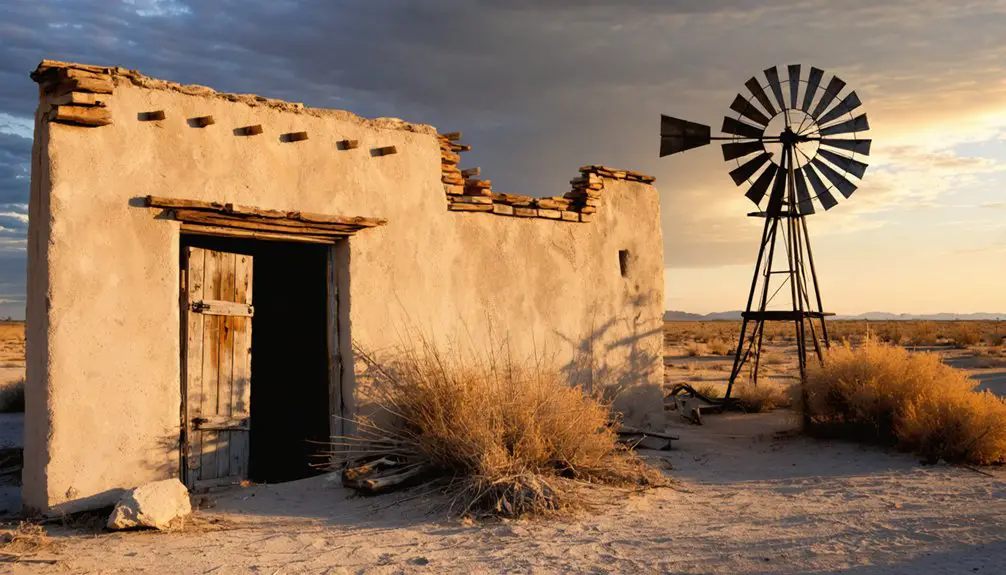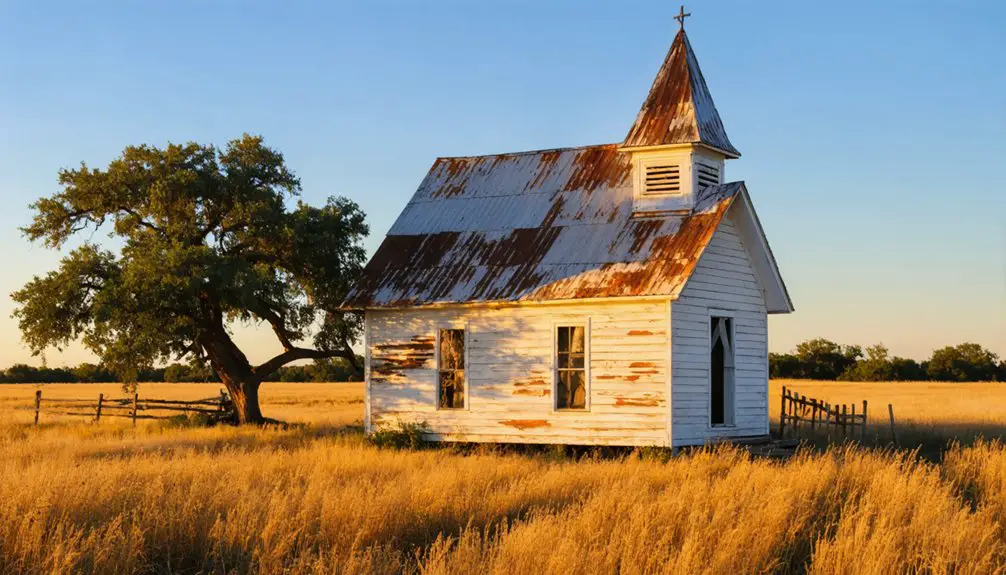
Texas has over 500 ghost towns waiting for you to explore, each one shaped by booms, busts, and broken promises. You’ll find mining ruins in Terlingua, where mercury once fueled a population of 2,000. Railroad departures gutted towns like Belle Plain and Lobo almost overnight. Farming shifts emptied agricultural communities like Cartersville and Chalk Mountain. These silent landscapes carry stories of ambition, labor, and loss that’ll pull you deeper into Texas history.
Key Takeaways
- Terlingua, once a thriving mercury mining town with 2,000 residents, now houses only about 50 people amid striking mining ruins.
- Towns like Belle Plain and Lobo collapsed economically after railroad rerouting, leaving behind cemeteries, ruins, and abandoned structures.
- Glenrio is among Texas’s best-preserved ghost towns, featuring intact mid-century structures like the Little Juarez Diner and State Line Motel.
- Agricultural ghost towns like Cartersville and Chalk Mountain thrived in the 1860s before market shifts caused their eventual population decline.
- When visiting ghost towns on private land, always secure owner permission beforehand and never remove artifacts or disturb existing structures.
Texas Ghost Towns Shaped by Mining Booms
When cinnabar was discovered in Brewster County’s Terlingua in the mid-1880s, it sparked a mercury mining boom that transformed a remote stretch of Rio Grande desert into a bustling community of roughly 2,000 residents.
A single cinnabar discovery in the 1880s turned Terlingua’s remote desert into a thriving community of 2,000.
Miners also extracted terlinguaite, a mineral unique to the district, adding another layer to Terlingua’s rich mining legacies. You can still walk among the ruins and aging infrastructure that stand as silent witnesses to those community transformations.
The extraction economy that once fueled daily life here eventually exhausted itself, leaving behind a semi-abandoned town where only about 50 residents remain today.
If you visit, you’ll find a hauntingly beautiful landscape where ambition, hard labor, and resource depletion converged — a raw, honest reflection of how mining shaped and ultimately unmade an entire community.
Texas Ghost Towns That Died When the Railroad Left
If you’ve ever driven through a Texas town that feels frozen in time, you’ve likely passed through a place the railroad abandoned.
When rail companies rerouted their lines, they didn’t just redirect trains — they pulled the economic lifeline right out from under entire communities, leaving businesses, homes, and schools to crumble.
Towns like Belle Plain and Lobo are stark reminders that when the railroad left, the people followed, and the ghost towns they left behind tell a story of sudden, irreversible collapse.
Railroad Departure Killed Towns
The railroad giveth, and the railroad taketh away — a brutal truth that erased several Texas towns from the map almost overnight.
When tracks bypassed Belle Plain in 1883, residents packed up and followed the railroad to Baird, leaving Callahan County’s former seat nearly empty. That’s railroad impact in its rawest form — no negotiation, no warning, just exodus.
Lobo survived longer, functioning as a San Antonio-El Paso Railroad watering stop until depot closure in 1962 finally ended operations.
Thurber demonstrated brief town resilience by pivoting from coal to oil after 1917, but railroad abandonment eventually won, shrinking the population to roughly 10 residents by the late 1930s.
You can almost feel the desperation in these communities — hustling to adapt before the silence became permanent.
Ghost Towns Left Behind
Railroad towns didn’t fade slowly — they collapsed the moment tracks rerouted or depots shuttered, stranding entire communities in place. Belle Plain lost its county seat status when the railroad bypassed it for Baird in 1883, triggering an immediate exodus.
Thurber survived by switching from coal to oil, yet still emptied out by the late 1930s, leaving roughly 10 residents behind.
These places aren’t just ghost town legends — they’re cultural heritage you can still witness firsthand. Lobo operated over a century as a railroad watering stop before its 1962 depot closure sealed its fate.
Today, private owners have restored it for film festivals and events. You’ll need permission to visit, but standing where those tracks once ran connects you directly to lives the railroad both built and abandoned.
Texas Farming Ghost Towns Left Behind by Shifting Markets
Once thriving as essential trade hubs for surrounding farmlands, agricultural ghost towns like Cartersville in Parker County and Chalk Mountain in Erath County tell a quiet story of communities built by boom and buried by shift.
Both towns flourished in the 1860s, supporting flour mills, cotton gins, schools, churches, and general stores. Their farming history ran deep, sustaining families and commerce for decades.
But as market shifts reshaped agricultural trade in the early 1900s, residents drifted away and most commercial structures vanished by the 1920s.
Chalk Mountain’s Masonic lodge survived a tornado only to be relocated, while Cartersville’s church stood as the town’s last structure before arson destroyed it in July 2021.
You can still trace their outlines if you know where to look.
Texas Ghost Towns Best Preserved Today
Not every ghost town faded into foundations and folklore — some held on just enough to let you walk through history nearly intact. Glenrio stands out as one of the country’s best-preserved mid-century examples, where the Little Juarez Diner, State Line Motel, and a Streamline Moderne Texaco station still anchor the townsite.
You can move freely through its abandoned infrastructure without excavating your imagination.
Terlingua offers a different experience rooted in mining heritage, where mercury extraction ruins and visible equipment remnants tell the story of a boomtown that once held 2,000 residents.
Today, roughly 50 people remain amid the ruins. Belle Plain’s cemetery, dating to 1878, and the collapsed remnants of Belle Plain College give you tangible connections to communities that railroad decisions ultimately erased.
What Still Stands in Texas Ghost Towns?
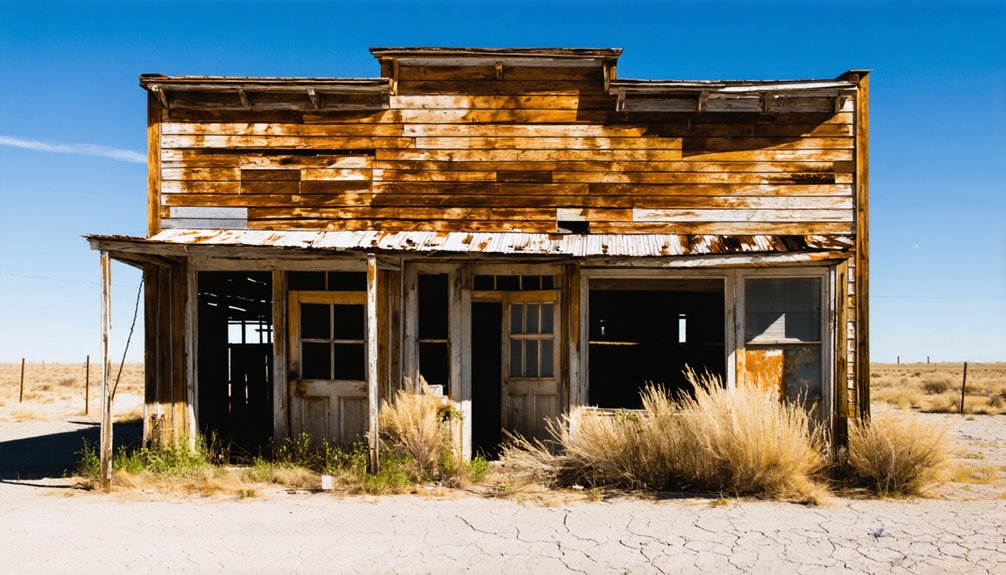
Scattered across Texas, the structures that survived tell you more about a town’s final years than its peak ones.
The buildings left standing rarely capture a town’s glory — they capture its goodbye.
In Glenrio, you’ll find abandoned architecture with real historical significance — the Little Juarez Diner, State Line Motel, and a Streamline Moderne Texaco station still standing mid-century intact.
Belle Plain’s cemetery holds marked graves dating to 1878, alongside ruins of Belle Plain College and the former dean’s residence.
Terlingua’s mining infrastructure remains visible against the Brewster County landscape.
In Cartersville, arson claimed the last standing church in July 2021, erasing what little remained.
Medicine Mound lost most of its buildings to a 1932 fire.
These remnants aren’t just ruins — they’re physical records of communities that built something real, and they reward anyone willing to seek them out.
Ghost Towns That Outlasted Their Original Purpose
Some Texas ghost towns refused to disappear entirely, finding new identity long after their founding industries collapsed.
You’ll find Lobo standing as a prime example of abandoned heritage reimagined. Three visionaries purchased the former railroad stop in 2001, transforming it into a private venue hosting film festivals and cultural events.
That’s economic transformation at its finest — a town built around a depot and water supply, now thriving through creativity rather than commerce.
Terlingua followed a similar path. Mercury mining collapsed, leaving roughly 50 residents behind, yet the town reinvented itself as a destination for travelers drawn to its haunting ruins and rugged landscape.
You can visit both communities today, experiencing their layered histories firsthand — proof that Texas ghost towns sometimes outlast the very industries that created them.
Can You Still Visit These Abandoned Texas Towns?
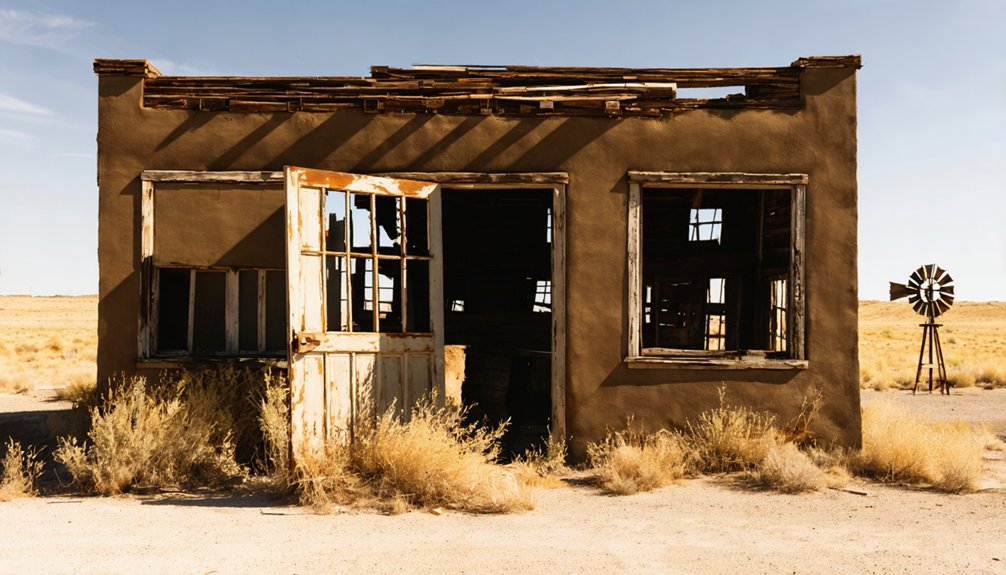
Visiting these ghost towns is entirely possible, though each comes with its own set of rules and expectations.
Glenrio welcomes ghost town tourism freely, letting you walk among its preserved Streamline Moderne structures without restriction.
Terlingua’s ruins sit openly accessible, where you can wander through remnants of mercury mining history.
Lobo, however, operates as private property, so you’ll need to contact lobo-texas.com before arriving.
Historical preservation shapes how these towns receive visitors — some are protected sites, others are simply fading landscapes.
Belle Plain’s cemetery and college ruins remain visitable, connecting you directly to lives lived in the 1870s and 1880s.
Wherever you explore, respect the structures, leave nothing behind, and recognize that your presence helps keep these stories alive.
How to Access Texas Ghost Towns on Private Land
If you’re hoping to explore a privately owned ghost town like Lobo, you’ll need to secure permission before setting foot on the property.
You can reach out to Lobo’s current owners directly through lobo-texas.com, where contact procedures are clearly outlined for prospective visitors.
Respecting these boundaries isn’t just courteous — it’s what keeps these fragile, historically rich sites accessible to future generations of explorers.
Requesting Private Property Permission
Many of Texas’s most intriguing ghost towns sit on private land, meaning you’ll need to secure permission before setting foot on the property. Respecting private landowner permissions isn’t just courtesy — it’s the law.
Start by researching ownership through county appraisal district records, then reach out directly via phone, email, or dedicated websites. Lobo, for example, requires contact through lobo-texas.com before any visit.
Once you’ve gained access, ghost town etiquette matters. Don’t remove artifacts, disturb structures, or stray beyond agreed boundaries.
Landowners who’ve opened their properties trust you to honor that arrangement. Treat the site as if you’re a guest in someone’s home — because you are. Responsible behavior today keeps these remarkable pieces of Texas history accessible for future explorers.
Contacting Ghost Town Owners
Ghost town preservation increasingly depends on transparent communication between curious explorers and protective owners.
Before you visit, research the town’s current status — some operate as active event venues, others remain strictly off-limits.
Reach out early, explain your intentions honestly, and respect whatever boundaries owners set.
These caretakers aren’t gatekeepers — they’re stewards carrying the weight of history on private land.
Treat that responsibility seriously, and you’ll likely earn access to something genuinely irreplaceable.
How Private Owners Are Restoring Texas Ghost Towns
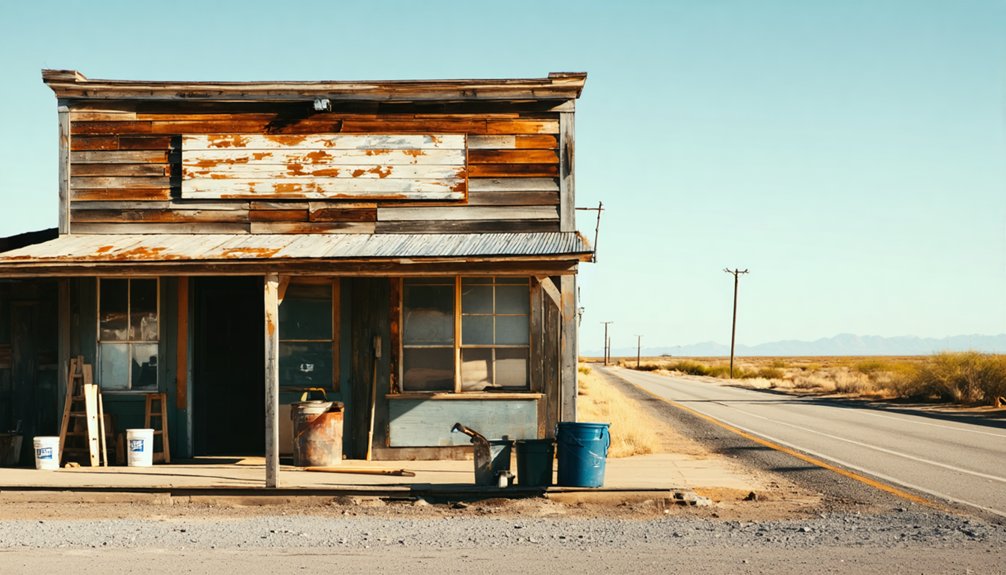
While most Texas ghost towns fade quietly into the landscape, a handful have found new life through private ownership and deliberate restoration. Lobo stands as a compelling example. Three private buyers purchased the abandoned railroad town in 2001, applying restoration techniques that preserved its authentic character rather than sanitizing its history.
You’ll find that community involvement shaped Lobo’s revival — the town now hosts film festivals and organized gatherings on its grounds. This model lets you experience genuine Texas history without government bureaucracy dictating the terms.
Visiting requires contacting owners through lobo-texas.com, respecting the private property boundaries that make preservation financially sustainable.
Private stewardship represents a growing trend, proving that individual initiative often protects cultural heritage more effectively than institutional programs ever could.
Frequently Asked Questions
Which Texas Ghost Towns Are Most Dangerous to Explore Due to Structural Instability?
When you’re urban exploration in Texas ghost towns, you’ll find structural hazards most severe at Terlingua, Thurber, and Belle Plain. Their crumbling mining infrastructure, collapsed buildings, and deteriorating ruins demand caution before you venture inside anything standing.
Are There Legal Consequences for Trespassing in Abandoned Texas Ghost Towns?
Yes, you’ll face real legal consequences for ignoring trespassing laws in Texas ghost towns. Private property rights remain enforced — like Lobo, where you must get permission first, or you’re risking fines and arrest.
Do Any Texas Ghost Towns Host Annual Festivals Celebrating Their Historical Heritage?
With over 100 years of railroad history, Lobo’s festival traditions invite you to explore heritage celebrations firsthand. You’ll need permission via lobo-texas.com, where private owners actively host organized film festivals honoring the town’s storied past.
Have Any Texas Ghost Towns Been Featured in Hollywood Film Productions?
You’ll find Lobo’s haunting landscapes have attracted Hollywood portrayals, making ghost town tourism thrive there. Since 2001, it’s hosted film festivals on its restored grounds, letting you experience its cinematic, nostalgic charm firsthand.
What Wildlife Species Have Taken Over Abandoned Texas Ghost Town Structures?
Nature always finds a way — wildlife adaptation thrives amid urban decay in these forgotten places. You’ll discover bats, owls, and rattlesnakes claiming crumbling structures, while deer and coyotes freely roam the overgrown, abandoned streets.
References
- https://www.ghostsandgetaways.com/ghost-towns
- https://en.wikipedia.org/wiki/List_of_ghost_towns_in_Texas
- https://www.hipcamp.com/journal/camping/texas-ghost-towns/
- https://www.southernthing.com/ruins-in-texas-2640914879.html
- https://www.youtube.com/watch?v=6u47HvHWZXM
- https://www.youtube.com/watch?v=–I2R5l0e1E
- https://www.texasescapes.com/TOWNS/Texas_ghost_towns.htm
- https://www.tripadvisor.com/Attractions-g28964-Activities-c47-t14-Texas.html
- https://www.reddit.com/r/texas/comments/1m7wq5d/favorite_texan_ghost_towns/
- https://texashighways.com/travel/the-quest-to-resurrect-a-ghost-town/