Planning a ghost town road trip to Ammans Crossing means heading into Kendall County‘s layered limestone terrain, where a once-thriving frontier river crossing faded into history after the railroad bypassed it. You’ll navigate scenic rural roads, explore remnants of a settlement that once housed 200–300 residents, and connect to nearby ghost towns like Welfare, Comfort, and Sisterdale. Pack smart, bring offline maps, and respect private land boundaries. There’s far more to this vanished Hill Country community than first meets the eye.
Key Takeaways
- Ammans Crossing sits in Kendall County, accessible via rural scenic roads through limestone bluffs and river corridors best navigated with offline maps.
- Visit during spring or fall for mild weather; pack sturdy boots, water, sunscreen, and a camera before leaving due to limited cell service.
- The site features foundation outlines, fragments, and artifacts on privately owned land with no formal preservation or maintained attractions.
- Extend your trip into a ghost-town circuit by including Welfare, Comfort, and Sisterdale, each offering unique frontier history and architecture.
- Keep fuel topped off, respect private land boundaries, and look for stone foundations, rusted hardware, and fence lines throughout your route.
What Is Ammans Crossing and Why Visit It?
Tucked into the rolling hills of Kendall County, Ammans Crossing is a ghost town that once thrived along the upper Guadalupe River as a vital frontier crossing point. Early settlers built log cabins, farmed the land, and relied on a safe ford discovered through local legends involving a horse that could detect dangerous quicksand beneath the water.
A ghost town born from frontier grit, where a horse once led settlers safely across quicksand-laced waters.
At its peak, the settlement supported around 200–300 residents before railroad bypasses quietly strangled its economy.
You’ll find more than abandonment here. The surrounding river ecology remains alive — the Guadalupe still draws kayakers, tubers, and anglers through the same Hill Country landscape those frontier settlers navigated daily.
Visiting connects you directly to Texas’s raw boom-and-bust history while letting you experience genuine freedom across its open, rural terrain.
How Ammans Crossing Got Its Start on the Guadalupe River
Before roads were surveyed and towns were platted, the Guadalupe River shaped where people moved, settled, and traded across the Texas Hill Country. Ammans Crossing grew directly from that need — a practical river crossing that became a genuine frontier settlement.
Local legends trace its founding to Barney Plemons, who used a horse sensitive to quicksand to locate a safe ford. That discovery changed everything. River crossings like this one didn’t just move people — they built communities.
Picture what early settlers encountered here:
- Log cabins rising along wooded riverbanks
- Farms carved from Hill Country terrain
- Wagons loaded with goods fording clear water
You’re stepping into a story written by necessity, ingenuity, and the unstoppable pull of open land.
How Ammans Crossing Became a Texas Ghost Town
When you look at Ammans Crossing today, it’s hard to imagine it once thrived as a busy frontier river crossing where settlers and travelers forded the Guadalupe to move goods and people across the region.
The town’s fate shifted dramatically when the railroad bypassed it in the early 20th century, cutting off the transportation traffic that had kept local businesses alive.
Without that economic lifeline, residents packed up and left, leaving behind only remnants of what was once a small but essential Hill Country community.
A Frontier River Crossing
Like many Texas settlements that rose and fell within a generation, Ammans Crossing began with something practical: a safe way across the Guadalupe River. Barney Plemons discovered the ford using a horse that could sense quicksand, giving travelers a reliable route through untamed Hill Country terrain. That single discovery carried real cultural significance, shaping how settlers moved, traded, and survived.
Picture what early life looked like here:
- Log cabins rising along riverbanks where cottonwoods caught the wind
- Farmers hauling goods across a clear, flowing ford
- A frontier community threading itself into the landscape
The environmental impact of that daily river crossing shaped both the land and the people who depended on it. From one safe ford, an entire settlement took root.
The Railroad Bypassed It
Ammans Crossing had reached a modest but functioning peak—perhaps 200 to 300 residents, a river crossing that moved people and goods, a community with reason to believe it had a future.
Then the railroad came through the region and chose a different route. That decision quietly ended everything.
Without rail access, merchants couldn’t compete, travelers rerouted, and the economic foundation simply collapsed. Residents packed up and moved toward towns that the railroad had chosen instead.
The river crossing that once gave Ammans Crossing its purpose became irrelevant almost overnight.
Today, that collapse is exactly what makes the site historically significant. The absence of historic preservation efforts and limited tourism development means you’re visiting a place history largely forgot—which, for the freedom-seeking traveler, is precisely the point.
Residents Eventually Left
Once the railroad bypassed Ammans Crossing, the town didn’t collapse all at once—it emptied out slowly, the way a fire dies when you stop feeding it. Economic decline crept through quietly, closing businesses and pulling families toward towns with better connections.
Picture what they left behind:
- Empty log cabins with doors swinging open in the Hill Country wind
- Fields gone wild, reclaimed by cedar and limestone
- A river crossing nobody needed anymore, silent except for the current
Local legends kept the memory alive, but memories don’t pay for groceries or keep a school running. One by one, residents packed their wagons and moved toward opportunity.
What once held 200 to 300 people became stillness. That stillness is exactly what you’ll find waiting for you today.
Surviving Structures and Remnants at Ammans Crossing Today
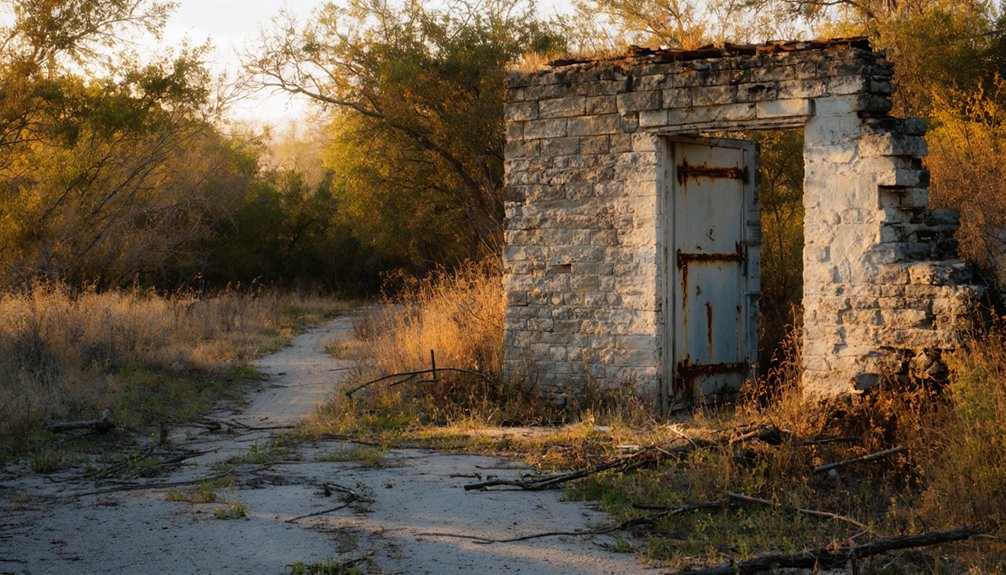
Though little remains of what was once a modest frontier community, the remnants at Ammans Crossing still tell a quiet, weathered story. You’ll find traces of frontier life embedded in the landscape — structural fragments, foundation outlines, and historical artifacts that connect you directly to the settlement’s working past.
The site sits on privately owned land, which limits access and complicates preservation efforts markedly. No formal historic designation currently protects what’s left, and flood risk from the Guadalupe River has worn the site further over time.
If you make the trip, approach it with respect for the land and an eye for detail. Even partial remains carry meaning, and reading the landscape carefully rewards those who travel with curiosity rather than just convenience.
Plan Your Drive to Ammans Crossing in Kendall County
Getting to Ammans Crossing means driving into the heart of the Texas Hill Country, where Kendall County’s rolling terrain and river corridors shape the route as much as the road signs do. You’ll travel through open landscapes rich with wildlife habitats and layered cultural heritage stretching back to frontier settlement days.
The road to Ammans Crossing winds through Kendall County’s layered terrain, where the landscape narrates history before the destination does.
Pack your map and expect roads that reward patience:
- Cedar-covered hillsides flanking two-lane highways where deer move freely at dusk
- River bottomlands glimpsed between limestone bluffs along the upper Guadalupe corridor
- Rural crossroads where weathered fences mark the edges of private ranch land
Keep your speed down and your eyes open. The drive itself tells the story before you ever reach the ghost town’s remnants.
Best Time to Visit Ammans Crossing
When you visit Ammans Crossing matters more than you might expect. Spring and fall offer the sharpest experience — mild temperatures, clear skies, and landscapes that reward exploration on foot.
Summer heat in central Texas can be punishing, and the Guadalupe River draws crowds that interrupt the solitude a ghost town deserves.
Winter visits bring quiet and a raw stillness that suits a place shaped by frontier hardship. You’ll find wildlife sightings easier in cooler months, when deer and birds move openly through the brush.
Early mornings give you the best light and the fewest distractions.
Local folklore runs deeper when you’re not rushed. Choose a weekday, arrive at dawn, and let the landscape speak. The freedom you’re after lives in the timing.
What to Pack for the Ammans Crossing Drive
Once you’ve locked in your timing, what you carry into Ammans Crossing will shape the entire experience. This remote Hill Country site offers no vendors, no cultural festivals, and no local cuisine stops nearby, so prepare before you leave.
Pack these essentials:
- Navigation tools — downloaded offline maps and a paper backup, since cell service fades fast in Kendall County’s rural corridors
- Sun and weather gear — a wide-brim hat, sunscreen, and a light rain layer for unpredictable Texas Hill Country skies
- Exploration kit — sturdy boots for uneven terrain, a camera for capturing remnants, and water for the dry stretches between towns
You’re stepping into abandoned frontier history, not a maintained attraction. Pack smart, move freely, and let the landscape tell its story.
Texas Ghost Towns Near Ammans Crossing Worth Combining
Kendall County sits within reach of several other forgotten Texas settlements, making it easy to turn your Ammans Crossing visit into a fuller ghost-town circuit.
You’ll find that combining stops stretches your drive into a richer exploration of the Hill Country’s boom-and-bust past without adding much distance.
Plan your route in advance, since some sites sit on private land and require research before you can confirm access.
Nearby Ghost Town Options
Since Ammans Crossing sits in the Texas Hill Country, you’re well-positioned to build a longer ghost-town loop through one of the state’s richest stretches of abandoned history. Kendall County‘s rolling terrain connects you to neighboring settlements where local legends still echo through crumbling stonework and overgrown creek beds.
The river ecology here shapes everything — flood plains, cedar breaks, and limestone bluffs mark where communities once thrived and quietly vanished.
Consider adding these stops to your route:
- Welfare, Texas — a faded rail-era hamlet with weathered structures frozen in time
- Comfort, Texas — a semi-preserved frontier town with authentic German settler architecture
- Sisterdale, Texas — a riverside ghost community tucked along a quiet Hill Country valley
Each stop deepens your understanding of Texas’s boom-and-bust frontier cycles.
Planning Combined Visits
Planning a multi-stop ghost town loop through the Texas Hill Country rewards you with layered history that no single site can deliver alone. Start at Ammans Crossing, where the river crossing’s remnants anchor your route in frontier practicality.
Then push outward toward neighboring Kendall County settlements, each carrying its own local legends tied to ranchers, outlaws, and forgotten commerce. You’ll find historical artifacts scattered across these sites — worn stone foundations, rusted hardware, faded fence lines — that collectively paint a richer picture of Texas boom-and-bust cycles.
Map your stops by distance, keep fuel topped off, and respect private land boundaries. The freedom of open Hill Country roads connects these fragments of the past into one continuous, deeply satisfying journey through a Texas most travelers never see.
Frequently Asked Questions
Is Ammans Crossing Located on Publicly Accessible or Privately Owned Land?
Like a locked door on an open road, private ownership can block your path. Land access to Ammans Crossing isn’t guaranteed, so you’ll want to research and respect boundaries before you venture out.
Are Pets Allowed When Visiting Ghost Town Sites in Kendall County?
No universal pet policies exist for Kendall County ghost town sites. You’ll want to check visitor guidelines for each location, since private land ownership often dictates whether you can bring your furry trail companion along.
Does Ammans Crossing Have Any Formal Historic Preservation or Landmark Designation?
You won’t find any formal landmark designation protecting Ammans Crossing. Its historic significance remains unguarded, and preservation efforts face real challenges — private land ownership and flood risk leave this evocative frontier remnant vulnerable, waiting for freedom-seeking explorers like you.
Is There Cell Phone Service Near Ammans Crossing in the Texas Hill Country?
Ironically, cell coverage is as ghostly as the town itself. You’ll likely find weak signal strength in the Texas Hill Country’s rugged terrain, so embrace the freedom of disconnecting and let Ammans Crossing’s wilderness silence truly speak to you.
Are Guided Ghost Town Tours Available for Ammans Crossing or Nearby Sites?
No formal guided tour options exist for Ammans Crossing, but you’ll find nearby Hill Country tours showcasing historical artifacts and frontier stories. Explore independently, embrace the freedom, and let the rugged Texas landscape speak for itself.
References
- https://kids.kiddle.co/Ammans_Crossing
- https://en.wikipedia.org/wiki/List_of_ghost_towns_in_Texas
- https://www.burningcompass.com/countries/united-states/states/texas/texas-ghost-towns-map.html
- https://hank.sanmarcostx.gov/SMHC/DOCUMENTS/Extinct Cities.pdf