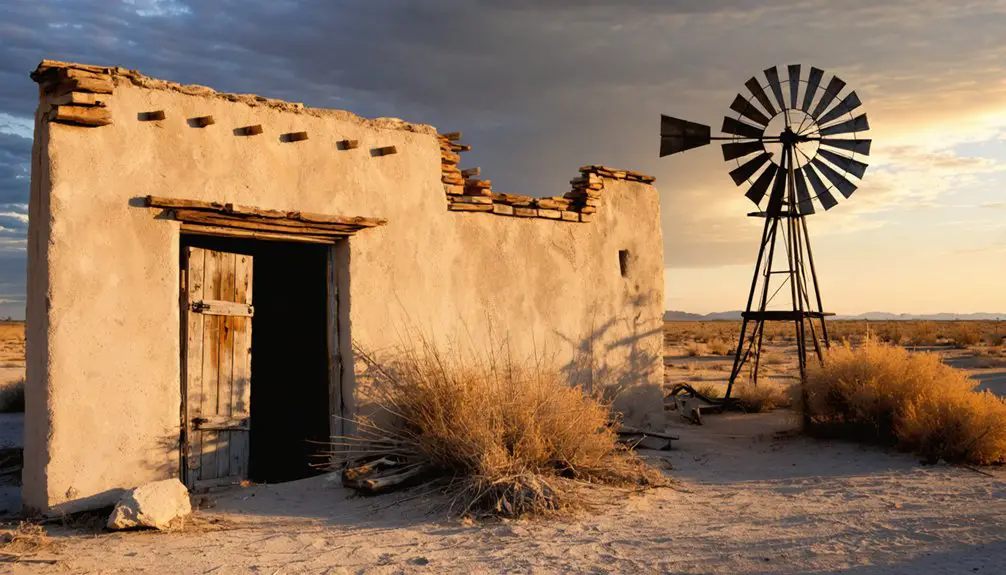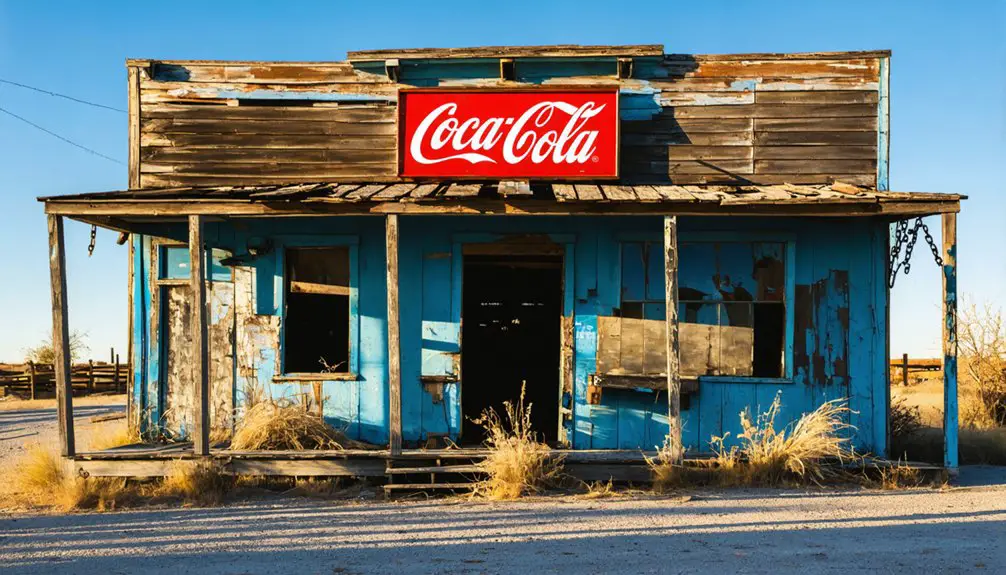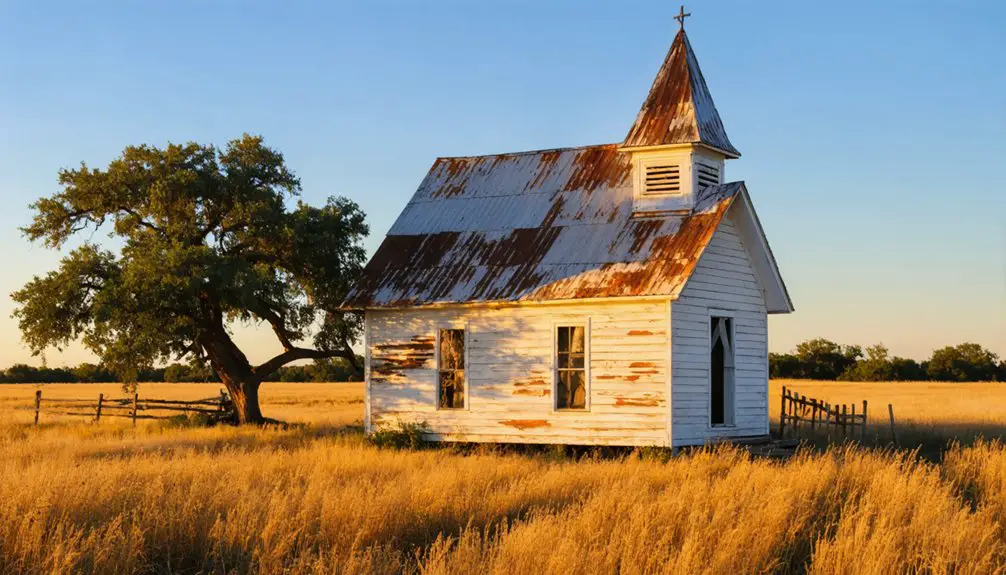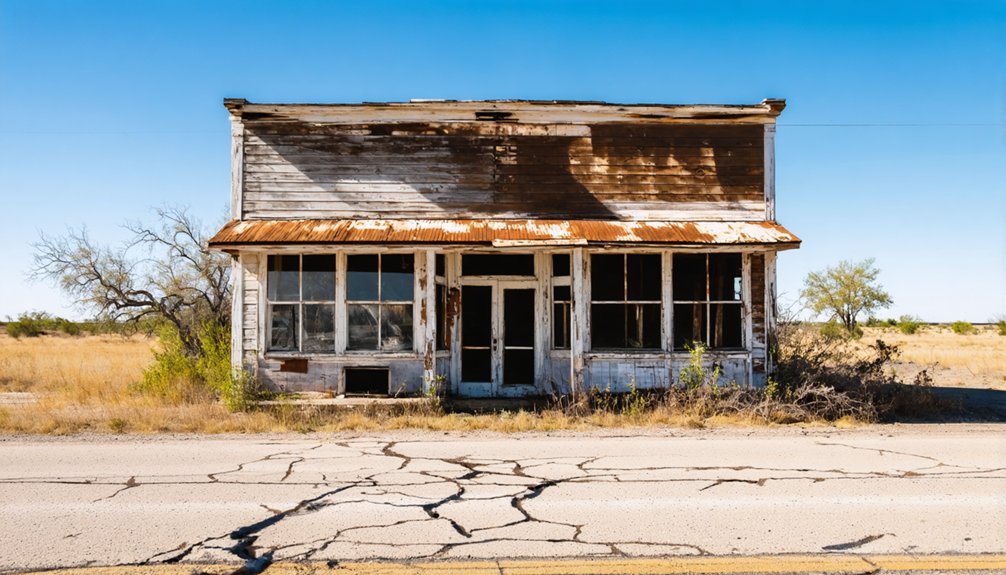
Planning a ghost town road trip to Cheapside, Texas means heading to Ranch Road 2067, about 21 miles southeast of Gonzales in south-central Gonzales County. You’ll find a weathered 1897 church, scattered ruins, and open ranchland views that tell the story of a cotton community that once housed nearly 500 people. Fuel up and pack supplies before you go, since there’s nothing out there. Everything you need to plan the perfect detour is just ahead.
Key Takeaways
- Cheapside sits along Ranch Road 2067, about 21 miles southeast of Gonzales, between U.S. 87 and U.S. 183.
- Fuel up and stock supplies in Gonzales beforehand, as Cheapside has no services, shops, or refreshment options available.
- Exploration is roadside only; most structures are fenced off, so bring binoculars and a camera for distant viewing.
- Key sights include the 1897 Cheapside Community Church and scattered remnants of a once-thriving cotton industry town.
- Pair the visit with nearby towns like Gonzales or Cuero for additional history, food, and regional attractions.
Where Exactly Is Cheapside, Texas?
Tucked into the rolling hills of south-central Gonzales County near the DeWitt County line, Cheapside sits along Ranch Road 2067, roughly 21 miles southeast of Gonzales between U.S. 87 and U.S. 183. You won’t find it on most modern maps, and that’s exactly what makes it worth tracking down.
The surrounding ranchland stretches wide and quiet, offering the kind of open-horizon freedom that pulls road-trippers off the beaten path.
Historical context runs deep here — settlers arrived as early as 1857, shaping a cotton-farming community that once buzzed with commerce.
Local legends tied to its English-influenced roots and frontier-era growth add another layer to the journey.
Plan your route in advance, fuel up beforehand, and expect a raw, unpolished slice of Texas history waiting at the roadside.
The Cotton Town That Built and Broke Cheapside
Cotton built Cheapside from the ground up, and then it tore the town apart just as completely. When prices collapsed during the Great Depression, the economy crumbled fast. Soil exhaustion finished what falling markets started, and the town never recovered.
Here’s what shaped Cheapside’s rise and fall:
- Thomas Baker settled the land in 1857, laying the foundation
- A cotton gin and gristmill opened in 1889, fueling commerce
- Population peaked near 500 during the Depression before collapsing
- The gin closed in the 1940s, and farmland reverted to pasture
- The last business shut down in 1989, sealing ghost-town status
You won’t find major preservation efforts or polished historical artifacts here. What you’ll find is raw, honest decay — and that’s exactly what makes Cheapside worth exploring.
What’s Left to See in Cheapside Today?
What remains of Cheapside won’t overwhelm you, but it’ll reward your curiosity if you know what you’re looking for. The standout piece of historic architecture is the Cheapside Community Church, built in 1897 and relocated to its current spot in 1949. It’s weathered but still standing, a quiet anchor to everything this town once was.
Beyond the church, you’ll find scattered remnants of former commercial buildings and a small community center. The Freeman-Watson store and the old post office location carry local legends of busier days when cotton wagons rolled through and saloons stayed loud past dark.
Some areas are fenced off, so plan on roadside viewing. Bring a camera, compare what you see against archival photos, and let the silence do the storytelling.
How to Get to Cheapside on Your Road Trip
Getting to Cheapside is straightforward once you orient yourself around south-central Gonzales County, near the DeWitt County line. You’ll find this historically significant settlement along Ranch Road 2067, roughly 21 miles southeast of Gonzales, tucked between U.S. 87 and U.S. 183.
Tucked along Ranch Road 2067, Cheapside sits quietly in south-central Gonzales County, roughly 21 miles southeast of Gonzales.
Before you roll out, prep smart:
- Fill your tank before leaving Gonzales — services vanish fast heading southeast
- Download offline maps since rural cell coverage gets unreliable
- Pack food and water for the open road stretch
- Note the cultural impact of landmarks like the 1897 community church along your route
- Expect fenced areas — roadside viewing is often your best access point
The drive itself rewards you with rolling Texas hills before delivering you straight into living history.
Fenced Off and Mostly Ruins: What You’ll Actually Find
When you pull up to Cheapside, don’t expect to wander freely through the remains — much of the area is fenced off, making roadside viewing your most realistic option.
The standout survivor is the Cheapside Community Church, built in 1897 and still standing after being relocated in 1949.
Beyond that, you’ll spot only scattered remnants and crumbling structures that hint at a town that once boasted hotels, saloons, and a bustling cotton economy.
Roadside Viewing Only
Before you pull off Ranch Road 2067 expecting to wander freely through crumbling storefronts, know this: much of Cheapside is fenced off, and you’ll be doing most of your exploring from the roadside. That doesn’t mean the stop isn’t worth it — historical architecture and local legends reward the sharp-eyed traveler.
Make the most of your visit by:
- Photographing the 1897 Cheapside Community Church from the road
- Scanning fence lines for remnants of former commercial buildings
- Noting the rolling ranchland that swallowed the old cotton fields
- Capturing wide-angle shots of the rural landscape for context
- Cross-referencing the Portal to Texas History photographs on your phone
Respect the fencing, stay road-safe, and let the quiet landscape tell Cheapside’s story on its own terms.
Church And Scattered Remnants
Once you’ve scoped the lay of the land from the road, the two things worth fixing your eyes on are the Cheapside Community Church and whatever scattered remnants still poke through the brush.
Built in 1897 and relocated in 1949, the church stands as the clearest example of historical architecture still holding its ground. It carries the community legacy of settlers who built something real out of raw ranchland.
Beyond the church, you’ll find crumbling structures and leftover bones of the old commercial district — former store sites, a vanished post office, and fragments the decades haven’t fully swallowed. Fencing limits how close you can get, so bring binoculars and a camera.
What’s left won’t last forever, which makes seeing it now worth the detour.
Towns Worth Stopping at Before or After Cheapside
Since Cheapside sits between U.S. 87 and U.S. 183, you’ve got easy access to a handful of small Texas towns worth folding into your route. These stops balance historical preservation with glimpses of community redevelopment, giving your trip real depth beyond the ghost town itself.
- Gonzales – Famous for “Come and Take It,” packed with museums and historic sites.
- Cuero – Home to the Turkey Trot festival and solid local dining.
- Yoakum – Known for leather goods and a charming downtown district.
- Lockhart – Texas’s official barbecue capital, absolutely worth the detour.
- Seguin – Offers riverfront parks, historic architecture, and fuel stops.
Each town adds cultural texture without pulling you far off your path through south-central Texas.
What to Bring for Your Cheapside Ghost Town Visit
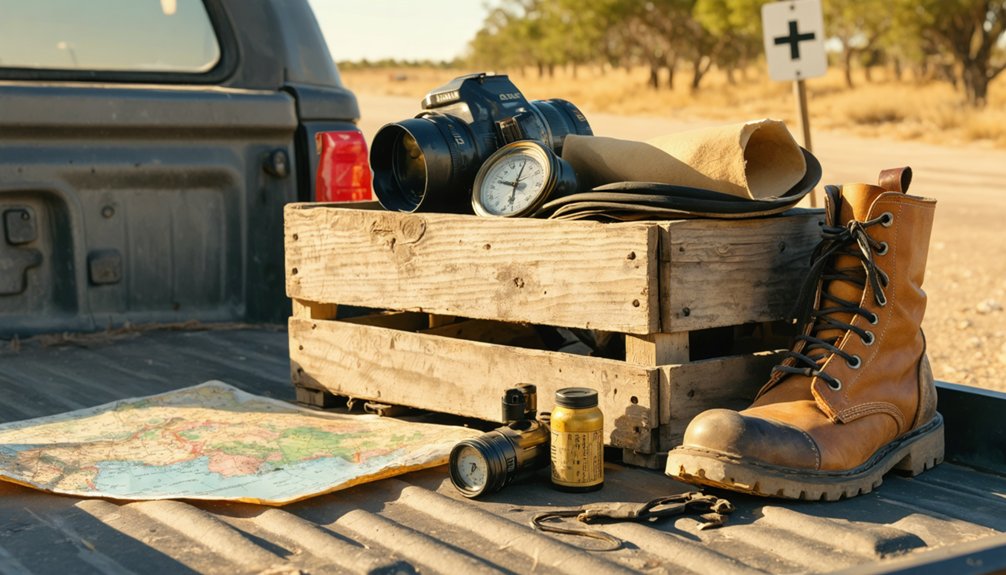
Before you head out to Cheapside, pack smart because services out there are virtually nonexistent. Load up on food, water, and fuel ahead of time.
Don’t rely on your phone’s GPS alone — download offline maps or bring a paper road map for the rural backroads.
Toss a camera and sturdy walking shoes in your bag, since the surviving church and scattered remnants reward a closer look from those prepared to explore them.
How you navigate to Cheapside can make or break your ghost town experience, so don’t leave home without a reliable paper map or a downloaded offline GPS route. Cell service is unreliable in south-central Gonzales County, and you’ll want to explore freely without dead zones killing your momentum.
Pack these navigation essentials before hitting Ranch Road 2067:
- Downloaded offline maps covering Gonzales and DeWitt County lines
- Paper county road map for historical preservation research and backroad confidence
- Coordinates for Cheapside Community Church as your primary landmark
- Notes on local legends and surrounding ranch roads to avoid trespassing
- Fuel checkpoints marked between U.S. 87 and U.S. 183 before reaching the site
Arriving prepared means spending less time lost and more time discovering what remains.
Food and Water Supplies
Getting your navigation sorted is only half the battle—your body needs fuel just as much as your GPS does. Cheapside offers zero refreshment options on-site, so you’re responsible for everything you consume out there. Pack more water than you think you’ll need, especially in Texas heat, and throw in high-energy snacks that travel well.
Before hitting Ranch Road 2067, stock up in Gonzales, about 21 miles away, where you’ll find solid local cuisine ranging from BBQ joints to casual diners. Fill your tank, grab a cooler, and load it with enough supplies for the full trip.
That freedom you’re chasing across open ranchland disappears fast when dehydration sets in. Prepare ahead, and the road stays yours.
Camera and Sturdy Footwear
Once you’ve topped off your cooler and fueled up in Gonzales, turn your attention to two essentials that’ll make or break your time at Cheapside: a camera and sturdy footwear. The terrain mixes uneven ranchland with crumbling remnants, and you’ll want to document every weathered detail of the historical architecture while staying sure-footed.
Pack these before you roll out:
- Wide-angle lens or smartphone to capture the 1897 Cheapside Community Church
- Trail shoes or boots for traversing rough, fenced-off terrain safely
- Extra memory cards — local legends and forgotten storefronts deserve multiple shots
- Polarizing filter to cut Texas glare on aged wood and stone
- Small notebook to sketch building layouts or jot down roadside discoveries
Is Cheapside Worth Adding to Your Road Trip Route?
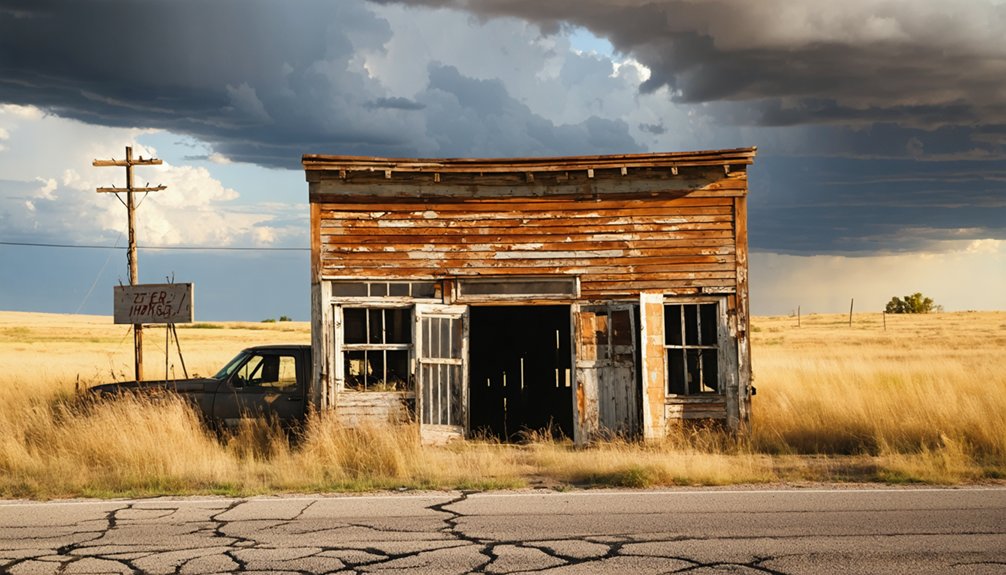
Whether you’re mapping out a Texas back-roads adventure or hunting for overlooked history, Cheapside earns a spot on your route as a quick but rewarding detour. Don’t expect tourist infrastructure — there are no visitor centers, guided tours, or roadside markers welcoming you in.
What you’ll find instead is raw, unfiltered historical preservation in the form of a standing 1897 church, scattered remnants of a once-thriving cotton community, and open ranchland that tells its own quiet story.
Plan it as a focused stop between Gonzales and Cuero, fuel up beforehand, and arrive ready to observe from the roadside. If you value authentic, off-the-beaten-path discovery over polished attractions, Cheapside delivers exactly the kind of freedom-driven experience that makes Texas back-road travel worthwhile.
Frequently Asked Questions
Who Was the First Permanent Settler to Arrive in Cheapside?
You’ll discover that Thomas Baker’s the pioneer who kickstarted Cheapside’s ghost town history, building his log cabin in 1857. His adventurous pioneer stories shaped this freedom-loving Texas settlement into the thriving community it’d eventually become.
What Was Cheapside Originally Named After When Founded in 1882?
When you explore this ghost town tourism gem, you’ll discover Dr. E. R. Henry named Cheapside after London’s famous Cheapside Street in 1882. Its historic landmarks carry that bold, adventurous English spirit you’re craving to uncover.
When Did Cheapside’s Post Office Officially Open for the First Time?
You’ll discover that Cheapside’s post office officially opened on June 5, 1882, where local legends thrived alongside historical architecture, connecting freedom-seeking settlers to the wider world through dusty trails and boundless Texas possibility.
How Large Did Cheapside’s Population Grow During the Great Depression?
You’ll find it remarkable that Cheapside’s population swelled to around 500 during the Great Depression, defying ghost town preservation odds before economic decline factors like crashing cotton prices and soil exhaustion ultimately crushed the community’s adventurous, freedom-seeking spirit.
When Did the Cotton Gin in Cheapside Permanently Close Down?
You’ll discover the cotton gin permanently closed during the 1940s, a pivotal moment in ghost town tourism history. Embrace historical preservation as you explore Cheapside’s adventurous, freedom-filled past etched across its rugged, sun-soaked Texas landscape.
References
- https://theforgottensouth.com/cheapside-texas-ghost-town-history/
- https://en.wikipedia.org/wiki/Cheapside
- https://www.texasescapes.com/CentralTexasTownsSouth/Cheapside-Texas.htm
- https://www.nbcdfw.com/news/local/cheapside-texas-ghost-town/78726/
- https://www.washingtontimes.com/news/2018/nov/12/some-recall-community-of-cheapside-now-a-ghost-tow/
- https://kqvt.com/texas-town-vanished-overnight-cheapside/
- https://texashistory.unt.edu/ark:/67531/metapth758004/m1/3/
- https://allacrosstexas.com/texas-ghost-town.php?city=Cheapside
- https://texashistory.unt.edu/ark:/67531/metapth933108/