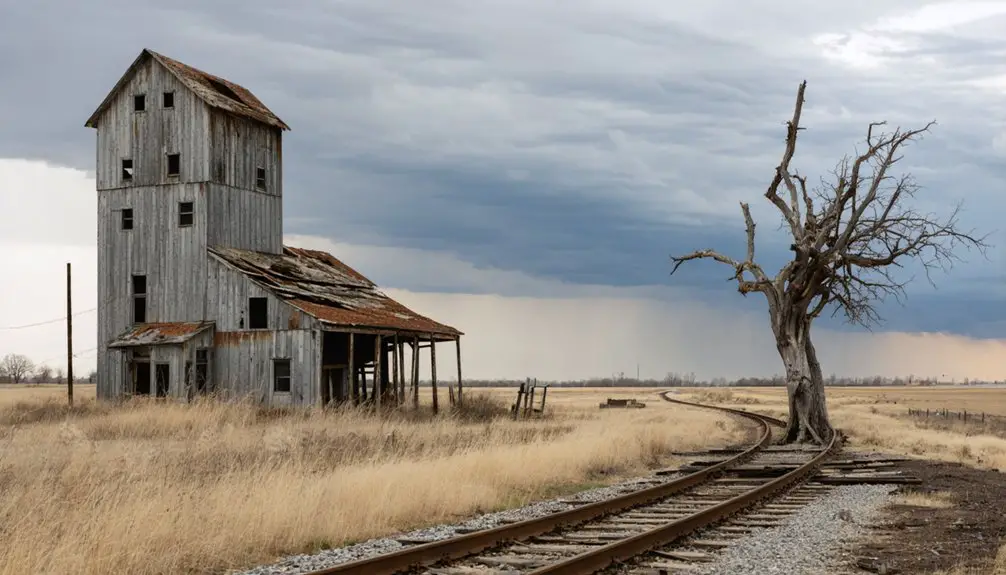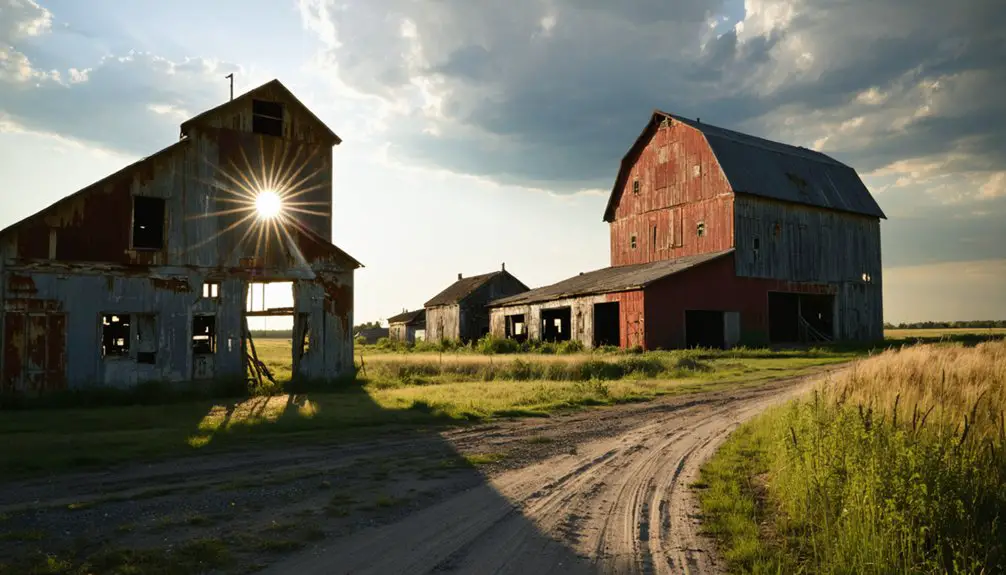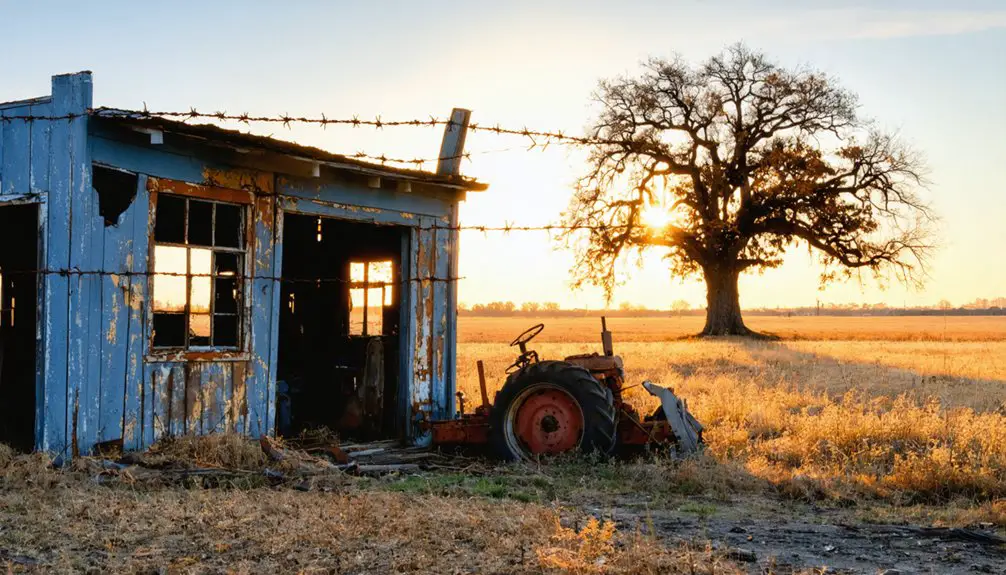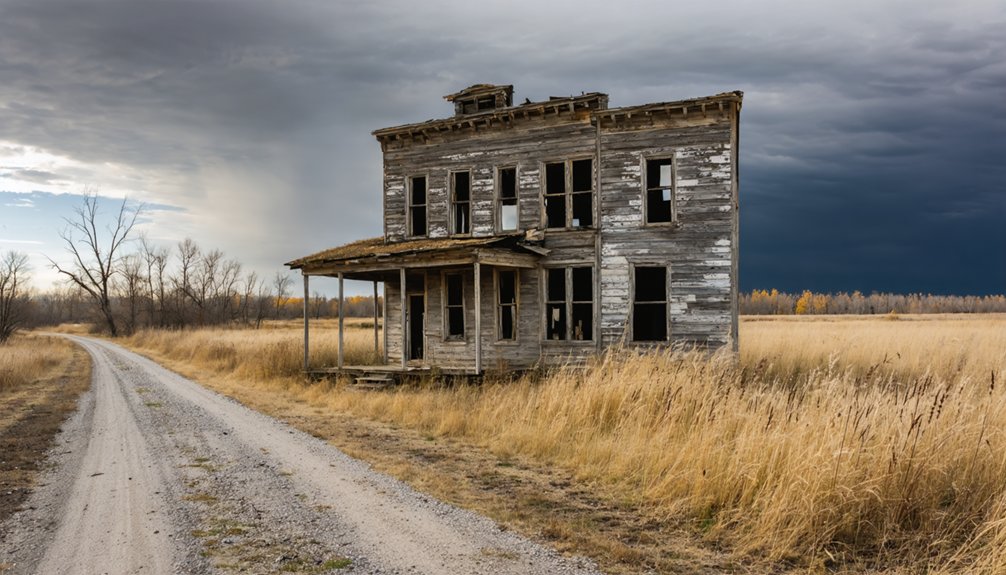
Planning a ghost town road trip to Dorothy, Minnesota means heading to Louisville Township in Red Lake County, where flat farmland and open skies frame the silence of a forgotten community. Named after a Catholic church built in 1880, Dorothy briefly thrived when the railroad arrived but collapsed after it left. Today, weathered structures and overgrown lots are all that remain. There’s far more to this haunting landscape than first meets the eye.
Key Takeaways
- Dorothy, Minnesota, sits in Red Lake County near Red Lake Falls, accessible via rural county roads off Highway 32 or Highway 59.
- The ghost town offers no preserved buildings or interpretive signs, only decaying structures and natural reclamation reflecting its quiet decline.
- Visit during late summer or fall daylight hours for scenic golden fields and optimal photography lighting conditions.
- A typical visit lasts thirty minutes; pack water, a camera, comfortable shoes, and offline maps for navigation.
- Nearby ghost towns like Gully, Mentor, and Oklee complement Dorothy’s story of railroad-era settlement and regional decline.
What Is Dorothy, Minnesota?
Tucked away in Louisville Township, Red Lake County, Dorothy, Minnesota is a ghost town that’s nearly faded from the map entirely. It got its name from St. Dorothy’s Catholic Church, built in 1880, long before a post office made it official in 1898.
Deep in Red Lake County, Dorothy, Minnesota barely exists — a ghost town named for a church before it was ever official.
The Northern Pacific Railway gave Dorothy a brief pulse of life around 1916–17, drawing residents, a grain elevator, and a school to the area. By 1938, only 25 people remained.
When the railroad left in the early 1970s, so did Dorothy’s future. A 2014 church fire erased one of its last standing symbols, making historical preservation nearly impossible.
What you’ll find today are scattered remnants and open land — a place where community memory quietly outlasts the structures that once defined it.
How Dorothy Became a Ghost Town
Dorothy’s fate followed a pattern you’ll recognize in ghost towns across the Midwest — a railroad built it up, and its abandonment tore it down.
The Northern Pacific Railway rolled through around 1916–17, giving Dorothy a station, a grain elevator, and a reason to exist. But when the railroad shut down in the early 1970s, the town’s economic backbone snapped.
The final blow came on October 24, 2014, when St. Dorothy’s Catholic Church — the landmark that gave the town its name — burned to the ground, erasing what little identity the community had left.
Railroad Arrival And Departure
When the Northern Pacific Railway extended its lines through the area around 1916–17, Dorothy transformed from a quiet rural settlement into a functioning station town. That railroad history gave the community real momentum — a grain elevator rose up, families settled in, and the town built genuine infrastructure around the reliable rhythm of freight and travel.
But transportation decline hit hard. When the railroad abandoned its lines in the early 1970s, Dorothy lost its economic backbone overnight. The grain elevator followed, closing not long after. Without rail access, there was no practical reason for commerce to stay.
Residents left gradually, structures deteriorated, and the landscape reclaimed what people had built. The railroad both created Dorothy and, by leaving, quietly erased it.
Church Fire Ends Era
The last recognizable landmark in Dorothy burned to the ground on October 24, 2014, when St. Dorothy’s Catholic Church caught fire and was lost completely. Built in 1880, the church had outlasted the post office, the grain elevator, and the railroad — standing as the town’s final symbol of historical preservation against decades of urban decay.
Once it was gone, Dorothy lost its last anchor to the past. You can still drive through and see scattered remnants, but there’s no longer a single structure that tells the town’s story at a glance.
The fire didn’t just destroy a building — it erased the last visible thread connecting the landscape to its history. What remains now is open land, quiet roads, and the weight of what’s been lost.
What’s Left to See in Dorothy Today?
When you arrive in Dorothy today, you’ll find only a handful of houses and weathered structures scattered across the rural landscape, offering a haunting glimpse into what was once a modest but functioning community.
The town’s most recognizable landmark, St. Dorothy’s Catholic Church, met a tragic end on October 24, 2014, when fire destroyed it and erased the last major visual anchor of the settlement’s identity.
What remains is largely reclaimed by nature, making your visit more of a quiet, reflective roadside stop than an exploratory tour of preserved historic buildings.
Surviving Structures And Buildings
Although Dorothy once held a grain elevator, a Catholic church, a school, and several homes, you’ll find very little standing today. The 2014 fire that consumed St. Dorothy’s Catholic Church erased the town’s most recognizable landmark, leaving almost no trace of its architectural styles behind.
Historical preservation simply never took hold here, and the rural landscape has slowly reclaimed what residents left behind.
What remains are a handful of weathered houses and deteriorating structures scattered along the roadside. Don’t expect organized ruins or marked sites — Dorothy offers raw, unfiltered abandonment.
You’ll spot aged wood, overgrown lots, and the quiet stillness of a place time forgot. Pull over, take it in, and let the silence tell the story that no standing building can anymore.
The Church’s Tragic End
Built in 1880 and once the heart of Dorothy’s identity, St. Dorothy’s Catholic Church gave this small community both its name and its soul. For over a century, it stood as the most powerful symbol of community memory in an otherwise fading landscape.
Then, on October 24, 2014, fire destroyed it completely.
That loss hit harder than most realize. When you visit today, you won’t find any trace of the structure — just open land where something meaningful once stood.
Historical preservation never had a chance here, and the fire erased Dorothy’s last recognizable landmark almost overnight.
As you pass through, let that absence speak to you. Sometimes what’s missing tells a more powerful story than anything still standing ever could.
Rural Landscape Remnants
What remains in Dorothy today won’t take long to absorb — and that’s kind of the point. Urban decay has quietly swallowed most of what once stood here, leaving only fragments behind. Historical preservation never took hold, so what you’ll find is raw and unfiltered.
Expect to encounter:
- A handful of weathered houses sitting off the rural road, some barely standing
- Overgrown lots where the grain elevator and church once anchored community life
- Wide, open farmland stretching in every direction, offering striking roadside photography
You’re not visiting a curated museum — you’re reading a landscape. Dorothy rewards the curious traveler who finds meaning in absence. Pull over, take your shots, and let the silence tell the story before moving on.
The 2014 Fire That Erased Dorothy’s Last Landmark
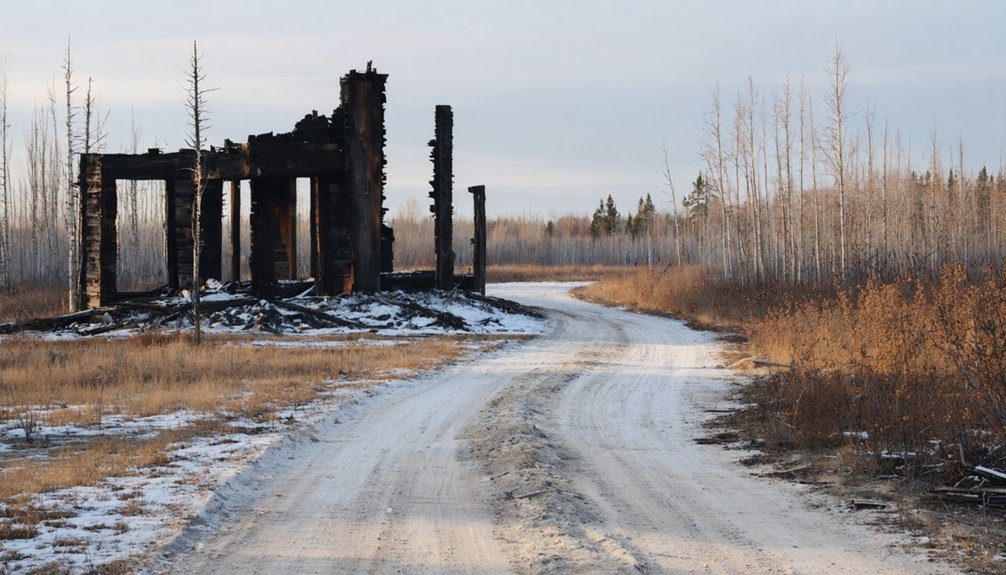
When St. Dorothy’s Catholic Church burned down on October 24, 2014, the town lost its last recognizable landmark. That fire didn’t just destroy a building — it erased a living symbol of historical preservation that had quietly anchored the site for over a century.
You can still drive out to Dorothy, but you’ll find no church silhouette breaking the flat northwestern Minnesota skyline anymore. Community decline had already stripped away the grain elevator, the school, and most of the houses long before the flames arrived. The fire simply delivered the final blow.
What remains now is open land, scattered remnants, and silence. If you’re chasing authentic ghost-town atmosphere, that absence tells a more powerful story than any preserved structure ever could.
Is Dorothy, Minnesota Worth the Drive?
Whether Dorothy is worth the drive depends entirely on what you’re looking for. If you crave open roads, quiet landscapes, and raw history, it delivers. This isn’t a polished heritage site — it’s a place where community memory lingers in overgrown lots and weathered structures.
Come prepared for:
- A quick roadside stop — Dorothy rewards curiosity, not long itineraries.
- Honest historical preservation — what remains is unfiltered, unglamourized, and real.
- Wide-open northwestern Minnesota scenery — the landscape itself tells the story.
You won’t find interpretive signs or gift shops. You’ll find silence where a railroad once ran and a church once stood. For travelers who value authentic, unscripted exploration, Dorothy is absolutely worth the detour.
Where Is Dorothy and How Do You Get There?
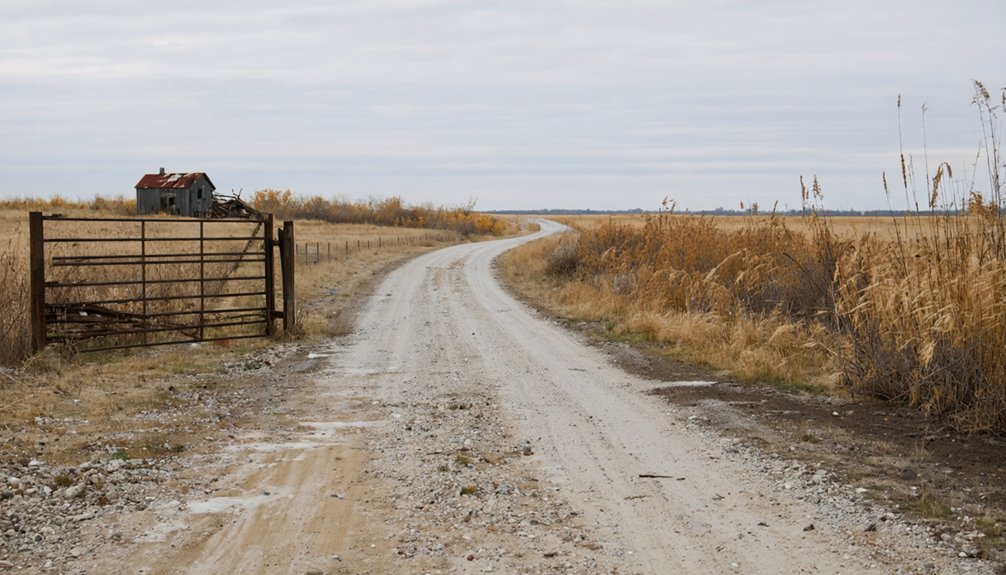
Dorothy sits in Louisville Township, Red Lake County, in northwestern Minnesota, roughly within the orbit of Red Lake Falls. You can reach it by taking rural county roads off Highway 32 or Highway 59, both of which cut through this stretch of flat, agricultural terrain.
The drive itself sets the tone — sparse farmland and open sky gradually give way to the quiet, overgrown remnants of a town that time left behind.
Dorothy’s Geographic Location
Tucked into the rural expanse of northwestern Minnesota, Dorothy sits within Louisville Township in Red Lake County, not far from the small city of Red Lake Falls. Its remote setting makes it ideal for travelers chasing historical preservation stories and local legends etched into the landscape.
To orient yourself before you go, keep these three geographic anchors in mind:
- Red Lake Falls serves as your nearest hub for fuel and supplies.
- Dorothy lies along quiet rural roads that cut through flat, open farmland.
- Northwestern Minnesota’s wide skies give the drive its own reward.
You won’t find Dorothy on every map app, so download offline maps beforehand. The surrounding countryside is vast and unhurried, perfectly matching the freedom-seeking spirit you’re bringing to this road trip.
Routes To Dorothy
How you reach Dorothy depends on where you’re starting, but Red Lake Falls is your best launching point regardless of direction. From there, you’ll navigate quiet county roads through flat, open farmland that feels untouched by modern development. That sense of isolation is exactly what draws people chasing historical preservation and local legends tied to forgotten communities.
From the south, Highway 32 carries you efficiently into Red Lake Falls. From the east, US-2 connects through Crookston before you turn northwest.
GPS helps, but paper maps give you a better feel for the rural grid. Once you’re within a few miles of Dorothy, slow down. The roads narrow, signage thins out, and the landscape itself signals that you’ve crossed into somewhere the modern world largely passed by.
When Should You Visit Dorothy, Minnesota?
Since Dorothy offers little more than a roadside glimpse into a vanished community, timing your visit around daylight hours is essential. Clear afternoon light helps you appreciate what remains while honoring the spirit of historical preservation. Plan your stop around three simple priorities:
- Visit midday when natural light reveals the landscape’s quiet details and overgrown remnants.
- Avoid winter months when rural northwestern Minnesota roads can become hazardous and visibility drops markedly.
- Come during late summer or fall when the setting amplifies community nostalgia through golden fields and open skies.
You won’t need hours here — a focused thirty-minute stop captures everything Dorothy offers. Bring your camera, respect the private land surrounding the area, and let the silence tell the story.
What to Pack for a Dorothy Ghost Town Visit

Packing light makes the most sense for a stop like Dorothy, where you’ll spend more time observing than exploring. Grab your camera or smartphone and think through basic photography tips before arriving — wide-angle lenses capture the flat northwestern Minnesota landscape beautifully, while close-up shots document the weathered structures still standing.
Wear comfortable walking shoes since the terrain is uneven and rural. Bring water, a snack, and a fully charged phone for navigation, as cell service can be spotty. A notebook helps if you’re passionate about historical preservation and want to record details about what remains.
Dress in layers, especially in shoulder seasons when temperatures shift quickly. You won’t need much gear — just enough to document a town that time quietly left behind.
Other Ghost Towns Near Dorothy Worth Adding to Your Route
Dorothy fits naturally into a longer loop through Minnesota‘s ghost-town landscape, and several forgotten settlements in the region are worth adding to your route. Red Lake County and its surrounding area hold quiet remnants that reward curious travelers chasing community nostalgia and historical preservation.
Consider these nearby stops:
- Gully, Minnesota – A faded railroad town with scattered structures that reflect the same rail-dependent decline Dorothy experienced.
- Mentor, Minnesota – A small settlement where you’ll find lingering architecture and a strong sense of vanished community life.
- Oklee, Minnesota – Worth a short detour for its rural character and connection to the region’s Scandinavian settlement history.
Linking these stops creates a fuller picture of how entire communities disappeared when transportation and economics shifted away from them.
How to Visit Dorothy’s Ghost Town Without Trespassing
Visiting a ghost town like Dorothy means walking a fine line between exploration and trespassing, so you’ll want to plan your approach carefully. Much of what remains sits on private land, and even structures showing visible urban decay aren’t open for entry. Stick to public roads and roadside viewpoints where you can photograph the landscape without crossing property lines.
Dorothy rewards observation rather than hands-on exploration. You can absorb the atmosphere, document the site’s condition, and appreciate what little preservation efforts have managed to keep standing — all from a respectful distance.
Before visiting, check local county resources to understand land ownership boundaries. Keep your vehicle off private driveways, leave nothing behind, and treat every surviving remnant as the fragile historical artifact it genuinely is.
Frequently Asked Questions
Was Dorothy, Minnesota Ever Officially Incorporated as a Town?
Dorothy never officially incorporated as a town — it’s one of ghost town history’s most fascinating abandoned sites. You’ll find it existed as an unincorporated community, yet it carried the heart of an entire civilization within it.
Who Was Joseph H. Mathews, Dorothy’s First Postmaster?
You’ll find that Joseph H. Mathews served as Dorothy’s first postmaster when the office opened in 1898, making him a key figure in the town’s postmaster history and early community development.
Are There Any Local Festivals or Events Held Near Dorothy?
Don’t hold your breath for local food festivals or community parades in Dorothy itself — it’s nearly abandoned. You’ll want to explore nearby Red Lake Falls, where you’ll find livelier community events worth your time.
Has Any Preservation Group Attempted to Restore Dorothy’s Remaining Structures?
No known historic preservation or restoration efforts have targeted Dorothy’s remaining structures. You’re exploring a town that nature’s quietly reclaiming, where weathered remnants tell raw, unfiltered stories without anyone intervening to polish or preserve them.
Are There Any Documented Personal Accounts From Dorothy’s Former Residents?
You won’t find haunted stories or ghost sightings documented from former residents — ironically, the real ghosts of Dorothy, Minnesota are the silent, vanished voices of people who once called this forgotten railroad town home.
References
- https://www.onlyinyourstate.com/trip-ideas/minnesota/spooky-small-town-mn
- https://www.onlyinyourstate.com/experiences/minnesota/ghost-towns-mn
- https://quickcountry.com/minnesota-ghost-towns/
- http://wikimapia.org/13663040/Dorothy-Minnesota-Ghost-Town
- https://en.wikipedia-on-ipfs.org/wiki/List_of_ghost_towns_in_Minnesota
- https://1037theloon.com/ghost-town-in-n-minnesota-could-work-as-a-creepy-movie-location/
- https://thievesriver.com/blogs/articles/ghost-towns-in-minnesota
- https://en.wikipedia.org/wiki/Category:Ghost_towns_in_Minnesota
- https://dbpedia.org/page/Dorothy
- https://www.viamichelin.com/maps/united_states_of_america/minnesota/_/dorothy-56750