Starting your ghost town road trip to Ebony, Texas is easier than you’d think. Head 23 miles west of Goldthwaite in Mills County, and you’ll find a town that once peaked at 113 residents before fading into silence by the late 1950s. Use GPS coordinates 31.48155190, -98.89782580 to navigate precisely. You can still walk the cemetery and community center grounds. Stick around, because there’s a fascinating story behind how this forgotten town got its name and disappeared.
Key Takeaways
- Ebony, Texas sits approximately 23 miles west of Goldthwaite in Mills County, making Goldthwaite an ideal base for your trip.
- Use GPS coordinates 31.48155190, -98.89782580 to navigate precisely to this remote ghost town in open ranch country.
- Key landmarks include a historic cemetery and community center, both marked on early 1980s highway maps.
- Nearby ghost towns like Mullin, Priddy, and Zephyr can be combined with Ebony for a full-day regional route.
- The town is virtually abandoned since the late 1950s, offering an authentic, unhurried ghost town exploration experience.
What Was Ebony, Texas Before It Became a Ghost Town?
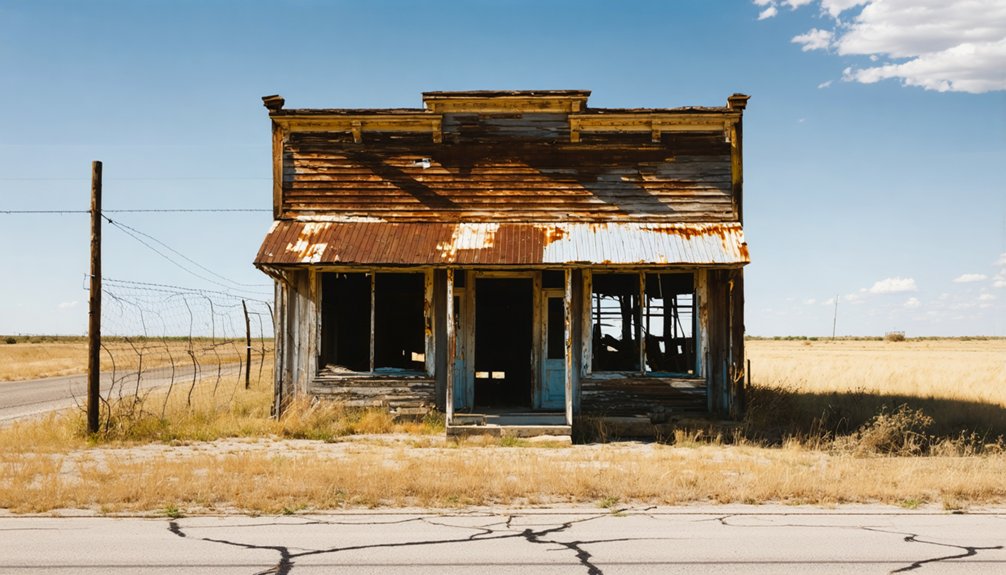
Before it earned its ghost town reputation, Ebony, Texas was a small but functioning rural community that took root in the 1880s under a different name entirely. Settlers first called it Buffalo, but federal postal rules rejected that name when residents applied for a post office in 1891.
The community renamed itself Ebony, honoring a local cowboy named Ebony Shaw, and opened its post office on January 5, 1891, with Victoria Griffin serving as the first postmistress.
From those early years, the town grew steadily, reaching 113 residents by 1930. Local legends tied to that cowboy namesake add color to the historical architecture and rural character that once defined this Mills County settlement.
You’re stepping into a place that genuinely lived before it disappeared.
How Ebony Got Its Name After Rejecting Buffalo
When residents first applied for a post office in 1891, federal officials rejected the name Buffalo, likely because too many Texas towns already claimed it.
The community needed a new name fast, and they found their answer in a local cowboy named Ebony Shaw, whose name they adopted to secure postal approval.
You can trace the town’s entire identity back to that single bureaucratic moment on January 5, 1891, when the post office officially opened under the name Ebony.
Buffalo Name Gets Rejected
Though the name Buffalo felt like a natural fit for this fledgling Texas community, federal postal authorities had other ideas. When settlers submitted their post office application in 1891, officials rejected Buffalo outright, likely because duplicate place names already cluttered the postal system.
That rejection forced the community to rethink its identity entirely. Rather than defaulting to something generic, locals chose to honor one of their own. They named the town Ebony after Ebony Shaw, a local cowboy whose legend carried real weight in the region.
The post office officially opened on January 5, 1891, with Victoria Griffin stepping in as the first postmistress. That single naming decision now shapes how historians and road trippers connect local legends and historical architecture to the broader story of this Mills County settlement.
The 1891 Post Office
Federal postal authorities rejected the name Buffalo in 1891, and that single decision quietly rewrote this small Texas community’s identity forever.
On January 5, 1891, the post office officially opened under the name Ebony, honoring a local cowboy named Ebony Shaw. Victoria Griffin stepped in as the first postmistress, anchoring the town’s new identity with purpose.
You can appreciate how local legends surrounding Shaw gave the community something meaningful to rally behind. The name carried weight, connecting everyday life to the people who actually shaped the land.
While little town architecture from that era survives today, the post office itself represented the community’s formal recognition on the American frontier. That small building once stood as proof that Ebony existed, thrived, and mattered.
Honoring Cowboy Ebony Shaw
Behind that post office name lies a story worth knowing. When federal officials rejected “Buffalo” in 1891, locals didn’t just pull a name from thin air. They honored Ebony Shaw, a local cowboy whose presence left a mark on this corner of Mills County.
That’s the kind of local folklore that makes ghost town road trips genuinely rewarding. You’re not just passing through a forgotten dot on a map — you’re standing where real people built something meaningful around their own community figures.
Shaw’s name now anchors one of Central Texas’s quiet historical landmarks, even as the town itself faded. When you visit, remember that the name itself is the monument. It outlasted the post office, the businesses, and the population.
How the Post Office Both Built and Killed Ebony, Texas
Few forces shaped small Texas communities more decisively than the U.S. postal system, and Ebony’s story proves that point from both directions. When residents applied for a post office in 1891, federal officials rejected the name Buffalo, forcing the name change that would define this place forever.
That approval on January 5, 1891, with Victoria Griffin serving as first postmistress, gave Ebony its official identity and legitimate standing among Texas communities. Local legends suggest the renamed town thrived partly because that postal recognition attracted settlers and commerce.
But the historical architecture of community life crumbled when the post office closed around 1945. Population had already dropped from 113 residents in 1930 to just 50 by 1940. Without mail service, Ebony’s institutional backbone collapsed, and the town never recovered.
Ebony’s Population Rise and Fall From 1910 to 1950
Between 1910 and 1950, Ebony lived out a compressed version of the boom-and-bust cycle that defined so many rural Texas communities. In 1910, just 35 people called it home.
Ebony’s story was brief and brutal — 35 souls in 1910, chasing a future that rural Texas rarely delivered.
By 1930, that number had climbed to 113, supporting two businesses and enough daily activity to sustain local legends about the town’s cowboy roots and frontier character. You can almost picture the historical architecture that once anchored this small community — storefronts, a post office, structures built by settlers who believed Ebony had a future.
Then the decline hit fast. By 1940, population dropped to 50. Within a decade, the post office closed, businesses disappeared, and the community unraveled.
That forty-year arc from modest growth to near-abandonment tells you everything about the fragility of isolated rural life.
Why Ebony, Texas Became a Ghost Town by the Late 1950s
By the mid-20th century, Ebony’s decline had become irreversible, and the discontinuation of its post office around 1945 stripped the community of its last major anchor.
Once the post office closed, residents lost a critical hub for daily life, and businesses that had already thinned out couldn’t survive the shrinking population.
If you’re tracing Ebony’s ghost town story, you’ll find that the loss of these core services created a cycle that left the town virtually abandoned by the late 1950s.
Post Office Closure Impact
When Ebony lost its post office around 1945, the community lost more than a mail stop—it lost the institutional anchor that had defined it as a place since 1891. Post offices carried real weight in rural Texas. They put a town on federal maps, gave residents an official address, and signaled that a community was worth recognizing.
Once that designation disappeared, Ebony’s identity began unraveling fast. Businesses had already thinned out, and without postal service, there was little reason to stay. By the late 1950s, the town sat virtually abandoned.
Today, historical preservation efforts keep fragments of Ebony’s story alive, and local legends surrounding figures like Ebony Shaw give curious road-trippers something worth tracking down. You’re not just visiting a ghost town—you’re reading its final chapter.
Population Decline Factors
Ebony’s population collapse didn’t happen overnight—it unfolded across decades as the pressures common to small rural Texas towns stacked up one by one.
Economic decline hit hard after the post office closed around 1945, stripping the community of its last reliable anchor. Without that hub, businesses followed, families relocated, and the social fabric unraveled fast.
By the late 1950s, virtually no one remained.
If you dig into the family stories connected to Ebony, you’ll find a familiar pattern: younger generations left for cities offering steady work, while older residents aged out of the community.
The population peaked at 113 in 1930, then dropped to 50 by 1940—a trajectory that left little room for recovery.
Understanding that arc makes visiting the site far more meaningful.
Lost Community Services
What turned Ebony from a living community into a ghost town wasn’t a single dramatic event—it was the quiet disappearance of the services that kept rural life functional. When the post office closed around 1945, Ebony lost its clearest symbol of civic identity.
Businesses had already faded, leaving residents with fewer reasons to stay. You can almost read that story in the remaining historical architecture—structures that once supported a population of 113 now stand as silent markers of what existed here.
Local legends about the cowboy Ebony Shaw, whose name the town proudly carried, feel heavier against that backdrop of loss. Once the services vanished, the people followed.
How to Find Ebony, Texas From Goldthwaite
If you’re mapping out a Central Texas ghost town road trip, Ebony sits about 23 miles west of Goldthwaite in the far western reaches of Mills County. Head west out of Goldthwaite and let the open highway pull you deeper into quiet ranch country.
Goldthwaite itself makes a solid launching point — grab some local cuisine before you leave, since services disappear fast once you push westward. Keep your eyes open for vintage signage along the route, as older markers occasionally point toward communities that barely exist anymore.
Ebony’s coordinates land around 31.48155190, -98.89782580 if you’re running GPS. The drive is straightforward, the landscape honest, and the destination rewards anyone willing to chase down a place most maps have already forgotten.
What’s Left to See in Ebony, Texas Today
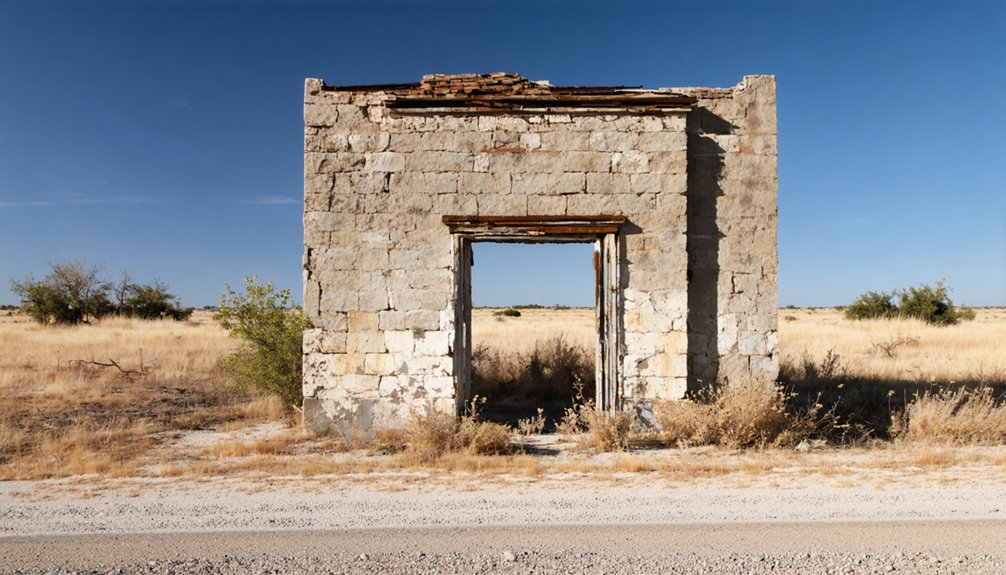
When you arrive in Ebony today, you won’t find much standing, but early 1980s highway maps still documented a cemetery and a community center on the site.
Those two features represent the most concrete reminders of a town that once supported over a hundred residents.
If you make the trip, treat what’s left as a historical marker rather than a destination with visible infrastructure.
Cemetery and Community Center
Though Ebony’s busiest days are long gone, you’ll still find a couple of quiet reminders that a real community once took root here. Early 1980s highway maps confirmed two surviving landmarks: a cemetery and a community center. These aren’t polished tourist attractions, but that’s exactly what makes them worth your time.
The cemetery connects you to local legends and the families who carved out lives in this remote stretch of Mills County. Walking it feels like stepping into heritage preservation made personal.
The community center, modest as it may be, hints at the social bonds that once held Ebony together.
Come with respectful curiosity, and you’ll leave with something most tourist stops can’t offer — a genuine sense of place.
Limited Physical Remnants
Beyond the cemetery and community center, physical remnants at Ebony are scarce — and that scarcity tells its own story. When you walk this land, you’re stepping through a settlement that once held over a hundred residents, two active businesses, and a functioning post office. That world is mostly gone now.
Don’t expect surviving historical architecture or well-marked sites. What you’ll find instead are open stretches of Mills County terrain, quiet enough to make local legends feel plausible.
Residents who knew Ebony in its final years carried stories that never made it into formal records.
That absence is precisely what draws certain travelers here. You’re not consuming a polished attraction — you’re reading a landscape that refused to preserve itself neatly, and that demands something honest from you in return.
The Cemetery and Community Center Worth Stopping For
Even as Ebony faded into near-total abandonment by the late 1950s, two features survived long enough to appear on early 1980s highway maps: a cemetery and a community center. These aren’t just remnants — they’re your connection to the people who built something real in western Mills County.
By the late 1950s, Ebony had nearly vanished — yet a cemetery and community center held on.
The cemetery grounds invite quiet reflection, where weathered markers carry names tied to local legends of ranching families and frontier life.
The community center, modest as it may be, hints at historic architecture that once anchored social life for residents who peaked at 113 strong back in 1930.
When you roll through Ebony, don’t just pass by. Stop, walk the grounds, and let the silence tell the story that the maps can barely hold.
Other Ghost Towns Near Ebony Worth Adding to Your Route
Ebony doesn’t have to be your only stop. Mills County and its neighbors hold several forgotten communities worth weaving into your route. You’ll find historical architecture, local legends, and quiet roads connecting each site into one compelling journey.
- Goldthwaite – The county seat sits 23 miles east and offers historical architecture that anchors the region’s past.
- Mullin – A small Mills County town with its own decline story and local legends worth uncovering.
- Priddy – Northwest of Goldthwaite, this faded community adds another layer to Central Texas ghost town history.
- Zephyr – Located in Brown County, Zephyr carries local legends and remnants that reward curious travelers.
String these stops together, and you’ve built a full-day route through genuinely forgotten Texas.
How to Plan a Mills County Ghost Town Road Trip
Planning a Mills County ghost town road trip starts with a single decision: pick Goldthwaite as your base. From there, Ebony sits just 23 miles west, making it an easy first stop. Fill your tank, download an offline map, and head out early while the light is flat and golden.
Build your route around local legends and the cultural significance each settlement carries. Ebony’s story — from Buffalo to ghost town in under a century — sets the tone perfectly. Photograph the cemetery and community center, then push deeper into the county toward other abandoned settlements.
Keep your schedule loose. The best discoveries happen when you turn down an unmarked road without pressure. This region rewards the curious, the unhurried, and the genuinely free.
Frequently Asked Questions
Is There an Entrance Fee to Visit Ebony, Texas?
You’ll pay no entrance fee to explore Ebony, Texas! It’s an open ghost town where you’re free to roam, connecting with historical preservation efforts and uncovering local legends scattered across this hauntingly abandoned Central Texas landscape.
Are There Any Guided Ghost Town Tours Available in Mills County?
Guided tours aren’t your compass here—you’ll chart your own course through Mills County’s historical landmarks and local legends. Ebony’s ghost town spirit rewards independent explorers who crave freedom over structured tours.
Can You Camp Overnight Near the Ebony, Texas Ghost Town Site?
No official campgrounds exist near Ebony, so you’ll need to research private land permissions and campground regulations carefully. Always prioritize safety considerations, as this remote Mills County ghost town offers little infrastructure for overnight adventurers seeking freedom.
Is the Ebony Cemetery Open to Genealogical Research Visits?
Weathered stones whisper local legends beneath Texas skies—you’ll likely find the Ebony cemetery accessible for genealogical research, as these historical landmarks typically welcome visitors, but you should contact Mills County officials to confirm current access policies.
What Is the Best Time of Year to Visit Ebony?
Spring and fall offer you the best seasonal weather for exploring Ebony’s quiet, windswept grounds. You’ll dodge summer’s brutal heat, and you might catch nearby local festivals that bring Central Texas’s rich heritage beautifully alive.
References
* https://www.texasalmanac.com/places/buffalo-3