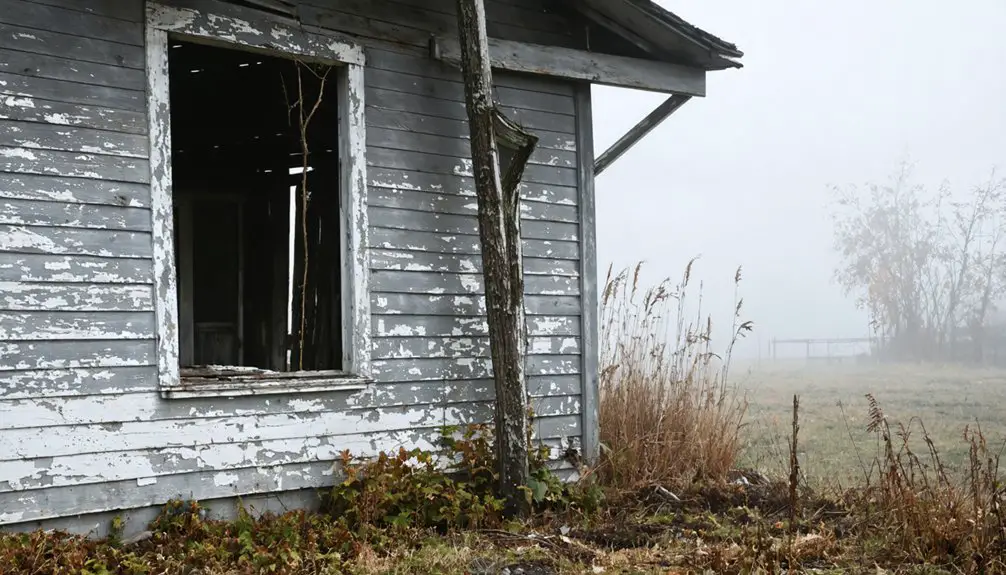
Planning a ghost town road trip to Finn Town, Michigan means visiting a place that’s more memory than landmark. You’ll find it on Buttersville Peninsula near Ludington, where over 30 Finnish immigrant families built homes, fish shanties, and a dance hall along Pere Marquette Lake’s southern shore in the 1860s. No markers identify the site today — just silent shoreline and beach grass hiding buried stone foundations beneath the sand. There’s more to this vanished community’s story than meets the eye.
Key Takeaways
- Finn Town is located on Buttersville Peninsula along the southern shore of Pere Marquette Lake, near Ludington, Michigan.
- No markers or physical signs identify the site, so bring historical maps and conduct prior research before visiting.
- Stone foundations from original structures are buried beneath beach sand, leaving virtually no visible remains above ground.
- The last visible structure, a weathered red fish shanty, disappeared around 1950, making this a truly vanished ghost town.
- Nearby Old Victoria, roughly 15 miles south of Ontonagon, offers well-preserved log cabins as a complementary road trip stop.
Where Was Finn Town, Michigan?
Tucked along the southern shore of Pere Marquette Lake, Finn Town once occupied the Buttersville Peninsula near Ludington’s harbor channel on Lake Michigan’s eastern shore. Finnish immigrants established this vibrant fishing community during the 1860s, creating a cultural heritage worth exploring today.
If you’re planning a visit, drive to Ludington, Michigan — but don’t expect locals to recognize the name. Most haven’t heard of it.
The site itself holds no physical traces; preservation efforts never reached Finn Town before time erased it completely. Beach sand now covers what were once wood homes, fish shanties, and ice houses.
Despite its invisibility, understanding where Finn Town stood helps you appreciate the determined immigrant families who carved out their lives along this rugged lakeshore.
Who Were the Finnish Settlers That Built Finn Town?
During the 1860s, Finnish immigrants arrived along Lake Michigan’s eastern shore and built Finn Town from the ground up. They carried their Finnish culture across an ocean, determined to carve out independence through fishing, farming, and sheer will.
These settlers created something remarkable from nothing:
These Finnish settlers built something extraordinary from nothing—community, identity, and independence on a remote Michigan shoreline.
- Over 30 families formed a self-sufficient community bound by shared immigrant history
- A central dance hall served as church, school, and social gathering space
- Wood homes, fish shanties, and ice houses defined their hardworking coastal lifestyle
- Economic freedom came through fishing and farming, free from outside dependence
You’re looking at people who refused to surrender their identity while building a new life. Their courage transformed a remote Michigan shoreline into a living, breathing community.
How Do You Get to the Finn Town Site Today?
Getting to Finn Town requires some mental adjustment before you even start the drive—you’re heading to a place that exists more in history books than on any modern map.
Drive to Ludington, Michigan, and navigate toward the Buttersville Peninsula along Lake Michigan’s eastern shore, near Pere Marquette Lake’s southern shoreline.
Don’t expect locals to recognize “Finn Town” by name—most haven’t heard of it. Pull up historical preservation resources before arriving, since no markers guide you there.
You’ll find stone foundations blending into beach sand where wood homes and fish shanties once stood.
Follow visitor guidelines by respecting the natural landscape—nothing remains to touch or disturb, but the shoreline itself tells the story.
Bring historical maps, your curiosity, and realistic expectations.
What Remains at Finn Town’s Original Site?
Once you arrive at the site, the answer to what remains is both simple and sobering—almost nothing. The Buttersville Peninsula has swallowed nearly every trace of this once-vibrant Finnish community. Settlement remnants and historical artifacts have either disappeared or blended invisibly into the landscape.
Here’s what you’ll actually encounter:
- Stone foundations buried beneath beach sand where fish shanties once stood
- Shoreline silence where 30+ families once laughed, worked, and gathered
- Scattered beach grass covering ground where wood homes and ice houses stood
- Open sky where a dance hall once served as church, school, and community heart
The last visible structure, a weathered red fish shanty, vanished around 1950.
What remains isn’t physical—it’s the weight of knowing something irreplaceable once thrived here.
Which Ghost Towns Near Ludington Are Worth Visiting?
While Finn Town’s shoreline offers little more than silence and buried stone, the region surrounding Ludington holds ghost town experiences worth adding to your itinerary.
Drive roughly 15 miles south of Ontonagon to reach Old Victoria, a site that delivers genuine historical preservation you can actually see and touch. Unlike Finn Town’s vanished footprint, Old Victoria’s hand-hewn log cabins still stand on their original foundations from the Victoria Copper Mine era.
Old Victoria’s hand-hewn log cabins still stand — history you can actually see and touch.
The Society for the Restoration of Old Victoria, Inc. actively maintains the site’s cultural heritage, giving you a tangible connection to Michigan’s Finnish immigrant past.
You can also time your visit around Log Cabin Day in June or the Arts & Crafts Fair in August for an immersive, living experience of the region’s history.
Frequently Asked Questions
When Did Finn Town’s Population Reach Its Peak Size?
Like a flame before it flickers out, Finn Town peaked in the 1860s. You’ll find this ghost town history fascinating—over 30 families thrived here before these abandoned settlements faded into Michigan’s forgotten past.
What Fishing Methods Did Finn Town Residents Originally Use?
Unfortunately, you won’t find specific historical fishing techniques documented for Finn Town’s settlers. What’s known is they practiced traditional fishing methods common to 1860s Finnish immigrants, making their community thrive through determined, hands-on historical fishing expertise along Lake Michigan’s shores.
Are There Guided Tours Available Specifically for Finn Town Visitors?
No guided tours exist, no marked trails await you — Finn Town’s ghost town legends live only in memory. You’ll explore freely, uncovering tourist attractions independently, driving to Ludington and discovering this vanished Finnish settlement entirely on your own terms.
What Happened to the Families Who Abandoned Finn Town?
You’d find that Finn Town’s families scattered as fish populations dwindled, leaving behind ghost town legends and abandoned buildings. They relocated, repurposing structures along West Loomis Street, trading their tight-knit fishing heritage for survival elsewhere by mid-20th century.
Is Finn Town Recognized on Any Official Michigan Historical Registry?
You won’t find Finn Town on any official Michigan historical registry. Its urban legends and ghost stories live only in the memories of older Ludington residents, as no formal recognition preserves this forgotten Finnish fishing community.
References
- https://www.swedishfinnhistoricalsociety.org/2020/10/11/finn-town/
- https://www.upnorthmichigan.com/historic/oldvict.html
- https://www.mlive.com/travel/2016/10/michigan_ghost_towns.html
- https://en.wikipedia.org/wiki/List_of_ghost_towns_in_Michigan
- https://www.reddit.com/r/Ludington/comments/n4d020/finn_town/