Before you plan your ghost town road trip to Kirk, Texas, you need to know there are actually two towns with that name. Limestone County’s Kirk dates back to the 1870s, built by German settlers, and still has faint traces worth photographing. Bexar County’s Kirk was a railroad junction that vanished entirely by the 1950s. Each tells a different story of Texas decline, and knowing which one suits your route makes all the difference.
Key Takeaways
- Texas has two ghost towns named Kirk: one in Limestone County and one in Bexar County, each with distinct histories worth exploring.
- Limestone County’s Kirk sits 7 miles east of Mart, offering documented German settler history dating to the 1870s via rural backroads.
- Bexar County’s Kirk, 14 miles southwest of San Antonio near I-35, vanished by the 1950s and now fuels local ghost stories.
- Both Kirks declined due to railroad abandonment, though Limestone’s fade was gradual while Bexar’s disappeared within a decade after WWII.
- Visiting either Kirk means bearing witness to fading history, as preservation efforts are minimal and last traces are slowly disappearing.
Which Kirk, Texas Are You Looking For?
Before you load the car and punch Kirk, Texas into your GPS, you need to know that two separate Texas communities shared that name—one tucked into Limestone County and one sitting in southwestern Bexar County near Von Ormy.
Each site carries its own history, geography, and roadside character. Limestone County’s Kirk traces back to German farmers in the 1870s, building a documented timeline that ghost-town researchers and urban legends enthusiasts can actually follow.
Bexar County’s Kirk rose as a railroad junction community and vanished from maps by the 1950s, leaving behind folklore traditions tied to postwar abandonment near present-day Interstate 35.
Knowing which Kirk you’re chasing determines your route, your research, and what you’ll actually find when you arrive.
Kirk, Texas in Limestone County: What Survived a Century of Decline
When German farmers put down roots in Limestone County during the 1870s, they built something meant to last—and in a stubborn, diminished way, Kirk did.
At its peak, the community supported four stores, a cotton gin, and a school serving 122 students. The post office ran from 1890 to 1914 before Mart absorbed postal duties.
At its peak, Kirk claimed four stores, a cotton gin, and 122 students—before Mart quietly swallowed its post office.
By 1948, Kirk still held two businesses, two churches, a school, and a cemetery. The school merged into the Mart Independent School District in 1968, marking another quiet loss.
Today, the population hovers near ten.
You won’t find dramatic urban legends here—just a documented, honest fade. Preservation efforts remain minimal, but the cemetery and scattered structures still anchor the site seven miles east of Mart, waiting for curious road-trippers willing to look.
Kirk, Texas in Bexar County: A Railroad Town That Vanished by the 1950s
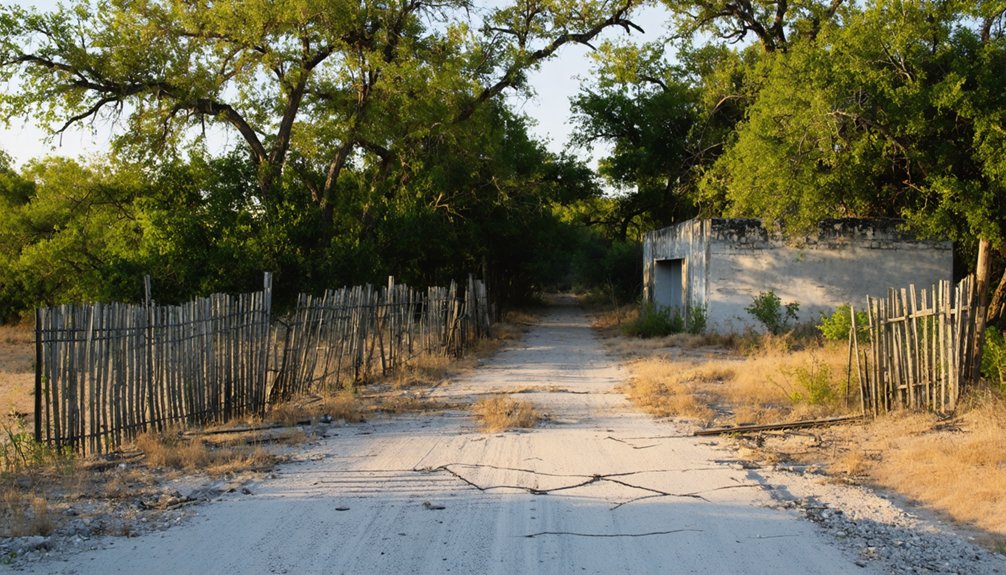
Southwest of San Antonio, where the International-Great Northern Railroad crossed the San Antonio Southern Railway near present-day Interstate 35, another Kirk once existed—this one in Bexar County, about 14 miles from downtown.
By the 1930s, it had a station and scattered houses, with kids attending school in Von Ormy. It wasn’t a booming settlement, but it was real, functional, and tied directly to railroad geography.
Then the postwar years hit, traffic patterns shifted, and Kirk quietly disappeared from maps by the 1950s.
Today, the site feeds local urban legends and ghost stories more than it feeds historical records. If you’re routing through southwestern Bexar County along I-35, you’re already passing through Kirk’s old footprint—you just won’t see a sign telling you so.
Limestone County or Bexar County: Which Kirk Should You Visit?
When you’re planning your Kirk road trip, you’ll need to pick a county first, because two separate Texas communities carried that name. Limestone County’s Kirk offers the stronger historical footprint, with a documented timeline stretching from 1870s German settlement through post office closure, school consolidation, and population collapse.
If you’re already routing through San Antonio, though, Bexar County’s Kirk fits naturally into a southwestern regional loop along the I-35 corridor.
Two Kirks, One Choice
Before you load up the car and point it toward Kirk, Texas, you’ll need to answer one question: which Kirk? Two separate communities shared the name, and they tell very different stories.
Limestone County’s Kirk grew from German farming roots in the 1870s, leaving behind a documented trail of post offices, cotton gins, and a school.
Bexar County’s Kirk was a railroad junction near San Antonio that faded into urban decay after World War II, swallowed by the expanding metro sprawl.
Both communities bust ghost town myths that abandonment happened overnight. Each declined gradually through losing railroads, schools, and businesses.
Your choice shapes your entire route, so nail down the county before you hit the road.
Historical Footprint Comparison
Both Kirks left marks on the Texas map, but those marks aren’t equal in depth or clarity. Limestone County’s Kirk gives you a documented timeline you can actually follow — German settlers in the 1870s, a post office, four stores, a cotton gin, and a school serving 122 students.
You can trace the economic decline through concrete milestones: business closures, postal service loss, and school consolidation in 1968. Population shifts tell the same story, dropping from 172 in 1900 to just 10 by 2000.
Bexar County’s Kirk offers far less. A railroad junction, a few houses, and a postwar disappearance — that’s roughly the entire record. If historical depth matters to your road trip, Limestone County wins without debate.
Regional Route Fit
Where your road trip already takes you should drive the Kirk decision more than history alone. If you’re threading through Central Texas, Limestone County’s Kirk sits seven miles east of Mart, fitting naturally into a rural backroads loop. You’ll find the strongest historical footprint there, complete with ghost stories rooted in decades of decline and near-abandonment.
If San Antonio anchors your route, Bexar County’s Kirk slots easily into a southwestern swing near I-35. Urban legends around railroad ghost towns tend to thrive in corridors like this one, where postwar abandonment left little trace behind.
Match your Kirk to your direction of travel. Both reward curiosity, but neither justifies a major detour alone. Build the site into a larger route, and it earns its place.
How to Reach Kirk, Texas
Getting to Kirk, Texas depends on which Kirk you’re chasing. Both sites reward the effort, but the routes differ substantially.
For Limestone County Kirk, head seven miles east of Mart on rural farm roads. This site carries the strongest cultural influences, shaped by German settlers whose economic impacts built cotton gins, stores, and schools across the 1800s.
For Bexar County Kirk, you’re steering through southwestern Bexar County near the I-35 corridor, roughly 14 miles southwest of downtown San Antonio. This version rose through railroad economic impacts at the International-Great Northern and San Antonio Southern junction before postwar decline erased it from maps.
Confirm your destination county before leaving home. Two communities share one name, and hitting the wrong road wastes a trip.
Why Kirk Mirrors the Classic Texas Ghost Town Pattern
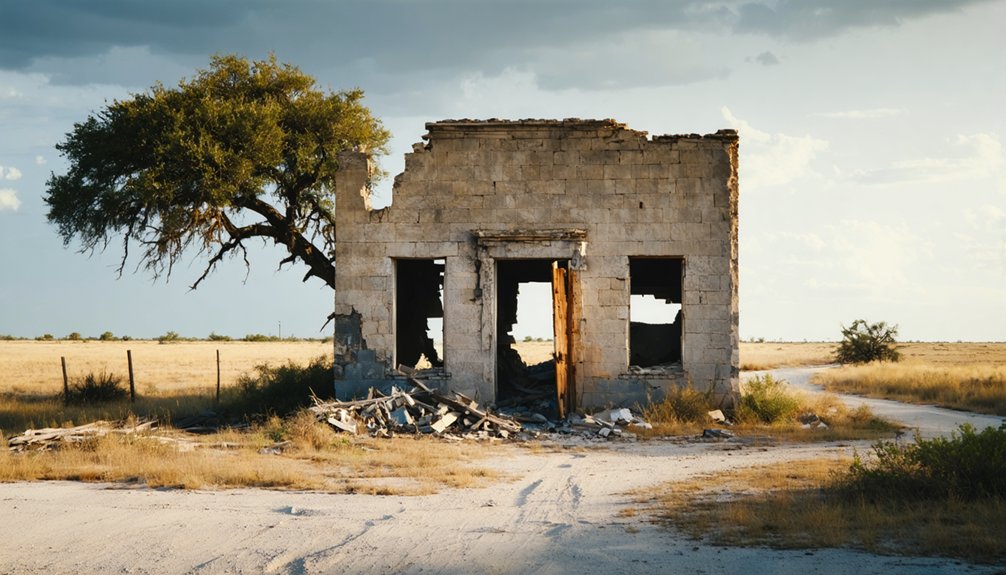
Once you’ve traced Kirk’s history, you’ll recognize a pattern that repeats across dozens of Texas ghost towns — railroads build communities, and their decline kills them.
When the lines serving Bexar County’s Kirk lost traffic after World War II, the settlement vanished from maps within a decade.
Then, just as the railroad dealt the first blow, school consolidation delivered the final one — Limestone County’s Kirk lost its last institutional anchor in 1968 when the Mart Independent School District absorbed its one-room school.
Railroad Decline Drives Abandonment
Few Texas ghost towns fade without a reason, and Kirk’s story follows a pattern you’ll recognize the moment you study the map: when the railroad shifted or stopped serving a community, the businesses dried up, the post office closed, and the people left.
Bexar County’s Kirk sat at two railroad junctions, yet postwar decline erased it from maps by the 1950s. That disappearance carries real cultural significance — it represents entire communities that built lives around rail access, then lost everything when that access vanished.
Limestone County’s Kirk followed a similar arc, its post office closing in 1914 as economic energy drained away.
Preservation efforts remain minimal in both locations, making your road trip an act of bearing witness before the last traces vanish entirely.
School Consolidation Signals End
School consolidation doesn’t just close a building — it signals that a community has lost the population needed to sustain itself.
In 1968, the Mart Independent School District absorbed Kirk’s local school, effectively marking the end of organized community life in Limestone County’s Kirk. What had once served 122 students in 1897 simply couldn’t justify its existence anymore.
For you as a road-tripper invested in historical preservation, that date matters. It’s a concrete milestone that separates Kirk’s active years from its quiet fade into near-abandonment.
Community memory lives in details like these — the schoolhouse that once anchored daily life, now gone into a larger district. When you visit Kirk, you’re walking ground where an entire civic identity slowly dissolved, one institution at a time.
Frequently Asked Questions
Can You Camp Near Either Kirk, Texas Ghost Town Location?
Neither Kirk location has designated campgrounds, but you’ll find nearby options if you research camping regulations carefully. Embrace local wildlife, wide skies, and Texas freedom as you explore these forgotten ghost towns on your own terms.
Are There Guided Ghost Town Tours Available in Limestone County?
With 122 students once filling its school, Limestone County’s Kirk doesn’t offer formal guided tours of its abandoned sites or haunted legends — but you’re free to explore independently and uncover its faded history yourself.
What Is the Best Time of Year to Visit Kirk?
Spring and fall offer the best travel months for Kirk, Texas. You’ll enjoy mild seasonal weather, making exploration comfortable. Avoid summer’s brutal heat and winter’s unpredictability so you can freely roam this fascinating ghost town.
Are There Any Historical Markers Specifically Dedicated to Kirk, Texas?
No confirmed historical markers specifically dedicated to Kirk, Texas have been found, but you’ll discover the site’s historical significance and cultural preservation through its abandoned landmarks, cemetery, and the broader Texas ghost-town legacy surrounding it.
Is Photography Permitted on Private Land Surrounding Kirk’s Remains?
You’ll need landowner permission before shooting on private land surrounding Kirk’s remains. Private land regulations strictly govern photography permissions, so always respect boundaries, seek consent, and you’ll capture Kirk’s haunting beauty without legal trouble.
References
- https://www.facebook.com/groups/1784294158550093/posts/4233084370337714/
- https://en.wikipedia.org/wiki/Kirk
- https://www.tshaonline.org/handbook/entries/kirk-tx-limestone-county
- https://mix941kmxj.com/from-the-biggest-little-city-in-texas-to-ghost-town-kirklands-tragedy/
- https://www.facebook.com/groups/1784294158550093/posts/4233863710259780/
- https://en.wikipedia.org/wiki/List_of_ghost_towns_in_Texas
- https://www.texasescapes.com/TexasPanhandleTowns/Kirkland-Texas.htm
- https://www.tshaonline.org/handbook/entries/kirk-tx-bexar-county