Mineral Springs sits about 2.5 miles southeast of Tatum, Texas, off Highway 149 in Panola County — but don’t expect signage. This ghost town was founded by African-American settlers in the 1870s, briefly revived by a railroad in 1888, then abandoned before 1910 when the trains stopped coming. Dense pine forest has swallowed everything. Pack boots, insect repellent, water, and a camera before you go. There’s far more to this forgotten place than the woods reveal.
Key Takeaways
- Mineral Springs is located 2.5 miles southeast of Tatum, Texas, accessible via the south side of Texas State Highway 149 in Panola County.
- Pack water, sturdy boots, insect repellent, long sleeves, and a camera before exploring the dense, overgrown piney woods terrain.
- No buildings, markers, or infrastructure remain; reclaimed wilderness offers wildlife observation, silence, and imagination-fueled exploration of a forgotten settlement.
- Inform someone of your route beforehand and bring reliable navigation tools, as the dense forest offers no clear directional landmarks.
- Pair your visit with other Texas ghost towns like Terlingua, Lobo, and Indianola to enrich your road trip experience.
What Mineral Springs Actually Was Before It Became a Ghost Town
Before Mineral Springs became a ghost town swallowed by East Texas pines, it was a living, breathing community built on hope — specifically, the hope that a local spring held miraculous healing powers.
African-American settlers arrived in the 1870s, establishing a church that anchored both cultural heritage and daily life.
Health tourists followed, drawn by claims of medicinal waters.
Then came the Texas, Sabine Valley, and Northwestern Railway in 1888, briefly injecting economic energy through timber shipments and flag-stop service.
But when the spring’s curative claims collapsed under scrutiny, so did the town’s future.
The railway stop vanished before 1910.
By 1948, the church had fallen, and woods had reclaimed every clearing.
Today, architectural remnants are practically nonexistent — nature has erased almost everything, leaving only stories behind.
The African-American Settlers Who Founded Mineral Springs in the 1870s
When you visit Mineral Springs, you’re walking ground that African-American settlers claimed in the 1870s, building a community from scratch in the piney woods of Panola County.
They erected a church that anchored daily life, giving the settlement a spiritual and social core that held the community together for decades.
Their choice of location wasn’t random — they built around springs they believed carried healing powers, drawing health-seekers and shaping the town’s identity from its earliest days.
Community Roots In 1870s
Though the land had long held meaning for the Anadarko people who called it home, it was African-American settlers in the 1870s who planted the roots of what would become Mineral Springs. Their settlement patterns reflected both resilience and intention — they didn’t just pass through; they built.
At the heart of their community stood a church, constructed in the 1870s, that anchored social and spiritual life in the piney woods of northwestern Panola County.
When you trace the native history of this land, you’ll recognize layers of human presence stacked across centuries. These settlers added their own chapter, drawn by springs they believed carried healing power.
Their faith — in the water, in community, in each other — shaped everything that followed.
Church As Community Hub
That church wasn’t just a building — it was the spine of the entire settlement. When African-American founders raised it in the 1870s, its church architecture became the physical heartbeat of Mineral Springs.
You’re not just looking at a forgotten structure when you research this place — you’re tracing where community gatherings shaped daily life, marked celebrations, mourned losses, and forged collective identity.
These settlers built something deliberate and defiant. Freedom meant ownership, and that church represented both.
Every gathering inside those walls reinforced what they’d claimed for themselves in the piney woods of Panola County.
Settlement Around Healing Springs
Why did African-American settlers in the 1870s plant roots in this particular pocket of Panola County’s piney woods? The answer bubbles up from the earth itself. Natural springs drew these determined founders, who believed the waters carried genuine healing power.
Surrounded by rich local flora and native fauna, they built lives shaped by both faith and hope.
You’re walking into a story of community born from conviction. These settlers didn’t stumble here accidentally — they chose this land deliberately, constructing a church that anchored their growing neighborhood.
The spring’s reputation for medicinal properties attracted health-seekers, briefly transforming this woodland clearing into a destination.
That optimism defined Mineral Springs before skepticism and economic decline eventually silenced it. Understanding their courage makes your visit far more meaningful.
Why Health Seekers Traveled to Mineral Springs Hoping for a Cure
When you visit Mineral Springs, you’re stepping onto ground that once drew desperate health seekers who believed the local spring waters could cure their ailments. Early settlers named the town for these springs, and word spread quickly, pulling in health tourists hoping the mineral-rich waters held genuine medicinal power.
No scientific evidence ever backed those claims, though, and once the healing properties were exposed as unsubstantiated, the town’s brief prosperity began its irreversible collapse.
Medicinal Spring Water Claims
Before the age of modern medicine, the promise of healing waters was enough to set people on long, dusty journeys toward hope. Mineral Springs drew exactly that kind of traveler. Spring legends surrounding the local waters spread quickly, pulling health seekers into the piney woods of northwestern Panola County with expectations of cure and renewal.
You’d find layers beneath those claims, though. Native history reveals that the Anadarko people knew this land long before settlers arrived, suggesting the springs carried significance well before word spread among Anglo communities.
Early settlers built their identity around those waters, naming the entire town after them.
Science, however, never validated a single medicinal property. When doubts surfaced, the crowds stopped coming, and Mineral Springs began its quiet, irreversible slide toward abandonment.
Health Tourists Sought Cures
Health seekers didn’t need much convincing in the late 1800s—rumor of curative waters traveled faster than any newspaper headline. People suffering from ailments packed their bags and headed straight to Mineral Springs, Texas, chasing relief they couldn’t find elsewhere.
The springs sat nestled within rich local flora, surrounded by towering pines that made the piney woods feel like nature’s own sanctuary.
You can almost picture them arriving hopeful, breathing in the clean air of what was also a thriving wildlife habitat, convinced that healing waited just beneath the earth’s surface. They built their hopes on belief rather than science.
Eventually, those claims crumbled under scrutiny, visitors stopped coming, and the town quietly surrendered itself back to the woods that still hold it today.
Unproven Healing Properties Exposed
Belief, not evidence, built Mineral Springs into a destination. Word spread that the local spring’s mineral water could cure ailments, and health seekers came chasing healing myths rather than verified science. Nobody ever validated those claims — no physician, no study, no documented recovery. Yet the hope alone was enough to sustain a community for years.
When skeptics finally questioned the water’s curative powers, the town’s foundation crumbled fast. Visitors stopped arriving. Commerce dried up. The railway flag stop disappeared before 1910, and the settlement had nowhere left to turn.
You’re now free to wander where those desperate pilgrims once walked, searching for miracles the earth never promised. The woods have reclaimed everything, leaving only the silence of a dream that science refused to validate.
The Railroad That Briefly Saved Mineral Springs: Then Left It Behind
When the Texas, Sabine Valley, and Northwestern Railway pushed through Mineral Springs in 1888, it injected the struggling settlement with a pulse it hadn’t felt before. Suddenly, lumber moved out of those piney woods on iron rails, and the town breathed again.
Railroad history here is brief but electric — a flag stop meant trains only halted when someone waved them down, a fragile lifeline at best.
A flag stop was no guarantee — trains only paused for those desperate enough to wave one down.
That lifeline snapped before 1910. Once the stop disappeared, so did the economic momentum. Economic decline followed swiftly, accelerated by growing skepticism about the spring water’s curative claims.
Without healing tourists or rail commerce, Mineral Springs had nothing left to anchor it. When you walk this land today, you’re standing where ambition collapsed under the weight of two broken promises.
The Ghost Stories and Legends Still Attached to Mineral Springs

Every ghost town earns its ghost stories, and Mineral Springs has collected more than its share. When you walk the overgrown clearings where settlers once gathered around those supposedly healing waters, local folklore follows your every step.
Residents long gone left behind whispered tales of unexplained sounds near the collapsed church site, shadows moving through the dense piney woods, and voices carried on still air.
No historical architecture survives to anchor these legends to physical reality, which somehow makes them stronger. Without walls to examine or floors to cross, your imagination fills the silence.
The spring that promised miraculous cures, the railway flag stop that vanished before 1910, the African-American congregation whose church crumbled by 1948 — each abandoned chapter fuels another story you’ll carry home with you.
How to Find Mineral Springs Near Tatum, Texas
Carrying those ghost stories with you, the next step is finding the place that inspired them. Head to Tatum, Texas, then drive approximately 2.5 miles southeast until you reach the south side of Texas State Highway 149 in northwestern Panola County. You’ll know you’re entering the piney woods when dense tree lines swallow the open road.
Before exploring, fuel up on local cuisine in Tatum — you’ll want energy for *orienteering* overgrown terrain. Once you arrive, slow down and stay alert; the thick woods invite excellent wildlife observation, with native species reclaiming what settlers once cleared.
No modern facilities exist here, so arrive prepared. The freedom this site offers is raw and unfiltered — just you, the trees, and a town that history quietly swallowed whole.
What Remains at Mineral Springs Today
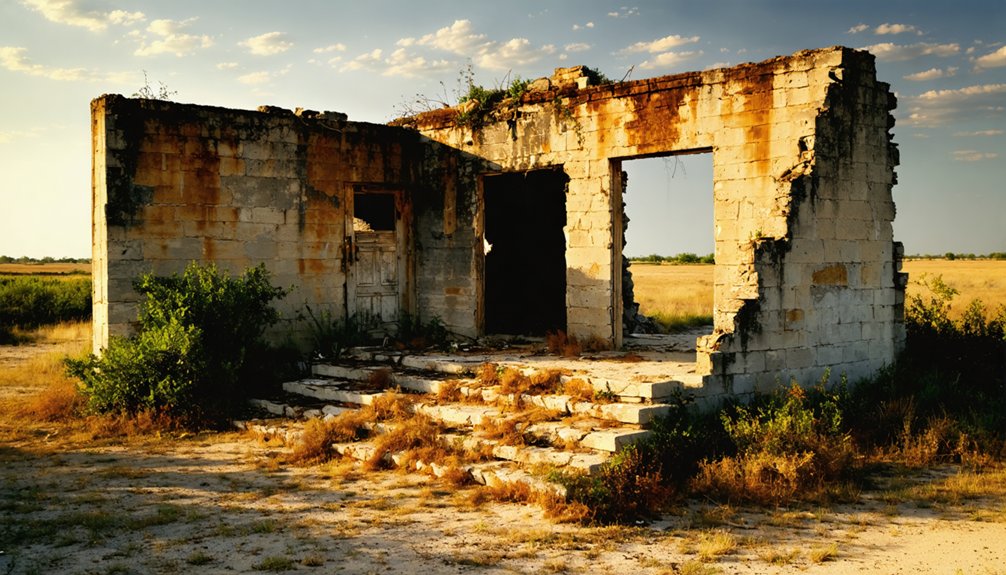
Once you step beyond the tree line, you’ll find that Mineral Springs offers no buildings, no markers, and no modern infrastructure — just dense piney woods that have quietly reclaimed every clearing the settlers once carved out.
Beyond the tree line, Mineral Springs offers no buildings, no markers — just dense piney woods reclaiming what settlers once carved out.
By 1948, the African-American church had collapsed, and the woods swallowed what remained.
Today, local flora dominates the landscape, with East Texas pines and undergrowth erasing every trace of the 1870s settlement.
The springs that once promised healing waters leave no visible evidence of their supposed powers.
Wildlife habitats now occupy spaces where families once gathered, traded, and worshipped.
You’ll walk through silence broken only by rustling canopy and birdsong.
What Mineral Springs offers isn’t ruins — it’s absence, and that absence carries its own unmistakable, haunting weight.
What to Bring to an Abandoned Texas Ghost Town
Visiting a site like Mineral Springs — where no facilities, signage, or infrastructure exist — means your preparation determines everything. Pack water, sturdy boots, and insect repellent for the dense piney woods terrain. Bring a compass or downloaded offline maps since cell service near Tatum isn’t guaranteed.
Carry a camera to document what remains — you won’t find historical artifacts lying openly, but light filtering through reclaimed woodland tells its own story. A notebook serves well when tracing local legends surrounding the medicinal springs and the collapsed 1870s African-American church.
Wear long sleeves; East Texas brush is unforgiving. Tell someone your route before leaving. Freedom in places like this comes from self-sufficiency — the more prepared you arrive, the deeper you’ll explore.
Other Texas Ghost Towns Worth Adding to Your Road Trip
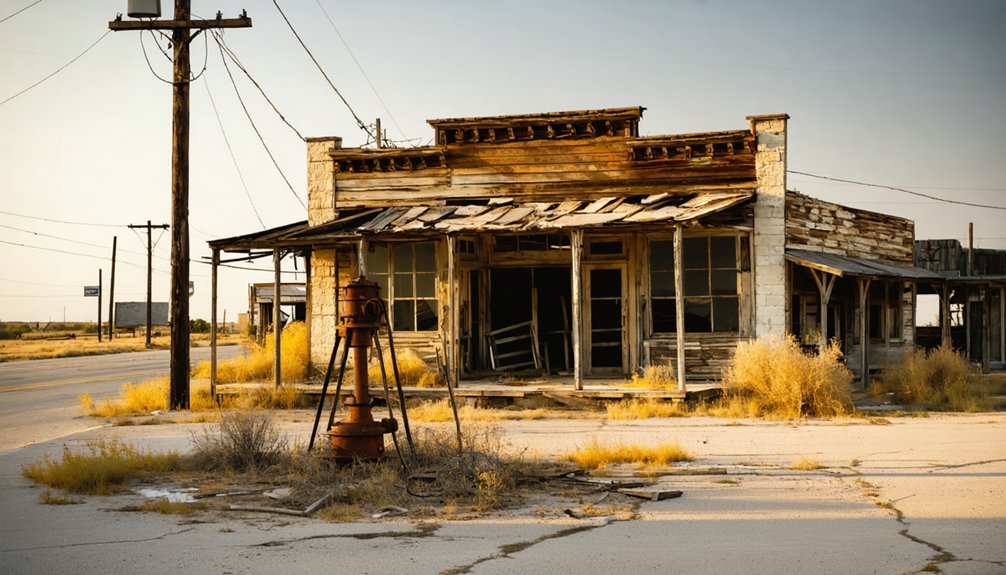
Mineral Springs rewards the curious, but Texas holds dozens of ghost towns that’ll deepen any serious road trip through the state’s forgotten past.
Terlingua, tucked against the Big Bend wilderness, delivers crumbling historical architecture alongside vivid local legends tied to mercury mining tragedies.
Lobo in Culberson County strips the landscape bare, offering eerie silence and desert-bleached structures that tell stories without speaking.
Indianola, swallowed twice by hurricanes, leaves only foundations and ghosts where a thriving Gulf port once stood.
Each stop pulls you further from the ordinary and closer to Texas as it actually lived.
Chain these towns together deliberately, study their histories before you arrive, and you’ll move through the state like someone reading a book most travelers never open.
Frequently Asked Questions
Is There an Entrance Fee to Visit Mineral Springs Ghost Town?
Like the untamed piney woods that reclaimed its clearings, Mineral Springs roams free — there’s no entrance fee. You’ll explore these historical landmarks and enjoy wildlife viewing completely unchained, answering only to your own adventurous spirit.
Are Pets Allowed When Visiting the Mineral Springs Site?
No specific pet policies exist for Mineral Springs, but since it’s an open, natural ghost town, you’ll likely find it among pet friendly areas. Keep your adventurous companion leashed while exploring the untamed, reclaimed woods!
Is Camping Permitted Overnight at the Mineral Springs Location?
The knowledge doesn’t stretch a million miles on camping regulations or overnight accommodations at Mineral Springs. You’ll want to contact local Panola County authorities before you pitch your tent, as no official information’s available here.
What Is the Best Season to Visit Mineral Springs, Texas?
Spring’s your best bet for visiting this historical landmark—you’ll dodge summer’s brutal heat, enjoy manageable trails through reclaimed woods, and cap your adventure sampling East Texas’s local cuisine in nearby Tatum before exploring Mineral Springs’ haunting, freedom-calling mysteries.
Are Guided Tours Available at the Mineral Springs Ghost Town Site?
No guided tours exist at Mineral Springs, so you’ll independently uncover its historical landmarks and local legends. Embrace that freedom — explore dense piney woods, breathe forgotten history, and let raw adventure drive your self-guided discovery of this hauntingly abandoned settlement.
References
- https://www.tshaonline.org/handbook/entries/mineral-springs-tx
- https://en.wikipedia.org/wiki/Mineral_Springs
- https://www.ccpl.org/charleston-time-machine/clementia-mineral-spring-ghost-town-never-was
- https://kids.kiddle.co/Mineral_Springs
- https://www.sfasu.edu/heritagecenter/9597.asp
- https://www.tshaonline.org/handbook/entries/mineral-water-springs-and-wells