If you’re planning a ghost town road trip to Union Center, Kansas, you won’t find it on any map—because it doesn’t exist. The town you’re actually looking for is Uniontown, a haunting ghost town in Shawnee County that was established in 1848 along the Oregon-California Trail. Cholera epidemics, fire, and shifting trade routes erased it completely by 1859. Stick around to uncover everything you need to plan your trip.
Key Takeaways
- Union Center is likely a confusion with Uniontown, a verified ghost town in Shawnee County, Kansas, established in 1848 along the Oregon-California Trail.
- Uniontown declined due to cholera epidemics, residents burning structures to control disease, and the absence of railroad access by 1859.
- Key remnants include a dated 1848 stone near Green Wildlife Area and a cholera victims’ cemetery listed on the National Register of Historic Places.
- Nearby ghost towns like Diamond Springs and Russell Springs can be added to create a multi-stop Kansas road trip itinerary.
- Visitors must respect private land boundaries, obtain permission where required, and stay on marked trails to avoid legal issues.
Is Union Center, Kansas a Real Ghost Town?
While the name “Union Center” might spark curiosity on a Kansas ghost town road trip, it’s not actually a documented ghost town — you’re likely thinking of Uniontown, a verified ghost town in Shawnee County with a far more dramatic story to tell.
Established in 1848, Uniontown once boasted 60 buildings, 14 stores, and 19 saloons along the Oregon-California Trail. Local legends tie its collapse to devastating cholera epidemics that drove settlers to burn the town entirely by 1859.
Today, no historical architecture survives above ground — only a dated stone near the Green Wildlife Area and a cholera victims’ cemetery listed on the National Register of Historic Places remain. If you’re chasing genuine frontier history, Shawnee County is where your road trip belongs.
The Real Ghost Town You Should Visit: Uniontown
Tucked into Shawnee County along the historic Oregon-California Trail, Uniontown is the real Kansas ghost town worth building your road trip around. Established in 1848, it once boasted 60 buildings before cholera epidemics and shifting trade routes erased it entirely by 1859.
Established in 1848, Uniontown once thrived with 60 buildings — until cholera and forgotten trade routes wiped it from the map.
Local legends say settlers burned the town themselves to stop the disease from spreading.
Here’s what makes Uniontown worth your drive:
- A cemetery listed on the National Register of Historic Places preserves graves of 33 cholera victims
- A dated stone near the Green Wildlife Area stands as the last surviving piece of historical architecture
- Active ground-penetrating radar research continues uncovering the town’s lost footprint
You won’t find standing buildings, but Uniontown delivers something rarer — raw, unfiltered frontier history.
What Happened to Uniontown, Kansas?
When you explore Uniontown’s history, you’ll discover a story shaped by devastating cholera epidemics in 1849 and 1850 that drove terrified settlers to burn the town and flee entirely.
What once stood as a thriving frontier hub with 60 buildings simply ceased to exist, leaving no clear record of its exact location.
Today, researchers from the Kansas Geological Survey actively use ground-penetrating radar and other advanced methods to find the lost site and a possible mass grave linked to those deadly outbreaks.
Cholera Epidemics Strike
Cholera hit Uniontown like a death sentence in 1849, and it struck again in 1850 before the town could recover. Settlers didn’t wait around — they burned the historical architecture themselves, torching buildings to stop the spread.
Local legends say the panic was absolute, the kind that erases everything you’d built.
Three brutal realities shaped Uniontown’s end:
- Two successive epidemics killed dozens, overwhelming a frontier community with no medical infrastructure.
- Residents burned their own town, destroying structures rather than risk further contamination.
- A mass grave likely holds cholera victims, its exact location still unknown despite modern research efforts.
You’re visiting a place where survival meant abandonment. The freedom settlers sought on the Oregon Trail became the very thing that killed their community.
Town Burns And Abandons
By 1850, Uniontown was already dying — and then its own residents finished the job. Terrified by back-to-back cholera epidemics, settlers made a desperate decision: burn it down. They torched their own buildings, believing fire could stop the disease from spreading further.
Within years, what had been a thriving frontier crossroads of 60 buildings vanished entirely.
You won’t find dramatic ruins here. Economic logic and fear erased this community more thoroughly than any battlefield could. Competing settlements absorbed the survivors, and shifting transportation routes made Uniontown irrelevant almost overnight.
Yet its cultural significance endures. Historical preservation efforts continue uncovering what flames and time buried. Researchers still search for a possible mass grave, proving that even a town its own people destroyed refuses to disappear completely from memory.
Lost Location Research
Where exactly did Uniontown go? Beyond urban legends and campfire stories, researchers are actively hunting answers. Dr. Blair Schneider and the Kansas Geological Survey lead serious preservation efforts using cutting-edge science to recover what cholera and time erased.
Their methods include:
- Ground Penetrating Radar — scanning beneath the soil surface to detect buried structures and potential mass graves
- Magnetic surveying — identifying underground anomalies consistent with human settlement
- Optically Stimulated Luminescence — determining when soil was last exposed to light, pinpointing disturbed ground
You’re visiting a town so thoroughly vanished that even its coordinates remain unknown. Researchers may eventually use DNA testing to confirm cholera victims’ remains. Until then, the dated stone near Green Wildlife Area‘s parking lot stands as your only honest landmark.
How Cholera and Fire Destroyed Uniontown
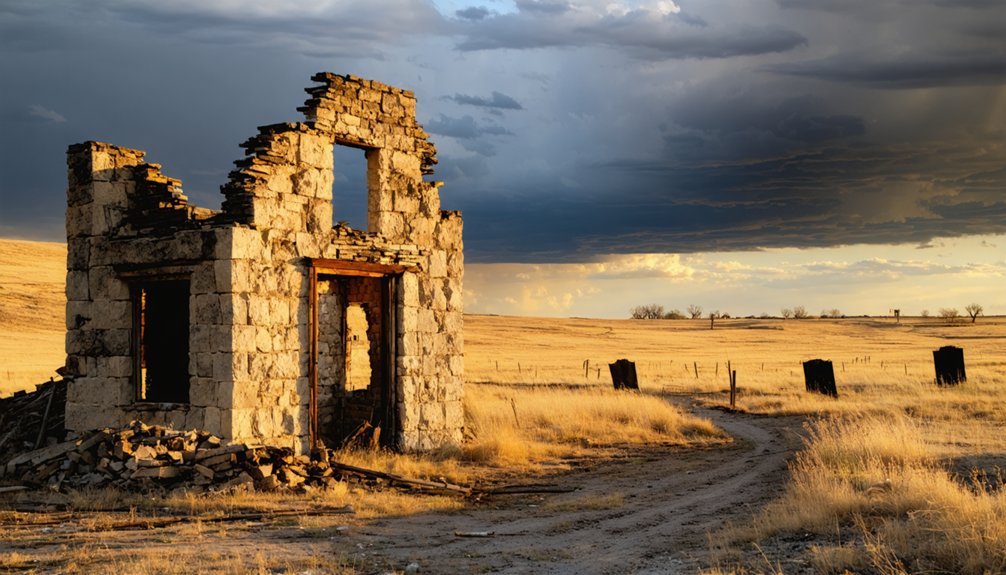
When you dig into Uniontown’s history, you’ll find that cholera epidemics in 1849 and 1850 hit the settlement with devastating force, killing dozens of travelers and terrifying those who remained.
Faced with the spreading disease, settlers made the drastic decision to burn the town to the ground in hopes of stopping the contagion.
That fire, combined with the trauma of repeated outbreaks, drove the final nail into Uniontown’s coffin, leaving the site completely abandoned by 1859.
Cholera Epidemics Struck Hard
Cholera hit Uniontown like a death sentence, tearing through the bustling trail town in 1849 and again in 1850, killing dozens of settlers and travelers who’d stopped to rest along the Oregon-California Trail.
Terrified survivors burned the town to stop the spread.
You’re looking at three devastating ripple effects:
- 33 confirmed cholera victims rest in a privately owned cemetery now listed on the National Register of Historic Places
- Historical preservation efforts have kept this cemetery intact, protecting what little physical evidence remains
- Archaeological excavation using Ground Penetrating Radar continues searching for a suspected mass grave nearby
Researchers believe more victims exist in an unmarked mass grave.
Dr. Blair Schneider’s team actively works to locate it, using soil testing and magnetic detection methods to reclaim Uniontown’s buried truth.
Settlers Burned The Town
Terrified survivors didn’t wait for cholera to finish the job — they lit Uniontown on fire themselves. After the 1849 and 1850 epidemics ravaged the population, panicked settlers torched their own buildings, believing fire would stop the disease from spreading. They weren’t wrong to be afraid — cholera killed fast and moved faster.
That desperate act of historic preservation-in-reverse erased nearly every structure overnight. Today, researchers rely on archaeological techniques like Ground Penetrating Radar, magnetic surveys, and Optically Stimulated Luminescence to recover what the flames consumed.
You won’t find charred ruins waiting for you, but you’ll find a story worth chasing. The fire didn’t just destroy a town — it buried a chapter of American frontier history that scientists are still working to uncover.
Complete Abandonment Followed
By 1859, Uniontown had simply ceased to exist. What cholera didn’t kill, fire consumed, and what fire spared, time erased. You’re looking at one of history’s cleanest disappearing acts — a 60-building frontier hub reduced to memory within a decade.
Three forces drove the complete abandonment:
- Epidemic mortality — Cholera outbreaks in 1849 and 1850 decimated the population and triggered the burning of structures.
- Economic collapse — Competing settlements and shifting transportation routes strangled remaining commerce.
- Physical erasure — No railroad arrived, sealing Uniontown’s fate permanently.
Today, historical preservation efforts and ongoing archaeological excavation work keep Uniontown’s story alive. Researchers use ground-penetrating radar to locate a suspected mass grave, proving that even erased places deserve recovery. Freedom means honoring forgotten ground.
What’s Left to See at the Uniontown Site Today
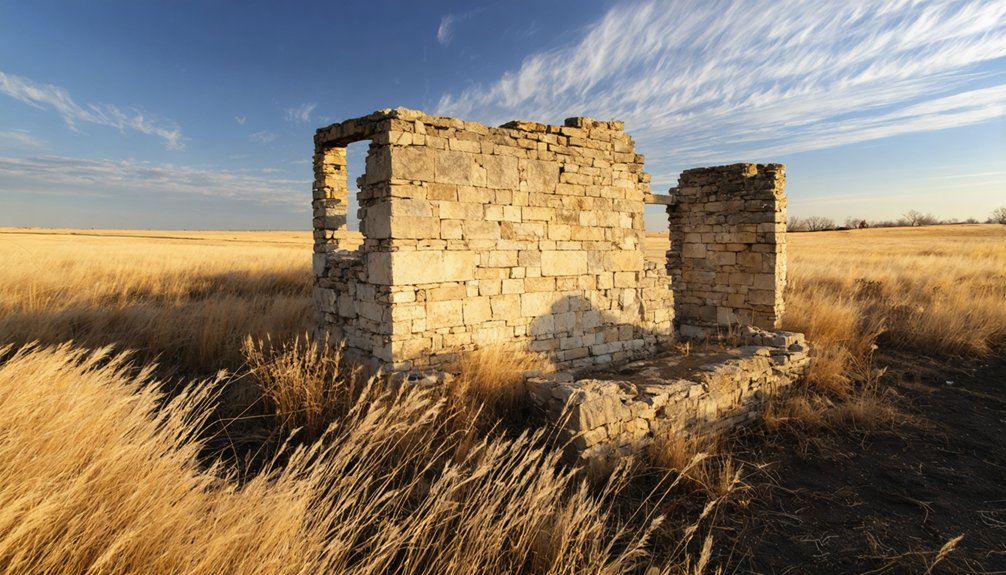
Though little remains of Uniontown’s once-bustling 60-building frontier settlement, what you’ll find at the Shawnee County site still carries a haunting weight. A dated stone near the Green Wildlife Area parking lot stands as one of the few surviving historical artifacts connecting you directly to 1848.
A single dated stone near the parking lot — one of the few artifacts still connecting you to 1848.
The privately owned cemetery, listed on the National Register of Historic Places, preserves graves of 33 cholera victims — quiet testimony to the epidemic that ultimately erased the town.
Preservation efforts continue through active research, as scientists from the Kansas Geological Survey use ground-penetrating radar and magnetic methods to locate a possible mass grave.
You won’t find reconstructed buildings or tourist markers here — just raw, open land holding secrets that researchers are still working to uncover.
How to Get to the Green Wildlife Area in Shawnee County
Reaching the Green Wildlife Area in Shawnee County is straightforward once you’re heading toward Topeka, Kansas, which sits at the heart of the region. From Topeka, navigate southwest toward the wildlife area, where preservation efforts protect what little remains of Uniontown’s story.
Once you arrive, look near the parking lot for the dated stone — one of the few historical artifacts still marking this lost frontier settlement.
Follow these steps for a smooth visit:
- Map Shawnee County’s Green Wildlife Area before departing, as rural roads can be unmarked.
- Park at the designated lot and walk the surrounding grounds carefully.
- Respect all preservation efforts — the cemetery is privately owned and listed on the National Register of Historic Places.
You’re now standing where history quietly endures.
Private Land, Trespassing Laws, and Other Kansas Ghost Town Rules
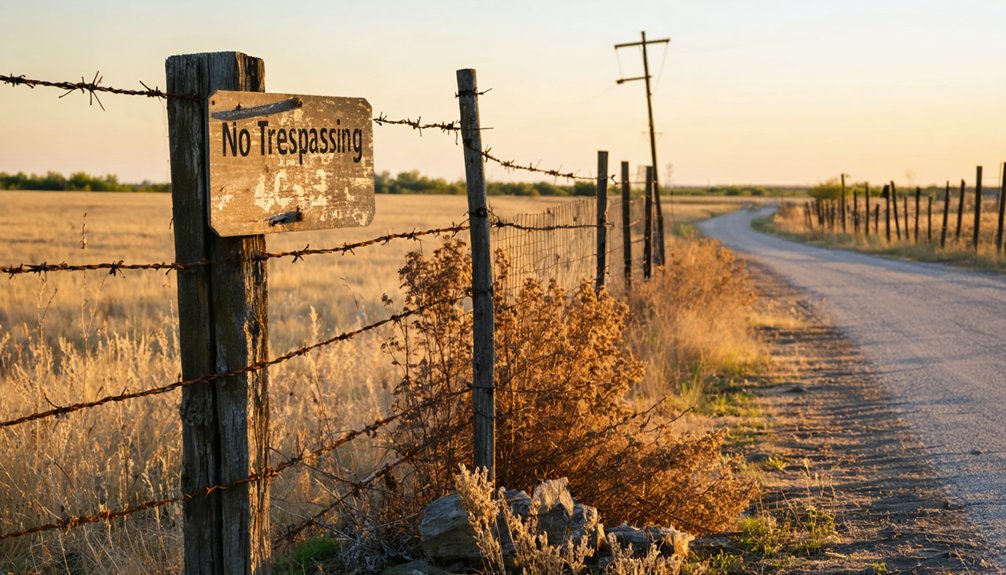
Before you chase down Kansas ghost towns, you’ll need to understand the rules that govern access to these sites. Land ownership matters enormously here — many abandoned towns sit on private property, and Kansas trespassing laws carry real consequences, including fines and arrest.
Always research who owns the land before you visit. Public sites like the Green Wildlife Area welcome explorers, but privately held ruins require written permission from the landowner. Don’t assume abandonment means open access — it doesn’t.
The Uniontown cemetery sits on privately owned land listed on the National Register of Historic Places, meaning it demands respect and proper authorization. Stay on marked trails, leave nothing behind, and never disturb graves or artifacts.
Your freedom to explore depends on honoring these boundaries responsibly.
Other Kansas Ghost Towns Worth Adding to Your Route
While you’re planning your route through Shawnee County, you can easily extend your trip to include other fascinating Kansas ghost towns that share Uniontown’s story of boom-and-bust history.
Trail towns like Diamond Springs, born from the Santa Fe Trail and abandoned when trade routes shifted, offer a glimpse into Kansas’s frontier past.
Railroad ghost towns like Russell Springs and Santa Fe lost their futures when rail lines chose other paths, leaving behind eerie remnants that reward curious travelers willing to seek them out.
Trail Towns Worth Visiting
Kansas’s ghost town trail doesn’t end at Uniontown — if you’re already driving through Shawnee County, you’d be doing yourself a disservice by skipping the other abandoned settlements scattered across the state.
Historical preservation efforts and archaeological techniques have helped uncover stories behind these three trail towns worth adding to your route:
- Diamond Springs — Born from Santa Fe Trail commerce, abandoned when trade routes shifted and left travelers behind.
- Russell Springs — A promising town whose future vanished the moment railroads chose a different path.
- Santa Fe — Another railroad casualty, reminding you how quickly economic decisions erased entire communities.
Each stop reveals how freedom-seeking settlers built ambitious lives, only to watch transportation and industry rewrite their destinies completely.
Railroad Ghost Towns Nearby
Railroads didn’t just build Kansas towns — they erased them. When rail lines bypassed settlements, communities collapsed almost overnight. Russell Springs and Santa Fe watched their futures vanish the moment railroad surveyors chose different routes. You can still drive through these corridors and feel the weight of that abandonment.
Add these stops to your route for a fuller picture of Kansas’s lost landscape. Historical preservation efforts have kept some remnants accessible, while archaeological excavations at select sites continue uncovering foundations, artifacts, and forgotten stories beneath the soil.
Each town represents an economic gamble that simply didn’t pay off.
You’re not just sightseeing — you’re tracing the invisible infrastructure that once determined whether a community lived or died. Kansas rewards that kind of curious, unhurried travel.
Kansas Ghost Towns Near Lawrence for a Quick Day Trip
If you’re based in Lawrence, you’re in luck — Kansas packs 20 ghost towns within just 25 miles of the city, making it easy to plan a half-day adventure without burning through a full tank of gas. Each stop carries its own urban legends and folklore stories worth chasing down.
Three standout destinations to explore:
Three ghost towns rise above the rest — each erased by fate, forgotten by time, unforgettable in legend.
- Diamond Springs – Born from Santa Fe Trail commerce, abandoned when trade routes vanished overnight.
- Russell Springs – A promising settlement killed simply because the railroad picked a different path.
- Saffordville – Swallowed by floodwaters, leaving only whispers behind.
Pack a map, charge your phone, and hit the road early. These towns won’t announce themselves — you’ll need to seek them out deliberately.
How to Build a Multi-Stop Kansas Ghost Town Itinerary
Building a multi-stop Kansas ghost town itinerary takes more strategy than simply stringing destinations together on a map. Group your stops by county to cut drive time, and anchor each cluster around a strong historical preservation site like Uniontown’s National Register cemetery in Shawnee County.
From there, layer in secondary tourist attractions — Diamond Springs along the Santa Fe Trail corridor, Russell Springs, or the flood-erased remnants of Saffordville.
Check land ownership before you go, since many sites sit on private property. Carry printed maps because cell service disappears in rural Kansas.
Schedule your heaviest driving early, leaving afternoons for slower exploration on foot. With 308 recognized ghost towns scattered across the state, you’ll never run short of compelling stops worth building a route around.
Frequently Asked Questions
What Is the Best Time of Year to Visit Kansas Ghost Towns?
Spring and fall offer ideal seasonal weather for exploring Kansas ghost towns. You’ll dodge summer’s brutal heat and winter’s harsh cold, while the mild temps let you fully absorb each site’s haunting historical significance.
Are There Guided Tours Available for Kansas Ghost Town Road Trips?
You’ll find limited guided tour options for Kansas ghost towns, so self guided exploration is your best bet. Grab maps, hit the open road, and uncover Shawnee County’s forgotten frontier settlements on your own thrilling terms!
Can Children Safely Explore Kansas Ghost Town Sites and Ruins?
Yes, children can safely explore Kansas ghost towns if you follow basic child safety and exploration guidelines—supervise kids closely, avoid unstable structures, wear sturdy shoes, and you’ll create unforgettable family adventures through history’s fascinating remnants!
What Photography Equipment Works Best for Capturing Ghost Town Remnants?
For historical preservation shots of crumbling stone and silence, you’ll want a wide-angle lens paired with a sturdy tripod. Your camera gear choices should include a polarizing filter to dramatically contrast Kansas’ vast skies against forgotten ruins.
Are There Nearby Hotels or Campgrounds Close to the Green Wildlife Area?
You’ll find lodging options and camping sites near Shawnee County’s Green Wildlife Area. Topeka’s hotels are just minutes away, while nearby state parks offer rugged camping sites perfect for your adventurous ghost town expedition!
References
- https://legendsofkansas.com/kansas-ghost-town-list/
- https://www.youtube.com/watch?v=dy7nLwjHkbY
- https://www.facebook.com/citizenpotawatomination/posts/somewhere-in-kansas-is-a-ghost-town-that-was-once-a-flourishing-potawatomi-tradi/964057992416686/
- https://www.kcur.org/arts-life/2022-04-09/ghost-towns-are-all-around-kansas-city-if-you-know-where-to-look
- https://en.wikipedia.org/wiki/List_of_ghost_towns_in_Kansas