To plan your ghost town road trip to Vindex, Maryland, start by using Kitzmiller as your base and grabbing a detailed topo map before you head out. You won’t find signs or parking lots here — just overgrown paths, buried foundations, and concrete steps that once led to the company store. Pair Vindex with nearby Kempton, Thomas, and Dodson for a full Garrett County loop. Stick around, and there’s much more to uncover.
Key Takeaways
- Vindex, Maryland, is an unmarked ghost town; use landscape cues like old railroad beds, concrete steps, and buried foundations to navigate the site.
- Base your trip in nearby Kitzmiller and contact local town hall for guidance before exploring Vindex’s overgrown, unmarked terrain.
- Extend your road trip by connecting Vindex with nearby ghost towns Kempton, Dodson, and Thomas for broader regional coal history context.
- Pack sturdy boots, a detailed topo map, and prepare for uneven terrain, as Vindex lacks signage, parking lots, or guided tours.
- Use landmarks like Deep Creek Lake and the North Branch Potomac River to navigate between ghost towns along rural back roads.
What’s Left to See at Vindex, Maryland
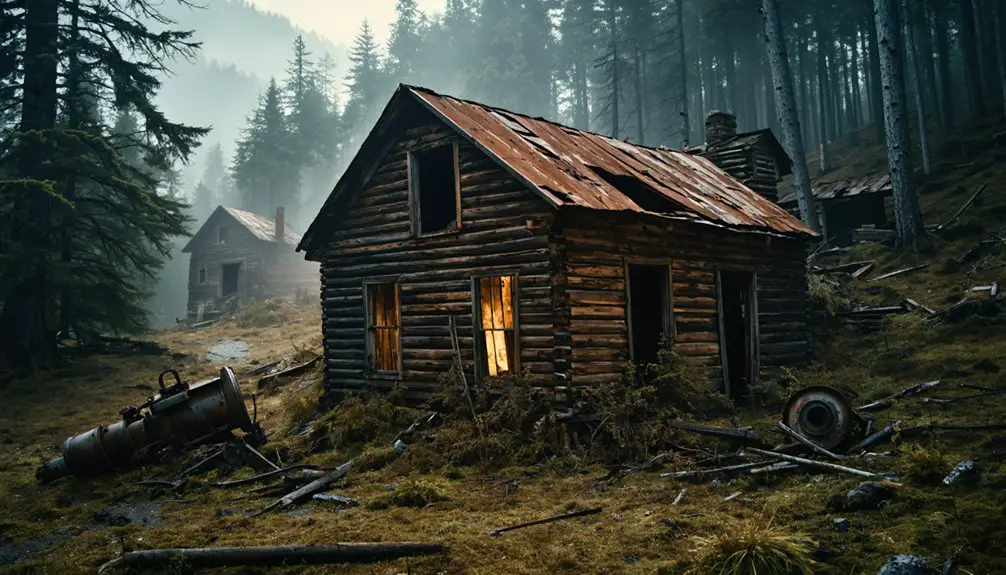
When you arrive at Vindex, don’t expect signage, parking lots, or guided tours—what’s left here is raw and unadorned. The most recognizable landmark is a short flight of concrete steps, once the entrance to the company store, now rising from nothing into open air.
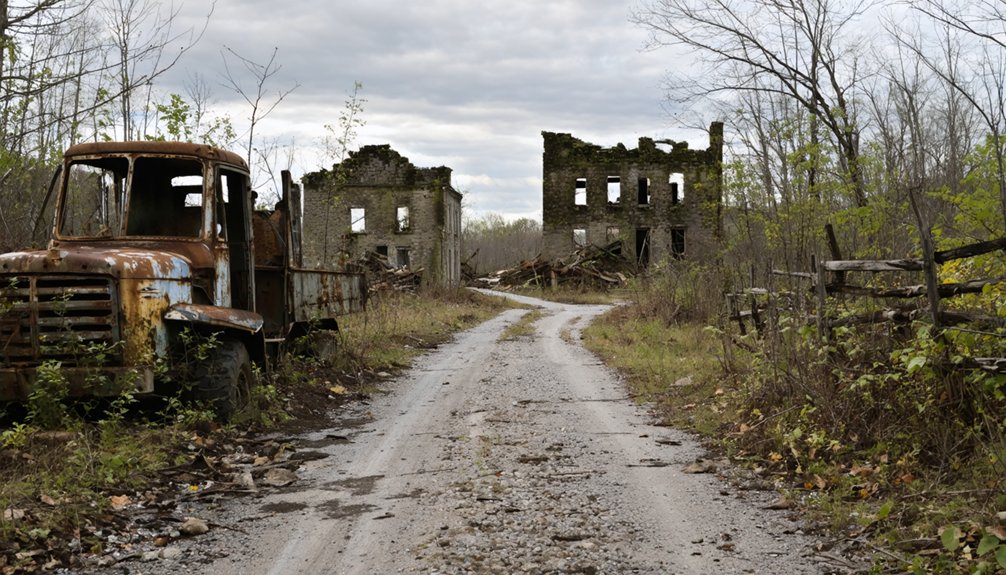
Beyond that, industrial remnants surface quietly—abandoned railroad beds, broken bridge structures, and buried foundations hidden beneath decades of forest regrowth. Overgrown pathways trace where streets and lanes once connected homes, churches, and a post office.
The Appalachian forest has reclaimed nearly everything else. You’ll need to look carefully, move slowly, and read the landscape like a map. Vindex rewards curiosity over comfort, making it ideal for travelers who’d rather discover something real than tour something restored.
How Did Vindex Go From Coal Town to Ghost Town?
Vindex didn’t collapse overnight—it followed a pattern common across Appalachia, where coal built towns fast and abandoned them faster. The Johnstown Coal and Coke Co. shaped every corner of daily life here: the store, the school, the churches, even the currency.
When coal demand dropped after World War II, that control became a liability. The Western Maryland Railway’s last Shay locomotive ran the mines until 1950, and when operations ceased, the jobs vanished with them.
Industrial decline hit hard and fast, leaving residents no economic reason to stay. Community disappearance followed predictably—families scattered, buildings rotted, and the forest reclaimed what people left behind.
What you’re walking through today isn’t decay so much as erasure, a town the modern economy simply forgot to preserve.
Nearby Ghost Towns Worth Adding to Your Vindex Road Trip
Once you’ve explored Vindex’s concrete steps and overgrown lanes, the surrounding region rewards you with an entire circuit of forgotten coal settlements. Dodson, Gleason, Kempton, and Thomas each carry their own historical significance, telling parallel stories of industrial decline across Garrett County’s remote hollows.
Kempton offers crumbling structures still visible through the tree line, while Thomas retains more surface-level character as a former railroad hub. Kitzmiller anchors the cluster geographically, sitting close enough to serve as your base.
Follow the old Western Maryland Railway corridors connecting these towns, and the route itself becomes part of the story. You’re not just driving between dots on a map — you’re tracing the bones of an economy that once powered the entire region before quietly disappearing into the forest.
How Do You Find Vindex Without Getting Lost?
Finding Vindex isn’t like plugging an address into Google Maps and following the blue line — the town’s largely unmarked, overgrown, and stripped of the signage that guides visitors to more developed historic sites.
Local navigation here means reading the landscape itself: old railroad beds, broken foundations beneath leaf litter, and that short flight of concrete steps where the company store once stood.
Before you head out, reach out to Kitzmiller’s town hall or connect with locals familiar with the area — that’s one of the most reliable visitor tips for actually locating the site.
Bring a detailed topo map, wear sturdy boots, and expect uneven terrain.
Treat the journey like exploration rather than tourism, and Vindex will reveal itself on its own terms.
Plan Your Vindex Visit as Part of a Garrett County Loop
Since Vindex sits in the heart of Garrett County’s former coal country, it makes natural sense to pair it with the other ghost towns scattered across the same stretch of western Maryland. Towns like Kempton, Dodson, and Thomas each carry their own story of industrial decline, and together they paint a fuller picture of what this region once was.
You can trace a loose loop through these settlements, following former mining corridors and rural back roads that still echo their working past. Watch for the forest reclaiming old foundations, crumbling grade lines, and forgotten lane entrances swallowed by brush.
Deep Creek Lake and the North Branch Potomac offer grounding landmarks as you navigate between stops. Treat the whole route as one connected landscape rather than isolated destinations.
Frequently Asked Questions
What Company Originally Owned and Operated the Vindex Coal Mines?
The Johnstown Coal and Coke Co. once ruled Vindex with an iron grip! You’ll feel coal mining history’s weight in every crumbling foundation, uncovering a company town legacy that controlled workers’ every breath and dollar.
What Ethnic Communities Settled in Vindex During Its Coal Mining Era?
You’ll find that Vindex’s coal mining history was shaped by ethnic community influence from Lithuanian, Italian, Eastern European, German, and Anglo-Saxon settlers, all drawn together by the promise of work in Appalachia’s booming mines.
What Was Company Scrip Called Locally in Vindex?
Locals called company scrip “flicker” — imagine clutching those tokens, your only purchasing power. This company scrip history shaped Vindex’s local economic impact, binding workers to the company store like invisible chains controlling every transaction you’d make.
When Did the Western Maryland Railway Stop Serving the Vindex Mines?
You’ll find that the Western Maryland Railway’s Shay locomotive stopped serving the Vindex mines in 1950, closing a crucial chapter in railway history and sealing the ghost town legends of this forgotten Appalachian coal settlement forever.
How Many Abandoned Coal Villages Exist Near the Potomac River Headwaters?
You’ll find a staggering 11 abandoned coal-mining villages scattered near the Potomac River headwaters! These ghost towns, bursting with historical preservation potential, aren’t your typical tourist attractions — they’re raw, untamed fragments of Appalachia’s forgotten industrial soul waiting for you to explore.
References
- https://www.historynewsnetwork.org/article/rousing-the-ghosts-of-appalachia
- https://en.wikipedia.org/wiki/Daniels
- https://www.washingtonpost.com/archive/local/2007/10/03/rousing-the-ghosts-of-appalachia/40740669-ded3-45af-b183-31c0bd1c4899/
- https://www.youtube.com/watch?v=sbFq0i5w0-c
- http://www.mountaindiscoveries.com/stories/fw2002/heritagetrail_plain.html
- https://en.wikipedia.org/wiki/List_of_ghost_towns_in_Maryland
- https://www.youtube.com/watch?v=yFJQo3mvDI0
- https://thedailyrecord.com/2001/08/24/preservation-grant-fires-dreams-of-reviving-old-coal-town/