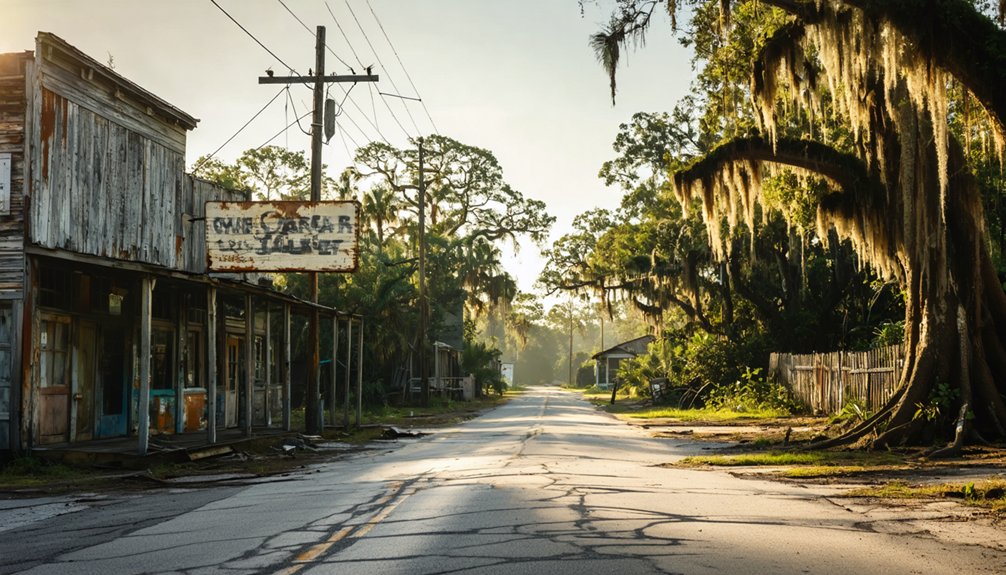
Planning a ghost town road trip to Zion, Florida is easier than you’d expect. You’ll find this forgotten coastal settlement hiding in plain sight along A1A, just north of Atlantic Avenue in Delray Beach. Born from a House of Refuge that sheltered shipwreck survivors in 1876, Zion quietly vanished after its post office and refuge both closed. Today, a single historical marker tells its story, and there’s far more to uncover about what shaped and erased this unique maritime community.
Key Takeaways
- Zion, Florida, began as Orange Grove House of Refuge #3 in 1876, serving as a coastal safety station for shipwreck survivors.
- The community declined after the post office closed in 1892 and the House of Refuge shut down in 1896.
- The last standing structure burned in 1927, leaving only a historical marker on A1A north of Atlantic Avenue.
- Reach the site easily by driving along A1A in Delray Beach; no hiking is required for this roadside stop.
- Combine your visit with nearby attractions like Morikami Museum, Wakodahatchee Wetlands, and Sandoway Discovery Center for a full day.
The House of Refuge That Turned Zion Into a Florida Coastal Settlement
When shipwrecks battered Florida’s lower Atlantic coast in the 1870s, survivors had almost nowhere to turn—the shoreline was largely empty, and help was miles away. The federal government responded by building Houses of Refuge, coastal preservation stations stocked with food, shelter, and a keeper ready to assist.
The shoreline was empty, the sea was merciless, and survivors had nowhere to turn.
Zion’s station, known as Orange Grove House of Refuge #3, opened in 1876 as the third such outpost on Florida’s east coast. It offered four downstairs rooms for the keeper’s family and an upper dormitory for rescued sailors.
That single structure became Zion’s entire identity. A post office followed in 1877, cementing the name officially.
This maritime history is what made Zion a settlement at all—not farming, not mining, just survival on a wild, wave-hammered shore.
Why Did Zion, Florida Become a Ghost Town?
Once Zion’s House of Refuge closed in 1896, the settlement lost its only reason to exist. The government closure wiped out the single service that had defined the community since 1876. Without the refuge keeper and the activity surrounding the station, there was simply nothing left to hold people there.
Economic decline followed quickly. The post office had already shut down in 1892, cutting Zion off from the basic infrastructure that kept small communities alive.
When the original building burned in 1927, the last physical trace disappeared.
Zion didn’t collapse dramatically. It just faded, quietly absorbed into what became Delray Beach. You won’t find ruins or a preserved district here. What you’ll find is a historical marker and a coastline that still carries the memory.
What’s Left to See at the Zion Site Today?
Standing at the Zion site today, you’ll find a historical marker rather than ruins or a preserved district. Coastal erosion has reshaped the shoreline since the refuge operated here, and the 1927 fire erased the last standing structure.
Still, the stop rewards curious road-trippers who appreciate layered history.
Here’s what you can take in during your visit:
- Historical marker – your primary connection to Zion’s documented past
- Sour orange grove remnants – ancient trees tied to the original refuge grounds
- Coastal landscape – read the shoreline knowing coastal erosion altered it dramatically
- Delray Beach context – surrounding development tells you how completely the town disappeared
No historical artifacts survive on-site, but the marker on A1A north of Atlantic Avenue makes the stop worthwhile.
How to Get to Zion in Delray Beach
Now that you know what’s waiting at the site, getting there is straightforward. Head to A1A just north of Atlantic Avenue in Delray Beach, Palm Beach County, on Florida’s east coast. You’ll find the historical marker where Zion once stood, tucked into a coastal setting that still hints at the area’s maritime past.
Park along the beachside road and walk the shoreline where coastal ecosystems meet the urban edge of modern Delray Beach. The drive itself rewards you — A1A hugs the Atlantic, giving you open water views the whole way in.
This isn’t a remote destination requiring a long hike. It’s a quick, meaningful stop where historical preservation meets an accessible beach setting, perfect for road trippers who value freedom over crowds.
What to Combine With Your Zion Visit in Delray Beach
Since Zion is a quick stop rather than a full-day destination, pairing it with nearby Delray Beach highlights makes the trip worth the drive. You’ve got maritime history, coastal ecology, and vibrant local culture all within easy reach.
- Morikami Museum and Japanese Gardens – A surprising cultural detour just minutes inland.
- Delray Beach Oceanfront – Walk Atlantic Avenue’s beach access points and feel the same coastline shipwreck survivors once feared.
- Wakodahatchee Wetlands – Explore coastal ecology up close through this celebrated boardwalk bird sanctuary.
- Sandoway Discovery Center – A small but packed maritime history museum in Delray Beach covering Florida’s Atlantic coast natural and nautical past.
Combining these stops transforms a brief historical marker visit into a genuinely rewarding Florida road trip day.
Frequently Asked Questions
Was Zion, Florida Ever Officially Incorporated as a Town?
Zion never gained official incorporation as a town. This historical settlement existed purely around a coastal preservation refuge station — once it closed, the community dissolved quietly into what you now know as Delray Beach.
How Many Houses of Refuge Were Built Along Florida’s Atlantic Coast?
Florida built five Houses of Refuge along its Atlantic coast, and you’ll find their coastal preservation legacy fascinating. These stations of historic architecture once dotted the shoreline, offering survival shelters to shipwrecked sailors braving Florida’s unpredictable seas.
Who Was the Keeper of the Orange Grove House of Refuge?
The Orange Grove history doesn’t clearly name the refuge keeper stories you’re seeking. Unfortunately, the specific keeper’s identity isn’t documented in available records, but you can explore local Delray Beach archives to uncover this fascinating maritime guardian’s tale.
Are There Any Photographs of the Original Zion Refuge Structure?
You’ll want to dig into photographic archives and historical preservation societies in Delray Beach — some early images may exist, but the 1927 fire destroyed much, making surviving photographs rare and incredibly valuable to researchers like you.
Did Any Other Florida Refuge Settlements Become Ghost Towns Like Zion?
History repeats itself — other Florida refuge settlements faced similar coastal settlement decline. You’ll find sites like Gilbert’s Bar mirror Zion’s fate, where historic preservation efforts mark all that’s left of these forgotten maritime communities.
References
- https://en.wikipedia.org/wiki/List_of_ghost_towns_in_Florida
- https://www.youtube.com/watch?v=hL66H2MFRVk
- https://www.ghosttowns.com/states/fl/zion.html
- https://wereintherockies.com/grafton-ghost-town/
- https://www.florida-backroads-travel.com/florida-ghost-towns.html
- https://www.zionriverresort.com/grafton-ghost-town/
- https://www.narcity.com/miami/17-abandoned-ghost-towns-you-must-visit-in-florida
- https://stories.simplyioa.com/the-top-6-ghost-towns-in-florida
- https://backpackerverse.com/10-florida-ghost-towns-perfect-ghost-hunting-destinations/
- https://www.zionadventurephotog.com/single-post/grafton-ghost-town-things-to-do-around-zion-national-park