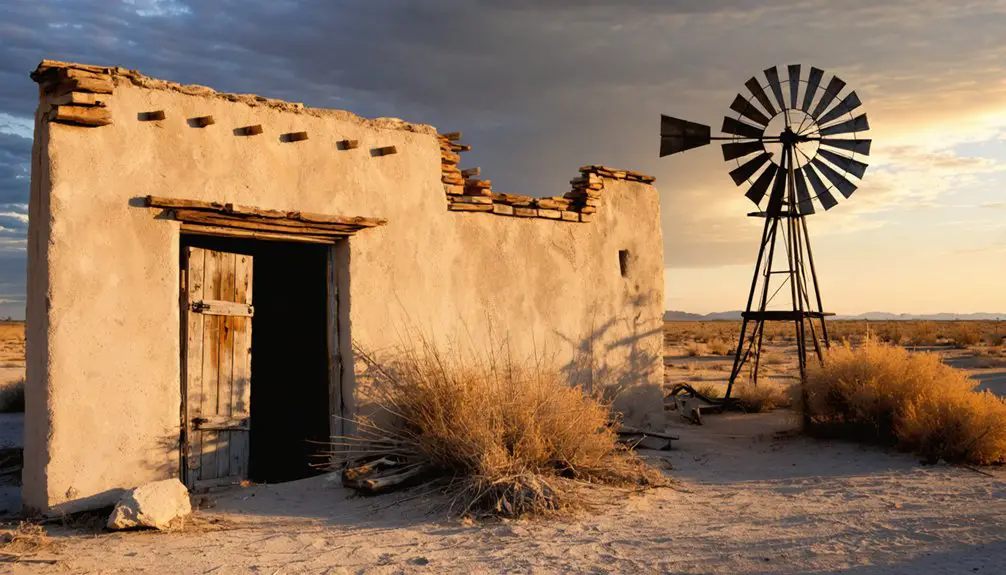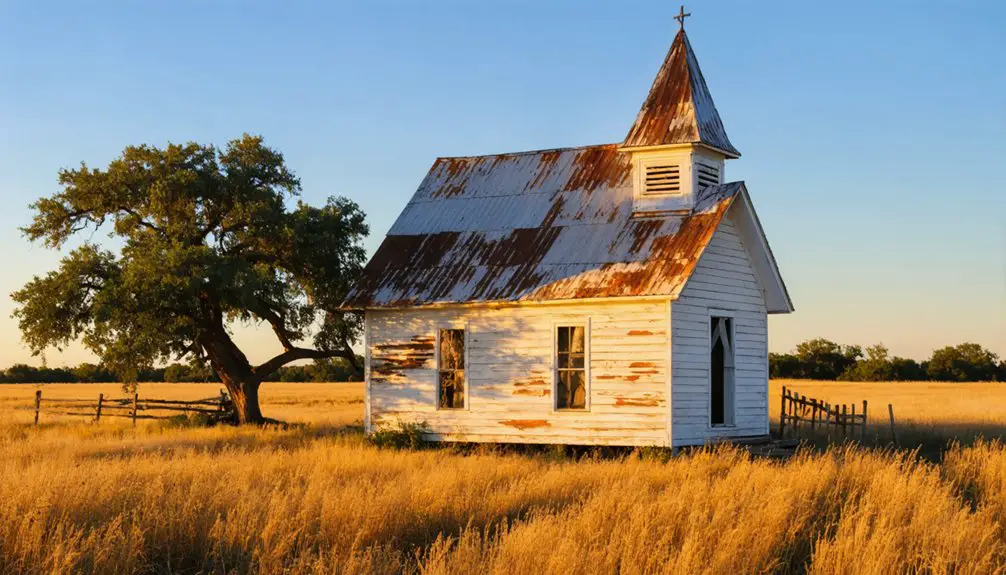
Planning a ghost town road trip to Denhawken, Texas doesn’t require much effort, but it rewards you with authentic Texas history. You’ll find this small Wilson County settlement about 14 miles east of Floresville, where St. John’s Lutheran Church and a historic cemetery still stand as quiet proofs to German settler heritage. Wrap up your visit with a stop in Floresville for local food. There’s far more to this fascinating story than meets the eye.
Key Takeaways
- Denhawken is located 14 miles east of Floresville at the junction of State Highway 119 and Farm Road 1347.
- The town was founded in the late 1890s by German settlers, with its name derived from three founding families.
- Key landmarks include St. John’s Lutheran Church, Denhawken Cemetery established in 1904, and a remaining blacksmith shop.
- The entire visit takes less than half a day, making it ideal as a scenic detour rather than a full-day trip.
- Stop in Floresville for dining before or after exploring the rural roads and landmarks surrounding Denhawken.
What Is Denhawken, Texas: and Why Ghost Town Fans Love It?
Tucked into eastern Wilson County about 14 miles east of Floresville, Denhawken is an unincorporated community that ghost town fans find hard to resist. You’ll find it at the junction of State Highway 119 and Farm Road 1347, where South Texas rural life unfolds quietly around you.
German settlers built this community between 1895 and 1898, and their legacy still shows in the church, cemetery, and blacksmith shop that remain standing.
Pair your visit with local cuisine from nearby Floresville before heading out, and keep your eyes open for wildlife observation opportunities along the rural roads leading in.
Denhawken isn’t fully abandoned, which makes it even more compelling — it’s a living fragment of history you can actually explore on your own terms.
How Denhawken Got Its Unusual Name
Few town names in Texas carry as much backstory as Denhawken. In 1905, three founding families — D.C. Denmark, W.L. Hawk, and Charles Steenken — each contributed letters from their surnames to create the name you see on maps today. It’s a piece of local folklore you won’t find anywhere else, and it gives the community a distinct identity that still sparks curiosity among road trippers.
When you visit, that naming story feels alive against the backdrop of surviving historic architecture, including St. John’s Lutheran Church and the old blacksmith shop. These landmarks connect you directly to the German settlers who shaped this community starting in the late 1890s.
Denhawken’s name isn’t just unusual — it’s a living signature of the families who built it.
The German Settlers Who Founded Denhawken
Between 1895 and 1898, German farmers pushed into eastern Wilson County and staked their claim on a stretch of rich black soil that would become Denhawken. Local folklore ties the community’s identity directly to these founding families, whose agricultural evolution shaped everything from land use to local trade.
German farmers arrived between 1895 and 1898, planting roots in eastern Wilson County’s rich black soil.
You’ll want to know these four key settler families before you visit:
- Denmark
- Hawk
- Steenken
- Peters, Wehmeyer, Lambeck, Bohman, Havelah, and Stahl
Each family carved out farmland and built the social fabric that sustained the community for decades. The railroad’s arrival in 1898 accelerated that growth, connecting these independent settlers to broader markets.
Their hard work left behind landmarks you can still explore today, including a church, cemetery, and blacksmith shop.
How the Railroad Put Denhawken on the Map
Those German farming families laid the groundwork, but it was steel rails that gave Denhawken its economic pulse. When the San Antonio and Gulf Railroad arrived in 1898, it connected these hardworking settlers to broader markets, transforming isolated farmsteads into a trading hub.
Suddenly, crops grown in that rich black soil could move efficiently, and goods could flow back in.
You’ll appreciate how this railroad history shapes your road trip experience today. As you explore the quiet back roads near State Highway 119, watch for wildlife spotting opportunities — white-tailed deer and native birds still roam these rural stretches.
Afterward, head toward Floresville to sample local cuisine that reflects the region’s deep German heritage. That railroad spark made all of it possible.
Why Denhawken Shrank After the Railroad Era
Railroad towns often burn bright and fade fast, and Denhawken followed that familiar arc. Once the railroad’s economic pull weakened, the community lost its momentum. Several forces pushed Denhawken toward its quiet present-day footprint:
Railroad towns burn bright and fade fast — Denhawken simply followed that familiar, inevitable arc.
- Improved roads pulled residents toward larger towns offering better local cuisine and services.
- Agricultural shifts reduced the need for on-site mills and trade stores.
- Younger generations left for cities, shrinking the population from 75 in 1947 to just 46 by 1990.
- Wildlife spotting and open land replaced commercial activity as the area’s defining character.
You’re not visiting a town frozen in failure, though. Denhawken simply shrank into something quieter — a rural remnant where history survives in a church, a cemetery, and a blacksmith shop worth finding.
Landmarks Still Standing in Denhawken Today
When you pull into Denhawken today, you’ll find that a handful of landmarks still anchor the community’s German farming roots. St. John’s Lutheran Church stands as one of the most visible survivors, offering a quiet but powerful reminder of the faith that shaped early settler life.
You’ll also want to visit the Denhawken Cemetery, formerly known as Mesquite Prairie Cemetery, where German families who relocated from Fayette and Lavaca Counties began burying their dead as early as 1904.
St. John’s Lutheran Church
St. John’s Lutheran Church stands as Denhawken’s most enduring landmark, anchoring this quiet community’s heritage in South Texas. You’ll find it a rewarding stop on your ghost-town route, especially if you appreciate authentic historical character.
Plan your visit around these four highlights:
- Photograph the church’s classic rural architecture against open ranchland
- Explore nearby trails offering excellent wildlife observation opportunities
- Sample local cuisine in Floresville before making the 14-mile drive east
- Walk the surrounding grounds to absorb the area’s German settler atmosphere
The church reflects the determination of German farming families who built lasting institutions from scratch. Its survival gives you a tangible connection to Denhawken’s 1890s roots, making it far more meaningful than simply reading about a forgotten community on a map.
Denhawken Cemetery History
Tucked on the eastern edge of the settlement, the Denhawken Cemetery—formerly known as the Mesquite Prairie Cemetery—tells a story that predates the town’s official name by nearly a decade. Founded in 1904 by German farmers who relocated from Fayette and Lavaca Counties, it became the community’s most enduring landmark.
You’ll find weathered headstones bearing surnames tied to Denhawken’s founding families, each one quietly holding local legends that never made it into formal records. Cemetery restoration efforts have helped preserve what time and neglect threatened to erase, giving visitors a legible connection to the settlement’s roots.
Walk the grounds slowly—you’ll notice the careful balance between preservation and decay. It’s one of those stops that turns a casual road trip into something genuinely worth remembering.
St. John’s Lutheran Church and the Denhawken Cemetery
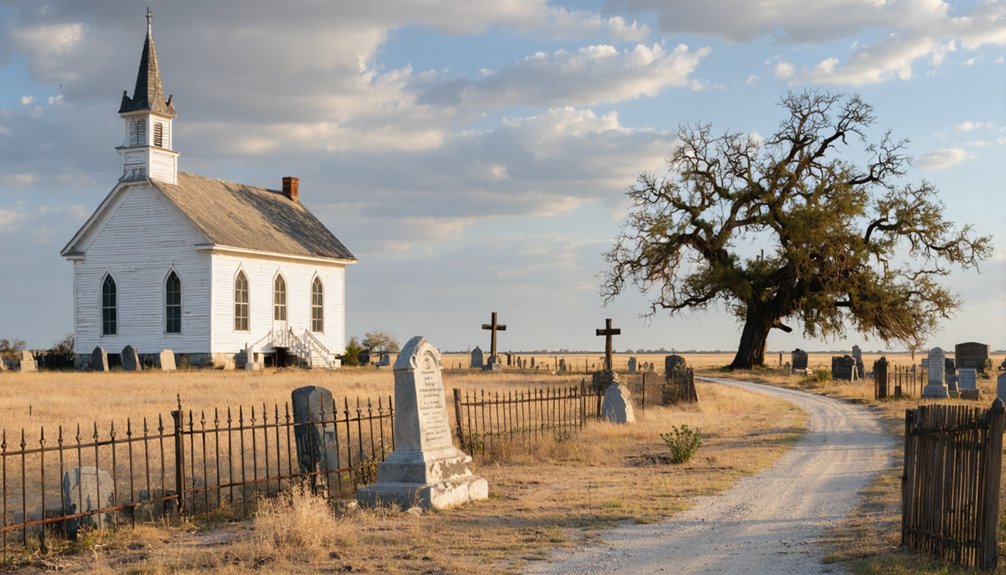
Two of Denhawken’s most enduring landmarks, St. John’s Lutheran Church and the Denhawken Cemetery, reward curious travelers who crave authentic history over tourist traps. You’ll find both sites quietly anchoring this small community’s identity.
The cemetery, formerly called Mesquite Prairie Cemetery, was founded in 1904 by German farmers relocating from Fayette and Lavaca Counties.
Plan your visit around these highlights:
- Walk the cemetery grounds and read the German-surname headstones
- Photograph St. John’s Lutheran Church exterior
- Explore surrounding outdoor activities like rural hiking along county roads
- Sample local cuisine at nearby Floresville before or after your stop
Both landmarks reflect the resilience of a tight-knit farming community that carved meaningful lives from South Texas’s rich black soil.
Where Is Denhawken and How Do You Get There?
Once you’ve soaked in the quiet history at St. John’s and the cemetery, finding your way home is straightforward.
Denhawken sits in eastern Wilson County at the junction of State Highway 119 and Farm Road 1347, roughly 14 miles east of Floresville.
You’ll drive through open ranch land where wildlife observation comes naturally — watch for white-tailed deer and wild turkey moving through the brush along the roadside.
Floresville makes a logical base, offering local cuisine rooted in South Texas ranching culture before or after your visit.
No complicated navigation required — the rural roads are uncrowded and easy to follow.
The drive itself rewards you with honest Texas countryside that matches the community’s unpretentious, hardworking character perfectly.
How To Plan Your Denhawken Road Trip Stop

Planning a Denhawken stop takes almost no effort since the site is compact and the landmarks sit close together near the Highway 119 and Farm Road 1347 junction. Build your visit around these four priorities:
- Walk the Denhawken Cemetery for its 1904 German settler history and scenic viewpoints across open South Texas ranchland.
- Photograph St. John’s Lutheran Church and the surviving blacksmith shop before the afternoon light fades.
- Drive the junction slowly to absorb the rural layout and remaining structures.
- Stop in Floresville, just 14 miles west, for local cuisine at one of its established spots before or after your visit.
You won’t need more than a half-day, making Denhawken an ideal detour rather than a destination requiring serious planning.
Frequently Asked Questions
Is There an Admission Fee to Visit the Denhawken Cemetery?
You don’t pay an admission fee to explore the Denhawken Cemetery. You’re free to walk through this historical preservation site, connecting with rich cemetery history dating back to 1904 and honoring German settler families.
Are Restrooms or Facilities Available Near the Denhawken Landmarks?
Don’t expect visitor amenities or historic signage pointing to restrooms—Denhawken’s ghost town charm means you’re roughing it freely! Plan ahead, pack supplies, and embrace the open rural landscape before exploring the church, cemetery, and blacksmith shop.
Is the Blacksmith Shop Open to the Public for Tours?
No confirmed tours are available at the blacksmith shop, but you can still soak in its rich blacksmith history from the outside — it’s a hauntingly evocative relic that speaks volumes about Denhawken’s hardworking frontier past.
What Is the Best Time of Year to Visit Denhawken?
Like a canvas waiting for the perfect light, spring and fall offer the best seasonal weather for your visit, delivering cooler temperatures and golden photography opportunities that’ll make Denhawken’s historic landmarks truly come alive.
Can Visitors Park Safely Near St. John’s Lutheran Church?
You’ll find parking safety near St. John’s Lutheran Church fairly straightforward, as the rural setting offers open roadside space. Church accessibility is easy, letting you explore freely without maneuvering crowded lots or complicated entry points.
References
- http://pacweb.alamo.edu/InteractiveHistory/projects/rhines/StudentProjects/2006/Denhawken/template.html
- https://www.texasescapes.com/SouthTexasTowns/Denhawken-Texas.htm
- https://en.wikipedia.org/wiki/List_of_ghost_towns_in_Texas
- https://www.tshaonline.org/handbook/entries/denhawken-tx
- https://en.wikipedia.org/wiki/Denhawken
- https://www.wilsoncountyhistory.org/talk-denhawken
- https://www.texasescapes.com/TOWNS/Texas_ghost_towns.htm
- https://authentictexas.com/texas-ghost-towns/
- https://www.facebook.com/groups/1411334002431699/posts/3838217476409994/
- https://texashistory.unt.edu/ark:/67531/metapth61101/m1/168/