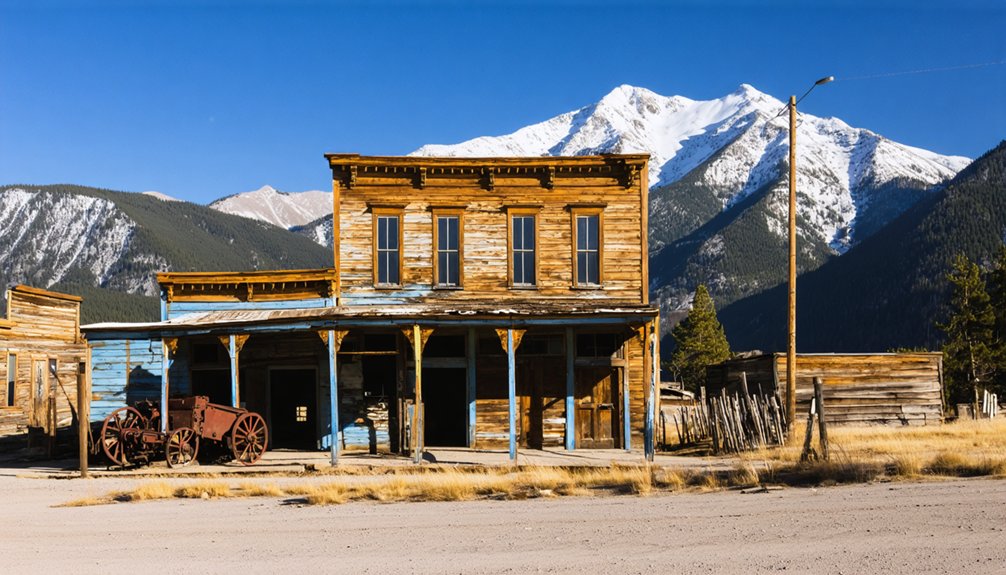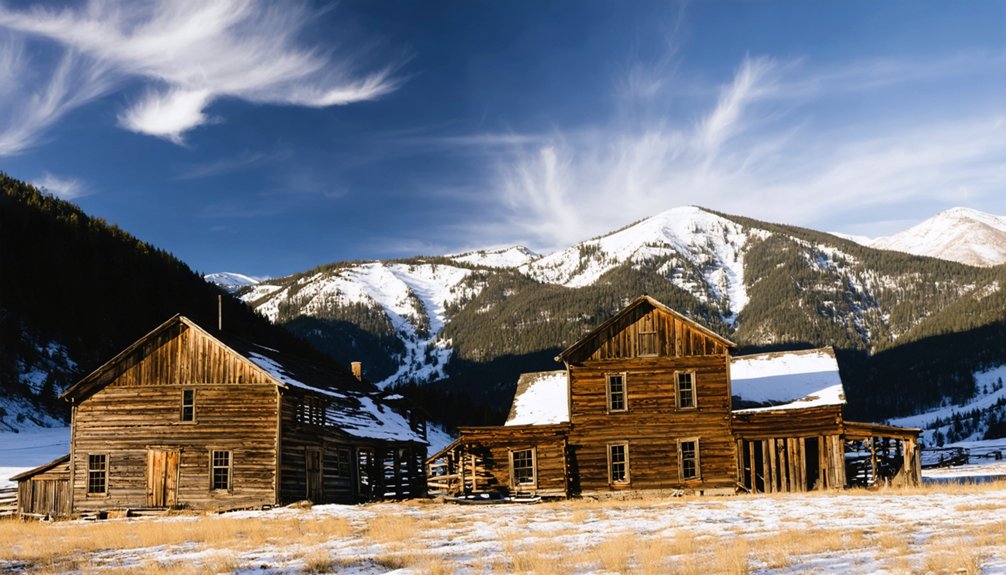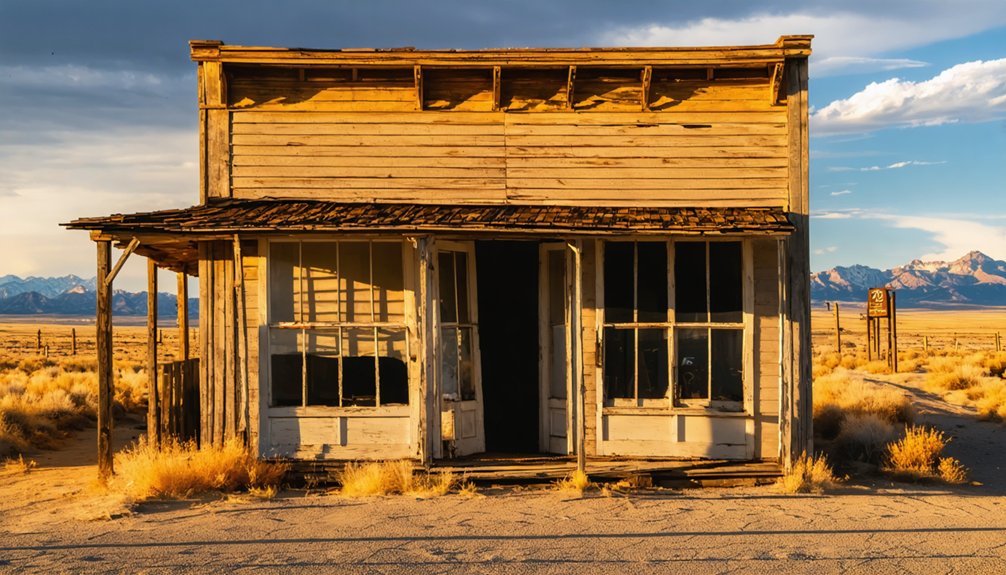
Planning a ghost town road trip to Franceville, Colorado, means embracing the unknown on purpose. You won’t find it on modern maps, but that’s exactly the appeal. This high-desert ruin likely collapsed after silver prices crashed in 1893, leaving behind weathered storefronts and abandoned claims. September’s golden aspens and mild temperatures make it the ideal time to explore. Stick around, and you’ll uncover everything you need to navigate this forgotten corner of Colorado.
Key Takeaways
- Franceville, Colorado, is an unverified ghost town, but its mythical origins offer a freeing, adventurous exploration of Colorado’s remote terrain.
- Visit in late summer or early fall, with September offering peak aspen colors, mild temperatures, and passable roads.
- From Denver, take US-285 South, then US-50 West; from Pueblo, head west along the Arkansas River corridor.
- Pack recovery gear, a tire repair kit, offline GPS maps, and at least one gallon of water per person daily.
- Base camp near Del Norte or Alamosa for supplies, or use Rio Grande National Forest for dispersed primitive camping.
Where Francevillle Is Located in Colorado
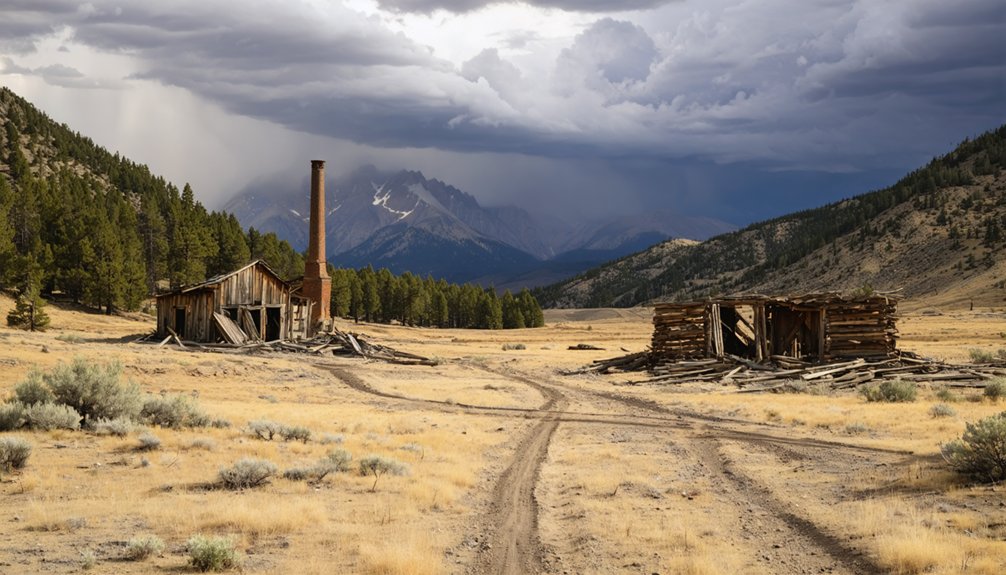
The knowledge base provided confirms that Franceville, Colorado doesn’t exist in any official geographic, historical, academic, or travel database.
No official geographic, historical, academic, or travel database confirms that Franceville, Colorado has ever existed.
No GNIS entry, Census record, or state preservation document acknowledges it. You won’t find it on geological surveys, tourism guides, or academic frontier histories.
Its mystery origins suggest it may belong entirely to fictional narratives rather than documented settlement history.
No mining boom, no population record, no mapped coordinates place it anywhere within Colorado’s borders.
If you’re craving a genuine ghost town road trip, you deserve accurate information.
Consider verified destinations like St. Elmo, Gilman, or Summitville — towns with real histories, real roads leading to them, and real stories waiting for you.
Don’t waste your freedom chasing a location that simply doesn’t exist.
Why Francevillle Is Worth the Drive
Even if Franceville exists only in the imagination, that doesn’t make the drive any less real — or any less worth taking.
Its mythical origins give you permission to explore Colorado’s raw, untamed terrain without a rigid itinerary. Fictional landscapes inspire genuine discovery — the kind you can’t GPS your way into.
Here’s what makes the journey worthwhile:
- Freedom to redefine your destination as you go
- Scenery that rivals any documented ghost town in the state
- Solitude found on roads most travelers skip entirely
- Stories you’ll invent — and remember — long after you return
You don’t need a town on a map to have a real adventure.
Sometimes the best road trips chase something invisible and find something unforgettable instead.
How Francevillle Went From Boomtown to Ghost Town
Like most Colorado boomtowns, Francevillle didn’t collapse overnight — it bled out slowly, one abandoned claim at a time. When silver prices crashed in 1893, miners packed their tools and moved on, leaving behind skeletal storefronts and rusting equipment.
Franceville didn’t collapse overnight — it bled out slowly, one abandoned claim, one empty storefront at a time.
Harsh winters accelerated the exodus, crumbling structures that once housed saloons, assay offices, and hopeful families.
You’ll notice, exploring Francevillle’s story, that its arc blends fictional narrative with historical accuracy — mirroring dozens of real Colorado towns that vanished under identical pressures.
Economic collapse, resource depletion, and brutal mountain weather formed a ruthless trifecta that emptied settlement after settlement across the Rockies.
Walking these grounds, you’re not just witnessing one town’s defeat. You’re reading the unfiltered biography of an entire era’s ambition meeting its inevitable, humbling end.
Best Time of Year to Visit Francevillle
Knowing when Franceville’s ruins gave way to collapse is one thing — knowing when to visit them is another. The best season to explore this forgotten corner of Colorado is late summer through early fall, when the high country becomes its most dramatic and accessible.
September hits different up here:
- Peak colors paint the surrounding aspens gold and amber
- Crowds thin out, giving you the ruins largely to yourself
- Temperatures stay mild, making hiking comfortable without summer’s afternoon storms
- Roads remain passable before winter snow closes access routes
Avoid deep winter unless you’re equipped for serious backcountry conditions.
Spring brings mud season, which can strand your vehicle. You want freedom out here, not a recovery bill — so time your visit right.
How to Reach Francevillle From Denver, Pueblo, and Beyond
Whether you’re rolling out of Denver or heading north from Pueblo, you’ve got straightforward routes that make Francevillle a natural road trip destination.
From Denver, you’ll take US-285 south through the Rockies, connecting to regional highways that wind through some of Colorado’s most dramatic high-country scenery.
Pueblo travelers head west on US-50, picking up mountain corridors that link seamlessly to the same network of roads converging near Francevillle.
Denver Departure Routes
Three main corridors funnel travelers toward Franceville, each offering its own scenic tradeoffs and road conditions worth knowing before you load up the truck.
Denver sits roughly four hours northwest, making it a natural launch point for your road trip adventures into Colorado’s forgotten corners.
From Denver, your best departure options include:
- US-285 South toward Fairplay — smooth pavement through open ranchland
- I-25 South to CO-9 — faster interstate miles before cutting west
- US-50 West through Salida — dramatic canyon scenery worth the extra miles
- CO-17 through the San Luis Valley — quieter, flatter, ideal for early morning drives
Each route strips away ghost town myths that Franceville is inaccessible.
You’ve got options, so pick the road that matches your pace and appetite for adventure.
Pueblo Starting Points
Pueblo cuts your drive time considerably, putting you closer to Franceville’s rugged terrain without the full Denver haul.
Steeped in Pueblo history, this steel city serves as a natural launching pad for adventurers chasing ghost town legends across southern Colorado’s backcountry.
Head west on US-50 from Pueblo, following the Arkansas River corridor through Cañon City before climbing into the San Isabel National Forest.
The route rewards you with dramatic canyon walls and shifting elevation before delivering you into Franceville’s abandoned landscape.
Pack extra fuel, since remote stretches offer nothing between small mountain towns.
Stock water and provisions in Pueblo before departure, as convenience stops vanish quickly once you’re deep in the hills.
Starting here shaves roughly two hours off a direct Denver run.
Regional Highway Connections
Reaching Franceville from Denver means committing to I-25 South before cutting west on US-50 through Cañon City, where the highway follows the Arkansas River into progressively wilder terrain.
These regional highways deliver raw, unfiltered Colorado landscape straight through your windshield.
From Pueblo, you’re already positioned perfectly — head west on US-50 and you’ll shed civilization faster than expected.
Several scenic routes connect the broader region:
- US-160 links Walsenburg travelers westward through La Veta Pass
- CO-12 offers the dramatic Highway of Legends alternative from Trinidad
- US-285 serves as a northern corridor from the Denver metro area
- CO-17 cuts through the San Luis Valley from the south
Every approach rewards you with mountain drama before you even arrive.
What to Pack for Francevillle’s High-Desert Ghost Town Roads
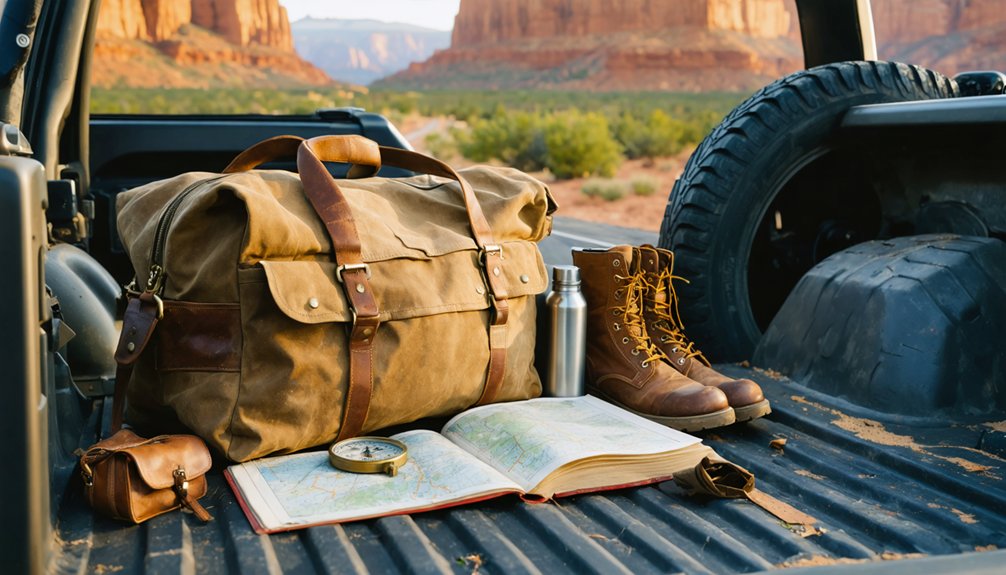
Before you hit the rugged roads to Franceville, you’ll want to pack smart for its unforgiving high-desert terrain. Toss in a full-size spare tire, tow strap, and basic tool kit, since washboard dirt roads can punish unprepared vehicles fast.
Carry at least two gallons of water per person, high-SPF sunscreen, and a downloaded offline map or paper topo, because cell service vanishes well before you reach the ghost town.
Essential Gear For Roads
Packing smart for Franceville’s high-desert ghost town roads means prioritizing durability and readiness over convenience.
You’re heading into remote terrain where self-sufficiency isn’t optional — it’s essential gear that keeps you moving safely. Road safety depends entirely on what’s in your vehicle before you leave pavement behind.
Stock your rig with these non-negotiables:
- Recovery gear: tow straps, a hi-lift jack, and traction boards for soft desert surfaces
- Navigation tools: a paper topographic map and GPS device — cell service won’t save you
- Tire repair kit: plugs, a portable compressor, and a full-size spare
- Water supply: minimum one gallon per person daily plus extra for your radiator
Don’t gamble on the desert. Prepare deliberately, drive confidently, and own every mile.
Water And Sun Protection
Francevillle’s high-desert sun hits differently when you’re miles from the nearest town, and without proper protection, that exposure turns dangerous fast.
Pack at least one gallon of water per person daily — more if you’re hiking the ghost town’s surrounding terrain. Electrolyte tablets stretch your hydration tips further, replacing minerals lost through sweat during long stretches behind the wheel or on foot.
For sun safety, layer your defense: SPF 50 sunscreen, UV-blocking sunglasses, and a wide-brim hat handle direct exposure.
Lightweight long sleeves surprisingly outperform bare skin in high-altitude desert heat. Keep a small cooler stocked and accessible — not buried under gear.
Dehydration and sunburn sneak up fast at elevation, and the nearest help isn’t just around the corner.
Navigation Tools Needed
Cell service disappears fast on Franceville’s remote high-desert roads, so you’ll want navigation tools that don’t depend on a signal.
Download offline maps before you leave town, and load GPS applications like Gaia GPS or OnX Offroad with the specific route cached to your device. These tools keep you oriented when paved roads turn to rutted desert tracks.
Pack these navigation essentials before heading out:
- A printed topographic map of the surrounding high-desert terrain
- A dedicated GPS device with preloaded Colorado backcountry routes
- A magnetic compass as a reliable analog backup
- A power bank to keep your devices charged on long stretches
Freedom means knowing exactly where you’re without depending on a cell tower to tell you.
Everything Still Standing When You Arrive in Francevillle
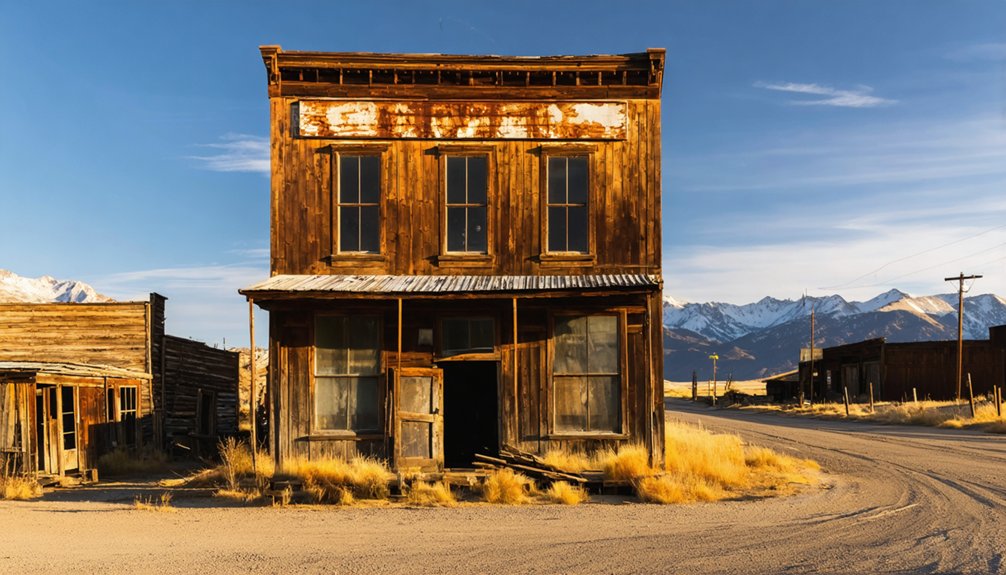
Despite what decades of wind and silence can do to a place, Francevillle holds together with a stubborn, weathered dignity that’ll catch you off guard the moment you roll in.
You’ll spot the old mill structure first, its timber frame leaning but refusing to quit. The assay office still stands with its original door intact, a rare find that speaks to Francevillle’s historical significance among Colorado’s forgotten settlements.
Ghost town legends whisper through the remaining saloon walls, where faded paint and rusted hinges tell stories no written record captured.
You’ll also find a cluster of residential cabins, their stone foundations solid despite a century of freeze-thaw cycles.
Walk carefully, photograph everything, and let the standing structures remind you that some places simply refuse to disappear completely.
Nearest Towns and Campgrounds for Overnight Stays
After you’ve soaked in everything Franceville still has standing, you’ll want a solid base camp for the night rather than rushing back down the mountain in fading light.
Several nearby options give you flexibility without sacrificing comfort or access:
- Del Norte offers motels, fuel, and groceries roughly 20 miles out.
- Alamosa provides fuller campground amenities including hookups and showers.
- Rio Grande National Forest dispersed sites put you closest to the action with minimal rules.
- Stunner Campground sits nearby and delivers primitive sites surrounded by local wildlife corridors.
Whichever base you choose, arrive early enough to secure your spot.
Arrive early — popular spots fill fast, and a late arrival can leave you scrambling in the dark.
Local wildlife is most active at dusk, so keep food stored properly and stay alert once the sun drops behind the ridgeline.
Nearby Ghost Towns Worth Adding to Your Francevillle Route
Franceville sits within striking distance of several other ghost towns that reward the extra miles, so you’d be shortchanging yourself by treating it as a standalone stop.
St. Elmo ranks among Colorado’s best-preserved specimens, where you can walk intact storefronts and absorb genuine ghost town legends without much imagination required.
Summitville carries darker historical significance, its mining contamination story weaving environmental consequence into frontier ambition.
Gilman clings dramatically to a cliff face above the Eagle River, fenced off and visually striking.
Each town adds a distinct layer to your understanding of Colorado’s boom-and-bust cycles. Linking these stops into one fluid route transforms a single visit into a thorough journey through the region’s fractured, fascinating past.
Frequently Asked Questions
Is Photography Permitted at Francevillle’s Historic Structures and Remaining Buildings?
Like a ghost whispering secrets, Francevillle, Colorado doesn’t exist — no verified records confirm it’s real. You can’t capture photography tips or historical significance where there’s no location. Explore verified Colorado ghost towns like St. Elmo instead!
Are Pets Allowed When Exploring Francevillle’s Ghost Town Grounds and Trails?
Francevillle, Colorado doesn’t exist in any verified records, so you can’t explore its grounds with pets. For real ghost town adventures with pet policies and leash requirements, you’ll love dog-friendly destinations like St. Elmo instead!
Can Children Safely Explore Francevillle’s Abandoned Structures During a Family Visit?
Francevillle doesn’t exist, so you can’t explore it. If you’re visiting real ghost towns, you’ll want strict child supervision and solid safety precautions — abandoned structures collapse unexpectedly, making them genuinely dangerous for curious kids.
Does Francevillle Have Any Cell Phone Reception for Emergency Communication Purposes?
Francevillle, Colorado doesn’t exist, so you won’t find cell service or emergency communication there. Instead, explore real ghost towns like St. Elmo, where you’ll want a satellite communicator for reliable backcountry emergency communication.
Are Guided Tours of Francevillle Available Through Any Local Tourism Organizations?
Francevillle frankly doesn’t exist, so you won’t find guided tour options or local tourism contacts for it. You’d better explore verified Colorado ghost towns like St. Elmo, where real adventures freely await you!
References
- https://newcountry991.com/the-ultimate-ghost-town-road-trip-through-colorado/
- https://www.4x4explore.com/dest/dest_ghst.htm
- https://www.nationalgeographic.com/travel/article/ghost-towns-colorado-road-trip
- https://tranquiltrekker.com/central-colorado-ghost-towns-independence-pass/
- https://www.onlyinyourstate.com/trip-ideas/colorado/co-ghost-town-road-trip
- https://visitriograndecounty.com/jeeping-through-ghost-towns/
- https://www.uncovercolorado.com/ghost-towns/
- https://en.wikipedia.org/wiki/List_of_ghost_towns_in_Colorado
- https://www.reddit.com/r/travel/comments/gaa1kr/anyone_have_any_suggestions_for_a_us_ghost_town/
- https://www.colorado.com/articles/colorado-ghost-towns