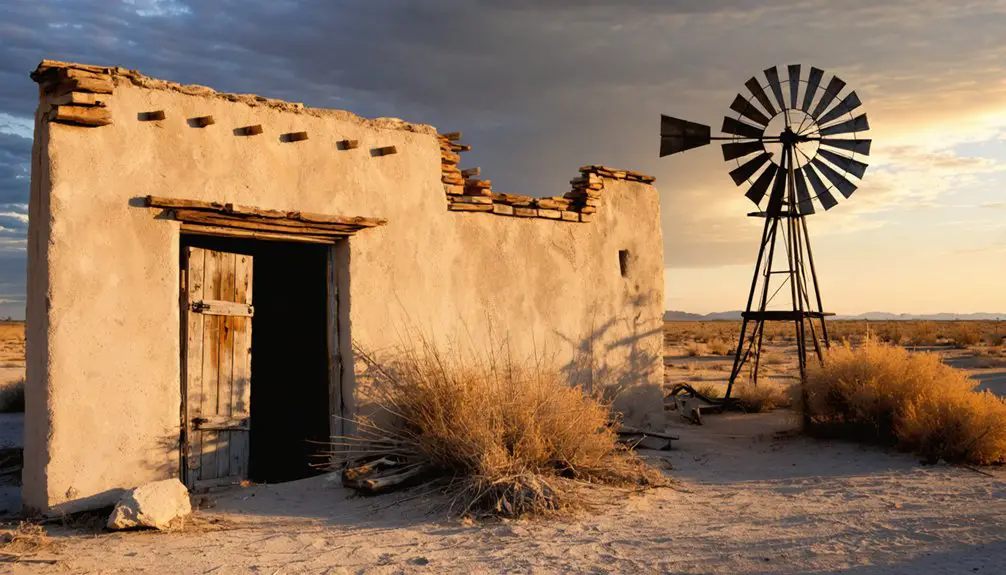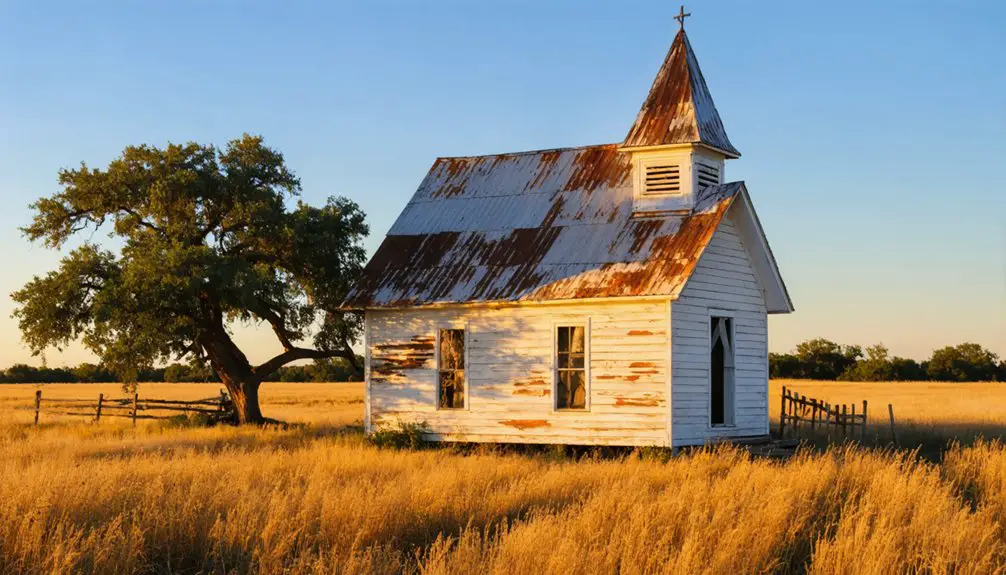
Planning a ghost town road trip to League Four, Texas means embracing mystery from the start. This forgotten settlement is one of Texas’s 511 ghost towns, with no confirmed county, founding date, or pinpointed location. You’ll need offline maps, sturdy boots, plenty of water, and patience. Research local historical societies before you go and always respect private property boundaries. Stick around, and you’ll uncover everything you need to make this haunting adventure unforgettable.
Key Takeaways
- League Four is a mysterious Texas ghost town with no confirmed county, settlement date, or definitive map location, requiring detective work to find.
- Research local historical societies and county maps, download offline maps, and engage with locals to help pinpoint League Four’s approximate location.
- Pack essential supplies including water, fuel, sturdy boots, gloves, and a flashlight, as infrastructure and reliable cell service may be absent.
- Never explore abandoned structures alone, watch for rattlesnakes in warmer months, and always secure permission before entering privately held land.
- Nearby ghost towns like Lobo, Terlingua, and Glenrio can be paired with League Four to create a fuller, rewarding road trip experience.
What We Actually Know About League Four, Texas
When you dig into the details of League Four, Texas, you hit a wall almost immediately — and that’s kind of the point.
This ghost town exists in Texas history as little more than a name on a list, with no confirmed county, no settlement date, and no recorded abandonment.
Wikipedia places it among Texas’s 511 ghost towns, neighboring entries like Crosby, Leesville, and Gonzales offering more context than League Four itself ever could.
Yet League Four, Texas significance lies precisely in its mystery.
It represents the forgotten edges of westward expansion — communities that rose, faded, and left almost no trace.
Neither the Texas Almanac nor the Handbook of Texas fills the gaps.
You’re chasing a ghost of a ghost town, and that’s exactly what makes it worth exploring.
Where in Texas Is League Four Located?
Pinning League Four to a spot on the map is where the mystery gets both frustrating and fascinating. No confirmed county ties it down, and its ghost town origins remain buried in hidden histories that even dedicated Texas researchers haven’t fully uncovered.
What you do know is that it appears alongside nearby entries like Crosby, Leesville, Gonzales, Lemonville, and Orange — giving you a loose geographic cluster to work with. That places it somewhere in south-central to coastal Texas, though nothing’s guaranteed.
If you’re chasing this town, you’ll need patience and a willingness to explore surrounding communities for clues. Consider contacting local historical societies along that corridor. Sometimes the best ghost town discoveries aren’t found on polished maps — they’re earned through genuine curiosity and old-fashioned legwork.
Why Texas Has More Ghost Towns Than Any Other State
As you plan your road trip to League Four, you’ll quickly realize that Texas’s sheer geographic expanse makes it a breeding ground for ghost towns, with 511 abandoned settlements — more than any other U.S. state.
The industrialization boom and westward expansion of the 1800s drove settlers into remote corners of Texas, founding towns that thrived briefly before economic decline stripped them of purpose.
When industries collapsed or trade routes shifted, communities couldn’t survive, leaving behind the hollow shells you’ll encounter scattered across the Texas landscape today.
Texas’s Vast Geographic Expanse
Texas’s sheer size—nearly 270,000 square miles—gives it more room for towns to rise, struggle, and vanish than any other state in the Lower 48.
That geographic diversity means you’re traveling through piney eastern forests, Gulf Coast plains, Hill Country limestone, and west Texas desert all within one state. Each region birthed its own communities tied to specific industries—timber, cotton, cattle, mining—and when those industries collapsed, towns emptied fast.
You’ll find cultural heritage layered into every abandoned structure, every crumbling foundation, every weathered sign. Texas didn’t just grow wide; it grew fast, often outpacing the resources settlers needed to survive.
That explosive, uneven expansion left behind more ghost towns than anywhere else—511 documented remnants waiting for curious travelers like you to explore them.
Industrialization And Westward Expansion
When industrialization swept across the United States in the 1800s, Texas absorbed the impact harder and faster than almost anywhere else.
Industrial growth fueled rapid settlement, then rapid abandonment when resources dried up. Frontier life demanded everything from settlers — and gave no guarantees.
Communities rose and collapsed around:
- Railroads that bypassed towns overnight, stripping away economic lifelines
- Mining operations that exhausted deposits and emptied populations just as quickly
- Agricultural booms that drought, debt, and falling prices ultimately destroyed
You’re traveling through the aftermath of that brutal cycle.
Texas’s 511 ghost towns — more than any other state — aren’t accidents. They’re the direct consequence of ambition colliding with an unforgiving landscape and unpredictable economy.
Economic Decline Drives Abandonment
Economic decline didn’t just hollow out Texas towns — it erased them entirely, and the numbers prove it. With 511 ghost towns, Texas leads every other U.S. state, and economic factors drove most of those abandonments.
When railroads bypassed communities, industries collapsed, or resources dried up, residents didn’t linger — they left.
You can trace those population shifts across the landscape today. Towns that once bustled with miners, ranchers, and traders became silent overnight once the economic engine stalled.
League Four tells that same story. Without a sustaining industry or growing population, it simply faded.
Understanding these forces sharpens your appreciation when you’re standing in the ruins. You’re not just seeing decay — you’re witnessing the direct consequence of economies that failed and people who followed opportunity elsewhere.
What to Expect When You Visit League Four
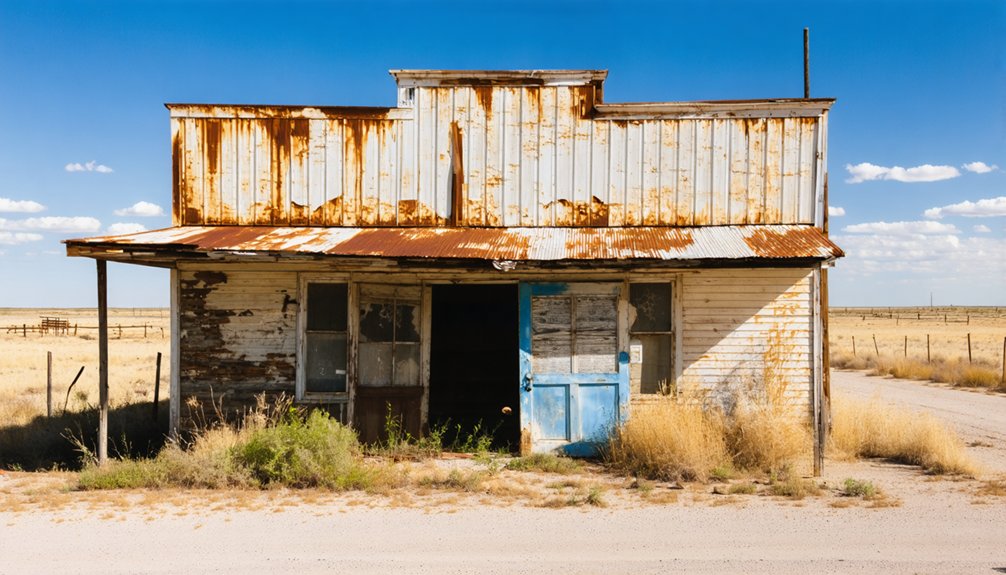
Getting to League Four requires some detective work, as its exact county location remains unrecorded and modern maps offer little guidance.
Once you arrive, you’ll likely find remnants typical of Texas ghost towns — abandoned structures weathered by decades of neglect and the unrelenting elements.
Pack water, fuel up beforehand, and respect any posted property boundaries, since many of these sites sit on private land with limited public access.
Getting To League Four
Nestled somewhere in Texas without a confirmed county to its name, League Four is about as elusive as ghost towns get — you won’t find a welcome sign, a visitor’s center, or even a reliable set of driving directions waiting for you.
That mystery is exactly what makes ghost town exploration here so compelling. You’re chasing a piece of Texas history that even historians struggle to pin down.
Before you head out, keep these essentials in mind:
- Research nearby listed towns — Leesville, Gonzales, and Lemonville — to triangulate a general region
- Travel with offline maps since rural Texas signals are unreliable
- Prepare for unmarked roads, private land, and zero amenities
You’re not just taking a road trip — you’re conducting your own investigation.
Sights Upon Arrival
Once you’ve managed to track down League Four — no small feat given its near-mythical status on Texas ghost town lists — don’t expect a dramatic reveal.
Details about this place are scarce, and that ambiguity is part of its character. What you’ll likely find mirrors classic ghost town exploration across Texas: remnants of a community that quietly faded without fanfare or preservation efforts.
Unlike Terlingua’s adobe ruins or Glenrio’s Route 66 landmarks, League Four offers no confirmed structures or documented historical significance to anchor your visit.
Bring your curiosity, your camera, and a flexible mindset. The surrounding landscape tells its own story. You’re standing in a place most people don’t even know exists — and that freedom, that raw obscurity, is exactly what makes it worth finding.
Travel Tips And Precautions
Reaching League Four demands the same mindset you’d bring to any remote Texas ghost town: prepare thoroughly, because you won’t find convenience stores, gas stations, or cell service waiting for you out there.
Pack your road trip essentials before leaving civilization behind:
- Fuel up completely at the last town you pass through — remote Texas roads offer zero margin for error.
- Carry extra water since sparse rainfall defines this region, and dehydration hits fast in the heat.
- Download offline maps before departure, because digital navigation dies without signal.
Safety precautions matter equally.
Respect private property boundaries, since much of the surrounding land belongs to ranchers.
Wear sturdy boots, watch for unstable structures, and always tell someone your planned route and return time.
How to Get to League Four From Major Texas Highways

Finding League Four on a map is where the challenge begins, as this Texas ghost town lacks documented county placement, settled dates, or abandonment records. Its ghost town origins remain shrouded in mystery, with abandonment causes unrecorded and county boundaries unconfirmed.
Your best approach is cross-referencing nearby listed towns — Crosby, Leesville, Gonzales, and Lemonville — to triangulate a general region.
From major Texas highways, you’ll want to study east-central Texas corridors, as surrounding entries suggest that general direction.
Use Google Maps alongside historical Texas road atlases for the most accurate routing. Call local county historical societies before departing, since private land could restrict access.
Flexibility and research are your greatest tools when chasing a ghost town this elusive.
Can You Still Access League Four Today?
If you’re planning to visit League Four today, you’ll quickly discover that accessing this ghost town comes with real uncertainty—sparse records mean you can’t easily confirm whether roads leading there remain passable or if the land is privately owned.
You’ll want to research local county maps and contact Culberson County or neighboring county offices before you hit the road, since showing up uninvited to private property is both illegal and unsafe.
Despite these hurdles, ghost town enthusiasts who do their homework often find that the journey to forgotten Texas settlements like League Four rewards their persistence with a raw, unfiltered glimpse into the state’s abandoned past.
Current Access Challenges
Tracking down League Four today is where the mystery deepens—because unlike Lobo or Terlingua, this ghost town lacks even the basic coordinates or county designation that would put it on a traveler’s map.
Access limitations make planning nearly impossible without deeper research. You’re fundamentally chasing a name on an incomplete list.
Before you hit the road, consider these realities:
- No confirmed location means GPS won’t save you here
- Exploration restrictions likely apply if the land sits on private property
- Zero documented infrastructure suggests no clear entry point exists
Your best move is cross-referencing historical Texas records before departure.
The freedom to explore ghost towns depends on preparation—and League Four demands more homework than most destinations you’ll encounter across the Lone Star State.
Visiting League Four Today
Despite the research challenges outlined above, the real question is whether League Four is even worth the drive once you’ve done that homework.
The honest answer? No one’s guaranteeing what you’ll find. League Four sits in Texas history as a name on a list, stripped of county markers, dates, and population records.
But that ambiguity is exactly what draws adventurers like you. You’re not chasing a curated museum exhibit — you’re chasing raw, unfiltered remnants of lives once lived.
Pack water, fuel up early, and treat League Four as one stop within a broader Texas ghost town circuit. Combine it with documented sites for a fuller experience.
Freedom-seekers thrive on unknowns, and League Four delivers that uncertainty in spades.
Nearby Ghost Towns That Belong on the Same Trip as League Four
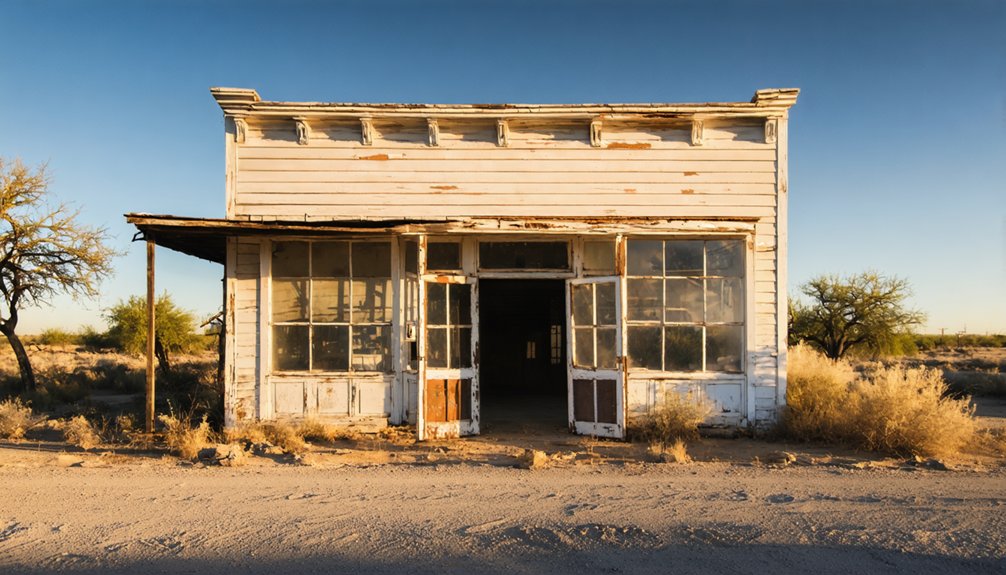
League Four may be little more than a name on a list, but you’re already in ghost town country the moment you start planning a route through Texas, so you might as well make it a full expedition.
Pair your stop with these destinations worth the detour:
Turn ghost town curiosity into a full-blown Texas expedition by pairing your stop with these worthy detours.
- Lobo Ghosttown: Tucked in Culberson County, this abandoned west Texas town offers crumbling desert structures and a surprisingly fascinating ownership history involving buyers from Frankfurt, Germany.
- Terlingua Adventures: Explore adobe ruins, mining equipment, and a cemetery with handmade crosses in this revived Brewster County former mining hub.
- Glenrio: Straddling the Texas-New Mexico border, this Route 66 Historic District still features a standing motel, gas station, and the legendary State Line Bar.
Why Lobo and Terlingua Complete the West Texas Ghost Town Route
When you trace a route through west Texas, Lobo and Terlingua don’t just complement each other — they anchor the entire ghost town experience.
Lobo Exploration rewards the curious with raw desert silence, dilapidated buildings frozen in time, and a backstory involving German buyers who once dreamed of arts festivals in the scrubland. It’s unfiltered and untamed.
Shift southeast toward Terlingua Culture, and the mood transforms. Adobe ruins, handmade cemetery crosses, and a legendary chili cook-off scene prove that some ghost towns refuse to stay quiet. The Starlight Theatre still serves cold drinks beneath open skies.
Together, these two stops give your road trip real texture — solitude in Lobo, community in Terlingua — making the entire west Texas ghost town route feel complete and worth every desert mile.
When to Visit West Texas Ghost Towns to Beat the Heat
Planning your visit around the right season makes the difference between a memorable road trip and a miserable one. West Texas summers are brutal, pushing temperatures past 100°F across Culberson County’s desert terrain. Smart weather considerations keep your adventure safe and enjoyable.
West Texas summers don’t forgive poor planning — triple-digit heat turns adventure into survival fast.
The best times to explore League Four, Lobo, and Terlingua fall within these windows:
- October through November – Mild temperatures, golden desert light, ideal for photography
- February through April – Wildflowers emerge, cooler mornings perfect for exploring ruins
- Early December – Crowds thin out, crisp air makes hiking comfortable
Lobo receives only 13.2 inches of annual rainfall, so flash flood risks remain year-round after storms.
Check forecasts before heading into remote Culberson County roads.
How to Stay Safe Exploring Abandoned Texas Ghost Towns
Abandoned structures like those scattered across Lobo and Terlingua look tempting to explore, but they’ll punish careless visitors fast. Rotting floors, unstable walls, and collapsing roofs turn curiosity into injury within seconds.
Follow these safety precautions before stepping inside anything.
Wear sturdy boots, long pants, and gloves to protect against rusty nails, broken glass, and desert wildlife. Bring a flashlight, extra water, and a charged phone. Never explore alone — always tell someone your itinerary.
Watch for rattlesnakes sheltering in cool, dark corners of ruins, especially during warmer months. Respect private ownership boundaries; Lobo sits on privately held land, so secure permission before entering.
These exploration tips keep your adventure on the right side of thrilling — and guarantee you actually make it home.
Frequently Asked Questions
What Photography Equipment Works Best for Capturing Ghost Town Architecture?
You’ll want a wide-angle lens for capturing expansive ruins and dramatic compositions. Master natural lighting techniques by shooting during golden hour, when soft shadows reveal textures and bring ghost town architecture’s haunting beauty to life.
Are There Guided Ghost Town Tours Available in West Texas?
You’ll find guided tour options breathing life into forgotten landscapes rich with ghost town history. West Texas operators, like those near Terlingua, lead you through time-weathered corridors, revealing stories of communities that simply “moved on.”
What Permits Are Required to Film at Abandoned Texas Ghost Towns?
You’ll need filming permits and must follow ghost town regulations based on land ownership. Check with Texas Parks & Wildlife, local counties, and private owners—like Lobo’s German residents—before you start rolling your camera!
Which Texas Ghost Towns Allow Overnight Camping on Their Grounds?
Like uncharted territory, overnight camping regulations vary—most Texas ghost towns, including Lobo and Terlingua, don’t officially offer ghost town amenities for camping. You’ll need to contact private owners or local authorities before pitching your tent.
Do Any Ghost Town Road Trip Apps Cover League Four Specifically?
You won’t find apps covering League Four’s ghost town history specifically—it’s too obscure. Pack road trip essentials, rely on general Texas ghost town guides, and embrace the freedom of discovering this mysterious, unnamed-county treasure yourself.
References
- https://en.wikipedia.org/wiki/Lobo
- https://texashighways.com/travel-news/four-texas-ghost-towns/
- https://www.youtube.com/watch?v=lC1q9gfrBB4
- https://authentictexas.com/texas-ghost-towns/
- https://en.wikipedia.org/wiki/List_of_ghost_towns_in_Texas
- https://www.youtube.com/watch?v=jrUKcXalLp0