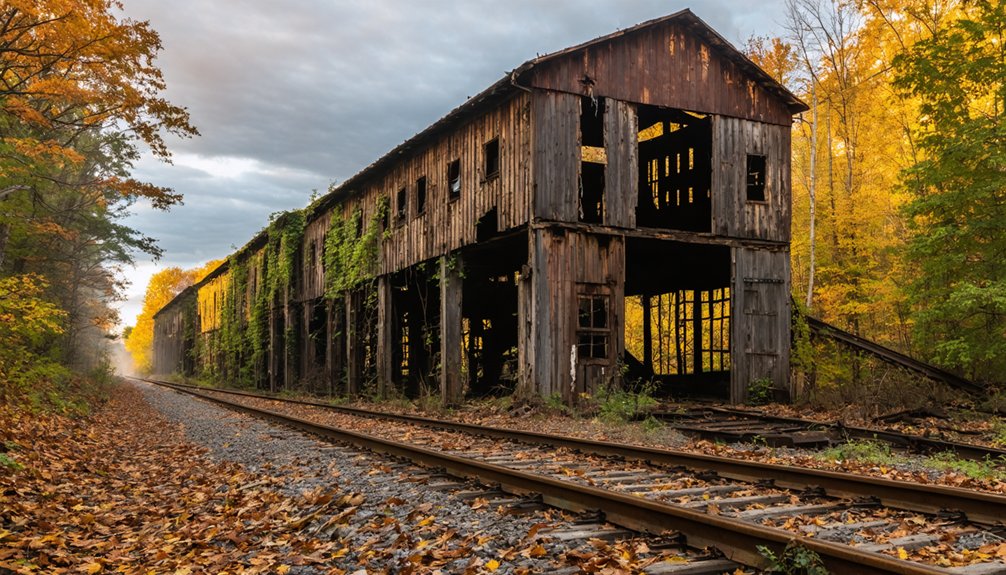
Start your ghost town road trip at the Marshfield historical marker on US 31, just north of Scottsburg near Terrell Road. You’re standing where the Reno Gang’s infamous 1868 train robbery unfolded, and that alone makes the stop worthwhile. Pack water, a paper map, and comfortable shoes before heading into Vienna Township’s forgotten farmsteads and old mill sites. There’s more to Scott County’s buried past than most travelers ever discover.
Key Takeaways
- Start at the Marshfield historical marker on US 31 at Terrell Road, north of Scottsburg, which commemorates the famous 1868 Reno Gang train robbery.
- Explore Vienna Township for old foundations, former mill sites, collapsed farmsteads, unmarked cemeteries, and abandoned railroad corridors throughout Scott County.
- Pack lunch, water, comfortable shoes, and both maps and GPS, as few amenities exist in this rural region.
- Keep your fuel tank full, start early, and allow a flexible schedule to accommodate unexpected discoveries along backroads.
- Drive slowly on rural stretches to appreciate weathered barns and forgotten rail lines, treating the journey itself as part of the adventure.
The Train Robbery That Put Marshfield on the Map
On a spring evening in May 1868, the Reno Gang pulled off what would become the third train robbery in American history, right here in the quiet railroad stop of Marshfield, Indiana.
They targeted the Jeffersonville, Madison and Indianapolis Railroad, making off with U.S. treasury notes and government bonds from Adams Express Company safes. The gang detached the engine and express car, abandoning them near Seymour after emptying the valuables.
The historical significance of that night still echoes through Scott County. The Pinkerton National Detective Agency hunted down several suspects, though vigilante justice ultimately denied them a formal trial.
Today, an Indiana Historical Bureau marker stands at US 31 and Terrell Road, inviting you to stand exactly where that bold, reckless chapter of post-Civil War America unfolded.
What’s Left of Marshfield, Indiana Today?
Where Marshfield once hummed with railroad activity, you’ll now find little more than a historical marker and the quiet stretch of countryside it guards. The Marshfield remnants won’t overwhelm you — there’s no crumbling depot, no weathered platform, just open Scott County land rolling past US 31 near Terrell Road.
That marker, though, carries serious weight. It stands north of Scottsburg’s city limits, beneath the railroad bridge overspan, silently narrating ghost town history to anyone willing to stop and read it. Indiana erected it in 2002, ensuring Marshfield’s criminal legacy wouldn’t vanish completely into the fields surrounding it.
You’re fundamentally visiting a memory.
But sometimes a single roadside marker, planted where outlaws once struck, tells a more powerful story than any preserved building ever could.
How to Find the Marshfield Historical Marker
Finding the Marshfield historical marker takes you along US 31, just north of Scottsburg’s city limits in Scott County, where the road passes beneath a railroad bridge overspan at the intersection with Terrell Road.
Pull over and you’re standing where outlaw history unfolded. Ghost town exploration doesn’t get more tangible than this.
Pull over here and outlaw history unfolds right beneath your feet. Ghost town exploration doesn’t get more tangible.
- Coordinates: 38°42′33″N, 85°46′54″W
- Marker ID: Indiana Historical Bureau #72.2002.8, erected 2002
- Landmark: Look for the railroad bridge overspan on US 31
- Nearest town: Scottsburg, approximately three miles southeast
- Access: Roadside stop, no admission required
The historical significance here hits differently when you realize trains still rumble overhead, echoing that May 1868 robbery.
You’re free to linger as long as you want.
Ghost Towns Near Scottsburg Worth the Detour
Once you’ve tracked down the Marshfield marker, you’ll quickly realize that Scott County hides several other forgotten settlements worth chasing down before you head home.
You can string together a genuinely rewarding day trip by mapping a loose loop around Scottsburg, hitting the abandoned clusters tucked into the rural townships where old railroad stops once kept small communities alive.
It’s the kind of afternoon that sneaks up on you — what starts as a quick detour stretches into hours of gravel roads, faded foundations, and stories you weren’t expecting to find.
Nearby Abandoned Settlement Clusters
Scottsburg sits at the center of a small constellation of forgotten settlements, and if you’ve already made the drive out to Marshfield, it’d be a shame to turn around without poking around a few of its equally compelling neighbors.
Scott County’s backroads hide abandoned structures with real historical significance waiting for curious explorers willing to wander freely.
Consider adding these stops to your route:
- Vienna Township remnants — quiet crossroads where old foundations still surface
- Former mill sites along nearby creek corridors
- Collapsed farmsteads dating to post-Civil War resettlement periods
- Old railroad corridor traces connecting forgotten water stops
- Unmarked cemetery plots tucked behind overgrown fence lines
Each spot rewards the traveler who moves slowly and pays attention.
Day Trip Route Planning
Plotting a ghost town day trip around Scottsburg doesn’t require much—just a full tank, a downloaded offline map, and a willingness to slow down at unmarked gravel turnoffs.
Start at the Indiana Historical Bureau marker on US 31 near Terrell Road, where the Reno Gang’s 1868 heist still lingers in local legends. From there, push northwest into Vienna Township, where Marshfield’s railroad silence hits differently than any museum could.
Pack lunch, because you won’t find much open out here. Talk to anyone you meet—gas station clerks and old-timers carry ghost stories that never made the history books.
Give yourself a loose schedule. The best discoveries on roads like these happen when you stop checking the clock.
What to Pack for a Scott County Ghost Town Stop

Before you load up the car and head northwest out of Scottsburg toward the old Marshfield site, take a minute to think about what’ll actually make the stop worthwhile.
Smart packing essentials and the right ghost town gear separate a forgettable pullover from a genuinely memorable experience.
Smart packing and the right gear turn a simple roadside stop into something you’ll actually remember.
Keep it simple and practical:
- Camera or charged phone for capturing the 2002 historical marker
- Comfortable walking shoes since the terrain around US 31 and Terrell Road is uneven
- Printed or downloaded maps because cell service gets spotty out there
- Water bottle — there’s nothing nearby once you leave Scottsburg
- Small notebook to jot down details about the Reno Gang robbery that’ll surprise you
You don’t need much.
You just need the right things.
The Best Season to Explore Scott County’s Abandoned Towns
Once your bag is packed and sitting by the door, the next question that’ll creep into your mind is *when* to actually make the drive.
Fall wins, hands down. The best weather hits Scott County somewhere between late September and early November, when the air carries that clean, cool bite and the tree line along US 31 burns amber and gold.
You’ll catch local wildlife moving through the fields near Vienna Township at dusk — deer edging out of the tree line, hawks circling the old railroad corridor.
Spring works too, but fall feels right for ghost town wandering. Something about shorter days and quiet roads makes Marshfield’s abandoned silence feel earned, like the place is finally telling you something.
How to Use Marshfield as the Start of an Indiana Ghost Town Road Trip

Once you’ve soaked in Marshfield’s outlaw history along US 31, you’re perfectly positioned to string together a haunting chain of Scott County’s forgotten settlements. Several other ghost towns lie within easy driving distance.
You’ll want to map your route before leaving home, grouping nearby extinct communities by geography rather than bouncing back and forth across the county’s back roads.
Think of Marshfield as your anchor point — the place where Indiana’s railroad past and its most notorious criminal chapter intersect — and let the surrounding ghost towns radiate outward from there.
Nearby Ghost Towns Worth Visiting
After snapping a photo of the Indiana Historical Bureau marker at Marshfield, you’ll find that Scott County and the surrounding region hide a handful of other forgotten settlements worth tracking down on the same afternoon.
Each stop adds another layer of ghost town history, and abandoned structures tell quiet stories about lives once lived.
Nearby spots worth adding to your route:
- Vienna – the township seat that quietly faded
- Lexington – an early Scott County settlement with deep roots
- Dupont – a Jefferson County river town frozen in time
- Brownstown – neighboring Jackson County’s historic core
- Deputy – a small Jefferson County crossroads with lingering charm
Keep your tank full, your map handy, and your curiosity wide open.
Planning Your Route Efficiently
Marshfield makes a natural anchor for your road trip because it sits right along US 31, one of southern Indiana’s most dependable north-south corridors. From here, route optimization becomes straightforward — you’re already positioned to swing north toward Scottsburg or push deeper into Scott County’s quieter backroads.
Don’t skip the scenic detours either; the rural stretches between ghost towns reward slower driving with weathered barns, forgotten rail lines, and landscapes that feel untouched by modern urgency.
Keep a paper map handy alongside your GPS, because some of these roads lose signal without warning. Start early, move loosely, and treat the open road itself as part of the experience.
The towns may be gone, but the journey between them still carries something worth chasing.
Frequently Asked Questions
Was Marshfield Ever Officially Incorporated as an Indiana Town?
The records don’t show Marshfield was ever officially incorporated. You’re exploring a ghost town that quietly faded from town history, leaving behind only railroad memories and a lone historical marker to tell its story.
Are There Restroom Facilities Available Near the Marshfield Historical Marker?
No restroom options or visitor amenities exist at the remote marker. You’ll want to stop in Scottsburg before heading out — she’s just three miles away, offering everything a free-spirited road tripper needs.
Can Visitors Access the Exact Robbery Site on Private Property?
You can’t access the exact robbery site since it’s on private property, but you’ll still feel that wild, nostalgic thrill standing near the historical marker, where the location’s historical significance brings the Reno Gang’s daring heist alive.
Is the Marshfield Ghost Town Listed on Any Official Heritage Registries?
Marshfield’s ghost town history isn’t on formal heritage registries, but you’ll find Indiana Historical Bureau marker #72.2002.8, erected in 2002, proudly honoring its heritage significance — a tangible reminder of America’s wild, untamed railroad past.
Did Any Reno Gang Members Escape Lynching and Face Formal Prosecution?
From what we understand, you won’t find Historical Trials in the Reno Gang’s story — vigilantes beat the courts to it, lynching members before formal prosecution ever happened. It’s a wild, unsettling chapter of outlaw justice you can’t forget.
References
- https://wikimapia.org/34624214/Marshfield-Indiana
- https://en.wikipedia.org/wiki/Marshfield
- https://www.hmdb.org/m.asp?m=238562
- https://www.in.gov/history/state-historical-markers/find-a-marker/marshfield-train-robbery/
- https://en.wikipedia.org/wiki/List_of_ghost_towns_in_Indiana
- https://www.youtube.com/watch?v=vYmOyOs821o