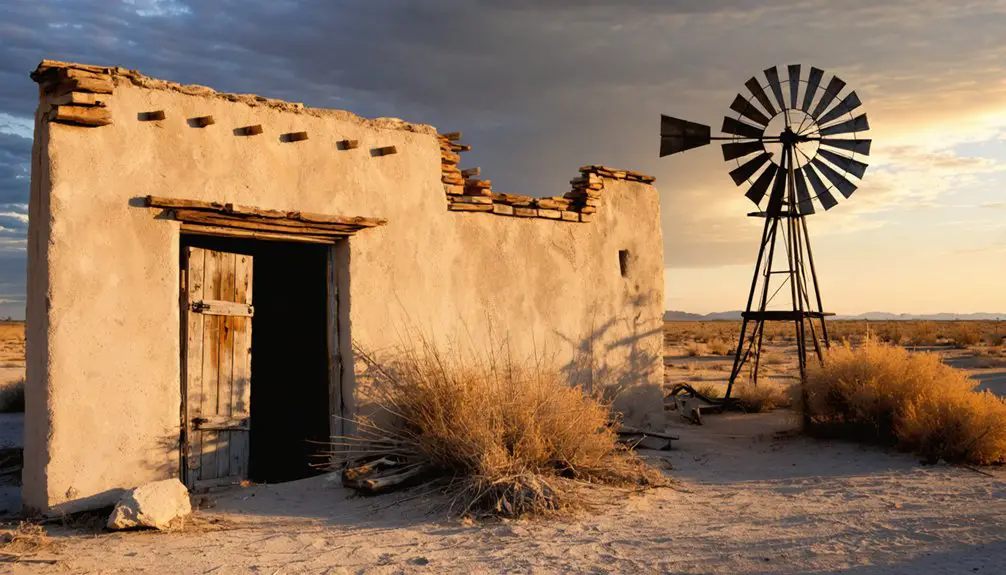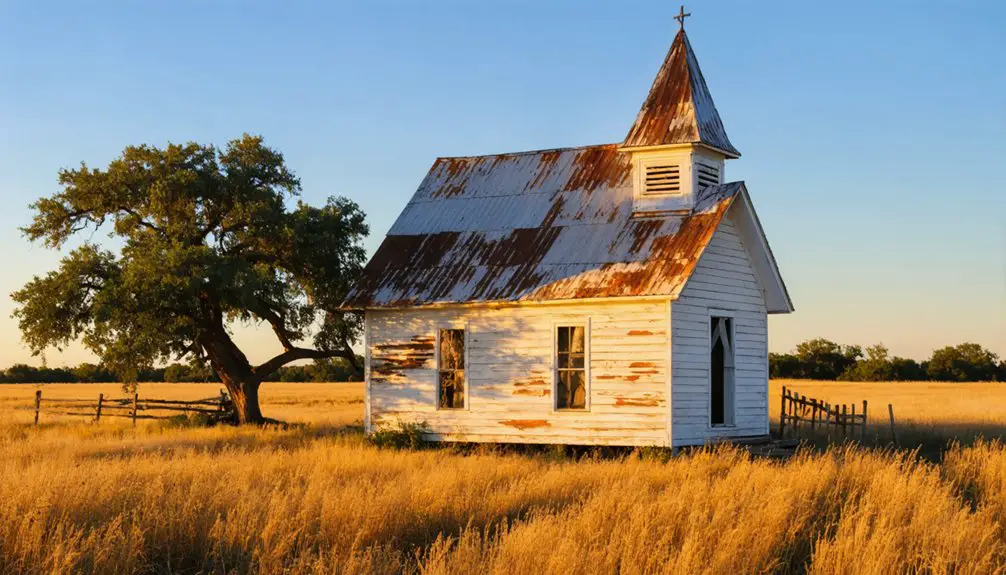
Start your ghost town road trip in Hondo, Texas, then head northeast on Farm Road 2676 about 5.6 miles to reach New Fountain, a historic Medina County settlement founded in 1846 by Henri Castro’s colonists along Verde Creek. You’ll find the Ebenezer Church, an old cemetery, and scattered ruins reclaimed by nature. Visit in spring or fall for the best experience, and pack water, sturdy shoes, and paper maps. There’s far more to this forgotten town than first meets the eye.
Key Takeaways
- New Fountain, a ghost town in Medina County, Texas, was established in 1846 by Henri Castro’s colonists along Verde Creek.
- Start your road trip from Hondo, traveling northeast via Farm Road 2676 approximately four miles to reach New Fountain.
- Visit during spring or fall for comfortable temperatures, avoiding summer’s extreme heat for a more enjoyable exploration.
- Pack water, sturdy shoes, sun protection, a camera, and paper maps, as cell service is unreliable along Farm Road 2676.
- Extend your trip by visiting nearby Quihi, just 1.8 miles east, featuring the historic Bethlehem Lutheran Church and cemetery.
What Is New Fountain, Texas?
Nestled in the Medina River valley of Medina County, Texas, New Fountain is a ghost town that’s steeped in 19th-century Texas colonial history. Established in 1846 by Henri Castro’s colonists, this settlement carries deep cultural significance as part of an ambitious empresario colonization effort.
You’ll find it situated along Verde Creek, roughly 5.6 miles east-northeast of Hondo, accessible via Farm Road 2676. The town once thrived with fascinating architecture, including a Masonic lodge, cotton gin, and Methodist church that still stands today.
Its primarily German-American founders shaped a unique cultural identity in this corner of Texas. Though largely abandoned, New Fountain’s surviving remnants offer you an authentic window into frontier colonial life that few ghost towns can match.
The History That Turned New Fountain Into a Ghost Town
What began as a story of resilience quickly became one of gradual decline. New Fountain’s Colonial Settlements carried remarkable Cultural Heritage, yet time eroded its population and purpose.
Three milestones defined its transformation:
- 1846 – Castro’s colonists abandoned Vandenburg after springs dried up, rebuilding four miles downstream along Verde Creek.
- 1857–1914 – A post office, Methodist church, cotton gin, and Masonic lodge flourished, then slowly fell silent as residents departed.
- Mid-1980s – No active organizations remained beyond the Ebenezer Church and its adjoining cemetery.
You’re looking at a community that fought geography, isolation, and time — and still left its mark.
That church standing today isn’t just a remnant; it’s proof that freedom-seekers built something worth remembering.
The Drive From Hondo: What the Route Actually Looks Like
You’ll start your journey in Hondo, a small regional hub sitting about 5.6 miles southwest of your destination.
From there, you’ll pick up Farm Road 2676 and head northeast, cutting through the quiet, rural terrain of the Medina River valley for roughly four miles.
When the landscape opens up near Verde Creek, you’ve arrived at what’s left of New Fountain.
Starting Point In Hondo
The drive to New Fountain takes only a few minutes from Hondo, but those few miles carry a surprising amount of history.
Head northeast on Farm Road 2676, and you’re already moving through layers of Texas settlement history. Hondo attractions may pull you in first, but don’t linger too long — the open road rewards the curious.
Before you leave Hondo, note these three markers of historical significance:
- Farm Road 2676 follows corridors used by Castro’s colonists in the 1840s.
- The Medina River valley shaped where settlers could survive and where towns would rise or vanish.
- The San Antonio Road once carried stagecoaches through this exact stretch of land.
You’re not just driving — you’re retracing footsteps of people who built something from nothing.
Farm Road 2676 Drive
Four miles of open road stand between you and New Fountain, and Farm Road 2676 delivers every inch of it through classic Texas Hill Country terrain — rolling scrubland, cedar breaks, and sky that stretches farther than it has any right to.
You’ll head northeast out of Hondo, leaving the regional hub behind almost immediately. The farm road cuts through the Medina River valley, tracing terrain that Castro’s colonists crossed on foot in 1846.
Scenic views open up along the route — quiet pastureland, creek bottoms, and the kind of wide-open emptiness that reminds you why you drove out here in the first place.
The road runs parallel to the historic San Antonio Road, so history travels alongside you the entire way to what remains of New Fountain.
Arriving At New Fountain
This ghost town exploration rewards those who pay attention. Three landmarks signal your arrival:
- Verde Creek bottomland — the water source that drew displaced colonists downstream from Vandenburg.
- The Methodist church and cemetery — New Fountain’s last standing structures from active settlement.
- Flat, open ranchland — the quiet that replaced a once-functioning Texas history community complete with gin, mill, post office, and stagecoach stop.
You’ll know you’ve arrived when the road offers nothing but silence.
What’s Left of New Fountain Today
Walking through New Fountain today, you’ll find little more than echoes of its 19th-century past. The remnants of this ghost town carry deep historical significance, offering a raw, unfiltered glimpse into early Texas settlement life.
The Methodist church and its adjoining cemetery stand as the most enduring survivors, a symbol of the community that once thrived here. The congregation held strong for over 100 years, remarkable considering the surrounding mainly Catholic region.
The Methodist church and cemetery endure — steadfast symbols of a congregation that outlasted a century in Catholic country.
The old Muennink Gin site also marks New Fountain’s innovative spirit — once home to Medina County’s first cotton gin, complete with electricity and a telephone.
Beyond these landmarks, nature has quietly reclaimed much of the town. By the mid-1980s, no active organizations remained, leaving only silence and scattered ruins to tell New Fountain’s story.
The Ebenezer Church and Cemetery You Shouldn’t Skip
Among the scattered ruins and reclaimed land, one site demands your full attention — the Ebenezer Church and its adjoining cemetery.
Organized in 1858 by Rev. Johann August Schaper, this Methodist congregation thrived for over 100 years in a largely Catholic region, proving that independent faith carves its own path.
The cemetery significance runs deeper than weathered headstones. It’s a direct record of Castro’s colonists — their struggles, resilience, and legacy.
Don’t leave without reflecting on these three realities:
- Ebenezer Church survived where an entire town couldn’t.
- The cemetery preserves surnames of original German-Alsatian settlers you won’t find elsewhere.
- Both sites connect you to an 1846 community that refused to disappear completely.
Walk the grounds. Read the stones. History speaks here.
The Muennink Gin Site and Other Remnants Worth Finding
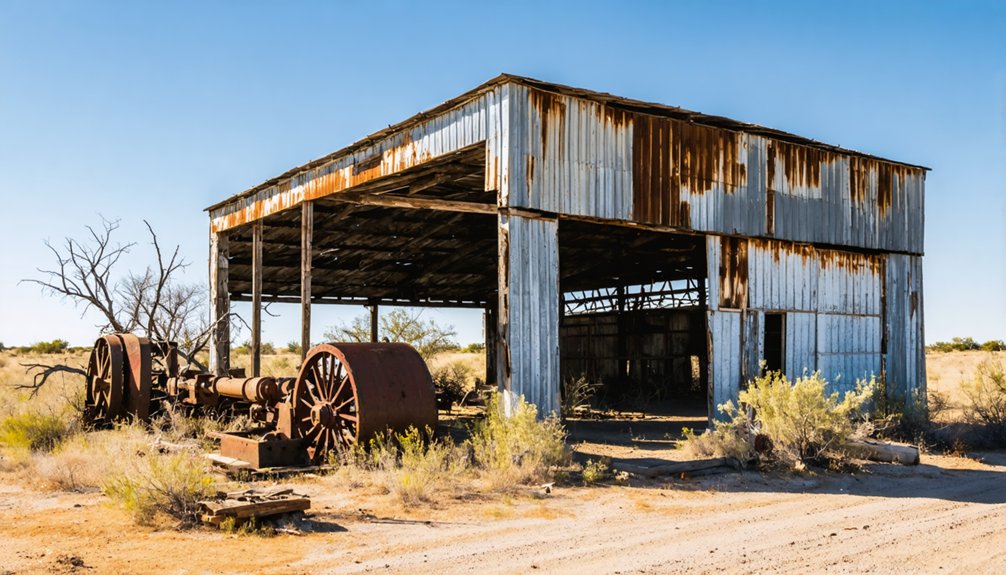
Beyond the churchyard, the ghost town‘s industrial past leaves its own mark on the landscape. The Muennink Gin site stands as a symbol of New Fountain’s ambition — it was Medina County’s first cotton gin, and it pushed boundaries by incorporating a tin roof, electricity, and telephone service when those luxuries were rare in rural Texas.
When you explore these ghost town remnants, you’re walking through layers of innovation that once drove a working community. The mill and Masonic lodge that thrived here by 1860 tell you this was never just a quiet farming settlement.
It was a place with real infrastructure and purpose. Not much physically survives, but reading the landscape carefully, you’ll feel the weight of what once stood here.
Quihi Is 1.8 Miles Away: Make It a Double Ghost Town Day
Two ghost towns for the price of one tank of gas — that’s the deal waiting just 1.8 miles east of New Fountain, where Quihi sits quietly along the same stretch of Medina County road.
Planned in 1845, Quihi carries its own ghost stories and historical significance through the standing Bethlehem Lutheran Church.
Make your double ghost town day count:
- Compare origins — New Fountain’s 1846 Methodist settlers versus Quihi’s 1845 Alsatian Catholic founders reveal two distinct immigrant identities sharing the same valley.
- Walk both cemeteries — headstones tell uncensored ghost stories no history book captures fully.
- Drive the historic San Antonio Road connecting both towns, a former stagecoach route still carrying its historical significance through the open Texas landscape.
You’re already here. Keep moving east.
When To Go and What To Bring

Spring and fall offer the most comfortable temperatures for exploring New Fountain’s open terrain, so plan your visit between March-May or October-November to avoid brutal Texas summer heat.
You’ll want sturdy walking shoes, sunscreen, plenty of water, and a camera to capture the Methodist church and cemetery’s weathered 19th-century character.
Pack a printed map or download offline navigation before you go, since rural Medina County roads can challenge cell service along Farm Road 2676.
Best Visiting Seasons
Fall and winter offer the most comfortable conditions for exploring New Fountain’s open terrain, with mild temperatures making it easy to walk the grounds around the Ebenezer Church and cemetery without battling the intense South Texas heat.
Ghost town photography thrives in these seasons, as softer light enhances the historic architecture’s details.
Plan your visit around these seasonal advantages:
- October–November – Cooler air arrives, seasonal wildlife becomes active near Verde Creek, and golden foliage adds depth to your photographs.
- December–February – Sparse vegetation reveals hidden structural remnants, offering cleaner sightlines across the property.
- March–April – Wildflowers bloom along Farm Road 2676, creating vivid foregrounds for wide-angle shots before summer heat intensifies.
Avoid summer months entirely; triple-digit temperatures make extended outdoor exploration genuinely dangerous.
Essential Packing List
Knowing when to visit New Fountain matters, but arriving unprepared can turn a rewarding ghost town experience into a frustrating one.
Pack these essentials before heading out on Farm Road 2676:
- Water and snacks – Rural Medina County offers few conveniences
- Sturdy walking shoes – Uneven terrain surrounds the cemetery and church grounds
- Camera or smartphone – Capture the historical significance of the Ebenezer Church and old gin site
- Sun protection – Texas heat hits hard on open ranch land
- Paper maps – Cell service gets spotty in the valley
- First aid kit – Smart prep for any remote ghost town exploration
- Notebook – Jot observations near historical markers along the old San Antonio Road
You’ll explore freely and confidently with the right gear.
Frequently Asked Questions
Was New Fountain Ever Considered for Official Texas Historical Landmark Designation?
The provided knowledge doesn’t confirm New Fountain’s official Texas Historical Landmark designation, but you’ll find its historical significance undeniable. Preservation efforts live on through the Methodist church and cemetery, keeping this ghost town’s legacy alive.
Are There Any Descendants of Original Castro Colonists Still Living Nearby?
The knowledge doesn’t confirm descendants nearby, but you’ll find descendant stories woven into Medina County’s rich historical significance. Explore local communities like Hondo and Quihi, where Castro colonist heritage actively shapes cultural identity and community pride today.
Can You Legally Access the Muennink Gin Site on Private Property?
You’ll need permission before accessing the Muennink Gin site, as property rights apply even to locations of historical significance. Always respect private boundaries, contact local landowners directly, and you’ll often find they’re proud to share their heritage.
Is New Fountain Featured in Any Organized Ghost Town Tour Packages?
You won’t find New Fountain in organized ghost town tour packages, but its historical significance makes it perfect for independent ghost town tourism. You’re free to craft your own adventure exploring this unique, off-the-beaten-path Texas treasure!
Are There Any Annual Events or Commemorations Held at Ebenezer Church?
Like a quiet sentinel standing guard, Ebenezer Church’s annual celebrations and commemorations aren’t documented in available records. You’d want to contact local Medina County historical societies directly to uncover any current Ebenezer Church history events or gatherings.
References
- https://en.wikipedia.org/wiki/New_Fountain
- https://www.youtube.com/watch?v=EcKNorOzxtk
- https://www.texasalmanac.com/places/new-fountain
- https://www.southernthing.com/ruins-in-texas-2640914879.html
- https://www.atlasobscura.com/things-to-do/texas/ghost-towns
- https://www.youtube.com/watch?v=tIv0bgcO34E
- https://www.texasescapes.com/TexasHillCountryTowns/Quihi-Texas.htm