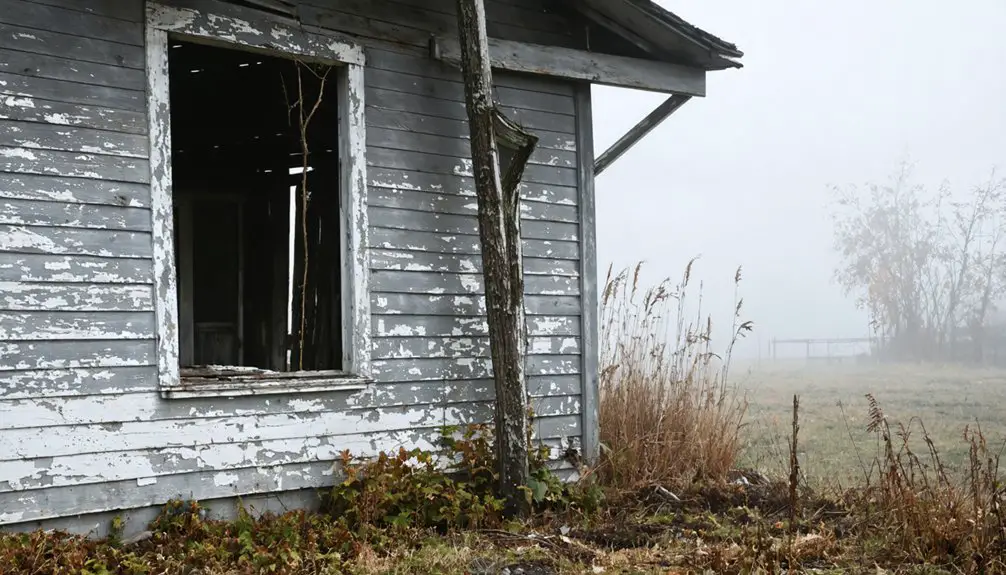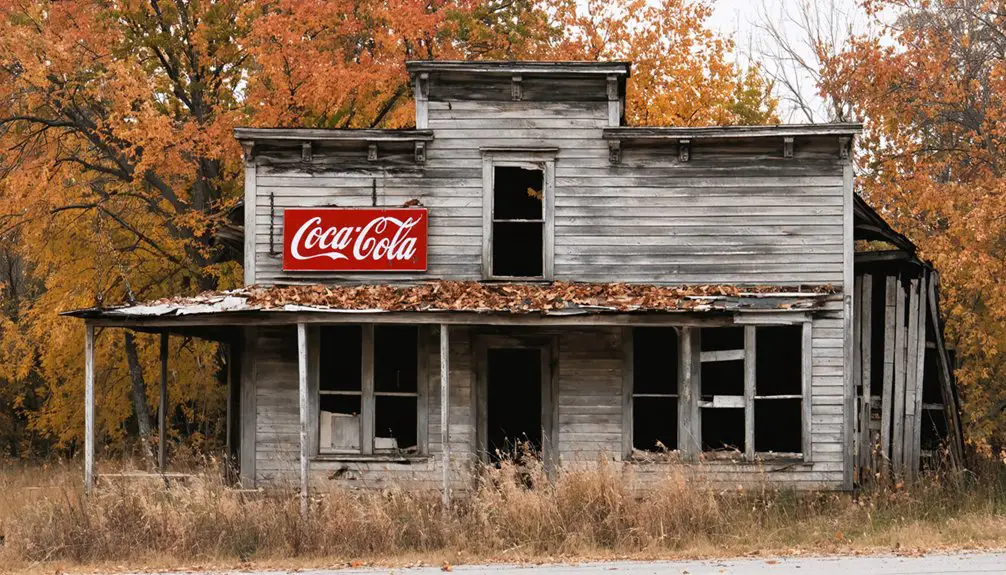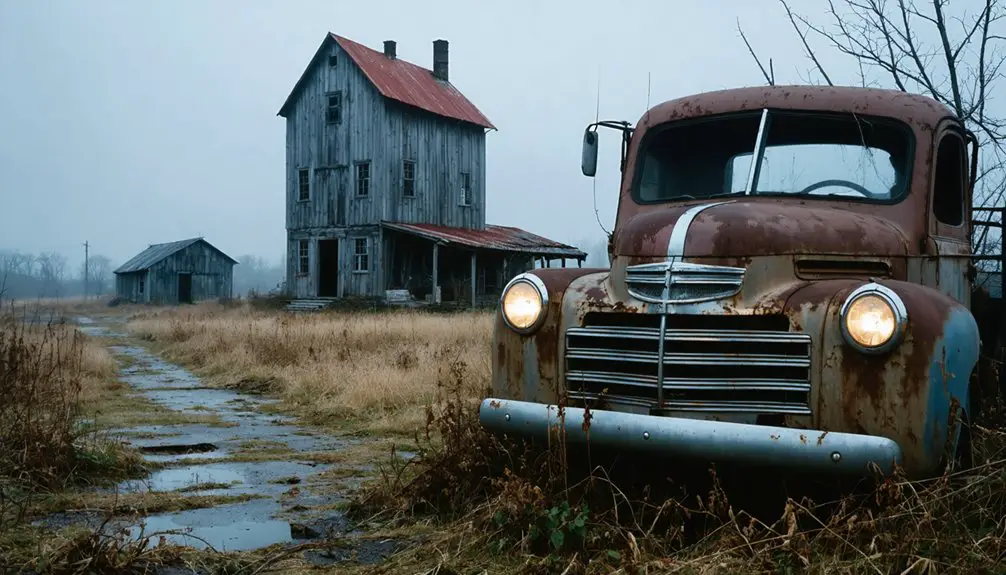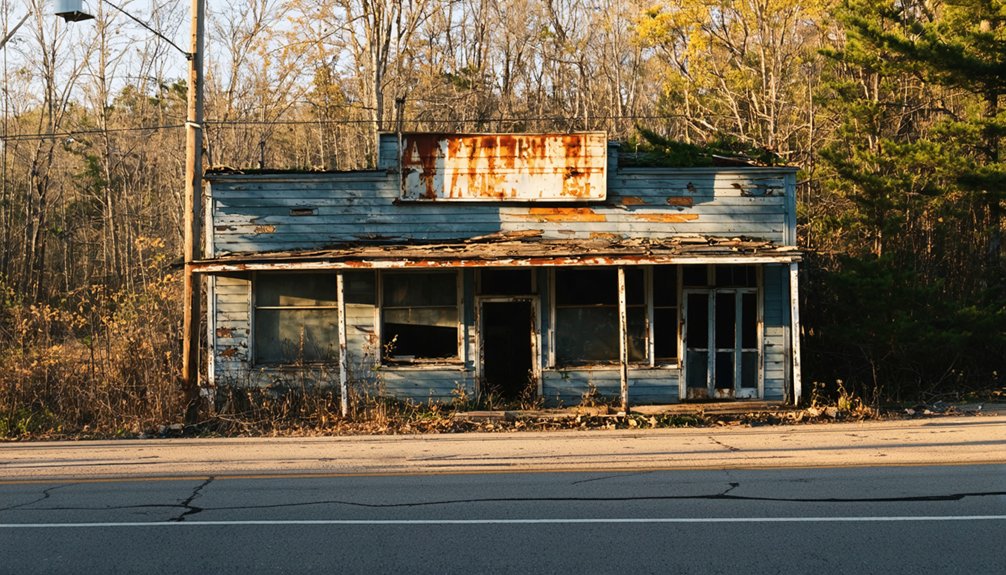
Planning a ghost town road trip through Menominee County, Michigan puts you on M-69, where lumber boomtowns like LaBranche and Wilson still haunt the landscape. LaBranche rose in 1882 before Wisconsin Land & Lumber abandoned it by 1943, while Wilson once housed nearly 500 residents before its railroad closed in 1950. You’ll find crumbling structures, a century-old saloon, and stories worth chasing. Stick around, and there’s far more waiting down this forgotten road.
Key Takeaways
- LaBranche and Wilson are two accessible ghost towns in Menominee County, connected by M-69 for a scenic historical road trip.
- LaBranche, founded in 1882, features a repurposed schoolhouse, operational tavern, and abandoned original structures reflecting Michigan’s timber boom.
- Wilson, once home to nearly 500 residents, preserves a historic 1902 saloon marking its railroad and post office heritage.
- Visit between May and October for the best road conditions, comfortable temperatures, and vibrant seasonal scenery along the route.
- Escanaba and Menominee city offer nearby dining and accommodations, making either a convenient base for exploring both ghost towns.
What Remains at LaBranche Ghost Town Today
Though much of LaBranche has surrendered to time and forest, a handful of structures still stand as quiet reminders of its logging-era past.
When you explore LaBranche history, you’ll find the old schoolhouse repurposed as a township hall, sitting quietly on the south side of M-69. The tavern, once a hub of frontier social life, has been modernized and remains operational — a rare example of ghost town preservation done right.
The old schoolhouse still stands, repurposed as a township hall — history quietly holding its ground on M-69.
Beside it stands a historic house, while across N. Gaber Road, an abandoned original structure offers a rawer glimpse into the past.
You won’t find a bustling town, but you’ll find something more honest — fragments of a community that once thrived on timber and tenacity, waiting for curious travelers like you to discover them.
Walking the Grounds of Wilson Ghost Town
From LaBranche, your next stop pulls you westward toward Wilson, another ghost town tucked into Menominee County’s layered past. Situated 18 miles west of Escanaba in Harris Township, Wilson once buzzed with nearly 500 residents before railroad closures silenced its streets in 1950.
Walking these grounds rewards your curiosity. The 1902 saloon still stands, offering a tangible anchor to a vanished era. It’s the kind of structure that fuels ghost stories and invites quiet reflection on lives once lived here.
The Menominee Range Historical Society actively pursues historical preservation, documenting Wilson’s story before time erases it completely.
You’re free to explore, photograph, and absorb what remains. Wilson doesn’t demand much from you—just attention and respect for what it silently preserves.
How to Reach LaBranche and Wilson via M-69
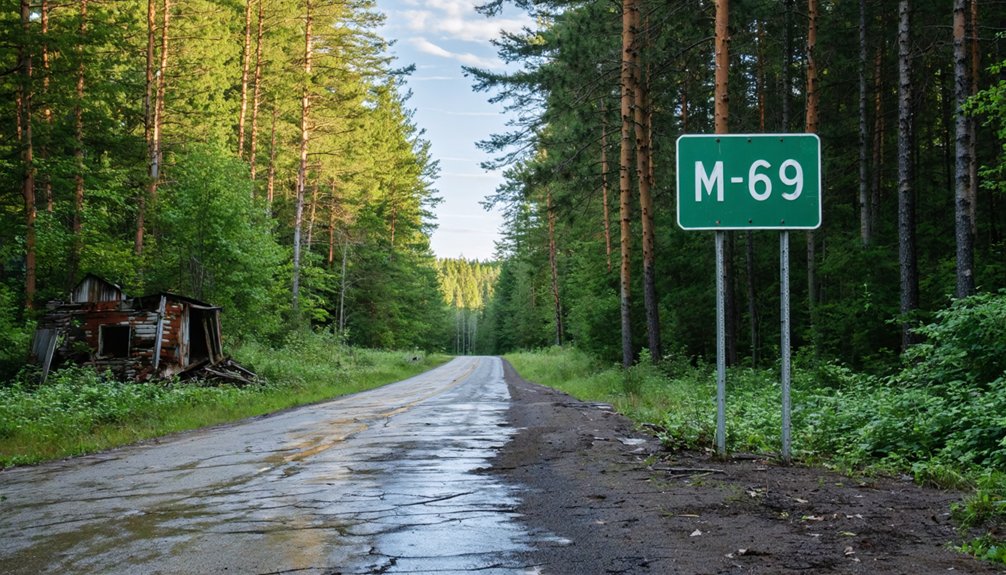
To start your M-69 journey, head into Michigan’s Upper Peninsula, where this scenic highway connects several historic lumber towns in Menominee County.
You’ll find LaBranche directly along M-69, where the old schoolhouse-turned-township-hall on the highway’s south side signals your arrival.
If you’re continuing to Wilson, drive roughly 18 miles west of Escanaba, where this once-thriving railroad community quietly waits off the main route.
Starting Your M-69 Journey
M-69 cuts straight through the heart of Michigan’s Upper Peninsula, and it’s your gateway to two of Menominee County’s most fascinating ghost towns—LaBranche and Wilson.
Start your journey from Escanaba, heading west along this scenic route. LaBranche sits directly along M-69, making it an effortless first stop where you’ll spot ghost town attractions like the repurposed schoolhouse, now serving as a township hall, and the still-operating LaBranche tavern.
From there, continue exploring Wilson, positioned roughly 18 miles west of Escanaba. Both communities carry deep historical significance, rooted in Michigan’s booming lumber and railroad era.
M-69 connects these remnants seamlessly, letting you move freely between sites without complicated detours. Pack a map, fuel up, and let the open road guide you through forgotten history.
Reaching LaBranche Via M-69
Heading west out of Escanaba, you’ll find M-69 cutting cleanly through Menominee County’s forested landscape toward LaBranche. This route drops you directly into Michigan’s timber legacy, where logging camps once dominated every ridge and hollow.
LaBranche history begins in 1882, when William Mueller‘s lumber operation transformed this remote stretch into a functioning community.
Today, you’re free to explore what remains on your own terms:
- Watch for the schoolhouse on M-69’s south side, now serving as a township hall
- Stop at the LaBranche tavern, still operating and connecting you to authentic local history
- Spot the abandoned original house across from the tavern on N. Gaber Road
These landmarks aren’t museum pieces behind velvet ropes — they’re living remnants waiting for curious travelers like you.
Locating Wilson From Escanaba
After exploring LaBranche’s remnants, Wilson is your next stop — another Menominee County community that traded its bustling past for quiet obscurity.
Head west from Escanaba approximately 18 miles, and you’ll find this unincorporated Harris Township settlement waiting with its own hidden history.
Wilson’s ghostly encounters start with its origins as Ferry Switch, a railroad depot and post office established in the early 1870s.
By the early 1900s, nearly 500 residents called it home.
Today, the 1902 saloon still stands as a stubborn survivor, reminding you of Wilson’s former significance.
When the railroad closed in 1950, businesses followed, leaving behind a hollowed shell of commerce.
Freedom-seekers craving authentic, undiscovered Michigan history will appreciate Wilson’s unpolished, raw preservation of a forgotten era.
Other Menominee County Ghost Towns on the Route
As you cruise along M-69, Menominee County reveals two ghost towns worth pulling over for: LaBranche and Wilson.
LaBranche, founded in 1882 as a lumber camp, still holds a working tavern, a repurposed schoolhouse, and a few weathered original structures that hint at its timber-boom past.
Wilson, once a bustling community of 500 residents, traces its roots to an 1870s railroad depot and still stands with its 1902 saloon as a quiet reminder of the region’s vanished prosperity.
LaBranche Ghost Town
Roughly 18 miles west of Escanaba, the ghost town of LaBranche sits quietly along M-69 in Menominee County’s Upper Peninsula. Founded in 1882 as a lumber camp, LaBranche history reflects Michigan’s timber boom and inevitable bust.
You’ll still find tangible remnants worth exploring:
- The schoolhouse, now a township hall, anchors the south side of M-69
- A modernized tavern continues operating, carrying LaBranche legends within its walls
- An abandoned original house on N. Gaber Road stands frozen in time
Wisconsin Land & Lumber Company acquired the settlement in 1909 after Mueller’s bankruptcy, operating until timber depletion forced closure in 1943.
The railroad followed in 1970, its rails transformed into the Felch Grade Trail — your perfect gateway into this forgotten community.
Wilson Ghost Town
Continuing west along your route, Wilson stands as another unincorporated ghost town tucked within Harris Township, Menominee County. Its Wilson history traces back to the early 1870s, when it operated as the Ferry Switch post office and railroad depot.
By the early 1900s, the community swelled to roughly 500 residents, reflecting its community significance as a thriving hub along the rail line.
You’ll find the 1902 saloon still standing, offering a tangible connection to Wilson’s busiest era. Once the railroad closed in 1950, businesses steadily disappeared, leaving behind only fragments of what was once a lively settlement.
Walking through Wilson gives you a raw, unfiltered glimpse into Upper Peninsula life, where industry once dictated everything—and its absence reshaped the landscape permanently.
What the Menominee Heritage Museum Reveals
Before leaving Menominee County, you’ll want to stop into the Menominee Heritage Museum, where family histories, local directories, and historical photographs bring the region’s vanished communities back to life.
Menominee history runs deep here, and the museum preserves ghost stories alongside documented records that reveal what daily life truly looked like in these forgotten towns.
Menominee history runs deep, preserved in ghost stories and documented records that reveal forgotten towns as they truly were.
Explore what you’ll uncover inside:
- Photographic archives capturing lumber camps, railroad depots, and townspeople who built communities that no longer exist
- Family histories and directories tracing lineages connected to LaBranche, Wilson, and other disappeared settlements
- Documented ghost stories collected by the Menominee Range Historical Society, blending folklore with historical fact
This stop grounds your entire road trip in real human stories, giving every abandoned structure you’ve already visited a powerful, lasting context.
Best Time of Year to Road Trip Menominee County
Though Menominee County’s ghost towns hold their haunted charm year-round, late spring through early fall offers the most rewarding road trip experience.
From May through October, you’ll navigate unpaved back roads without battling ice or snow, and overgrown sites become genuinely explorable. Summer brings vibrant seasonal attractions along the Menominee River corridor, while local festivals celebrate the region’s rich lumber heritage, giving you cultural context beyond abandoned structures.
Fall delivers perhaps the sharpest experience — Upper Peninsula foliage frames crumbling foundations dramatically, crowds thin considerably, and cooler temperatures make long drives comfortable.
Avoid winter unless you’re prepared for brutal lake-effect conditions that can strand vehicles on remote routes.
Whatever season you choose, start early, carry detailed maps, and fuel up before heading into sparsely populated township roads.
Restaurants and Lodging Near LaBranche and Wilson
Once you’ve locked in your travel window, planning where to eat and sleep keeps the adventure running smoothly.
Both ghost towns sit within reach of Escanaba and Menominee, where nearby accommodations and local cuisine give you comfortable options without sacrificing that rugged Upper Peninsula feel.
- The LaBranche tavern serves as a living piece of history where you can grab a drink among locals who know the area’s stories.
- Escanaba, roughly 18 miles east of Wilson, offers motels, diners, and local cuisine rooted in Great Lakes tradition.
- Menominee city provides riverfront lodging options with views across to Marinette, Wisconsin, making it a strong base camp.
Pack flexibility into your itinerary and let each stop shape your experience.
What Menominee County’s Timber Collapse Left Behind
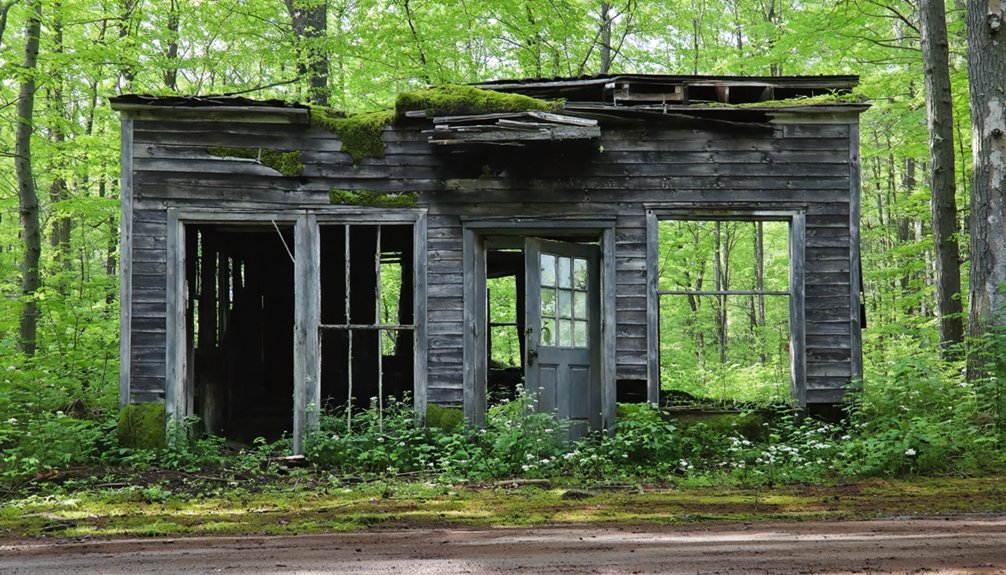
When the timber ran out, Menominee County didn’t fade quietly — it left behind a scattered mosaic of half-standing structures, overgrown rail grades, and shuttered post offices that now define the region’s ghost town landscape.
The timber’s absence didn’t erase Menominee County — it preserved it, frozen mid-collapse, in wood and rust.
That timber legacy shaped everything: thriving sawmills, bustling saloons, packed schoolhouses — then sudden silence. Wisconsin Land & Lumber’s 1943 shutdown and LaBranche’s 1948 post office closure mark the economic impact most visibly.
You’ll find the railroad’s ghost along the Felch Grade Trail, where decommissioned rails became a recreational path. Wilson’s 1902 saloon still stands as quiet proof that communities once thrived here.
Exploring these remnants, you’re not just sightseeing — you’re reading the physical record of an industry that built a region and then abandoned it.
Why Menominee County Belongs on Every Michigan Ghost Town List
Few regions in Michigan pack as many ghost town layers into a single county as Menominee does.
You’ll find logging camps, railroad depots, and vanished mill towns scattered across a landscape still rich with historical significance. The Menominee Range Historical Society even collects ghost stories tied to these forgotten places, adding an eerie dimension to your exploration.
Here’s why Menominee County deserves a spot on your list:
- Diverse decay – lumber towns, mining settlements, and railroad stops each tell a different story
- Accessible ruins – you can drive M-69, walk the Felch Grade Trail, and visit standing structures
- Living history – local museums preserve photographs, family directories, and cultural artifacts
You won’t just observe history here — you’ll move through it.
Frequently Asked Questions
Is Photography Permitted at the Abandoned Labranche House on N. Gaber Road?
No specific photography restrictions are mentioned, so you’re likely free to capture the abandoned architecture of LaBranche’s historic house. Embrace ghost town photography responsibly, respecting private property boundaries while documenting this hauntingly beautiful piece of Michigan’s lumber history.
Can Visitors Access the Felch Grade Trail Year-Round for Hiking or Biking?
Like a ribbon of freedom stretching through the wilderness, the Felch Grade Trail’s accessibility welcomes you year-round for hiking or biking, though you’ll want to prepare for Upper Peninsula’s challenging seasonal conditions, especially during harsh winter months.
Does the Labranche Tavern Host Any Ghost Town-Themed Events or Tours?
The available knowledge doesn’t confirm LaBranche Tavern hosts ghost town-themed events, but you’ll find the Menominee Range Historical Society actively collects ghost stories, celebrating the area’s rich historical significance—making it your perfect destination for immersive exploration!
Are There Guided Tours Available for Menominee County’s Ghost Town Sites?
With dozens of ghost town remnants scattered across the county, you won’t find formal guided tours, but you can freely explore abandoned structures and uncover local legends through the Menominee Range Historical Society’s self-guided resources.
What Is the Menominee Indian Spirit Stone Displayed at the Visitor Center?
When you visit the Menominee visitor center, you’ll discover the Spirit Stone, a sacred artifact carrying deep Spirit stone significance in Menominee history, symbolizing cultural heritage and spiritual connection that’s captivated explorers and history enthusiasts seeking meaningful freedom-filled adventures.
References
- https://99wfmk.com/labranche-michigan/
- https://www.michigan.org/article/trip-idea/incredibly-haunted-places-upper-peninsula
- https://99wfmk.com/wilsonmichigan/
- https://www.uptravel.com/places-to-visit/regions/central/menominee-county/
- https://beaumier.nmu.edu/ghosttowns/
- https://menomineemuseum.com/blog/ghost-stories-2020
- https://www.youtube.com/watch?v=OJT9ic7kje8