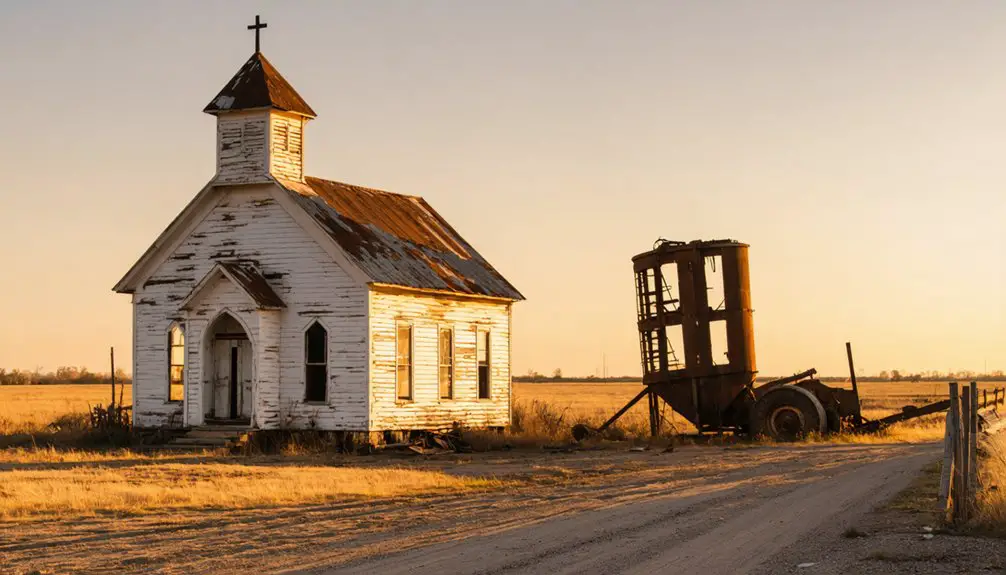
Planning a ghost town road trip to Citra, Oklahoma means heading into Hughes County’s open grasslands, where unpaved grid roads lead you to one of the state’s most completely abandoned sites. You’ll find no buildings, no fences—just an overgrown field and a weathered cemetery marking where a community once stood. Arrive early, bring offline maps, and pack plenty of water. There’s far more to this quiet, grass-swallowed place than first meets the eye.
Key Takeaways
- Citra, Oklahoma, is a Class 3 ghost town in Hughes County, accessible via unpaved grid roads from McAlester and Wilburton.
- The only remaining feature is an overgrown cemetery; no buildings, fences, or infrastructure exist at the site.
- Visit during summer mornings for optimal daylight and safety, avoiding winter mud and extreme midday heat.
- Prepare by downloading offline maps, carrying water and snacks, packing a first aid kit, and fueling up beforehand.
- Nearby ghost towns like Adamson offer standing structures, making a regional multi-stop road trip worthwhile and historically enriching.
Where Is Citra, Oklahoma Located?
Tucked away in Hughes County, Oklahoma, Citra sits on the east side of the former Choctaw Nation boundary — a detail that actually explains its name, since “Citra” derives from a prefix meaning “on this side.” That geographic identity tied directly to Choctaw territorial lines makes Citra a meaningful stop for anyone interested in cultural preservation and frontier history.
You won’t find it on most modern maps, and no paved roads lead you straight there. The site is completely overgrown, with grass swallowing what was once a functioning community. Environmental impact from decades of neglect has erased nearly every trace of human settlement.
Only the cemetery remains, standing as a quiet marker of a place that, by Oklahoma’s official definition, simply no longer exists.
What Is the Citra Ghost Town and Why Does It Matter?
When you visit Citra, you’re stepping into one of Oklahoma’s Class 3 ghost towns — a site so thoroughly reclaimed by time that only its cemetery survives.
The name itself tells the town’s origin story: “Citra” derives from a prefix meaning “on this side,” marking its position on the east side of the former Choctaw Nation boundary.
That single cemetery makes Citra matter, because it proves a community once existed here, even if no record captures exactly when or how many people once called it home.
Citra’s Ghost Town Classification
Citra, Oklahoma, isn’t your typical roadside curiosity—it’s a certified Class 3 ghost town, meaning you can reach it by standard 2WD vehicle without needing specialized equipment or off-road experience. Oklahoma officially classifies ghost towns as communities experiencing 80% population decline from peak or no remaining existence. Citra meets the harshest standard—it’s completely gone.
Here’s what that classification means for your visit:
- No buildings — just open sky where structures once stood
- No fences — vegetation has reclaimed every boundary line
- One cemetery — the sole surviving marker of historical significance
- Overgrown silence — grass swallows the entire former town layout
This cultural heritage site strips ghost town exploration down to its rawest form—just you, the land, and what once was.
The Meaning Behind Citra
Beyond the classification and the quiet overgrowth lies a name worth unpacking. “Citra” isn’t arbitrary—it pulls from a Latin-rooted prefix meaning “on this side,” a direct reference to the town’s position on the east side of the former Choctaw Nation boundary.
That geographic identity carries real historical significance. The name fundamentally marked where you stood relative to Choctaw territory—a living boundary marker embedded in everyday language. It’s a quiet but powerful reminder of how deeply Indigenous territorial lines shaped Oklahoma’s early settlements.
For you as a visitor, that cultural heritage adds dimension to what might otherwise feel like an empty field. You’re not just standing in overgrown grass—you’re standing on a site where geography, naming, and Native American history converged into a single, forgotten community.
Why Citra Still Matters
Though it’s little more than a cemetery surrounded by overgrown grass, Citra carries weight that outlasts its physical remains. Urban decay has swallowed nearly every trace of this former Choctaw Nation community, yet something powerful lingers.
Historical preservation isn’t always about grand monuments — sometimes it’s about bearing witness.
When you stand at Citra, you’re confronting:
- Silence — no traffic, no voices, just wind cutting through tall grass where streets once ran
- Erasure — foundations gone, fences gone, every building consumed by time
- Resilience — one cemetery refusing to disappear completely
- Freedom — open land stretching in every direction, uncrowded and unmanaged
Citra reminds you that history doesn’t always survive in museums. Sometimes it survives in a forgotten field you chose to find.
Why Citra Oklahoma Got Its Name From a Choctaw Boundary
When you look at Citra’s name, you’re reading a geographic story written by the land itself — “citra” is a Latin-derived prefix meaning “on this side,” directly referencing the town’s position on the east side of the former Choctaw Nation boundary.
The Choctaw Nation’s territorial line wasn’t just a political border; it was a powerful organizing force that shaped how settlers identified their surroundings and named their communities.
You can think of Citra as a place that wore its location like a badge, telling travelers exactly where they stood in relation to one of Oklahoma’s most significant historical boundaries.
Choctaw Nation Boundary Explained
Citra’s unusual name holds a clue to its past: it derives from a Latin-rooted prefix meaning “on this side,” a direct reference to the town’s position on the east side of the former Choctaw Nation boundary. That boundary wasn’t just a line on a map — it shaped communities, identities, and entire economies. Understanding it deepens Citra’s cultural significance and connects you to Oklahoma’s layered history.
Picture the boundary this way:
- A vast territorial edge separating Choctaw lands from Anglo-American settlement
- Invisible lines enforced by treaties and federal authority
- Towns sprouting just outside, named by their geographic relationship to it
- Ghost towns today standing as quiet markers of historical preservation
You’re walking ground that once defined a nation’s edge.
Citra’s “This Side” Meaning
Buried in the town’s name is a geographic confession: “Citra” derives from a Latin-rooted prefix meaning “on this side,” a direct nod to the town’s position just east of the former Choctaw Nation boundary.
That single word quietly captures the town’s historical significance — settlers knew exactly where they stood relative to sovereign Choctaw territory. You’re not just reading a place name; you’re decoding a boundary marker frozen in language.
The cultural heritage embedded in “Citra” reflects how deeply territorial lines shaped identity across early Oklahoma. When you visit the site today, that meaning hits differently.
Nothing remains except the cemetery, yet the name still tells you precisely where you’re — on this side of a line that once defined everything.
Geography Shaped The Name
Few place names carry as much geographic weight as Citra, Oklahoma — a town named not for what it was, but for where it stood. Its historical significance lives in a single prefix: *citra*, meaning “on this side.” That boundary wasn’t invisible — it shaped lives, land rights, and movement.
Picture yourself standing there, understanding:
- A defined Choctaw Nation boundary cutting across the Oklahoma landscape
- Communities forming on each side, each carrying distinct cultural impact
- Settlers identifying their location simply by which side they occupied
- A town receiving its permanent name from that geographic reality
You’re not just visiting a forgotten town — you’re standing where a boundary once determined everything. Geography didn’t just influence Citra’s name; it *was* the name.
How To Reach Citra Cemetery by 2WD Vehicle
Although no paved roads lead directly to the Citra Cemetery, you can reach it with a standard 2WD vehicle by using McAlester and Wilburton as your primary navigation anchors in southeastern Oklahoma. These two towns bracket the remote area where Citra once stood on the eastern edge of the former Choctaw Nation boundary.
From either town, you’ll navigate unpaved grid roads that cut through open grassland.
The Class 3 designation means you don’t need a truck or SUV — just a reliable vehicle and a printed map, since cell service disappears quickly out here.
The cemetery stands as the sole testament to Citra’s historical significance, and whatever preservation efforts exist depend entirely on respectful visitors who treat the site with care before driving back out.
What’s Left To See at the Citra Ghost Town Site?
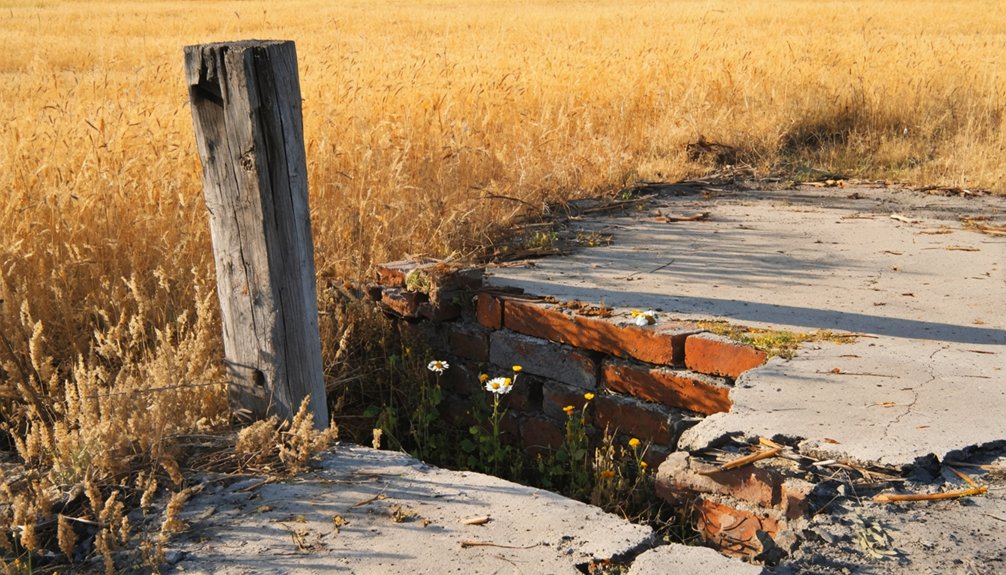
Once you’ve made it out to the Citra site, don’t expect much beyond open sky and overgrown grass — but what you’ll find carries its own quiet weight. No historical artifacts survive above ground, and preservation efforts never reached this far. Yet the place still speaks.
Citra offers no monuments, no markers — just open sky, overgrown silence, and a place that still speaks.
Here’s what you’ll actually encounter:
- The Citra Cemetery — weathered stones pushing through wild grass, the town’s only lasting marker
- Unbroken grassland — vegetation swallowing every former foundation and fence line
- Total silence — no traffic, no crowds, no infrastructure interrupting your thoughts
- Wide open horizon — the kind of sky that reminds you why people once chose to settle here
It’s raw, unpolished history — exactly as freedom-seekers tend to prefer it.
Best Time To Visit Citra Without Miserable Conditions
Timing your visit to Citra can mean the difference between a memorable road trip and a genuinely uncomfortable one. Summer offers the best conditions for exploring this site of cultural significance, giving you longer daylight hours to navigate unpaved roads and walk the overgrown grounds. However, extreme heat hits hard out here, so arrive early morning before temperatures peak. You’ll move freely, photograph clearly, and appreciate the cemetery’s historical preservation without rushing back to your vehicle.
Winter visits sound romantic but deliver cold temperatures and potentially muddy, unforgiving road conditions that’ll strand you miles from help. Remember, no cell service exists nearby, so poor timing isn’t just uncomfortable — it’s genuinely risky. Plan smart, and Citra rewards you with a raw, authentic glimpse into Oklahoma’s vanished past.
What To Pack for a Remote Citra Site Visit

Packing right for Citra separates a smooth visit from a dangerous one. You’re heading somewhere with no cell service, no emergency support, and no infrastructure — just overgrown land and a lone cemetery carrying historical significance. Respect that isolation by preparing deliberately.
- Water and snacks — Summer heat hits hard; carry more than you think you’ll need.
- Navigation tools — Download offline maps before you leave civilization behind.
- First aid kit — Remote terrain means you’re your own emergency responder.
- Camera and notebook — Document what remains and support preservation efforts by recording the cemetery’s current condition.
Your vehicle should have a full tank before you turn onto those unpaved roads. Citra rewards the prepared and punishes the careless.
Other Ghost Towns Near Citra Worth Adding to Your Route
While you’re already making the drive through Hughes County, it makes sense to extend your route and hit a few more ghost towns in southeastern Oklahoma. Adamson sits nearby and offers something Citra doesn’t — a monument and several standing houses that reflect active preservation efforts. Walking through Adamson gives you a tangible sense of historical stories that Citra’s overgrown fields can only hint at.
Use McAlester and Wilburton as your anchor points to map a flexible loop connecting multiple sites. Each ghost town tells a different chapter of Oklahoma’s territorial past, from Choctaw Nation settlements to early farming communities.
Stringing these stops together transforms a single cemetery visit into a full regional exploration, letting you move at your own pace through land that time has quietly reclaimed.
Frequently Asked Questions
Is There Cell Service Available at the Citra Ghost Town Site?
Like a lone wanderer beyond civilization’s reach, you’ll find no cell coverage at Citra. Signal strength vanishes completely here, so you’re truly off the grid — embrace that raw freedom, but plan accordingly before venturing out.
Does Citra Have Any Known Environmental Contamination or Safety Hazards?
You won’t encounter any known environmental hazards or contamination risks at Citra. Unlike Oklahoma’s Tar Creek Superfund sites, it’s free from such dangers, letting you explore this overgrown ghost town with peace of mind.
Can Visitors Legally Access the Citra Cemetery on Private Property?
Like a locked door with no key, legal access to Citra’s cemetery isn’t confirmed in available records. You should verify private property ownership and obtain permission before visiting to guarantee you’re exploring freely and responsibly.
Are There Any Entrance Fees Required to Visit Citra Ghost Town?
You won’t pay any entrance fees to explore Citra’s ghost town history. You’re free to roam, capture photography opportunities at the cemetery, and experience Oklahoma’s untamed, vanishing past without spending a single dollar on admission.
How Does Citra Compare to Adamson in Terms of Remaining Structures?
You’ll find Citra offers far fewer historical preservation highlights than Adamson—just a lone cemetery remains. Adamson’s got a monument and several houses, providing more tourist amenities for your adventurous, freedom-seeking exploration of Oklahoma’s vanishing past.
References
- http://www.ghosttowns.com/states/ok/citra.html
- https://en.wikipedia.org/wiki/List_of_ghost_towns_in_Oklahoma
- https://www.okhistory.org/publications/enc/entry?entry=GH002
- https://www.travelok.com/articles/oklahomaghosttowns
- https://sites.rootsweb.com/~okghstwn/cimarron/cimarron.htm
- https://www.ou.edu/news/articles/2024/may/ou-researcher-unveils-book-of-oklahomas-ghost-towns