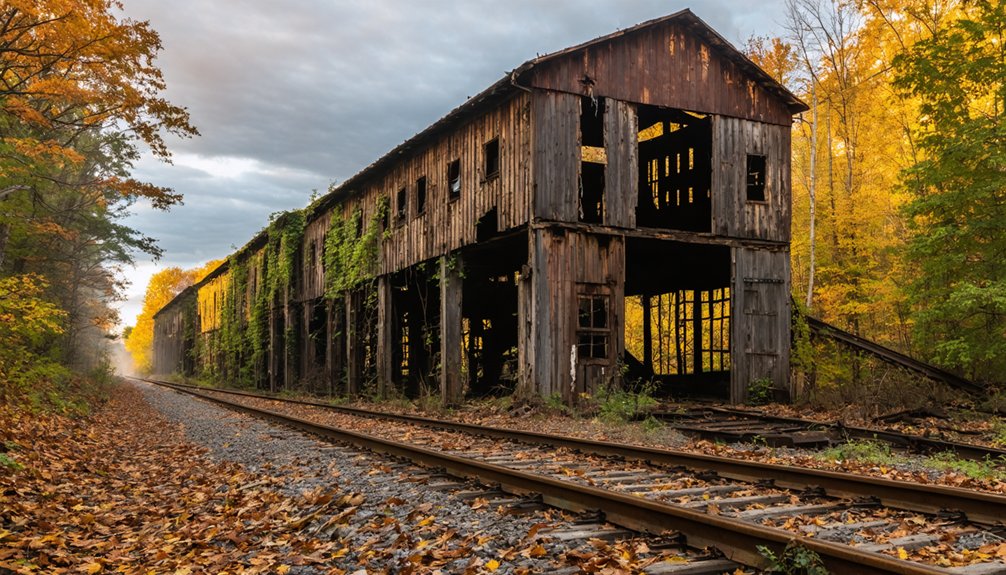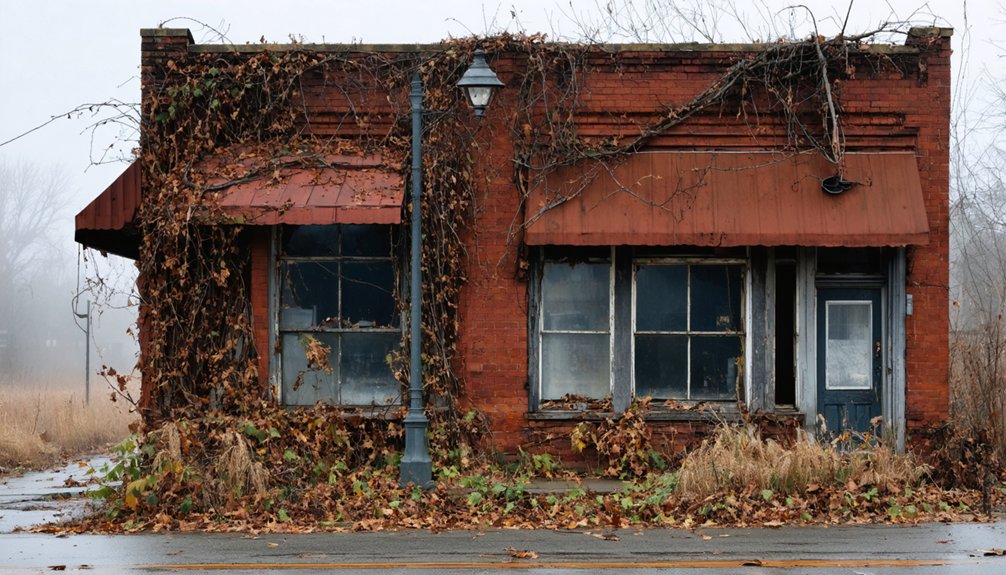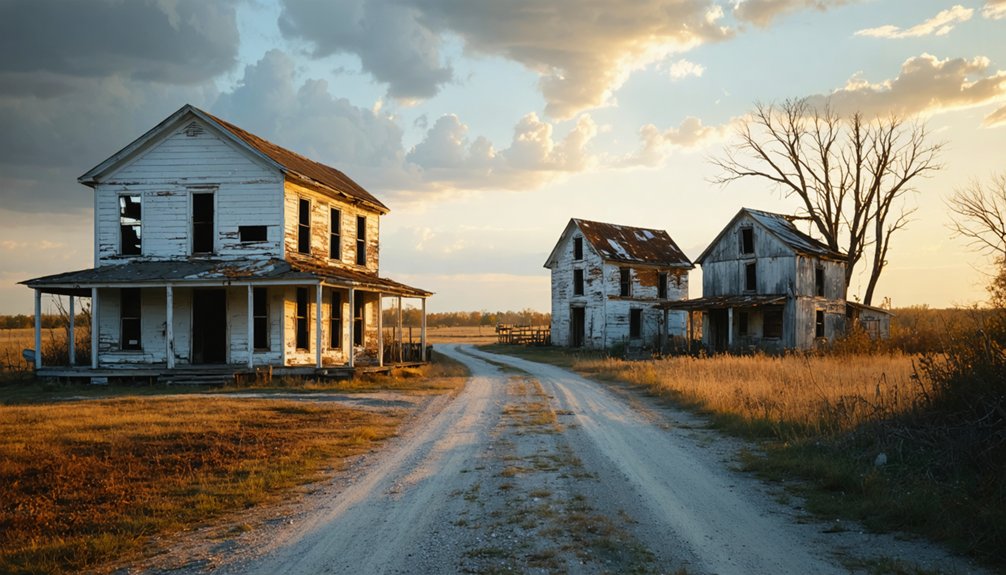
Your ghost town road trip to Fort Ritner, Indiana starts in Bedford, just 13 miles northwest of this hauntingly quiet Lawrence County relic. You’ll follow rural backroads southeast to reach a Level 4 ghost town that’s survived devastating floods, a hotel fire, and a century of slow abandonment. Fewer than 75 residents remain today, and the stories behind every crumbling structure run surprisingly deep — keep going to uncover everything worth knowing before you hit the road.
Key Takeaways
- Fort Ritner, not Renner, is the ghost town in Lawrence County, Indiana, with fewer than 75 residents remaining from nearly 1,000.
- Start your road trip in Bedford, driving 13 miles southeast through rural Lawrence County backroads to reach Fort Ritner in 20 minutes.
- Key historical sites include the 1913 Holland General Store, Methodist Episcopal Church, and remnants of a hotel destroyed by fire in 1977.
- Extend your trip by visiting Tunnelton, 15 miles east, then loop back through Mitchell to Bedford, covering roughly 53 total miles.
- Visit during spring or fall, bringing sturdy boots, a printed map, water, a flashlight, and a first aid kit.
Why Fort Ritner, Indiana Qualifies as a True Ghost Town
Although ghost towns exist on a spectrum, Fort Ritner, Indiana earns its classification through a combination of dramatic population loss, repeated natural disasters, and the near-total collapse of its commercial infrastructure.
Once home to nearly 1,000 residents, it now shelters fewer than 75 people. That’s a ghost town characteristic you can’t ignore.
You’ll find historical significance embedded in every remaining structure. The 1913-built Holland General Store, now a private residence, and the surviving Methodist Episcopal Church tell stories of floods, fires, and resilience.
The 1913 and 1937 floods, combined with a devastating 1977 hotel fire, systematically dismantled Fort Ritner’s commercial core. No active businesses remain today.
Lawrence County’s Level 4 ghost town classification confirms what you’ll see when you arrive — a community frozen between survival and disappearance.
How To Get To Fort Ritner From Bedford
If you’re starting your ghost town adventure in Bedford, Indiana, you’re already in the perfect launching point for Fort Ritner.
Head southeast from Bedford for 13 miles through Lawrence County’s rural backroads, following the winding path toward the East Fork of the White River.
You’ll know you’re getting close when the landscape opens up into the quiet, faded remnants of what was once a thriving community of nearly 1,000 residents.
Bedford Starting Point
Bedford serves as your launching pad for this ghost town adventure, sitting just 13 miles northwest of Fort Ritner. Known for its rich Bedford history as the “Limestone Capital of the World,” this Lawrence County seat offers solid local attractions before you hit the road.
Grab supplies at one of the downtown shops, explore the limestone heritage museums, or fuel up at a local diner. Once you’re ready, head southeast from Bedford’s town center, following Lawrence County roads toward the East Fork of the White River valley.
The drive takes roughly 20 minutes and winds through rolling Indiana terrain. Fort Ritner appears quietly along the roadside, its few remaining structures hinting at a community that once housed nearly 1,000 residents before floods and time took their toll.
Southeast Route Details
Once you’ve stocked up and soaked in Bedford’s limestone legacy, it’s time to hit the road southeast toward Fort Ritner.
Drive roughly 13 miles through Lawrence County’s rolling terrain, following Southern Indiana’s back roads toward the East Fork of White River.
Fort Ritner sits half a mile north of that river, platted by Michael Ritner back in May 1857. Its historical significance becomes clear the moment you arrive — a former bustling community of nearly 1,000 residents now reduced to fewer than 75 souls.
Your ghost town exploration reveals remnants worth photographing: the 1913 Holland General Store converted into a private residence, the flood-surviving Methodist Episcopal Church perched on higher ground, and the charred hotel site on Front Street.
Freedom-seekers will appreciate every quiet, forgotten mile leading here.
What You’ll Actually Find When You Arrive in Fort Ritner
Pulling into Fort Ritner, you’ll find a quiet stretch of Lawrence County road where just a handful of structures hint at what was once a thriving community of 1,000 residents.
The former Holland General Store, rebuilt after the devastating 1913 flood, now serves as a private residence — one of the hidden treasures that rewards curious travelers willing to explore off the beaten path.
Once a flood-ravaged general store, this quiet private residence now stands as Fort Ritner’s most unexpected hidden treasure.
Across the road, the hotel site still carries visible remnants of the 1977 fire that claimed its historic two-story structure.
Local legends tied to repeated flooding and evacuation give every remaining building a layered story.
The Methodist Episcopal Church, perched on higher ground, stands as the most resilient survivor.
Don’t expect open doors or welcome signs — Fort Ritner rewards observation, not tourism.
Best Time To Visit and What To Bring
Spring and fall offer the best conditions for exploring Fort Ritner and Renner, since summer heat and winter ice make rural Lawrence and Blackford County roads genuinely miserable.
You’ll want sturdy boots, a camera, water, and a printed map since cell service drops out fast in these isolated areas.
Pack a basic first aid kit and a flashlight too, because you’re wandering around aging structures with uneven ground and no one nearby to call for help.
Ideal Visiting Seasons
Although ghost towns can be explored year-round, late spring through early fall offers the clearest views of Fort Ritner and Renner’s remaining structures, with mild temperatures making long stretches of walking and photography far more comfortable.
Each season carries its own historical significance and seasonal attractions worth considering:
- Spring (April–June): Wildflowers frame abandoned structures beautifully, and you’ll encounter fewer crowds along Lawrence and Blackford County roads.
- Summer (July–August): Longer daylight hours give you maximum exploration time, though carry water since shade is scarce near open sites.
- Early Fall (September–October): Foliage transforms the landscape dramatically, highlighting the Methodist Episcopal Church and Holland General Store against vivid color.
Avoid winter visits when icy rural roads make navigation genuinely dangerous across Southern Indiana’s remote corridors.
Essential Gear Checklist
Exploring Fort Ritner and Renner demands practical preparation, since rural Lawrence and Blackford County roads offer little in the way of last-minute supplies or emergency assistance. Your gear recommendations should prioritize self-sufficiency above comfort.
Pack water, snacks, and a paper map alongside your phone, since cell coverage drops unpredictably across both counties.
Must-have items include sturdy walking shoes, a first aid kit, a portable charger, and a flashlight for examining darker interior remnants like the former Holland General Store site. Bring a camera to document weathered structures before seasonal decay claims more detail.
Dress in layers, since morning temperatures near the East Fork of White River run cooler than afternoon highs. You’re chasing history, so arrive ready to handle whatever these isolated backroads deliver.
Safety Supplies Needed
Gear fills your pack, but timing your visit to Fort Ritner and Renner determines whether that gear stays in reserve or becomes a lifeline.
Spring floods along the East Fork White River make March through May unpredictable. Aim for late summer or early fall when roads stay passable and structures remain accessible.
Pack your safety gear intentionally:
- First aid kit with wound care, medications, and emergency contact cards covering Lawrence and Blackford County responders.
- Emergency supplies including water purification tablets, a flashlight, and a backup battery — cell service disappears fast on rural Indiana roads.
- Travel precautions demand offline maps, a paper county atlas, and sturdy boots for uneven terrain around deteriorating foundations.
Freedom means choosing wisely before you leave, not improvising when it matters.
Which Ghost Towns Near Fort Ritner Are Worth Adding to Your Route?
Between these anchor stops, Lawrence County delivers Oolitic, Silverville, and Guthrie — each adding texture to your route without demanding major detours.
Mitchell serves as a practical resupply point before you push deeper into forgotten territory.
You’re not just driving roads here; you’re threading together a regional network of 41 documented Hoosier ghost towns, each one rewarding explorers who refuse the interstate.
The Full Southern Indiana Ghost Town Loop: Stops, Miles, and Order of Travel
Stitching those scattered Lawrence County stops into a coherent loop takes planning, so here’s the sequence that keeps your mileage tight and your backtracking minimal.
Launch from Bedford, work southeast through Fort Ritner’s ghost town history, then sweep through Tunnelton before circling back via Mitchell and Oolitic.
Your optimized three-stop travel sequence:
- Bedford → Fort Ritner (13 miles southeast) — photograph the 1913 Holland Store and Methodist Church before heading deeper.
- Fort Ritner → Tunnelton (roughly 15 miles east) — compare two isolated Southern Indiana ghost town histories side by side.
- Tunnelton → Bedford via Mitchell (complete the loop, approximately 25 miles) — restock supplies using these travel tips before extending north toward Renner via I-69.
You’ll cover roughly 53 miles total without doubling back unnecessarily.
Frequently Asked Questions
Is There an Admission Fee or Permit Required to Visit Fort Ritner?
You don’t need an admission fee or permit to explore Fort Ritner’s ghost town history. You’re free to roam its preservation efforts and remnants, but respect private property like the former Holland General Store residence.
Are There Any Guided Ghost Town Tours Available in Lawrence County?
Ironically, no formal guided tours exist, but you’ll uncover ghost town history and local legends yourself — Lawrence County’s abandoned streets practically narrate their own eerie stories, inviting your free, self-guided exploration through Fort Ritner’s haunting, flood-scarred remnants.
Can Visitors Legally Enter or Photograph the Remaining Fort Ritner Structures?
You’ll want to respect private property boundaries when pursuing ghost town photography at Fort Ritner, since the former Holland General Store is now a private residence. Always prioritize historical preservation by photographing from public roads only.
What Hotels or Campgrounds Are Closest to Fort Ritner for Overnight Stays?
You’ll find your best hotel recommendations in Bedford, just 13 miles away. For camping options, explore Lawrence County’s nearby state parks, giving you the freedom to immerse yourself fully in Southern Indiana’s hauntingly beautiful ghost town landscape.
Does Fort Ritner Have Any Annual Events or Historical Commemorations?
Fort Ritner doesn’t host annual celebrations or historical reenactments, but you’ll discover its compelling story through weathered structures and flood-scarred history. Explore freely, letting the ghost town’s silent remnants speak volumes about its dramatic past.
References
- https://www.youtube.com/watch?v=YWpz7IiZqVA
- https://kids.kiddle.co/Renner
- https://www.youtube.com/watch?v=-WJuB_HRDHU
- https://wkdq.com/southern-indiana-ghost-towns/
- https://www.ezhomesearch.com/blog/ghost-towns-in-indiana/
- https://www.youtube.com/playlist?list=PLTEGF8M6WgpcAR27o4ctL-8rMFLDtSHRy
- http://ingenweb.org/inlawrence/abandoned.htm