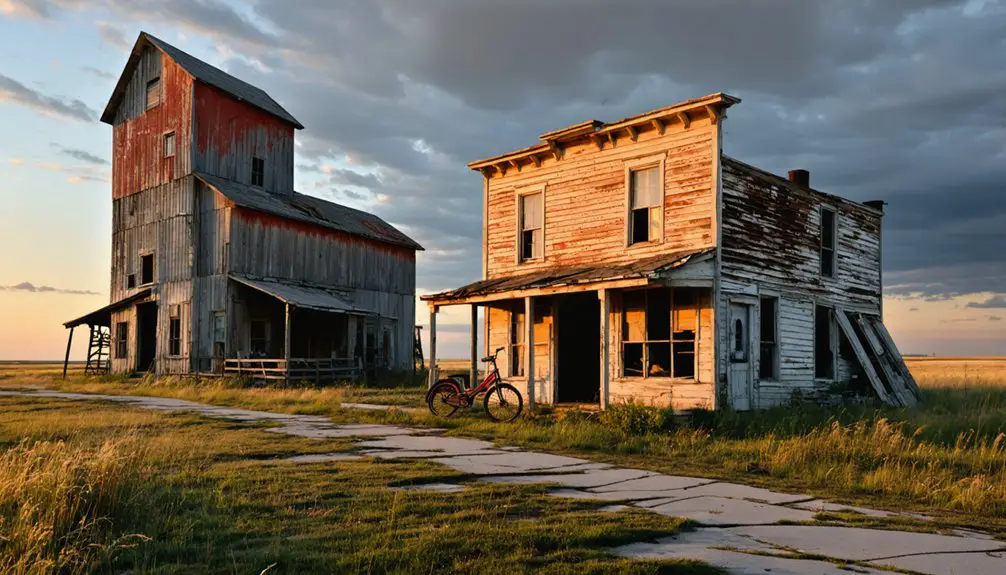
Planning a ghost town road trip to Petrel, North Dakota means heading to open ranch country in Adams County, roughly 6 miles north of Lemmon, South Dakota. This vanished Milwaukee Road siding once supported about 65 residents before the railroad’s decline erased it entirely. Today, no structures, roads, or signs remain — just windswept prairie. You’ll need offline maps, GPS coordinates, and plenty of water. Stick around to uncover everything you need to make this remote journey worthwhile.
Key Takeaways
- Petrel is located in Adams County, North Dakota, roughly 6 miles north of Lemmon, South Dakota, making Lemmon a practical base for your trip.
- No roads, buildings, or markers remain, so download offline maps and cross-reference county road maps before departing.
- Bring water and supplies, as the site sits in remote open ranch country with no tourist infrastructure or services nearby.
- GPS coordinates are unreliable at the site; rely on printed county maps and preparation for unmarked, open-country driving.
- Petrel offers no visual structures, so visit expecting a historically imaginative experience rather than physical ghost town remains.
What Was Petrel, North Dakota: A Milwaukee Road Siding That Briefly Became a Town
Tucked just a mile north of the North Dakota–South Dakota border, Petrel started as nothing more than a siding on the Milwaukee Road railroad line. By 1908, settlers had planted roots here, drawn by the railroad’s promise of connection and commerce.
The town even took its name from the long-winged birds spotted crossing that open prairie sky — a fitting symbol for a place built on movement and passage.
Petrel’s railroad origins gave it life, but that life was brief. By 1960, only about 65 people remained. Then the numbers kept falling.
Today, Petrel’s ghost town history is all that survives — no buildings, no roads, just windswept land between Lemmon, South Dakota and Haynes, North Dakota. You’re fundamentally chasing a memory across the border country.
Where Exactly Is Petrel, North Dakota Located?
You’ll find Petrel sitting in Adams County, North Dakota, roughly 1 mile north of the North Dakota–South Dakota border. It falls between two reference points you can actually navigate to: Lemmon, South Dakota, about 6 miles to the south, and Hettinger, the Adams County seat, about 21 miles away.
The site carries ZIP code 57638, placing it firmly in the border region where the two states meet across open ranch country.
Adams County Border Location
Where exactly do you find Petrel, North Dakota? Tucked inside Adams County, the site sits roughly one mile north of the North Dakota–South Dakota border, placing it in genuinely open country. You’re looking at about six miles from Lemmon, South Dakota, and 21 miles from Hettinger, the Adams County seat.
This border location shaped everything about Petrel’s story. Railroad-era growth pulled settlers here in 1908, and decades later, urban decay quietly erased what they’d built. Today, historic preservation isn’t a conversation anyone’s having about Petrel — the site’s classified as barren, with no buildings and no roads remaining.
For travelers craving freedom over tourist infrastructure, that rawness is exactly the point. You’re not visiting a curated exhibit; you’re standing where a real community once lived.
Distance From Nearby Towns
Petrel sits close enough to Lemmon, South Dakota — just six miles away — that you’d reach it before your coffee gets cold. That proximity makes it an easy detour if you’re already cruising the border region.
Heading north, Hettinger sits about 21 miles out, serving as Adams County’s seat and your best bet for fuel and supplies before you venture toward the site.
What you won’t find at Petrel is ghost town preservation in any formal sense — no markers, no restored structures, no guided tours.
What you’ll find is raw railroad history tied to the Milwaukee Road’s expansion across the northern plains.
Distance-wise, Petrel is accessible.
Historically, it rewards the curious traveler willing to read the landscape itself as the only remaining document.
ZIP Code And Region
Tucked just a mile north of the North Dakota–South Dakota border, this ghost town carries ZIP code 57638 and falls within Adams County — the same administrative region anchored by Hettinger to the north. That ZIP code actually connects Petrel administratively to Lemmon, South Dakota, reflecting how border geography blurs state lines in this open country.
You’re standing in a region where historical anecdotes about railroad settlers and vanishing communities define the landscape more than any road sign ever could. Local legends drift across both states here, carried by the same wind that once pushed Milwaukee Road trains through these plains.
Knowing Petrel’s exact regional position helps you frame your road trip accurately — you’re not lost out here, you’re precisely where forgotten history lives.
How Petrel Went From Railroad Town to Ghost Town
Like many small towns that dotted the Northern Plains in the early 1900s, Petrel owed its existence entirely to the railroad. When the Milwaukee Road pushed through Adams County around 1908, it created instant communities along its route, and Petrel was one of them. Settlers arrived, a small population took hold, and life briefly flourished near the North Dakota–South Dakota border.
But railroads gave, and railroads took away. As rail traffic shifted and rural populations thinned, Petrel couldn’t sustain itself. By 1960, only about 65 people remained.
Today, the Census Bureau doesn’t even track it. Unlike sites with historical preservation efforts or developed tourist attractions, Petrel offers nothing but open land and memory. You’re fundamentally visiting a coordinate, a place where a community once stood and quietly disappeared.
How to Get to Petrel From Lemmon or Hettinger?

Whether you’re coming from the south or the north, reaching Petrel means committing to open-country driving with minimal landmarks to guide you.
From Lemmon, South Dakota, you’re looking at roughly 6 miles heading north across the border into Adams County.
From Hettinger, the county seat, plan for about 21 miles heading south.
No GPS pin makes this easy, so cross-reference county road maps before you leave.
The site sits approximately 1 mile north of the North Dakota–South Dakota border, where abandoned structures once defined a railroad community.
Don’t expect urban legends about haunted buildings to reward you here — Petrel is classified as barren, with no roads or buildings remaining.
Pack water, download offline maps, and treat this drive as the open-road freedom it genuinely is.
What Will You Actually Find at the Petrel Site Today?
When you arrive at the Petrel site, you won’t find buildings, roads, or any visible trace of the town that once housed 65 residents. The landscape offers little to orient you, making the location more of a conceptual stop than a visual one.
You’re fundamentally standing on open prairie where a railroad community once operated, with nothing but history left to mark the ground beneath your feet.
Nothing Remains Today
If you make the drive out to Petrel today, you’ll find fundamentally nothing — no buildings, no roads, no preserved structures of any kind. The land has reclaimed everything. What once supported roughly 65 residents in 1960 now offers only open prairie and silence.
That absence carries its own weight. Historical preservation never reached Petrel, and without it, the site exists purely as memory. Yet the cultural significance of places like this runs deep — they mark where railroad ambition met rural reality, where communities briefly took root and then quietly dissolved.
You’re standing on ground that once moved with daily life, commerce, and connection to the Milwaukee Road. Nothing announces that history now. You bring the awareness yourself, or you pass through without knowing what was lost.
Site Visibility Challenges
Planning a visit to Petrel means accepting a hard truth upfront: the site offers almost no visual anchors to guide you. Unlike destinations where urban decay leaves behind crumbling facades or rusted structures, Petrel has erased itself almost completely. No buildings break the skyline. No roads cut through the grass to mark where a community once stood. The land has reclaimed everything.
Historical preservation never reached this corner of Adams County, leaving the 1908 railroad townsite to dissolve quietly into the North Dakota prairie. You’ll rely on coordinates, a good map, and your own imagination to reconstruct what once existed here.
That open-country emptiness is both the challenge and the draw — raw, unmediated history beneath your boots, with nothing curated standing between you and the silence.
How Petrel Fits Into North Dakota’s Broader Ghost Town Landscape
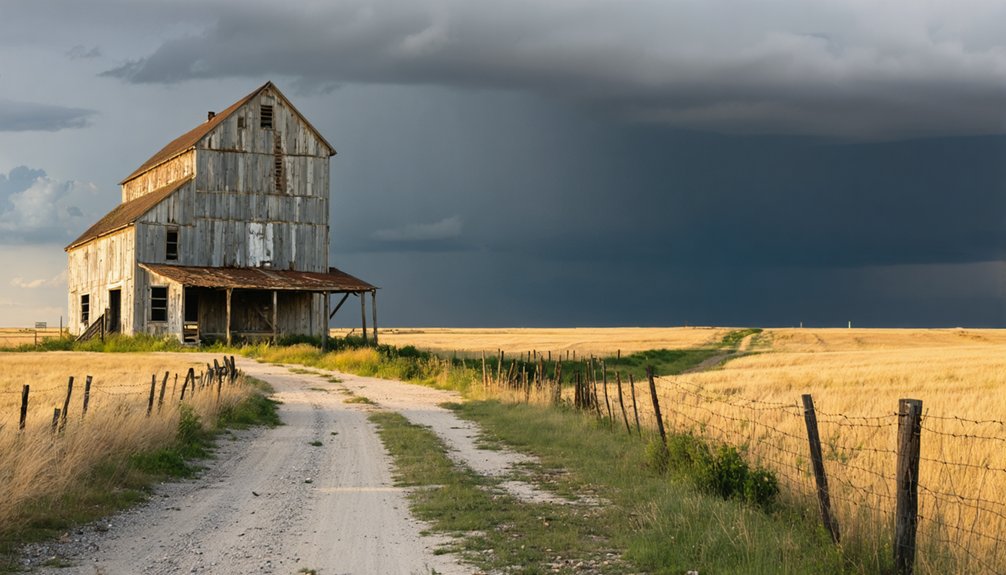
Petrel isn’t an outlier in North Dakota’s ghost town story — it’s a blueprint for it. Across Adams County and beyond, railroad towns rose fast and faded faster once the lines shifted or the population drifted.
Petrel mirrors that exact arc — settled in 1908, briefly alive with around 65 residents, then quietly erased. Its cultural significance lies in how clearly it reflects that statewide pattern of boom, bust, and abandonment.
You’ll find echoes of Petrel in dozens of barren sites scattered across the plains. Local legends of these vanished communities tend to survive longer than the buildings themselves.
When you visit Petrel, you’re not just stopping at one forgotten town — you’re reading the broader story of North Dakota’s rural collapse written plainly across open land.
Frequently Asked Questions
What Does the ZIP Code 57638 Actually Serve Today?
ZIP code 57638 serves Lemmon, South Dakota today — not Petrel’s vanished streets. You’ll find it anchoring a living local community, where historical preservation efforts keep the region’s railroad-era stories alive, just 6 miles away.
Is Petrel Accessible Year-Round Despite Harsh North Dakota Winters?
You can reach Petrel year-round, but winter travel tips matter here. Snow-packed roads test your resolve, yet hardy explorers still chase historic ghost towns beneath North Dakota’s vast, unforgiving skies. Plan boldly, drive carefully.
Are There Any Nearby Campgrounds or Lodging Options Close to Petrel?
Like a lone star guiding wanderers, Lemmon, South Dakota — just 6 miles away — offers your nearest lodging. You’ll find spots for campfire cooking and watching local wildlife roam freely across the open plains.
Can Visitors Legally Access the Petrel Site on Private Land?
You’ll need legal permissions before stepping onto Petrel’s private land access points. Always contact local landowners first, respect their boundaries, and honor their rights — true freedom means honoring others’ land while chasing your ghost town adventure.
Does Any Cemetery Survive at the Former Petrel Townsite Today?
Like a stubborn ember refusing to die, a cemetery may survive at Petrel. You’ll find historical preservation efforts and cemetery restoration possibilities uncertain, but this lone remnant could still anchor your freedom-fueled ghost town exploration.
References
- https://en.wikipedia.org/wiki/Petrel
- https://en.wikipedia.org/wiki/List_of_ghost_towns_in_North_Dakota
- https://www.houseofhighways.com/nearby/usa/midwest/north-dakota/petrel
- https://northernsentry.com/2025/06/26/north-dakota-ghost-towns/
- https://en.wikipedia.org/wiki/Category:Ghost_towns_in_North_Dakota
- https://www.youtube.com/watch?v=QKxWY4tHTOU
- https://en.wikipedia.org/wiki/Wikipedia:WikiProject_Ghost_towns/New_articles
- https://ghostsofnorthdakota892857007.wordpress.com/2015/10/30/true-ghost-towns-population-zero/
- https://www.ghosttowns.com/states/nd/nd.html
- https://www.youtube.com/watch?v=8GO57Im_dss