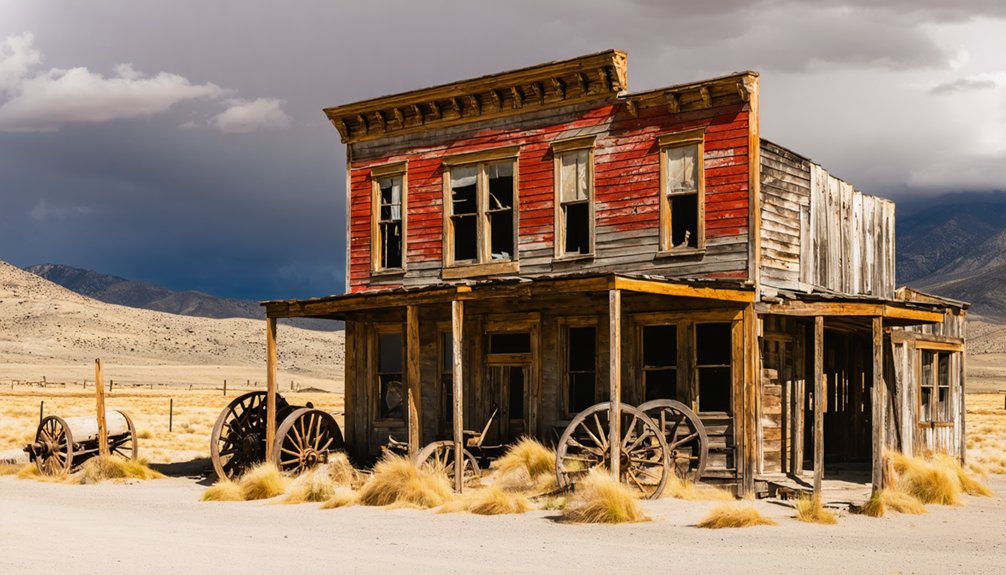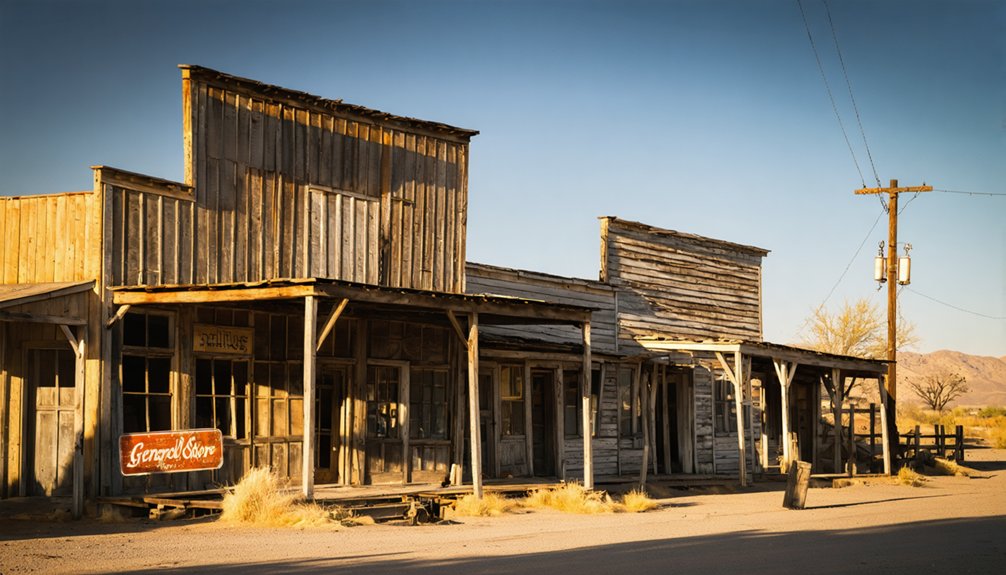
A ghost town is a once-thriving settlement that’s been abandoned but still has visible buildings and infrastructure. You’ll find these places emerged when communities lost their economic foundations—typically from depleted resources, collapsed industries, or rerouted transportation. Some maintain minimal populations, while others stand completely empty, frozen in time. They serve as both cautionary economic tales and increasingly popular tourism destinations where you can witness history’s remnants without modern distractions.
Key Takeaways
- A ghost town is a formerly populated settlement abandoned due to economic collapse, resource depletion, or transportation changes.
- These locations feature remaining buildings and infrastructure in various states of decay or preservation.
- Ghost towns often maintain minimal or no permanent residents but remain accessible to visitors.
- They serve as physical evidence of boom-and-bust economic cycles and failed community development.
- In Oregon, ghost towns are officially defined as incorporated cities without sufficient electorate to maintain government.
The Defining Features of Ghost Towns
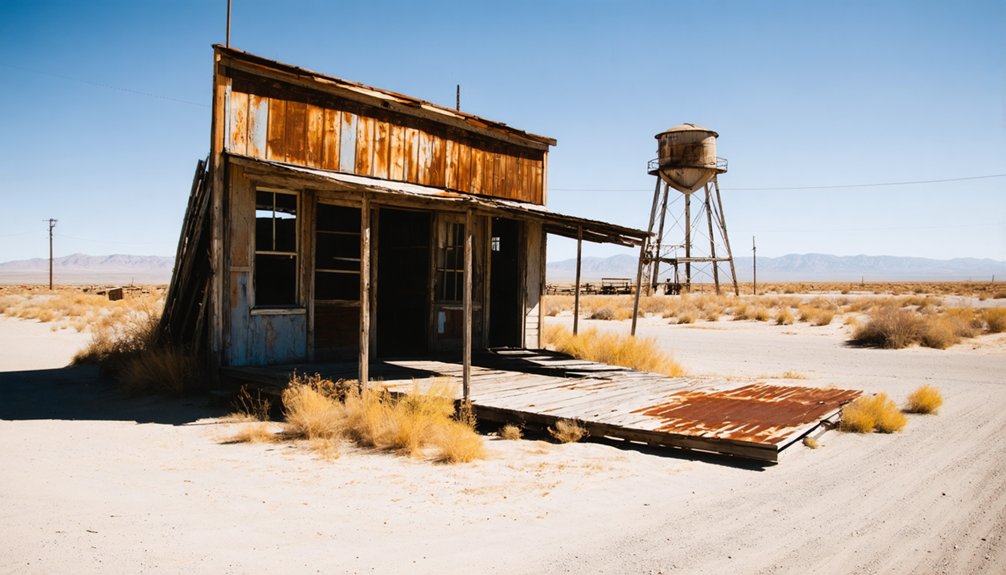
When exploring the concept of ghost towns, you’ll find several defining characteristics that distinguish these abandoned settlements from other historical sites. The most visible feature is urban decay—substantial buildings, roads, and other infrastructure that persist despite abandonment.
Ghost towns stand as haunting relics of the past, their crumbling structures silently testifying to abandoned dreams.
These tangible remains range from dilapidated main streets to town cemeteries and foundational traces of former dwellings.
A true ghost town must have lost its economic foundation, whether through resource depletion, industry collapse, or transportation network changes. You’ll notice markedly reduced populations, though complete abandonment isn’t always required—some maintain skeleton populations of residents who refused to leave. In Oregon, a ghost town is officially defined as an incorporated city that no longer has sufficient electorate to maintain its government.
Many ghost towns developed after the resource exhaustion of once-thriving industries like mining or logging.
Public accessibility to these physical remnants separates ghost towns from completely obliterated settlements, allowing you to witness firsthand the architectural evidence of these once-thriving communities.
How Thriving Communities Become Abandoned
The transformation from thriving community to ghost town typically begins when economic foundations crumble beneath once-stable settlements.
You’ll find resource management failures at the core of many abandonments—mines exhaust ore deposits, forests deplete, and soil degrades, destroying the economic purpose that once sustained life there.
Transportation shifts further accelerate decline when new highways or railroads bypass towns, redirecting crucial commercial flows elsewhere.
Natural disasters and environmental contamination can render areas uninhabitable, while governmental influence through policy decisions often determines which communities receive support and which face abandonment.
Migration patterns follow these economic realities as residents seek opportunities elsewhere, with younger generations leading the exodus.
This drain erodes community resilience, leaving behind only traces of cultural heritage and historical significance—empty structures standing as silent reminders of prosperity’s impermanence. Merriam-Webster defines these abandoned settlements as nearly deserted places that were once flourishing communities.
For locations to be officially classified as ghost towns, tangible remains must be visible and accessible to visitors who wish to experience these historical sites.
Exploring Famous Ghost Towns Around the World

While communities fade and disappear for various economic and environmental reasons, thousands of these abandoned settlements have transformed into fascinating time capsules around the world.
These deserted places stand as silent witnesses to history—frozen moments where human ambition once thrived.
Famous ghost towns exist across every continent, each telling unique stories of boom-and-bust cycles, natural disasters, or political upheaval. Many serve as popular tourist destinations that evoke a sense of nostalgia and mystery for visitors.
Global ghost towns worth exploring include:
- Bodie, California – A perfectly preserved gold rush town embodying the quintessential American Old West aesthetic
- Kolmanskop, Namibia – An abandoned German diamond mining settlement gradually being reclaimed by desert sands
- Hashima Island, Japan – A dramatic industrial ghost town with preserved mining structures rising from the sea
- Pyramiden, Norway – A frozen-in-time Soviet mining community in the Arctic, complete with the world’s northernmost Lenin statue
- Varosha, Cyprus – Once a modern tourist area in Famagusta, now abandoned since the 1974 Turkish invasion and fenced off by the Turkish army.
Economic Cycles Behind Town Abandonment
Behind every ghost town lies a complex economic story of rise and fall, typically rooted in the boom-and-bust cycles that characterize resource-dependent communities.
You’ll notice most abandoned towns suffered from extreme resource dependency, where mines closed or forests were depleted, triggering rapid economic collapse.
When primary industries fail, support businesses quickly follow, especially when economic shifts redirect capital elsewhere.
Transportation neglect often accelerates this decline—communities bypassed by railroads or highways face isolation and increased costs. The abandonment of towns along Route 66 demonstrates how new infrastructure can devastate previously thriving communities.
Government policies, including excessive taxation or failed revitalization efforts, can further push residents to leave.
Demographic trends reveal these places often housed transient workers with minimal community attachment, while technological obsolescence rendered many towns’ industries uncompetitive.
Natural disasters, wars, and disease outbreaks can also render settlements completely uninhabitable, forcing populations to permanently relocate.
Without infrastructure investment and community resilience through diversification, these single-industry towns simply couldn’t survive when their economic purpose disappeared.
The Afterlife: Tourism and Preservation Efforts
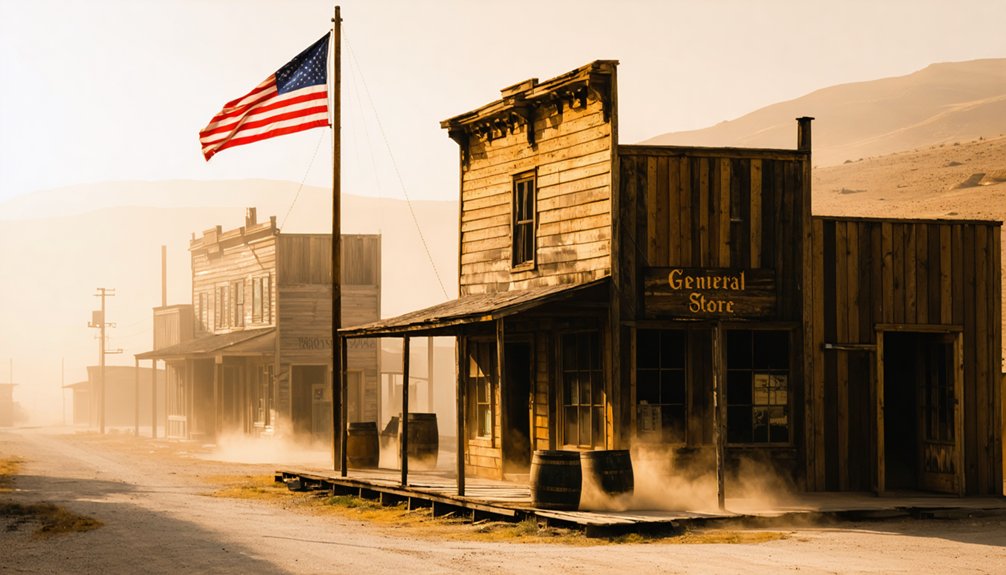
Once abandoned and forgotten, ghost towns have found new life through tourism, with the global ghost tourism market reaching USD 2.1 billion in 2024 and projected to grow to USD 6.3 billion by 2033 at an impressive 12.8% CAGR.
This afterlife tourism trend has municipalities investing in preservation initiatives as they recognize the economic potential.
You’ll find these preservation efforts taking various forms:
- Professional collaboration between tourism boards, historical societies, and private operators
- Transformation of abandoned towns like Bannack, Montana into viable attractions
- Integration of historical accuracy with entertainment value to appeal to diverse demographics
- Digital storytelling to enhance visitor experiences and drive social media interest
North America dominates this market with USD 910 million in revenue, representing 43% of the global ghost tourism economy. The popularity of these attractions is significantly driven by paranormal-themed media that has sparked greater public interest in supernatural experiences.
Visitors are often drawn to these locations due to the eerie atmosphere they provide, which creates a compelling experience despite potential fears.
Natural Disaster Ghost Towns: When Nature Reclaims
Nature’s devastating forces have repeatedly transformed thriving communities into desolate ghost towns throughout history.
You’ll find abandoned settlements worldwide that succumbed to earthquakes, which cracked foundations and collapsed infrastructure, forcing government evacuations as seen in Craco, Italy.
Devastating fires abruptly ended mining town eras like Bodie, California, leaving only charred remains.
The unforgiving flames consumed what miners had built, transforming bustling settlements into skeletal monuments of the gold rush era.
Flooding has driven communities to higher ground, with rivers changing course and submerging towns like old Kaw City.
Volcanic eruptions have buried entire settlements under ash and lava, making land uninhabitable for generations.
Long-term environmental impacts, including landslides exacerbated by deforestation and farming, have sealed the fate of numerous communities.
These natural disasters showcase humanity’s vulnerability against Earth’s power, leaving behind haunting reminders to nature’s reclamation of human spaces.
The Cultural Significance of Abandoned Places
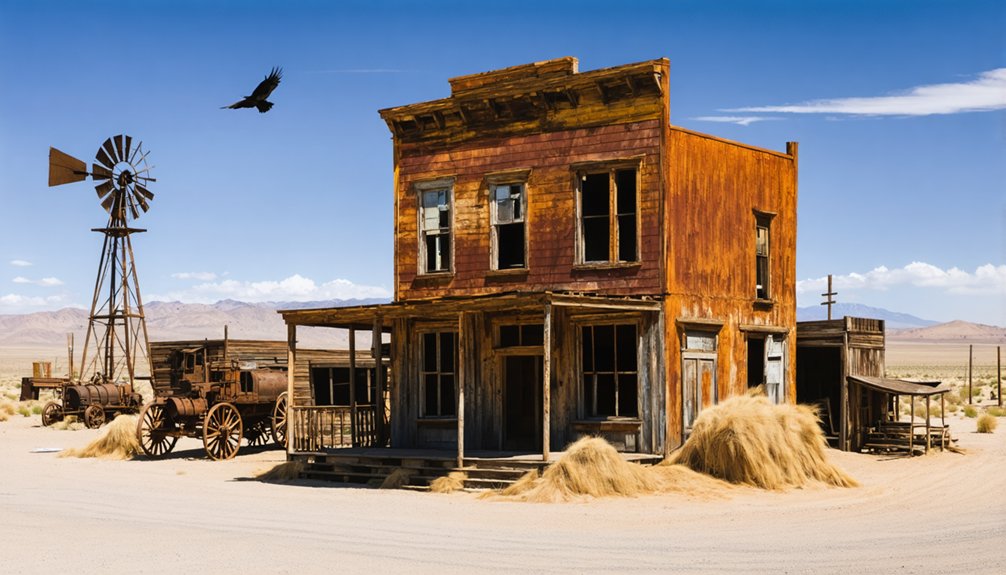
Ghost towns serve as powerful memorials to forgotten dreams and aspirations, preserving architectural remnants that tell stories of boom-and-bust cycles, displacement, and human resilience.
You’ll find these abandoned places increasingly popular as nostalgic tourism destinations where visitors can physically connect with tangible history while supporting local economies through heritage tourism.
Urban exploration photography has further elevated ghost towns in popular culture, with artists capturing the haunting beauty of decay and transforming these forgotten spaces into subjects of aesthetic contemplation and creative inspiration.
Memorials of Forgotten Dreams
Abandoned places stand as powerful memorials to forgotten dreams, preserving not only physical structures but also the complex narratives of human ambition and decline.
When you visit these sites of lost histories and fading memories, you’re witnessing the physical evidence of society’s perpetual evolution and collapse.
Ghost towns demand a deeper engagement beyond casual exploration:
- They function as cultural time capsules, revealing architectural styles and construction methods that document specific historical periods.
- They’ve become artistic canvases where decay itself possesses aesthetic value, attracting filmmakers and photographers.
- They represent economic cautionary tales, as seen in mining towns like Bodie that boomed to 8,000 residents before collapsing.
- They offer ethical challenges, requiring visitors to confront the real human costs behind these abandoned dreams.
Nostalgic Tourism Destinations
While once forsaken as mere relics of the past, ghost towns have evolved into significant cultural attractions that draw thousands of nostalgic tourists each year.
You’ll find these abandoned places serve as unique time capsules where architecture and artifacts remain frozen, offering authentic nostalgic experiences unavailable in commercialized destinations.
Heritage tourism to these sites satisfies your curiosity about forgotten lifestyles while connecting you to regional histories without modern distractions.
Though visitor numbers have declined dramatically in some regions—with drops exceeding 30% annually—ghost towns still inspire literature, films, and cultural narratives that preserve collective memory.
Despite challenges like structural decay and limited infrastructure, these destinations offer you freedom to explore unfiltered history.
Through responsible tourism, these abandoned places can potentially revitalize local economies while maintaining their haunting authenticity.
Urban Exploration Photography
In the shadows of forgotten places, urban exploration photography—commonly known as “urbex”—has emerged as a powerful artistic movement that documents abandoned manmade structures while preserving their stories.
When you venture into these forgotten spaces with your camera, you’re not just taking pictures—you’re preserving history that might otherwise be lost forever.
Urban exploration photographers follow several key principles:
- Take only photographs, leave no trace behind
- Master lighting techniques to capture decay’s atmospheric beauty
- Document the interplay between human architecture and nature’s reclamation
- Use composition to reveal the psychological dimensions of abandonment
Through photographic techniques like dramatic natural lighting and careful framing, you’ll capture the mysterious beauty of these spaces while contributing to a visual archive of transient locations facing potential destruction.
Ghost Towns in the Digital Age: Documentation and Memory

Modern technology has transformed how we preserve the legacy of ghost towns, offering unprecedented tools for documentation and virtual exploration. Geographic Information Systems (GIS) now identify potential ghost towns through spatial analysis, while photogrammetry creates detailed 3D models from photographs taken even with mobile phones.
These digital preservation methods capture structures with precise measurements and realistic color. You’ll find interactive content like virtual tours bringing these abandoned places to life without physical visitation.
Digital atlases compile historical data alongside 3D models, enabling virtual storytelling that embeds narratives into architectural features. Despite challenges including security constraints and language barriers, community-based initiatives thrive thanks to accessible technology.
Even defunct websites become “digital ghost towns,” requiring systematic archiving to preserve online cultural history—mirroring our efforts to document their physical counterparts.
Potential Futures: Revitalization and Repurposing
Ghost towns need not remain frozen in time or exist solely in digital archives—many now experience remarkable transformations through strategic revitalization efforts.
Data-driven revitalization strategies offer cost-effective approaches to breathe new life into these forgotten places.
Four proven approaches to ghost town renewal:
- Adaptive reuse of historic structures for housing, cultural venues, and retail spaces
- Community engagement to build trust and guide development that honors local heritage
- Targeted property rehabilitation using tax incentives and grants for brownfield remediation
- Strategic rebranding campaigns that highlight unique amenities and living experiences
You’ll find these methods work particularly well when combining demolition of unsalvageable structures with preservation of iconic elements.
The most successful transformations often involve nonprofit partnerships and incremental improvements to infrastructure and public safety.
Frequently Asked Questions
Are Ghost Towns Legally Protected From Demolition or Development?
Ghost towns don’t have automatic legal status protecting them from demolition. You’ll find protection varies based on historic designation, zoning laws, ownership rights, and environmental regulations that may restrict development.
Can People Legally Live in or Claim Abandoned Ghost Towns?
You generally can’t just claim ghost towns. You’ll need to resolve property rights issues and potential ownership disputes through legal channels before you can legally reside in these abandoned spaces.
How Do Ghost Towns Affect Property Values in Nearby Communities?
Shadows of abandonment darken your property market prospects. Ghost towns typically depress nearby values through negative perception, reduced services, and broader economic impact—though tourism potential occasionally offers a silver lining for adventurous investors.
What Paranormal Investigations Have Been Conducted in Famous Ghost Towns?
You’ll find investigators exploring paranormal experiences in Bodie, Ruby, St. Elmo, and Frisco, documenting apparitions, mysterious sounds, and ghostly presences while emphasizing their historical significance through preserved structures and violent pasts.
Do Ghost Towns Contribute to Environmental Restoration in Their Regions?
Ever wonder about nature’s resilience? Yes, ghost towns contribute considerably to environmental restoration through natural regeneration, offering space for ecological recovery. You’ll find restoration efforts reducing negative ecological impact after human abandonment.
References
- https://www.lindasellsmoore.com/blog/what-is-a-ghost-town/
- https://www.merriam-webster.com/dictionary/ghost town
- https://westernmininghistory.com/664/what-is-a-ghost-town-wmh-town-classifications-explained/
- https://history.howstuffworks.com/history-vs-myth/ghost-towns.htm
- https://www.britannica.com/topic/ghost-town
- https://en.wikipedia.org/wiki/Ghost_town
- https://plainenglish.com/lingo/ghost-town/
- https://exhibits.lib.utah.edu/s/ghost-towns/page/Introduction
- https://grokipedia.com/page/Ghost_Town
- https://www.loveexploring.com/gallerylist/66971/frozen-in-time-the-worlds-most-fascinating-ghost-towns