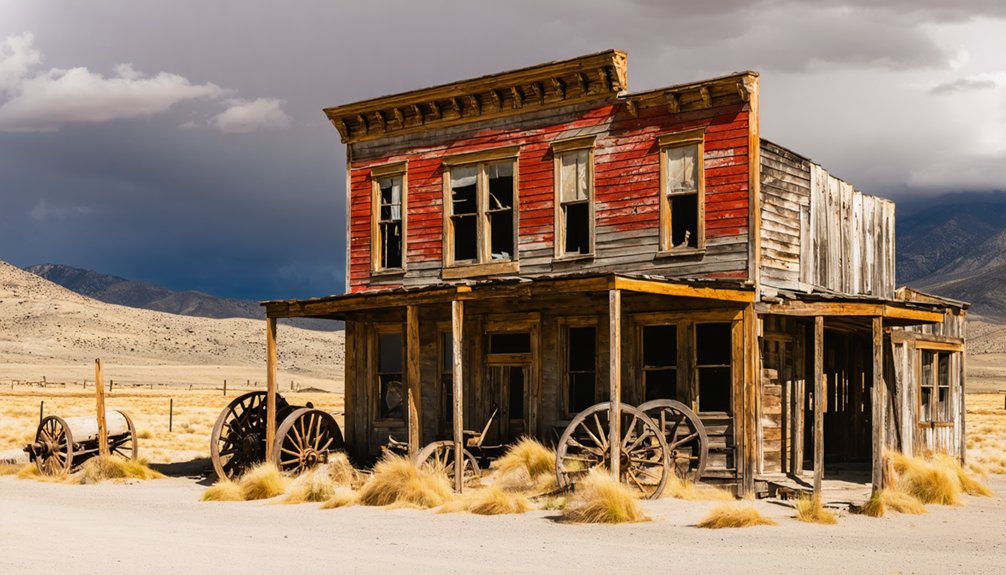
You’ll find Texas leading America’s ghost town count with 511 documented abandoned settlements, considerably outpacing California’s 346 and Kansas’s 308. These deserted communities cluster heavily in Texas’s Wilson County, where 31 ghost towns dot the landscape within a compact area. The state’s high concentration reflects centuries of boom-and-bust cycles, depleted resources, and shifting transportation routes. Exploring Texas’s ghost towns reveals fascinating patterns of America’s frontier settlement history.
Key Takeaways
- Texas leads the United States with 511 documented ghost towns, making it the nation’s ghost town capital.
- Wilson County in Texas has the highest concentration of ghost towns with 31 abandoned settlements.
- Texas’s ghost towns reflect boom-and-bust economic cycles throughout its rural areas and history.
- Twenty-five abandoned settlements are located within 25 miles of New Braunfels, Texas.
- Texas’s ghost town status is further emphasized by over 7,600 reported paranormal encounters, the most in any state.
The Top States With Abandoned Communities
Several states across America showcase distinct patterns of abandonment, with Texas leading the count of documented ghost towns, followed closely by California at 346 and Kansas at 308.
You’ll find Florida and South Dakota rounding out the top five, with 257 and 238 ghost towns respectively, while Oklahoma claims the sixth spot with 236.
Each state’s abandoned architecture tells a unique story of boom-and-bust cycles.
California’s ghost towns cluster in mining regions like the Sierra Nevada, while Kansas’s empty settlements dot the rural landscape where railroads once ruled.
Florida’s forgotten communities hide in plain sight, some consumed by modern development.
In South Dakota’s Black Hills, ghostly legends surround old mining camps, and Oklahoma’s abandoned towns stand as silent witnesses to the great land runs. With 511 ghost towns, Texas has the highest concentration of abandoned settlements in the United States. Wilson County alone contains 31 documented ghost towns, making it the densest region of abandoned settlements in the state.
Texas: Leading the Nation in Ghost Towns
Dominating America’s landscape of abandoned settlements, Texas stands as the undisputed leader with 511 documented ghost towns scattered across its vast territory.
You’ll find these haunting remnants of the past concentrated most heavily in Wilson County, where 31 ghost towns tell tales of frontier ambition and decline.
If you’re planning your ghost town tourism adventure, consider these key patterns:
- Wilson County’s highest concentration includes historic sites like Alum and Boldtville
- Twenty-five abandoned settlements cluster within 25 miles of New Braunfels
- Rural areas showcase the state’s boom-and-bust economic cycles
- Over 7,600 reported paranormal encounters make Texas America’s most haunted state
These haunted locations serve as powerful reminders of the American frontier spirit, where dreams rose and fell across Texas’s dynamic landscape. Emmy award-winning journalist Erica Hernandez explores these historic sites through innovative news reporting.
For comparison, California and Kansas follow Texas with 346 and 308 ghost towns respectively, highlighting the Lone Star State’s remarkable abundance of abandoned settlements.
Key Factors Behind Town Abandonment
Understanding why towns transform into abandoned shells reveals complex patterns of economic, social, and infrastructural change across America’s landscape.
You’ll find economic decline at the heart of most abandonments, as depleted natural resources and vanishing industries force residents to seek opportunities elsewhere. Communities experiencing population decline often see their median home values drop well below national averages.
Demographic shifts play a vital role too – when younger populations migrate out, they leave aging communities struggling to maintain basic services. High vacancy rates often follow this exodus, creating a visible sign of community decline.
Transportation changes can doom a town’s future, especially when new highways bypass once-bustling main streets.
You’ll notice this pattern clearly in former Route 66 communities that lost their lifeblood when traffic patterns changed.
Social inequality and racial discrimination have also shaped abandonment patterns, particularly in urban areas where historic disinvestment and poor services pushed residents to seek better options elsewhere.
Geographic Patterns and Distribution
You’ll find America’s ghost towns clustered in distinct regional patterns, with the highest densities stretching across the Great Plains and throughout the Western mining districts.
Texas, California, and Kansas form a dominant triangle of abandonment, together hosting over 1,100 ghost towns tied to mining, farming, and railroad expansion. Kern County, California stands out as the single county with the highest concentration, containing 113 abandoned settlements.
The Northeast shows markedly lower ghost town counts, while states like Oklahoma and South Dakota reveal dense clusters of failed agricultural settlements, often grouped within 25-50 mile ranges of each other. With 4,531 ghost towns documented across the country, these abandoned places serve as reminders of America’s boom-and-bust development cycles.
Regional Density Patterns
The distribution of ghost towns across the United States reveals distinct regional patterns, with the American West and Plains states harboring the highest concentrations.
You’ll find Texas leading with over 500 abandoned settlements, while California and Kansas follow with substantial numbers, reflecting dramatic economic shifts and regional demographics over time. South Dakota, with its 246 ghost towns, represents one of the highest concentrations in the Plains region. Texas’s total of 558 ghost towns reflects the state’s dramatic boom-and-bust history.
Key density patterns include:
- Wilson County, Texas boasts the highest concentration with 30+ ghost towns
- California’s abandoned settlements cluster in former mining regions
- Kansas shows heavy rural clustering tied to agricultural decline
- Florida’s 250+ ghost towns align with coastal development cycles
These patterns tell a story of America’s dynamic settlement history, where boom-and-bust cycles, changing transportation routes, and economic changes have left their mark on the cultural landscape.
Mining and Settlement Clusters
While mining activities drove the formation of countless settlements across America, distinct geographic clusters emerged where mineral-rich deposits intersected with favorable transportation routes.
You’ll find these mining heritage sites concentrated in states like California, Colorado, Nevada, and Montana, where gold, silver, and coal extraction sparked rapid town development. Notable examples like Bodie, California, and Bannack, Montana, showcase the intense settlement dynamics that characterized the American frontier.
These clusters often formed in challenging terrain, with towns springing up wherever precious metals were discovered. The settlement patterns reveal how closely tied these communities were to both the physical landscape and transportation networks.
When resources depleted or market conditions shifted, these once-bustling mining camps transformed into the ghost towns you can explore today.
Hidden History in New England States

Hidden beneath New England’s picturesque landscapes lies a fascinating network of abandoned settlements, each telling stories of industrial boom-and-bust cycles, environmental changes, and societal shifts.
You’ll discover hidden towns scattered across this historic region, from submerged communities beneath Quabbin Reservoir to forgotten infrastructure in declining mill towns.
Four distinct patterns of abandonment emerge across New England:
- Submerged villages in Massachusetts sacrificed for Boston’s water supply
- Mill towns that couldn’t survive industrial modernization
- Coastal settlements surrendered to nature’s forces and economic shifts
- Remote logging communities that faded as timber resources depleted
These ghost towns paint a compelling picture of New England’s evolution, where entire communities vanished as priorities shifted and resources dwindled, leaving only traces of their existence in the modern landscape.
Heritage Tourism and Historic Preservation
Across America’s landscape, ghost towns have evolved from forgotten relics into vibrant heritage tourism destinations, drawing visitors who seek authentic connections to the nation’s frontier past.
You’ll find these historic treasures protected through state parks, local historic sites, and the National Register of Historic Places, with preservation efforts focusing on stabilizing structures and creating interpretive experiences.
From California’s Bodie to Colorado’s St. Elmo, heritage tourism has transformed abandoned settlements into economic drivers for rural communities.
You can experience guided tours, ghost town festivals, and photography excursions while supporting local economies.
Though preservation challenges persist – including vandalism, harsh weather, and limited funding – partnerships between tourism boards, historical societies, and private operators guarantee these windows into America’s past remain accessible for future generations to explore.
Frequently Asked Questions
How Much Does It Cost to Purchase an Entire Ghost Town?
You’ll find ghost town prices ranging from $100,000 to several million dollars, depending on location and condition. When buying abandoned properties, expect higher costs for prime spots near tourist areas.
Can People Legally Live in Ghost Towns Today?
You can legally live in ghost towns if you’ve secured proper property rights through ownership, lease, or permits, but abandoned property rights vary between private and public ghost town residency situations.
What Happens to Unclaimed Property and Valuables in Ghost Towns?
Like forgotten gold dust scattered in the wind, unclaimed treasures become state property. You’ll find abandoned valuables either auctioned off, preserved as historical artifacts, or left to decay under government jurisdiction.
Are There Any Completely Underwater Ghost Towns in the United States?
You’ll find numerous completely submerged ghost towns across America’s lakes and reservoirs. Through underwater exploration, you can discover places like Monticello in Lake Berryessa and settlements beneath Lake Mead’s submerged history.
Do Ghost Towns Still Receive Mail or Maintain Postal Codes?
Like fading footprints in time, your ghost town mail service depends on location. You’ll find some maintain postal codes and receive mail through nearby towns’ delivery routes or PO boxes if there’s activity.
References
- https://infrastructureusa.org/spooky-infrastructure-ghost-towns-across-the-united-states/
- https://www.caller.com/story/news/local/2018/10/25/texas-state-most-historic-ghost-towns-america/1755702002/
- https://www.loveexploring.com/gallerylist/188219/the-us-state-with-the-most-ghost-towns-revealed
- https://devblog.batchgeo.com/ghost-towns/
- https://www.geotab.com/ghost-towns/
- https://en.wikipedia.org/wiki/Lists_of_ghost_towns_in_the_United_States
- https://www.youtube.com/watch?v=HS-FP_iDByo
- https://joybird.com/blog/top-ghost-towns-in-america/
- https://www.islands.com/2003205/state-with-most-abandoned-ghost-towns-texas/
- https://www.christywanders.com/2024/08/top-ghost-towns-for-history-buffs.html