Planning a ghost town road trip to Costin Village, Minnesota means tracing the echoes of a once-thriving iron mining community that vanished almost without a trace. You’ll navigate to section 4 of Nichols Township using GPS coordinates 47.53250°N, 92.62361°W, where 1,000 residents once lived and worked at the height of the Iron Range boom. Today, no structures remain, but the landscape still carries a powerful, invisible history — and there’s far more to this forgotten place than meets the eye.
Key Takeaways
- Costin Village is located northwest of Mountain Iron’s city center; use GPS coordinates 47.53250°N, 92.62361°W for precise navigation.
- No standing structures remain, but historical markers may indicate the former village location within the modern Mountain Iron landscape.
- Combine your visit with nearby ghost towns Ashton, Beaver, and Belden for a comprehensive Iron Range road trip experience.
- Pack water, maps, and communication devices, and stay alert to wildlife and any potentially unstable ground at exploration sites.
- Local roads and county routes provide site access, with nearby towns offering amenities like fuel, food, and lodging.
What Is Costin Village and Why Did It Disappear?
Once a thriving hub of Minnesota’s iron mining boom, Costin Village sprang to life in section 4 of Nichols Township, St. Louis County, Minnesota. John Costin founded this settlement, and by 1907, its historical demographics showed a peak population of 1,000 residents — a remarkable figure for such a remote Iron Range location.
The town’s survival depended entirely on mining technology and the iron ore extraction industry driving the regional economy. When that industry shifted, consolidated, or moved operations, communities like Costin Village simply couldn’t sustain themselves. Residents followed the work, leaving behind foundations and memories.
Today, the original townsite is absorbed into modern Mountain Iron, just northwest of the city center. You won’t find standing structures, but you’ll find a powerful story of boom, bust, and freedom sought through hard labor.
How Iron Mining Built Costin Village: and Abandoned It
How did a patch of northern Minnesota wilderness transform into a community of 1,000 people within just a few years? Iron. Specifically, the rich ore deposits beneath the Iron Range drew workers, families, and entrepreneurs who needed somewhere to live.
Iron turned wilderness into community — 1,000 people drawn by ore deposits buried beneath northern Minnesota’s Iron Range.
Mining technology drove everything. Once companies deployed industrial drilling and extraction equipment across St. Louis County, labor demands exploded overnight.
Costin Village emerged to meet those demands, rapidly developing community infrastructure — housing, supply networks, and essential services — that supported a booming workforce.
But mining technology giveth and taketh away. When operations shifted, consolidated, or exhausted local deposits, workers followed the work. Nobody stayed behind to maintain what John Costin had built.
You’re left today with coordinates on a map and a story worth chasing down a Minnesota back road.
What the Costin Village Site Looks Like Today
Standing at the Costin Village site today, you won’t find much to confirm that 1,000 people once called this patch of northern Minnesota home. The original settlement has been fully absorbed into modern Mountain Iron, leaving no distinct structures from the village’s brief but bustling era.
What you’re walking through is fundamentally reclaimed land, where foundations and memories sit quietly beneath the surface.
Keep your eyes open for historical markers near the area, as they occasionally signal where forgotten communities once stood.
Local landmarks in Mountain Iron proper can help orient you geographically and provide context for what this landscape once represented.
It’s a humbling stop — nothing dramatic, nothing restored — just open land carrying the invisible weight of a community that rose fast and disappeared completely.
How to Find the Costin Village Site From Mountain Iron
Finding the Costin Village site requires only a short drive northwest from Mountain Iron’s city center, putting you directly into section 4 of Nichols Township. Set your GPS to Mountain Iron, then navigate northwest using local roads into the township grid.
A short drive northwest from Mountain Iron leads directly to the historic Costin Village site in Nichols Township.
You’re targeting coordinates 47.53250°N, 92.62361°W, so a reliable mapping app makes the search straightforward.
Once you’re close, slow down and scan the landscape carefully. Local folklore suggests the area holds subtle remnants beneath the vegetation, invisible to rushed travelers.
Active preservation efforts have kept historical awareness alive, meaning you might spot informational markers near the former townsite.
St. Louis County roads provide reasonable access, and Mountain Iron’s city center sits nearby if you need fuel, food, or directions from locals who know the land well.
Nearby Ghost Towns Worth Adding to Your Route
Once you’ve explored the Costin Village site, Minnesota’s Iron Range offers several other ghost towns worth looping into your route. Each location carries its own community legacy, giving you a richer picture of how iron mining shaped and abandoned entire settlements across St. Louis County.
Consider adding these stops to your itinerary:
- Ashton – A quiet reminder of historical preservation efforts along Minnesota’s Iron Range corridor
- Beaver – Another former settlement where you can trace the boom-and-bust cycles that defined the region
- Belden – A compact detour that rewards curious travelers with raw, unfiltered mining-era history
Mapping these towns together turns a single stop into a full Iron Range circuit, letting you experience Minnesota’s forgotten communities on your own terms.
Where to Eat and Stay Near Mountain Iron
After a day of exploring abandoned townsites and open-pit mining history, you’ll want a solid base in Mountain Iron to recharge. The city’s local dining scene delivers honest, hearty meals perfect for road-weary travelers. Hit up nearby Virginia or Eveleth if you’re craving more variety, since the Iron Range corridor keeps your options open without locking you down.
For cozy accommodations, several small motels and inn-style lodges sit within a short drive, giving you flexibility without corporate hotel constraints. Hibbing and Virginia offer additional overnight choices if you’re threading multiple ghost towns into one long route.
Book ahead during summer months when Iron Range tourism peaks. You’re free to move on your own schedule, so choose lodging that fits your pace.
How to Explore Costin Village and Iron Range Ghost Towns Safely
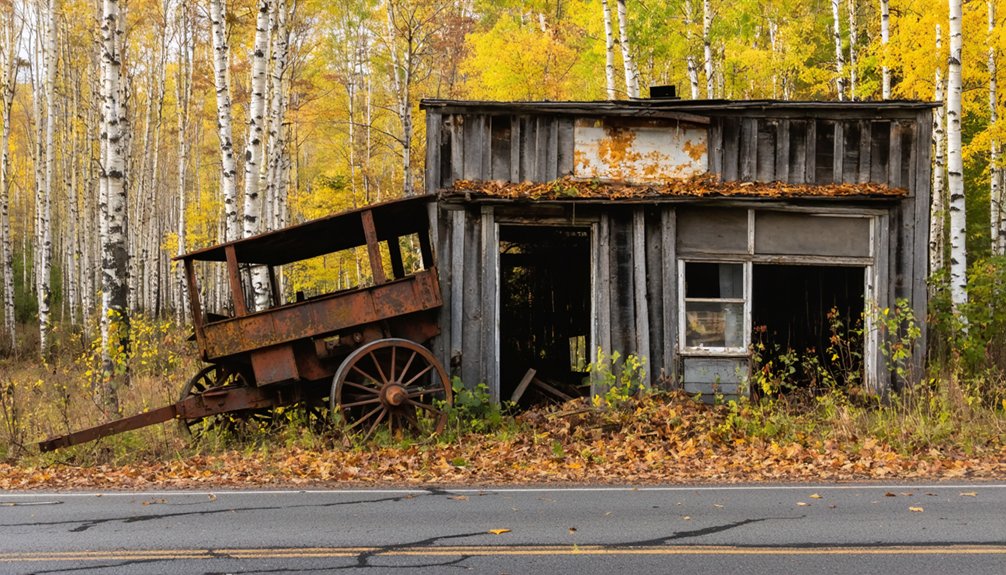
With your lodging squared away and your energy restored, it’s time to talk about staying safe while you explore Costin Village and the broader Iron Range ghost town circuit. These sites reward curiosity, but they demand respect.
Curiosity unlocks these forgotten places — but respect is the price of admission.
- Watch for local wildlife — black bears and timber wolves roam St. Louis County; make noise on trails and carry bear spray.
- Follow photography tips — shoot during golden hour for dramatic lighting on ruins, but never climb unstable foundations for a better angle.
- Travel prepared — pack water, a paper map, and a charged phone since cell coverage drops in rural sections of Nichols Township.
Stay aware, move deliberately, and you’ll leave with stunning images and a genuine connection to Minnesota’s vanished mining past.
Frequently Asked Questions
What Is the Best Time of Year to Visit Costin Village?
You’ll find Costin Village’s “bustling amenities” best in summer’s warm seasonal weather — ironic for a ghost town with none! June through August offers you clear roads, comfortable exploration, and the freest experience of this hauntingly silent historic site.
Are There Guided Tours Specifically Focused on Iron Range Ghost Towns?
You’ll find mining history tours and ghost town exploration experiences across Minnesota’s Iron Range! Local heritage groups and St. Louis County tourism actively offer guided excursions, connecting you to forgotten settlements like Costin Village and other abandoned mining communities.
Is Photography Permitted at the Costin Village Historical Site?
You’ll find photography’s generally permitted at Costin Village! Capture haunting foundations and overgrown remnants freely. Follow drone regulations before flying, and use golden-hour lighting for stunning, atmospheric shots that truly honor this forgotten Iron Range community.
How Long Should Visitors Plan for a Complete Costin Village Trip?
You’ll want to set aside half a day for trip planning purposes, as duration estimates suggest two to three hours exploring Costin Village’s remnants, with extra time for Mountain Iron’s nearby mining heritage sites and scenic surroundings.
Are There Any Annual Events Commemorating Costin Village’s Mining History?
No official annual events mark Costin Village specifically, but you’ll find Iron Range mining heritage festivals nearby in Mountain Iron. These celebrations champion historic preservation, letting you hashtag your freedom-loving spirit while honoring early 20th-century mining communities.
References
- https://en.wikipedia.org/wiki/Costin_Village
- http://wikimapia.org/14573356/Former-town-of-Costin-MN-Site
- https://kids.kiddle.co/List_of_ghost_towns_in_Minnesota
- https://www.minnesotahistory.org/post/a-complete-guide-to-the-ghost-towns-of-hennepin-county
- https://en.wikipedia.org/wiki/Sunday_Lake