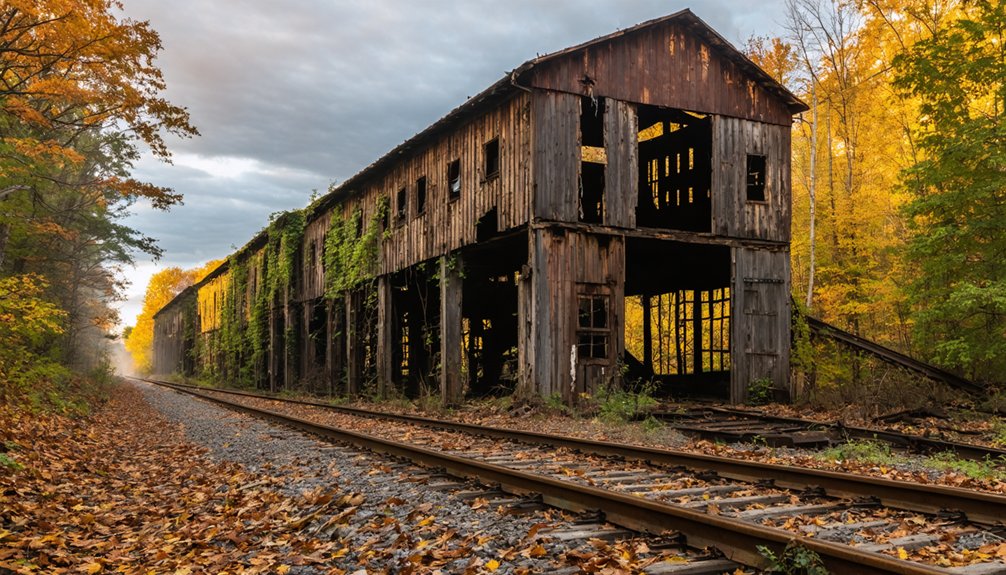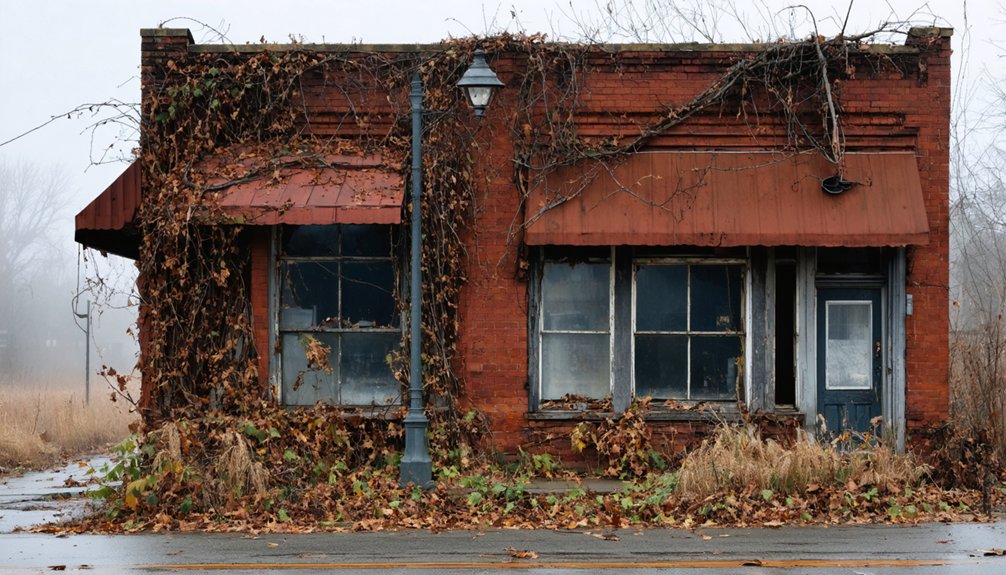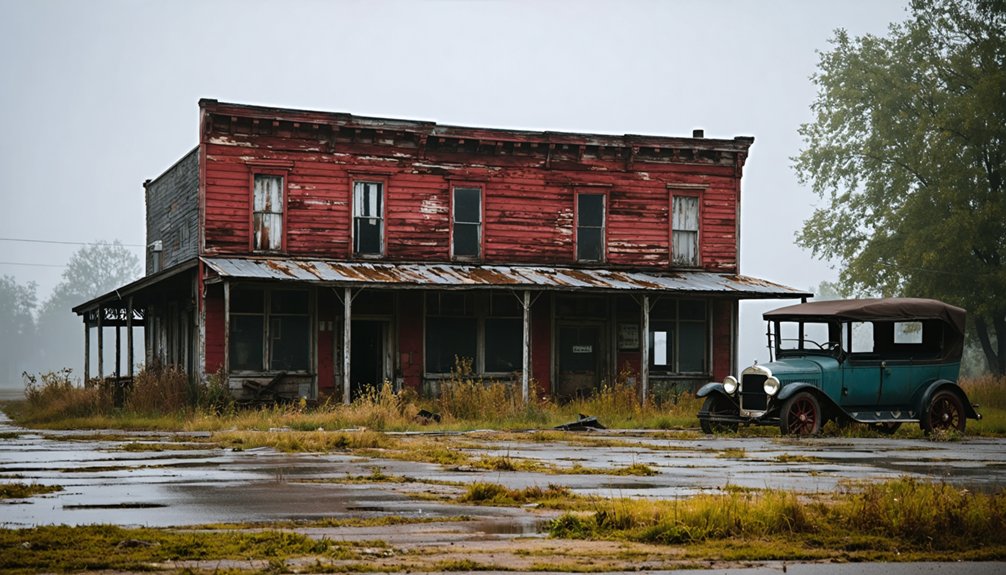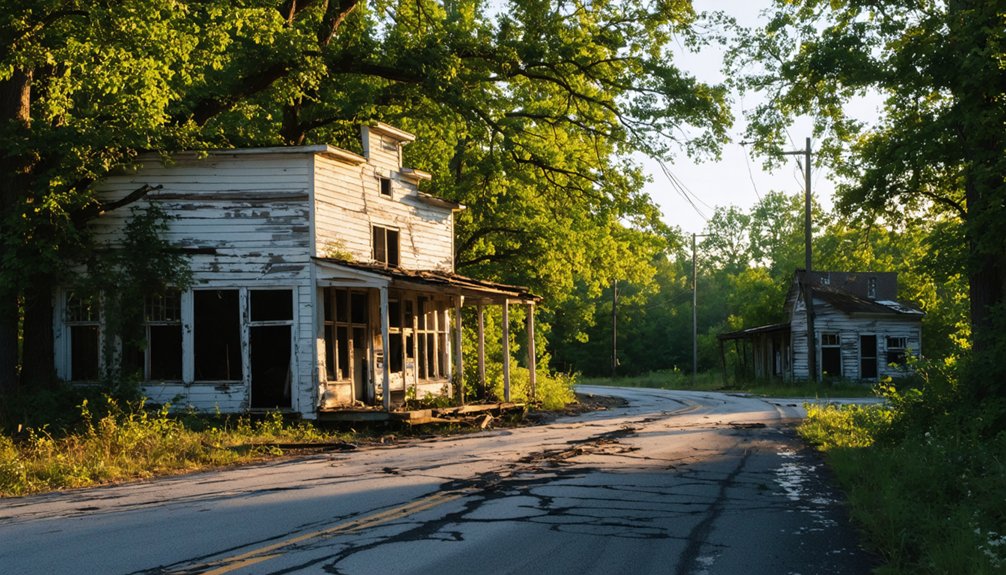
Planning your ghost town road trip to Springville, Indiana means tracing two forgotten settlements separated by decades of failed dreams and fresh starts. You’ll explore Lawrence County’s 1832 farming community, platted by Samuel Owens near Spring Creek, plus nearby vanished towns like Palestine, Bono, and Bryantsville. Pack sturdy boots, an offline map, and your camera before heading out. The full story of why Springville survived when its neighbors didn’t is worth uncovering for yourself.
Key Takeaways
- Springville, Indiana has two ghost town histories: Clark County’s 1798 trading post and Lawrence County’s 1832 farming community platted by Samuel Owens.
- Nearby ghost towns Palestine, Bono, and Bryantsville offer additional exploration opportunities, each with unique stories of frontier settlement and decline.
- Current attractions include the 1891 Springville Free Methodist Church, historic homes, Springville Park, and the revitalized Spring Creek.
- Essential gear includes sturdy hiking boots, a detailed paper map, offline GPS, a field notebook, and a fully charged portable battery pack.
- Visit at dusk for atmosphere, explore Spring Creek trails, and prepare for rural isolation in Lawrence County, Indiana.
Springville, Indiana: The Town That Became a Ghost Town Twice
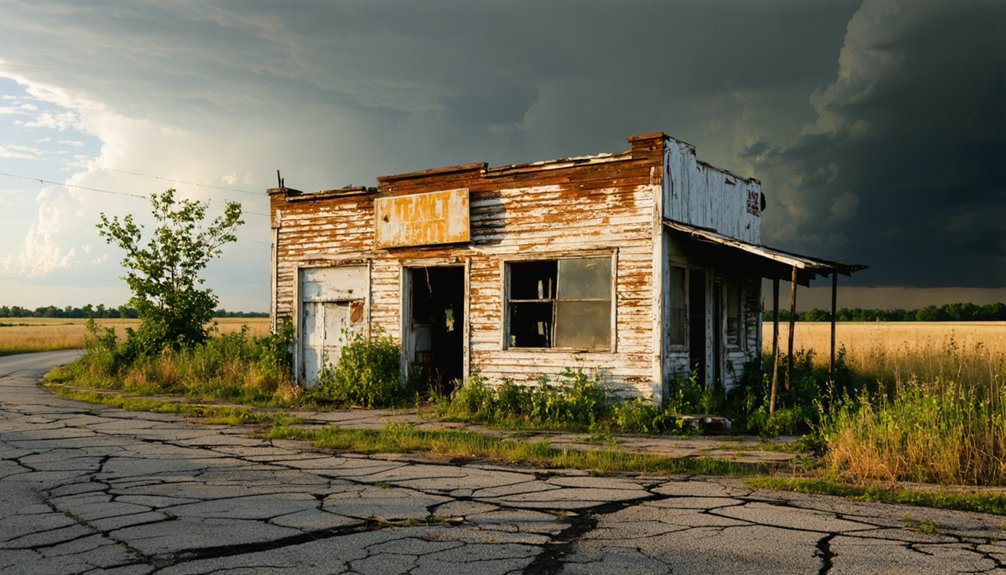
When most ghost towns fade once, Springville, Indiana managed to vanish twice — each time leaving behind a different story carved into Lawrence County’s limestone hills.
You’re standing at a crossroads of two separate communities sharing one name, one legacy, and plenty of ghost stories.
The first Springville rose around natural springs, drawing traders, Native Americans, and early settlers before land disputes swallowed it whole.
The second emerged in 1832 when Samuel Owens platted a farming community near Spring Creek, building something new from scratch.
Digging into Springville history reveals a pattern: ambitious settlers, promising starts, then quiet abandonment.
Each chapter left foundations, forgotten paths, and whispered legends.
That’s exactly what makes this road trip worth taking — you’re not chasing one ghost, you’re chasing two.
The Two Springvilles: Clark County vs. Lawrence County
Though they share a name, Indiana’s two Springvilles couldn’t be more different in origin, character, or fate.
Clark County’s Springville rose around 1798, fed by natural springs and French traders, sitting at the crossroads of four Native American trails heading toward Detroit and Cincinnati. It vanished by 1812, swallowed by politics and land disputes.
Lawrence County’s Springville tells a quieter story. Samuel Owens platted it in 1832 along Spring Creek, building a modest farming community that actually survived.
You’ll find remnants here — historic churches, a WPA-built gym, traces of a stagecoach route that once connected Leavenworth to Indianapolis.
Both towns chased permanence and lost it differently. Knowing which Springville you’re chasing shapes your entire road trip experience.
Why Springville Survived When Palestine, Bono, and Bryantsville Didn’t
Lawrence County’s ghost town graveyard reads like a cautionary tale: Palestine thrived as county seat until Bedford swallowed that title in 1825. Bono platted in 1816 and quietly dissolved. Bryantsville launched under the name Paris in 1835 and couldn’t hold onto either identity.
Palestine’s decline offers the sharpest lesson. Strip away political power, and a town loses its reason to exist.
Springville survival tells a different story. Samuel Owens platted it deliberately near Spring Creek in 1832, anchoring settlers to water, farmland, and a stagecoach route connecting Leavenworth to Indianapolis by 1835.
Those practical foundations outperformed political appointments every time. You’ll notice when you arrive that Springville never needed a courthouse to justify itself — it needed farmers, fresh water, and a road. It got all three.
Ghost Towns Near Springville Worth the Detour
While you’re exploring Springville, you’d be foolish to miss the haunting remnants of Lawrence County’s other lost towns scattered just beyond your windshield.
Palestine, once the county seat and most promising settlement in the region, vanished so completely after its 1825 relocation to Bedford that farms swallowed every trace of its 276 platted lots.
Push a little further down these back roads and you’ll find the ghost-town bones of Bono, platted in 1816, and Bryantsville, originally called Paris, where Dr. F. Crooke laid out lots in 1835 before time and circumstance erased them from the map.
Palestine’s Complete Disappearance
Before you leave Springville, it’s worth taking a detour to track down one of Indiana’s most completely vanished county seats—Palestine.
This forgotten settlement served as Lawrence County’s first seat of government back in 1818, with 276 lots laid out around a public square.
Palestine history reads like a cautionary tale—once considered the region’s most promising town, it lost its county seat status to Bedford in 1825.
After that, the public buildings sold off, residents scattered, and the land quietly returned to farmland.
Today, nothing remains. No markers, no foundations, no trace of the ambition that once defined it.
If you’re drawn to places that time has completely erased, Palestine delivers that eerie, wide-open freedom that ghost town hunters crave.
Bono And Bryantsville Ruins
If Palestine left you staring at empty fields, Bono and Bryantsville will satisfy that same hunger for erased history. The Bono ruins trace back to April 4, 1816, making it one of Lawrence County’s earliest platted settlements. You won’t find much standing, but the landscape itself tells the story.
Bryantsville history runs through a name change — originally called Paris before Dr. F. Crooke replatted it on May 28, 1835. That kind of reinvention speaks to the stubbornness of frontier settlers who refused to quit even when towns struggled.
Both sites sit within detour distance of Springville. Bring sturdy shoes, a good map, and your curiosity.
These places reward travelers who chase the forgotten rather than the familiar.
Abandoned Lawrence County Sites
Lawrence County hides more than just Bono and Bryantsville beneath its overgrown fields and quiet roadsides. Several other abandoned structures and historical landmarks reward curious explorers willing to wander off the beaten path.
Bartlettsville, platted in 1860 by Samuel J. Bartlett, left little trace behind. Rawlins, established in 1893 by the Standard Stone Company, rose and fell alongside the stone industry’s fortunes. Palestine, the county’s original seat, once boasted 276 lots surrounding a public square before relocating to Bedford in 1825, ultimately reverting entirely to farmland.
You won’t find dramatic ruins at every stop, but you’ll find something equally powerful — the silence of places history simply moved on from. Pack your map, trust your instincts, and let Lawrence County’s forgotten corners tell their stories directly to you.
What You’ll Still Find Standing in Springville Today
Springville isn’t a ghost town in the truest sense—you’ll still find real remnants of its living past scattered across the landscape. Pull off the road and you’ll immediately notice Springville architecture that has quietly outlasted generations of change.
The Springville Free Methodist Church, built in 1891, still stands as one of the most compelling historic landmarks in the area. Historic churches and homes pepper the surrounding streets, each telling a story of resilience.
The Springville Free Methodist Church has stood since 1891, a quiet testament to the resilience embedded in every surrounding street.
Springville Park now occupies what was once a neglected town center, transforming former decay into accessible green space. Spring Creek, once cluttered with community refuse, runs cleaner today.
You’re fundamentally walking through layered history—French trading influences, farming community roots, and stubborn 19th-century buildings that refused to disappear. Bring your camera; these survivors deserve documentation.
When to Visit Springville for the Best Ghost Town Experience
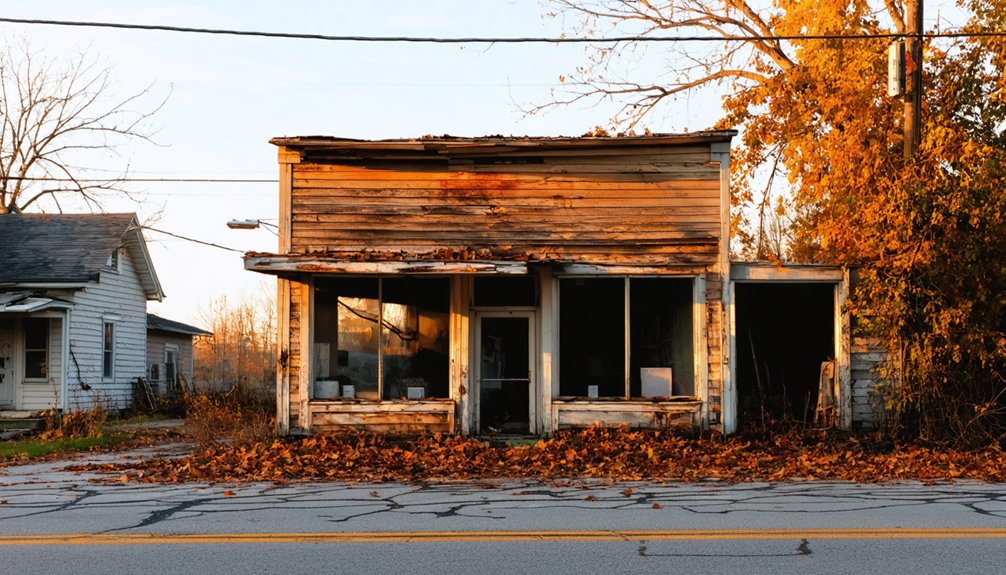
Timing your visit to Springville can make the difference between a forgettable drive-through and a genuinely atmospheric ghost town experience.
Hit the road in late October when the trees strip bare and long shadows stretch across Spring Creek. That’s when ghost stories feel earned rather than invented.
Early morning visits reward you with mist rising off the water, giving the old church grounds an eerie, cinematic quality.
Avoid summer weekends if you’re chasing solitude — crowds dilute the mood.
Spring thaw works surprisingly well too, when muddy back roads slow you down enough to actually notice details.
Local legends hit harder when you’re standing in silence, surrounded by what’s left.
Go at dusk at least once. You won’t regret it.
What to Pack for a Springville Ghost Town Road Trip
Before you hit the road to Springville, you’ll want to pack smart for both the journey and the exploration ahead. Toss in your essential road trip gear—snacks, water, and a charged phone—alongside ghost town supplies like sturdy boots, a flashlight, and a camera to capture the remnants of Indiana’s forgotten past.
Don’t leave without your navigation tools and safety basics, since Springville’s rural Lawrence County terrain can catch unprepared travelers off guard.
Essential Road Trip Gear
Whether you’re traversing overgrown trails near Spring Creek or poking around the remnants of Springville’s historic churches and homes, you’ll want to pack smart before hitting the road.
Your road trip essentials should include sturdy hiking boots, layered clothing, and a weatherproof jacket. Toss a detailed paper map into your packing checklist since cell service gets spotty in unincorporated areas.
Bring plenty of water, high-energy snacks, and a first-aid kit. A camera captures those crumbling architectural details worth remembering.
Pack a flashlight with extra batteries for exploring darker interior spaces. Portable power banks keep your devices charged when you’re miles from civilization.
Tuck insect repellent and sunscreen into your bag, because nature doesn’t care about your comfort — but preparation does.
Ghost Town Exploration Supplies
Packing for a Springville ghost town road trip demands more than your average weekend bag.
You’re stepping into layers of ghost town legends, abandoned trails, and forgotten lives. Pack smart, pack purposeful.
- Camera with extra memory cards – Capture historical artifacts, weathered foundations, and Spring Creek’s quiet banks before light fades.
- Waterproof boots – Spring Creek’s terrain stays muddy; soggy feet kill adventures fast.
- Detailed county map or offline GPS – Cell service disappears in unincorporated Lawrence County pockets.
- Field notebook and pencil – Document what you discover; pencils work when pens freeze or get wet.
You’re not just sightseeing—you’re uncovering stories that Indiana nearly swallowed whole.
The right supplies keep you moving freely through every forgotten corner.
Navigation And Safety Tools
Solid gear gets you to Springville—smart navigation tools and safety tips keep you from getting stranded there.
Download offline maps before leaving civilization; cell service disappears fast along rural Lawrence County roads. Pack a physical map as your backup—technology fails at the worst moments.
Your safety kit should include a first aid kit, emergency blanket, and a charged portable battery pack. Carry extra water since Spring Creek’s historic waters aren’t safe for drinking.
Tell someone your exact route and expected return time before you leave.
A reliable flashlight handles those shadowy abandoned structures safely, while sturdy boots protect you from unstable ground.
Your freedom to explore ghost towns like Springville depends entirely on your preparation before the adventure begins.
Frequently Asked Questions
Are There Guided Ghost Town Tours Available in the Springville Area?
No guided tours exist, but you can explore Springville’s ghost town history independently! You’ll uncover abandoned settlements, vanished county seats, and paranormal experiences while freely roaming historic trails, forgotten churches, and Spring Creek’s mysterious, adventure-filled surroundings.
Can Visitors Legally Access the Original Springville Clark County Site?
Imagine trekking where French traders once roamed! You’ll find accessing the original Springville Clark County’s abandoned sites tricky — it’s private farmland now. Always secure landowner permission before exploring this ghost town history to stay legally safe.
Are Camping Facilities Available Near the Lawrence County Springville Location?
The knowledge doesn’t confirm camping facilities near Lawrence County’s Springville, but you’ll find nearby state parks offering camping tips and local wildlife encounters. Embrace your freedom, pitch your tent, and explore Indiana’s adventurous wilderness surrounding this historic ghost town!
Is a Four-Wheel-Drive Vehicle Necessary to Reach Abandoned Nearby Settlements?
Swipe right on adventure! You don’t need a four-wheel-drive for ghost town accessibility near Springville’s abandoned settlements. Standard vehicle recommendations apply — most sites sit on rural roads you’ll navigate easily in any reliable ride.
Do Local Museums Offer Artifacts Recovered From the Vanished Town Palestine?
You’ll want to check Bedford’s local museums for Palestine history and artifact preservation efforts. These repositories often hold relics from the vanished county seat, letting you uncover fascinating fragments of Lawrence County’s forgotten, freedom-filled frontier past.
References
- https://kids.kiddle.co/Springville
- https://en.wikipedia.org/wiki/Springville
- http://genealogytrails.com/ind/lawrence/ghosttowns.html
- https://springvilleindiana.com/history/
- http://ingenweb.org/inlawrence/abandoned.htm
- https://www.cfpartner.org/news/9zgs8atfrgdl3jjsjoy6gwscpq3ndb
- http://lawrencecountyhistory.org/museum-corner-nov-2018